KEY TAKEAWAY: Energy density — calories per gram of food — is the concept that unifies the most important nutrition research of 2026. The JAMA vegan diet trial, the Circulation childhood beverage study, our June 2026 fibermaxxing research, and the fructose-glucose brain research all point to the same fundamental insight: food volume and food calories are separate variables, and optimising for volume over calorie density is the most sustainable, scientifically-supported approach to metabolic health. Here is the complete 2026 framework.
The Concept That Explains 2026 Nutrition
After 12 years of working with clients across the full spectrum of health goals — weight management, performance, metabolic disease prevention, energy optimisation, healthy ageing — I have arrived at the conviction that energy density is the most clinically useful and practically actionable concept in nutritional science. It is also the concept that makes the most sense of the seemingly contradictory advice that floods the wellness space.
Energy density is simple: it is the number of calories contained in a gram of food. A gram of butter contains approximately 7.2 calories. A gram of apple contains approximately 0.5 calories. A gram of broccoli contains approximately 0.34 calories. A gram of almonds contains approximately 5.8 calories.
The reason this concept matters so profoundly is that the human satiety system — the collection of hormonal, neural, and mechanical signals that tell the brain when to stop eating — responds primarily to the physical volume and mass of food consumed, not to its calorie content. The stomach has stretch receptors. The small intestine has hormone-secreting cells that fire in response to the physical presence of nutrients. These systems evolved in an environment where foods had roughly similar energy densities — the modern landscape, where food engineering can pack enormous calorie loads into tiny volumes, has created a fundamental mismatch between what the body can sense and what it is actually consuming.
📖 Also read: Low-Fat Vegan Diet Loses Weight Without Eating Less — JAMA 2026 — The JAMA Network Open August 2026 trial directly demonstrating energy density in action — 30% fewer calories per gram, no instruction to eat less, 5.9kg weight loss.
The August 2026 Evidence Convergence
The August 2026 research landscape has produced, in the space of three weeks, multiple independent lines of evidence that all point toward energy density as the unifying framework for healthy eating:
The JAMA vegan diet trial (August 17, 2026): 244 adults eating the same physical weight of food but 30% fewer calories per gram lost an average of 5.9kg in 16 weeks without any instruction to eat less. This is the energy density mechanism in its purest form: lower calorie concentration per gram equals fewer calories consumed while maintaining satiety. See our detailed coverage in Article 2 of this volume.
The Circulation childhood beverage study (June 22, 2026): 25,749 children followed for 25 years showed that liquid calories from sugar-sweetened beverages and juice — the highest-energy-density beverage category — predicted adult hypertension, while whole fruit (same fructose, much lower energy density due to fibre and water) did not. Energy density again: the problem is not fructose per se but fructose delivered in a high-energy-density, low-satiety-signalling liquid form.
The Neuron fructose-glucose brain study (June 2026): Fructose suppresses hunger-promoting neurons significantly less than glucose — explaining why beverages sweetened with high-fructose corn syrup produce satisfaction without satiety. HFCS delivers concentrated calorie energy density while leaving the brain’s hunger regulation system under-stimulated. The research we covered in our August 2026 Vol II series on the Monell Chemical Senses Center findings.
The fibermaxxing research (June 2026): Our Fibermaxxing guide documented how dietary fibre lowers the effective energy density of foods by adding physical bulk (water absorption, physical volume) and by directly stimulating GLP-1 — the appetite-regulating hormone. Higher fibre = lower effective energy density = fewer calories for equivalent satiety.
Energy Density in the Indian Food Environment
The Indian food environment presents a uniquely interesting energy density landscape — both extraordinary traditional resources and rapidly growing challenges.
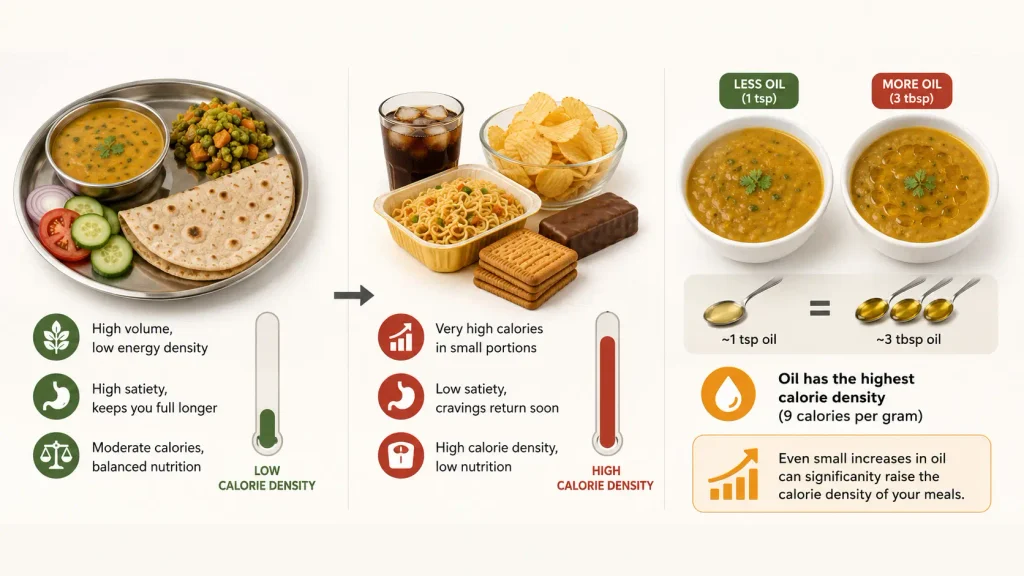
Traditional Indian cooking at its best: low energy density by design. The dal-roti-sabzi combination that forms the nutritional foundation of traditional Indian vegetarian cooking is, from an energy density perspective, extremely well-designed. Dal (lentils and legumes) contains water and protein that expands during cooking and provides sustained satiety. Sabzi (vegetable preparations) dominates plate volume with very low calorie density. Roti (whole wheat flatbread) contributes complex carbohydrate with fibre. The combination achieves high physical volume, sustained satiety, and moderate calorie delivery — exactly the formula the JAMA trial validated.
The displacement problem: what ultra-processed foods do to energy density. The nutritional crisis in urban India is not primarily that people are eating bad traditional food. It is that ultra-processed foods — commercial biscuits, packaged snacks, instant noodles, sweetened beverages, commercial sweets — are replacing portions of the high-fibre, high-water, low-energy-density traditional dietary pattern with extremely high-energy-density alternatives. A meal that was once built around dal and vegetables is now supplemented or replaced with snack foods that pack 500 calories into 80 grams of product that provides minimal satiety signalling. The calorie density has increased dramatically; the satiety response has not kept pace.
The oil quantity problem. Traditional Indian cooking uses cooking oil as a standard ingredient — but the quantity has increased substantially over the past two generations. Oil is the highest-calorie-density food category (9 calories per gram), and even small increases in oil quantity dramatically raise the energy density of otherwise low-calorie-density dishes. A dal that is cooked with one teaspoon of oil has a very different energy density profile from the same dal with three tablespoons of oil — and both would look identical on a food label check.
The Practical Energy Density Framework: My Clinical System
After 12 years of translating energy density research into practical eating habits for busy professionals and families, here is the system I have found most sustainable:
The plate division rule — volume before density: Before placing any calorie-dense food on the plate, fill at least half the plate’s volume with foods in the lowest energy density category: vegetables, salad, raw cucumbers, tomatoes, or broth-based soup. This is not about restriction — it is about sequencing. The low-density foods fill volume and activate satiety mechanisms before the higher-density foods arrive.
The beverage hierarchy — liquid calories are the highest-risk density category: Liquid calories are nutritionally unique in their ability to deliver calorie energy without activating stretch receptors or equivalent satiety hormone responses. Beverages should be water, brewed tea, or plain coffee — foods that deliver no or minimal calories regardless of volume consumed. The Circulation 2026 research confirms that this principle applies from childhood. The freshly brewed tea and longevity research confirms that tea specifically delivers non-caloric bioactive benefits that reinforce this recommendation.
The whole fruit over juice rule — always: The Circulation study’s differential finding — whole fruit protective, juice harmful — is the energy density principle made manifest. The same fructose, radically different energy density and satiety response. Always whole fruit. Always.
The cooking oil audit: I ask every client who cooks at home to measure the oil they use for one week without changing it — just measuring. Almost universally, the actual quantity is 2 to 3 times the perceived quantity. After the audit, I propose reducing by 30% — small enough to be imperceptible in texture and flavour, large enough to produce meaningful energy density reduction across the weekly dietary pattern.
The snack energy density test: Any packaged snack with more than 400 calories per 100 grams is extremely high energy density and should be a rare treat, not a daily habit. Most commercial biscuits, chips, and packaged snacks fall in the 450 to 550 calories per 100g range. Raw vegetables, whole fruit, and boiled eggs fall in the 15 to 155 calories per 100g range. The satiety per calorie is dramatically different.
Energy Density and the Hormonal System: The Complete Picture
Energy density does not operate in isolation — it interacts with the hormonal satiety system that we have covered extensively throughout our 2026 series. Understanding these interactions gives the most complete picture of why energy density optimisation works so reliably.
Low-energy-density foods are typically high in fibre, which ferments in the gut to produce SCFAs that stimulate GLP-1 — the appetite hormone also targeted by Ozempic. This is the connection between the JAMA vegan trial results and the GLP-1 natural stimulation research we covered in July 2026. Low energy density + fibre diversity = higher GLP-1 production = stronger satiety = spontaneous calorie reduction.
Low-energy-density eating combined with adequate protein activates a particularly powerful satiety combination: protein directly stimulates PYY and GLP-1 while providing the leucine needed for muscle protein synthesis. The July 2026 protein guidelines research and the JAMA vegan trial findings are complementary: higher-protein plant foods (legumes, tofu, tempeh) within a low-energy-density dietary pattern provide the satiety combination that makes calorie restriction unnecessary.
Sleep quality directly influences energy density choices. As our August 2026 Columbia University sleep and weight gain article documented, sleep-deprived brains preferentially seek high-energy-density, hyperpalatable foods — because the prefrontal cortex (rational food choice) is suppressed while the amygdala (reward-driven food preference) is activated. Protecting sleep quality is itself an energy density optimisation strategy: it preserves the prefrontal capacity to choose low-energy-density foods over the amygdala’s preference for calorie-dense rewards.
The 2026 Nutritional Consensus: What the Research Converges On
Looking back at the eight months of nutritional research we have covered on Live NU Life since June 2026, a consistent convergence emerges that I find both scientifically satisfying and practically actionable:
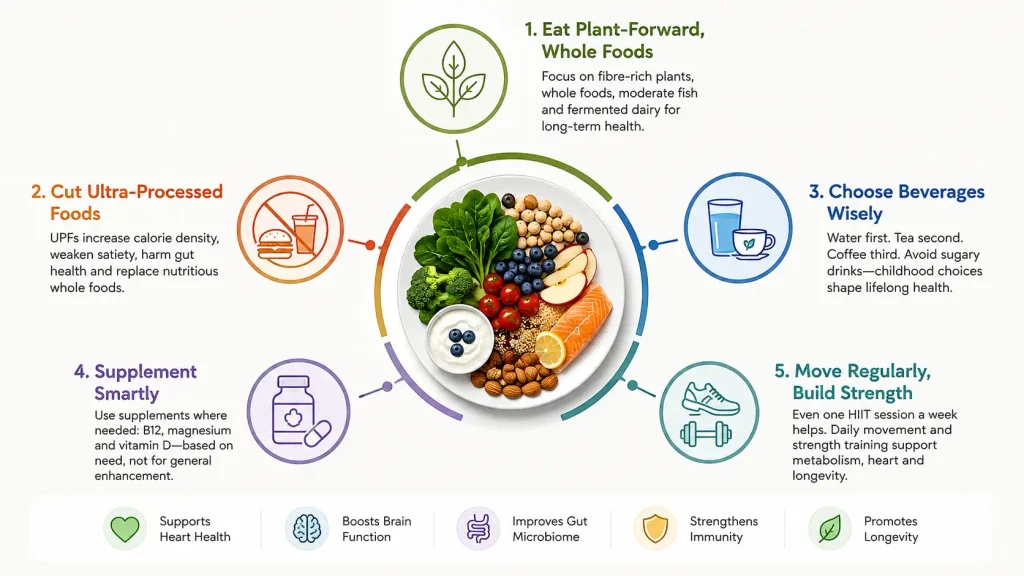
• The dietary pattern most strongly associated with metabolic health, cardiovascular protection, longevity, gut microbiome diversity, and cognitive health is plant-forward, fibre-diverse, whole-food-based — with moderate fish and fermented dairy. (USC Longevity Diet July 2026, Mediterranean research, JAMA vegan trial August 2026.)
• The most important single dietary change for most people is reducing ultra-processed food exposure — not because of any single ingredient, but because UPFs systematically raise energy density, suppress satiety signalling, disrupt gut microbiome health, and replace nutritionally complex whole foods with nutritionally simple calorie-dense packages. (UPF brain attention June 2026, sweeteners gut bacteria July 2026, toddler food research July 2026.)
• Beverages deserve specific attention because liquid calories bypass satiety mechanisms and because childhood beverage patterns have decades-long consequences. Water first. Brewed tea second. Coffee third. No sugary beverages in the daily routine. (Circulation childhood beverage study June 2026, sparkling water NUTRITION 2026, alcohol mortality August 2026.)
• Supplementation is most valuable where whole food patterns cannot adequately address specific micronutrient needs — primarily B12 for vegetarians and metformin users, magnesium for the chronically stressed and medication users, and vitamin D for populations with limited sun exposure. Supplements for general performance or cognitive enhancement without documented deficiency have a weak evidence base and some emerging risks. (B12 mitochondria research, magnesium 2026 review, tyrosine longevity study, fish oil brain trial.)
• Exercise remains irreplaceable, but the frequency threshold is more flexible than guidelines have implied. One weekly well-structured HIIT session produces meaningful fat loss and cardiovascular improvement. Daily movement matters as much as structured exercise. Resistance training specifically preserves the muscle that drives metabolic rate and longevity outcomes. (HKU once-weekly HIIT study August 2026, 7000 steps Lancet review, strength training women heart health June 2026.)
The Takeaway
Energy density is not a diet. It is a lens through which almost every nutritional decision becomes clearer. The JAMA August 2026 trial proved it produces weight loss without restriction. The Circulation study showed it predicts cardiovascular health from childhood. The fructose-glucose brain research explained the neurological mechanism. Our June 2026 fibermaxxing research explained how to optimise it through fibre diversity. And our entire 2026 series has demonstrated, across dozens of studies, that the foods with the lowest energy density — whole vegetables, fruits, legumes, whole grains — are also the foods with the strongest evidence for gut microbiome health, cardiovascular protection, cognitive function, and longevity. Eat more of them. Eat less of the high-density, low-satiety alternatives. The rest of the nutritional detail matters — but this single principle, applied consistently, is the most powerful nutrition intervention available without a prescription. For the complete evidence-based nutritional framework, see our Functional Nutrition guide and our Science-Based Longevity Protocols.
About the Author
Tanveer Ahmed Khan is a K11 School of Fitness Sciences-certified personal trainer and nutrition coach with 12+ years of strength training experience. Coaching: info@livenulife.com | Instagram: @fitwithtanveer | livenulife.com
Scientific References
1. Kahleova, H., Znayenko-Miller, T., Maracine, C., Holubkov, R., Barnard, N.D. (2026). Vegan Diets and Dietary Energy Density. JAMA Network Open. DOI: 10.1001/jamanetworkopen.2026.27483
2. Nguyen, M., et al. (2026). Childhood beverage consumption and adult hypertension. Circulation. DOI: 10.1161/CIRCULATIONAHA.125.077666
3. McKnight, A.D., de Araujo, A., et al. (2026). Attenuated hypothalamic response to fructose via a dedicated gut-brain pathway. Neuron. DOI: 10.1016/j.neuron.2026.05.013
4. All prior Live NU Life August 2026 series citations — Fibermaxxing, GLP-1, protein guidelines, USC Longevity Diet, sleep-weight Columbia, sweeteners-gut bacteria (see individual articles for full references).
5. Rolls, B.J. (2017). Dietary energy density: Applying behavioural science to weight management. Nutrition Bulletin, 42(3). (Key foundational energy density research for context.)