By Tanveer Ahmed Khan | Certified Trainer & Dietitian-Nutritionist (K11 School of Fitness Sciences, REPS India) | June 2026
Every few months, a nutrition concept breaks out of scientific literature and onto social media, picking up momentum until it becomes the thing everyone is asking about. In early 2026, that concept is fibermaxxing — and unlike many viral health trends, this one is grounded in real science.
But like most things that get translated from peer-reviewed journals to TikTok, something important has been lost in transmission.
I want to give you the complete picture — what fibermaxxing is, what the research actually supports, where the trend oversimplifies, and how to harness the genuine power of dietary fibre in a way that works for your specific body. This is the conversation I have been having with my clients throughout the first half of 2026, and it is one of the most important nutrition discussions of the year.
What Is Fibermaxxing?
At its core, fibermaxxing is a dietary approach that prioritises aggressively increasing daily fibre intake — typically far beyond standard public health recommendations of 25 grams per day for women and 38 grams per day for men.
The trend has been championed on social media by fitness influencers, biohackers, and wellness advocates on platforms like TikTok and Instagram, typically recommending fibre intakes of 50 to 100+ grams per day through a combination of high-fibre foods and supplementation.
In January 2026, CNN identified fibermaxxing as one of the year’s most significant nutritional movements. U.S. News & World Report’s survey of 58 health experts placed increased fibre intake among the top nutrition strategies for managing chronic disease in 2026. And Datassential research found that 60% of Gen Z consumers say they are interested in foods and beverages that are high in fibre.
The timing is not accidental. As experts explain, fibre has become “the new protein” in nutrition conversations — but with one significant difference: fibre is arguably more fundamental to whole-body health than protein alone.
Why Fibre Deserves the Attention It Is Receiving
Let me be direct about something: the underlying science behind increasing fibre intake is excellent. The trend is pointing toward something genuinely important.
The gut microbiome connection
Your gut microbiome — the community of approximately 38 trillion microorganisms living in your digestive tract — is now understood to be one of the central regulatory systems of human health. It influences immune function, inflammation levels, hormone production, blood glucose control, cardiovascular health, and, as I discussed in my previous article on ultra-processed foods, cognitive function.
Dietary fibre is the primary food source for these microbial communities. Specifically, it is fermented by beneficial bacteria — primarily Bifidobacterium and Lactobacillus species — into short-chain fatty acids (SCFAs): butyrate, propionate, and acetate.
These SCFAs are not just a byproduct. They are active signalling molecules that:
- Serve as the primary energy source for colonocytes (cells lining the colon), maintaining intestinal barrier integrity
- Reduce systemic inflammation through NF-kB pathway inhibition
- Stimulate the production of GLP-1 — the appetite-regulating hormone that is also the target of Ozempic and other weight-loss medications
- Support insulin sensitivity and blood glucose regulation
- Communicate with the brain via the gut-brain axis, influencing mood, stress response, and cognitive clarity
That last point about GLP-1 is particularly striking. Research published in 2026 has highlighted that high-fibre diets naturally stimulate GLP-1 production — the same mechanism by which expensive weight-loss medications work. This is one reason why Forum Health’s nutrition team described fibre as “the medication you don’t need a prescription for.”
The chronic disease protection evidence
The evidence base for fibre in chronic disease prevention is extensive and well-established:
The 2026 US News expert survey noted that increasing fibre intake was identified by 38% of experts as a key strategy for reducing chronic disease risk — with specific reference to reducing colorectal cancer risk, promoting digestive health, and aiding weight management.
Studies consistently show that people who meet daily fibre recommendations have significantly lower rates of type 2 diabetes, cardiovascular disease, colorectal cancer, and obesity compared to those who fall short. And the majority of adults globally — more than 90% of women and 97% of men in the US alone — are not meeting basic daily fibre recommendations, according to the University of Connecticut’s 2026 nutrition education data.
Where Fibermaxxing Goes Wrong
Here is where I need to speak plainly, because the social media version of fibermaxxing is creating problems I am seeing in my practice.
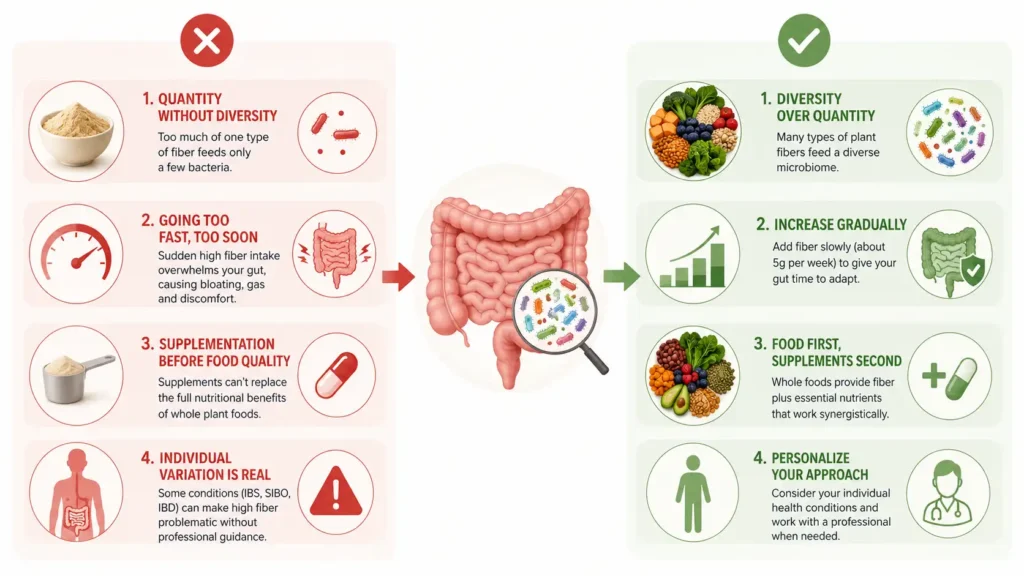
Problem 1: Quantity without diversity
This is the most significant scientific mistake in the fibermaxxing movement. The gut microbiome does not just need more fibre — it needs more types of fibre. Different bacterial species feed on different fibre structures. Feeding the entire microbial community requires feeding different sections of the colon with fibres that ferment at different rates.
Cailin Hall, Head of Research at prebiotic fibre supplement brand Myota, made this point emphatically in an interview with NutraIngredients: “The gut microbiome thrives off diversity, and consuming all fibre from one source is not the best strategy. I think the next phase of this trend needs to be about ‘smart fibermaxxing’ — consuming a diversity of plant-based prebiotic fibres based on science, not just social media.”
I have seen clients who were technically consuming 50+ grams of fibre daily — almost entirely from oat bran, psyllium husk, and chia seeds — while still complaining of bloating, constipation, and fatigue. The issue was not quantity. It was monotony.
The scientific principle here is straightforward: microbial diversity requires dietary diversity. A useful proxy target that I use in practice is the “30 plants per week” guideline — consuming 30 different plant-based foods (vegetables, fruits, legumes, whole grains, nuts, seeds, herbs, and spices) across seven days. Each different plant contributes a slightly different fibre profile, feeding a different section of the microbial community.
Problem 2: Going too fast, too soon
Professor Paul Clayton, one of the world’s leading longevity nutrition researchers who has spent five decades studying the longest-living populations, put it bluntly in an interview with LYMA: “Fibermaxxing is not for the weak. I’m not even sure it’s for the strong either.”
The caution is biochemically valid. If your current fibre intake is 15 grams per day and you jump to 60 grams overnight, your gut microbiome will not have the bacterial diversity needed to ferment the additional fibre efficiently. The result is significant gastrointestinal distress: bloating, gas, cramping, and altered bowel habits that can be genuinely debilitating.
In my practice, I follow a gradual escalation protocol: increase fibre intake by 5 grams per week, allowing 2 to 3 weeks at each level before progressing. This gives the microbial community time to adapt, diversify, and build the enzyme capacity needed to process increased fibre loads without discomfort.
Problem 3: Supplementation before food quality
I see clients arrive with bags full of psyllium husk supplements, inulin powder, and fibre-fortified protein shakes — while still eating significant amounts of ultra-processed food. This is backwards.
Fibre supplements have a role, but they cannot replicate the complete nutritional matrix of whole plant foods. When you eat a bowl of lentils, you are consuming fibre alongside resistant starch, polyphenols, B vitamins, iron, zinc, and prebiotic compounds that work synergistically. When you take a psyllium supplement, you get one type of fibre in isolation. Supplementation should augment a food-first approach, not substitute for it.
Problem 4: Individual variation is real
Some individuals — particularly those with irritable bowel syndrome (IBS), small intestinal bacterial overgrowth (SIBO), or inflammatory bowel disease (IBD) — may respond poorly to aggressive fibre increases. Specific fibre types (particularly fermentable oligosaccharides, the FODMAP category) can trigger significant symptom flares in sensitive individuals. For these populations, fibermaxxing without professional guidance is genuinely contraindicated.
The Smart Way to Fibre Max: My Clinical Protocol
After 12 years of working with clients across a wide range of metabolic profiles, here is how I approach building optimal fibre intake in a way that is sustainable, diverse, and genuinely effective.
Phase 1: Baseline assessment (Week 1)
Before increasing fibre intake, I map a client’s current diet carefully. Most clients are consuming 12–18 grams of fibre daily. I also assess for any digestive symptoms that might indicate underlying gut dysbiosis or sensitivity.
Phase 2: Food-first foundation (Weeks 2–4)
I introduce one additional serving of a whole-food fibre source per day, from the following rotation:
Soluble fibre sources (slow down glucose absorption, lower LDL cholesterol):
- Oats (1 cup cooked = 4g fibre)
- Lentils and chickpeas (1 cup cooked = 15g fibre)
- Apples with skin (1 medium = 4.5g fibre)
- Psyllium husk (1 tablespoon = 5g fibre)
Insoluble fibre sources (accelerate gut transit, support bowel regularity):
- Whole wheat roti (2 roti = 4g fibre)
- Vegetables, particularly broccoli, carrots, and green leafy vegetables
- Brown rice and whole grain cereals
- Nuts and seeds
Prebiotic-rich sources (selectively feed beneficial bacteria):
- Garlic and onion (fructooligosaccharides)
- Green bananas (resistant starch)
- Asparagus and leeks (inulin)
- Jerusalem artichokes (highest known prebiotic content per gram)
- Cooked and cooled potatoes or rice (retrograded resistant starch)
Phase 3: Diversity expansion (Weeks 5–8)
Once baseline fibre is established at approximately 25–30 grams, I focus on expanding diversity rather than pure quantity. I introduce the 30-plants-per-week tracking framework and encourage clients to rotate their vegetable and legume choices weekly.
During this phase, I also introduce fermented foods alongside the higher fibre intake: plain yoghurt, kefir, homemade idli or dosa fermented naturally, or fermented pickles (without added vinegar, which kills beneficial bacteria). The combination of prebiotic fibre and probiotic fermented foods creates a synergistic effect — probiotics survive in greater numbers when prebiotics are available to sustain them.
Phase 4: Targeted augmentation (Week 9+)
For clients with specific goals — metabolic health, weight management, athletic recovery — I introduce targeted fibre supplementation at this stage:
- Oat beta-glucan for LDL cholesterol and blood glucose control (3g/day is the clinically validated threshold)
- Partially hydrolysed guar gum (PHGG) for IBS-prone individuals who tolerate high-fermentation fibres poorly
- Inulin-type fructans for targeted prebiotic feeding of Bifidobacterium species
The target I aim for in most healthy adults by the end of this protocol is 35–50 grams of diverse fibre daily. Not 100 grams. Not overnight. A sustainable escalation to a level that demonstrably transforms gut microbiome diversity while remaining comfortable and achievable in real daily life.
A Day of Eating on a Smart Fibermaxxing Plan
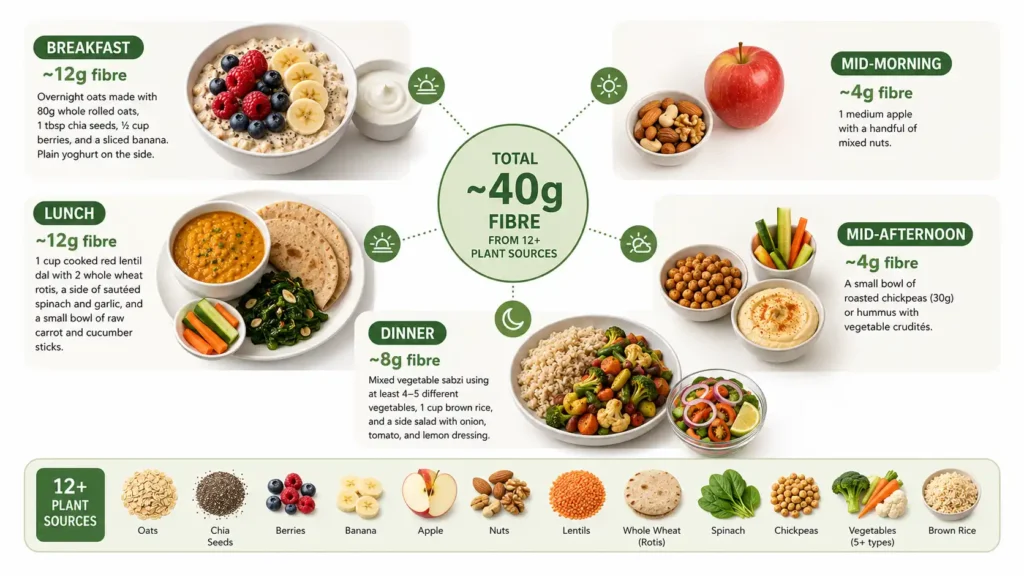
For practical illustration, here is a sample day from one of my client meal plans — structured for a busy professional aiming for 40 grams of diverse fibre:
Breakfast (approx. 12g fibre): Overnight oats made with 80g whole rolled oats, 1 tablespoon chia seeds, ½ cup berries, and a sliced banana. Plain yoghurt on the side.
Mid-morning (approx. 4g fibre): 1 medium apple with a handful of mixed nuts.
Lunch (approx. 12g fibre): 1 cup cooked red lentil dal with 2 whole wheat rotis, a side of sautéed spinach and garlic, and a small bowl of raw carrot and cucumber sticks.
Mid-afternoon (approx. 4g fibre): A small bowl of roasted chickpeas (30g) or hummus with vegetable crudités.
Dinner (approx. 8g fibre): Mixed vegetable sabzi using at least 4–5 different vegetables, 1 cup brown rice, and a side salad with onion, tomato, and lemon dressing.
Total fibre: approximately 40 grams from 12+ different plant sources.
Hydration: The Non-Negotiable Partner
I cannot write about increasing fibre intake without addressing hydration, because the two are biochemically inseparable.
Dietary fibre — particularly soluble fibre — absorbs water in the digestive tract. Without adequate water intake, increasing fibre leads directly to constipation rather than the digestive regularity it is supposed to deliver. As a rule, I recommend adding 250ml of water for every 5 grams of fibre added above your baseline intake.
For most clients moving from 15 to 40 grams of fibre, this means increasing daily water intake by approximately 1.25 litres alongside the dietary changes. This is non-negotiable, not optional.
The 2026 Context: Why Fibre Is Getting More Attention Than Ever
One of the most fascinating research directions of 2026 is the convergence of fibermaxxing with the GLP-1 medication trend. As I noted earlier, high-fibre diets naturally stimulate GLP-1 production. This has led researchers and clinicians to investigate whether dietary fibre optimisation could enhance the effectiveness of GLP-1 medications, reduce required doses, or serve as a standalone alternative for some patients.
Additionally, emerging research discussed in the NutraIngredients 2026 fibre trend report points to fibre’s potential role as nutritional protection against microplastics. As consumer awareness of microplastic contamination grows, the evidence that diverse dietary fibre may help bind and excrete some environmental contaminants through the digestive tract is becoming an additional argument for optimising intake.
This is early-stage research, and I would caution against overclaiming. But the direction is compelling, and it reinforces that the investment in gut health through fibre diversity is likely to pay dividends we have not yet fully mapped.
The Bottom Line
Fibermaxxing, at its core, is pointing toward one of the most important nutritional investments you can make: feeding your gut microbiome with the diversity and consistency it needs to regulate your immune system, your metabolism, your brain chemistry, and your long-term disease risk.
The trend earns its attention. The science is solid. The benefits are real.
But like all powerful tools, the mechanism matters as much as the intention. Flooding your gut with 100 grams of psyllium overnight will not deliver the results that a systematic, food-first, diversity-focused escalation protocol will deliver over eight to twelve weeks.
In my practice, the clients who achieve the most dramatic results from fibre optimisation are the ones who respect both the science and their body’s rate of adaptation. They count diversity as carefully as they count grams. They hydrate consistently. They combine prebiotic fibres with fermented foods. And they move gradually, methodically, and sustainably toward a gut microbiome that operates as the powerful health-regulating system it was designed to be.
That is smart fibermaxxing. And in 2026, it may be the single most impactful nutritional change the average person can make.
Scientific References
- U.S. News & World Report. (January 5, 2026). Top Health and Nutrition Trends for 2026, According to Experts. https://health.usnews.com/wellness/articles/top-health-and-nutrition-trends-for-2026
- Kerry Health and Nutrition Institute. (2026). Five Key Health and Nutrition Trends for 2026. https://khni.kerry.com/trends-and-insights/key-health-and-nutrition-trends/
- Forum Health. (2026). Fibermaxxing: Why Fiber Is the Biggest Nutrition Trend of 2026. https://forumhealth.com/nutrition/fibermaxxing-the-2026-trend-worth-paying-attention-to/
- NutraIngredients. (October 2025 / 2026). Fibermaxxing fades as fiber diversity dominates 2026 trends. https://www.nutraingredients.com/Article/2025/10/21/fibermaxxing-fades-as-fiber-diversity-dominates-2026-trends/
- University of Connecticut Healthy Family Connecticut. (March 2026). Top 5 Food and Nutrition Trends for 2026. https://healthyfamilyct.cahnr.uconn.edu/2026/03/11/top-5-food-and-nutrition-trends-for-2026/
- LYMA. (2026). Fibermaxxing and the Science Behind 2026’s Biggest Gut Health Trend. https://us.lyma.life/blogs/gut/fibremaxxing-what-it-is-how-it-works