By Tanveer Ahmed Khan | K11-Certified Trainer & Dietitian-Nutritionist | REPS India Registered | livenulife.com | 11 min read
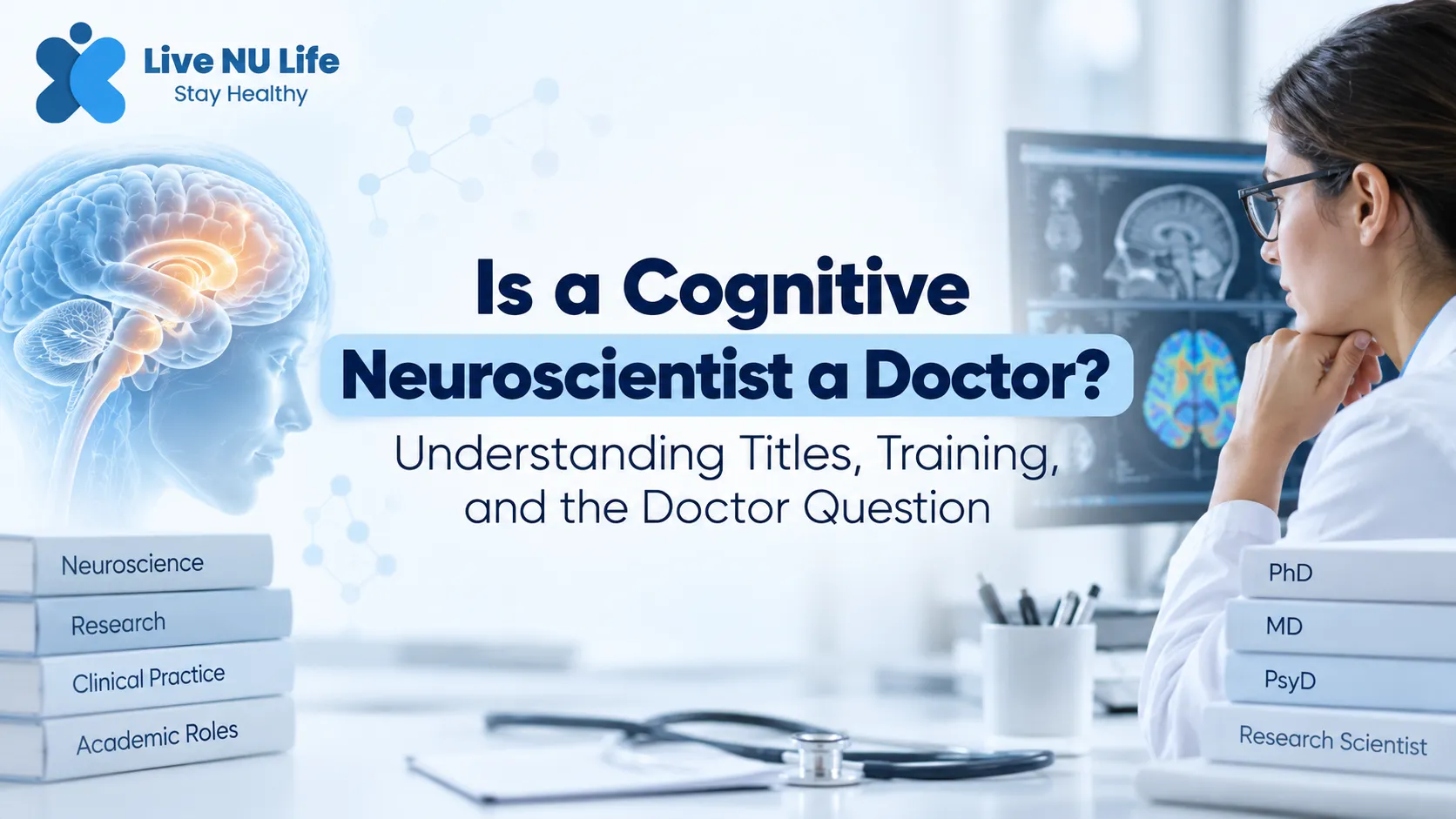
THE DIRECT ANSWER: Most cognitive neuroscientists are not medical doctors. The large majority hold a PhD (Doctor of Philosophy) in neuroscience, psychology, or a related discipline — not an MD (Doctor of Medicine). However, a subset of cognitive neuroscientists hold both degrees (MD-PhD), combining clinical medical training with research expertise. And some medical specialists — particularly neurologists, psychiatrists, and radiologists — conduct cognitive neuroscience research alongside their clinical practice. The distinction matters for what they do, what they can and cannot treat, and how they are trained.
The Two Meanings of “Doctor” — Why the Question Is Complicated
The word “doctor” in English is used in two quite different ways that are easily — and consequentially — confused.
In the academic sense, “doctor” refers to a person who holds a doctoral degree — the highest level of academic qualification in a field. Someone with a PhD (Doctor of Philosophy), EdD (Doctor of Education), JD (Juris Doctor), or any other doctoral credential is a doctor in this sense. They are addressed as “Dr” in academic and professional contexts.
In the medical sense, “doctor” refers specifically to a person qualified to practise medicine — to diagnose disease, prescribe medications, perform procedures, and provide clinical care to patients. A medical doctor typically holds an MD (Doctor of Medicine) or equivalent degree (MBBS in the British and Indian systems, DO in the osteopathic tradition), has completed a residency training programme, and is licensed by a medical regulatory authority to practise medicine.
The confusion arises because most people encounter the word “doctor” primarily in medical contexts — and therefore assume that anyone called “Dr” is a medical doctor who can see patients, diagnose conditions, and prescribe treatments. In academic research settings, this assumption is frequently wrong, and understanding the distinction is important for anyone seeking to understand what cognitive neuroscientists do and what they cannot do.
The Standard Training Path: PhD, Not MD
The large majority of people who work as cognitive neuroscientists — including those who run university research laboratories, publish research in academic journals, develop theories of how the brain works, and teach at universities — have followed the academic research training path rather than the medical training path.
The standard academic route to becoming a cognitive neuroscientist looks roughly like this:
Undergraduate degree (3–4 years): A bachelor’s degree in psychology, neuroscience, biology, cognitive science, or a related field. Strong candidates typically develop a foundation in both psychology (research methods, statistics, cognitive psychology) and biology (neuroanatomy, physiology, cell biology). In India, relevant bachelor’s programmes include B.Sc. in Psychology, B.Sc. in Life Sciences, or integrated M.Sc. programmes in cognitive science or neuroscience at institutions like NIMHANS, IISc, AIIMS, and the IITs.
Postgraduate degree — MSc or equivalent (1–2 years): A master’s degree deepening specialisation in neuroscience, cognitive science, or a closely related field. Not all PhD routes require a separate master’s degree — in the United States, many PhD programmes absorb the master’s level within the doctoral programme. In India and the UK, a separate master’s degree before doctoral admission is more commonly expected.
PhD (3–6 years): The doctoral degree is the primary research training for cognitive neuroscientists. A PhD student works under the supervision of an established cognitive neuroscientist, designing and conducting a series of original research studies that form the basis of a doctoral thesis — typically a book-length document (100,000 to 150,000 words in the UK tradition, somewhat shorter in the US) reporting the student’s research contributions and their theoretical significance. The PhD culminates in a thesis defence — an oral examination by a panel of expert examiners who question the candidate on their work and its implications.
Postdoctoral research (2–5 years): After completing a PhD, most people who pursue an academic career in cognitive neuroscience complete one or more postdoctoral research positions — fixed-term research roles in a laboratory, typically supervised by a senior academic, where they develop additional skills, build their publication record, and gain the experience needed to compete for independent academic positions.
Independent academic position: After postdoctoral training, competitive candidates apply for permanent academic positions — lectureships, assistant professorships, or equivalent roles — at universities and research institutions. This is the point at which they establish their own independent research laboratory and begin training their own PhD students.
At no point in this training pathway is a medical degree required or typically obtained. The cognitive neuroscientist who has followed this path holds a PhD — they are a doctor in the academic sense, entitled to be called “Dr” — but they are not a medical doctor and cannot practise medicine, diagnose patients, or prescribe treatments.
📖 Also read: What Actually Happens in Your Brain When You Learn Something New — This is the cognitive neuroscience research that directly applies to everyday life — understanding neuroplasticity, memory, and the biology of learning.
The MD-PhD: When Both Degrees Are Combined
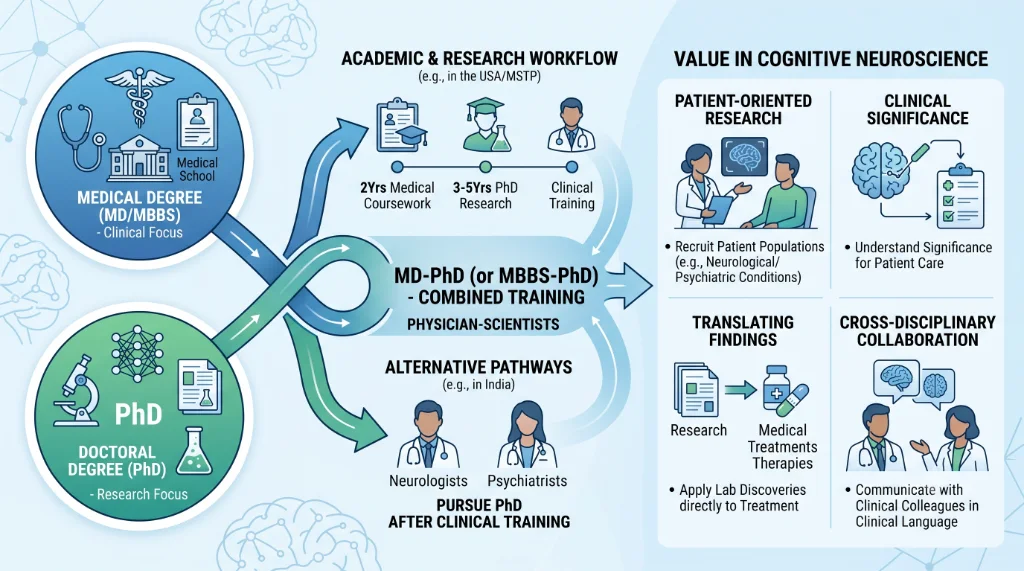
A significant and scientifically influential subset of cognitive neuroscientists hold both a medical degree (MD or MBBS) and a doctoral research degree (PhD). These individuals are sometimes called “clinician-scientists” or “physician-scientists,” and their dual training positions them uniquely at the intersection of clinical medicine and basic research.
In the United States, MD-PhD programmes — sometimes called Medical Scientist Training Programs (MSTPs) — are offered at most major research universities. These are 7 to 9 year programmes that typically involve 2 years of medical school coursework, 3 to 5 years of PhD research in a neuroscience or related laboratory, and then completion of the remaining medical school clinical training. They are extremely selective and prestigious, and their graduates go on to lead some of the most clinically relevant neuroscience research in the world.
The value of the MD-PhD combination in cognitive neuroscience is that it allows the scientist to:
• Recruit patient populations for research — people with specific neurological or psychiatric conditions whose brain differences illuminate how normal cognition works.
• Understand the clinical significance of research findings and prioritise questions with direct implications for patient care.
• Apply research findings to clinical practice directly, rather than relying on clinician collaborators to translate laboratory discoveries into treatment.
• Communicate with clinical colleagues about research findings in clinical language that facilitates genuine collaboration.
In India, the MBBS-PhD pathway is less formally integrated than the American MD-PhD programme, but it is not uncommon for clinicians — particularly neurologists, psychiatrists, and radiologists — to pursue doctoral research degrees after completing their medical training, or for medical institutions to offer combined clinical-research programmes.
The Neurologist: A Medical Doctor Who Studies the Brain
It is important to clarify the relationship between cognitive neuroscientists and neurologists, since both are associated with the study of the brain and nervous system but come from completely different training traditions.
A neurologist is a medical doctor who has specialised in the diagnosis and treatment of neurological disorders — diseases of the brain, spinal cord, peripheral nerves, and muscles. Neurologists complete a standard medical degree (MD or MBBS), followed by general medical residency training, and then a neurology fellowship lasting 2 to 3 years. They are qualified to see patients, order and interpret neuroimaging (CT, MRI), perform lumbar punctures and other procedures, prescribe medications, and manage conditions including epilepsy, stroke, multiple sclerosis, Parkinson’s disease, migraine, dementia, and traumatic brain injury.
Some neurologists conduct cognitive neuroscience research alongside their clinical practice. They may run research laboratories, supervise PhD students, publish scientific papers, and contribute to the academic literature on brain-behaviour relationships. But their primary professional identity is as clinicians, and their research typically focuses on questions with direct clinical relevance — understanding disease mechanisms, developing biomarkers, evaluating new treatments.
A cognitive neuroscientist who does not hold a medical degree cannot diagnose neurological or psychiatric conditions, prescribe medications, or provide clinical care. The cognitive neuroscientist who is not a clinician might study stroke patients or Alzheimer’s patients in a research context — with appropriate institutional approvals and in collaboration with clinical colleagues — but they cannot provide those patients with medical advice or treatment.
The Psychiatrist: Another Medical Specialist at the Brain-Mind Interface
Psychiatrists are medical doctors who have specialised in the diagnosis and treatment of mental health disorders — depression, anxiety, bipolar disorder, schizophrenia, PTSD, OCD, eating disorders, and personality disorders. Like neurologists, psychiatrists complete a medical degree and then a speciality residency in psychiatry, and some conduct cognitive neuroscience research alongside clinical practice.
The boundary between neurology and psychiatry reflects a historical distinction between “organic” brain disorders (neurological — visible structural abnormalities) and “functional” brain disorders (psychiatric — no visible structural abnormality, though this distinction has become increasingly difficult to sustain as neuroimaging has revealed measurable brain differences in most psychiatric conditions). Many of the most important questions in cognitive neuroscience — about emotion regulation, decision-making, social cognition, and the neural basis of mood — are as relevant to psychiatry as to neurology, and some of the most productive cognitive neuroscience research is conducted in psychiatric research settings.
The Neuropsychologist: Closest to a Clinical Brain-Behaviour Specialist
Among the people who work at the intersection of clinical practice and cognitive neuroscience, neuropsychologists are perhaps closest to what many people imagine when they picture a clinical brain scientist.
A neuropsychologist is typically a psychologist — not a medical doctor — who has specialised in the assessment and rehabilitation of cognitive impairments resulting from neurological conditions. Their training typically follows the standard academic psychology route (undergraduate degree, master’s, PhD) with specialisation in clinical neuropsychology, followed by supervised clinical practice and licensure as a psychologist.
Neuropsychologists administer standardised neuropsychological assessments — batteries of cognitive tests measuring memory, attention, language, executive function, visuospatial abilities, and processing speed — to patients with brain injuries, strokes, tumours, neurodegenerative diseases, and other neurological conditions. These assessments provide detailed profiles of a patient’s cognitive strengths and weaknesses that complement neuroimaging and inform diagnosis, prognosis, and rehabilitation planning.
A neuropsychologist is not a medical doctor but is a licensed psychologist qualified to conduct psychological assessment, formulate cognitive diagnoses (though formal medical diagnoses must be made by a physician), and provide psychological therapy and cognitive rehabilitation. In many countries, including India, neuropsychology is a growing clinical profession as awareness of cognitive assessment’s value in neurological care increases.
The Question of “Can They See Me as a Patient?”
For many people, the most practically relevant question about any health professional is: can I make an appointment with them and receive advice about my own health? The answer for cognitive neuroscientists who hold only a PhD and are not clinically trained is: no, not as medical patients in the conventional sense.
A cognitive neuroscientist without clinical training cannot:
• Diagnose neurological or psychiatric conditions.
• Prescribe medications.
• Order clinical investigations (MRI, blood tests, etc.) for diagnostic purposes.
• Provide medical advice about specific health conditions.
• Bill health insurance for clinical services.
What a cognitive neuroscientist without clinical training can do, and does do regularly, is:
• Enrol participants in research studies — including patients with specific neurological or psychiatric conditions — where participation involves brain scanning, cognitive assessment, or other research procedures.
• Provide general information about brain health and the science of cognition in educational contexts.
• Develop and evaluate brain-training programmes, educational curricula, or technology applications informed by cognitive neuroscience research.
• Consult with clinicians, educators, technology developers, or policymakers on the cognitive neuroscience evidence relevant to their work.
If you are experiencing cognitive symptoms — memory problems, attention difficulties, language problems, mood or personality changes — you should see a medical professional: your general practitioner (GP/family doctor) as a first contact, who can refer you to a neurologist, psychiatrist, or neuropsychologist as appropriate.
How to Identify a Cognitive Neuroscientist’s Credentials
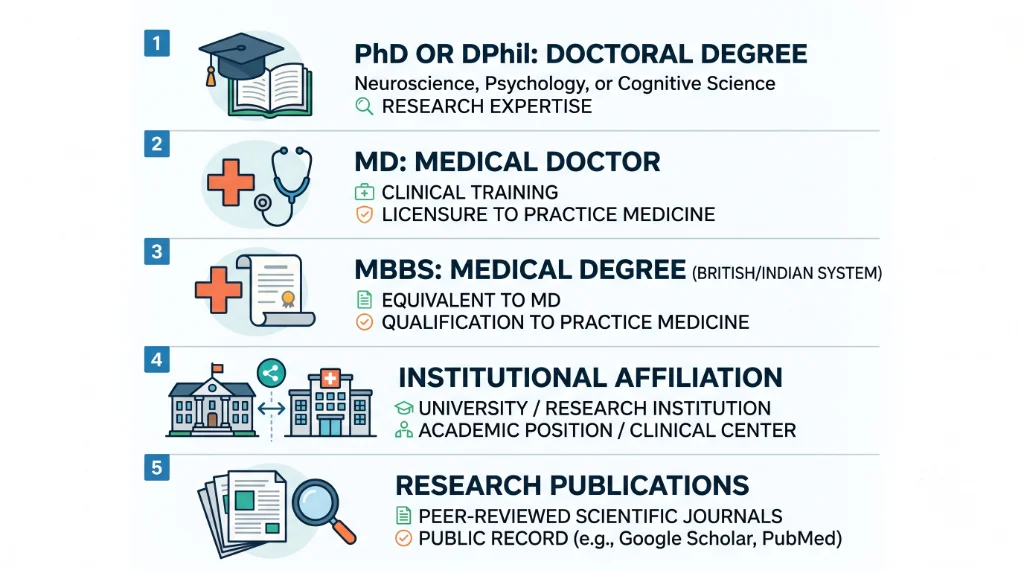
When encountering someone who describes themselves as a cognitive neuroscientist, the following credential markers are informative:
PhD or DPhil: A doctoral degree in neuroscience, psychology, cognitive science, or a related field. This is the standard credential for academic cognitive neuroscientists. Indicates research expertise but not clinical qualifications.
MD: A medical doctor’s degree. Indicates clinical training and licensure to practise medicine. An MD who also conducts cognitive neuroscience research may be listed as MD, PhD or may hold just the MD.
MBBS: The undergraduate medical degree in the British and Indian systems, equivalent to the MD in its qualification to practise medicine. An MBBS holder who has also done a PhD research degree may list MBBS, PhD.
Institutional affiliation: Academic cognitive neuroscientists are typically affiliated with a university or research institution and hold a faculty or research position. Clinician-researchers are typically affiliated with both a university and a hospital or clinical centre.
Research publications: Academic cognitive neuroscientists publish their work in peer-reviewed scientific journals. A quick search of their name on Google Scholar or PubMed will reveal their publication record.
The Indian Context: How to Pursue This Career
For Indian students interested in cognitive neuroscience as a career, several pathways are available:
Academic research route: Bachelor’s degree in psychology, life sciences, or engineering (including computer science for those interested in computational approaches) → MSc/integrated M.Sc. in neuroscience or cognitive science at NIMHANS, IISc, IIT Bombay, IIT Delhi, NBRC, or TIFR → PhD at one of these institutions or abroad → postdoctoral training in India or internationally → academic or research career.
Clinical neuroscience route: MBBS → postgraduate medical degree (MD in psychiatry or DM in neurology) → further specialisation and potential research involvement. Some Indian medical universities now offer combined clinical-research fellowships.
Technology application route: Bachelor’s or master’s degree in engineering, computer science, or mathematics with neuroscience exposure → employment in neurotechnology, AI, or cognitive computing companies applying neuroscience principles.
The National Brain Research Centre (NBRC) in Haryana, the Centre for Neuroscience at IISc Bengaluru, the Department of Cognitive Science at IIT Kanpur, and the TIFR National Centre for Biological Sciences in Mumbai are among the leading Indian institutions for cognitive neuroscience training and research.
The Takeaway: Researchers First, Clinicians Sometimes
The direct answer to “Is a cognitive neuroscientist a doctor?” is: most are doctors in the academic sense (holding a PhD), but most are not medical doctors qualified to diagnose, treat, or prescribe. A minority hold both degrees (MD-PhD or MBBS-PhD) and can function as clinician-scientists. The neurologist or psychiatrist who also conducts cognitive neuroscience research is a medical doctor first. Understanding these distinctions helps people know what to expect when they encounter a cognitive neuroscientist — whether as a research participant, a student, a colleague, or someone seeking to understand their cognitive health. For the actionable brain health insights that cognitive neuroscience research produces — and that everyone can apply regardless of their professional background — see our complete guide on What Actually Happens in Your Brain When You Learn Something New, our Sleep Hygiene guide, and our Stress Management guide.
About the Author
Tanveer Ahmed Khan is a K11 School of Fitness Sciences-certified personal trainer and REPS India-registered dietitian-nutritionist with over 12 years of experience. Coaching: info@livenulife.com | Instagram: @fitwithtanveer | livenulife.com
Scientific and Academic References
1. Gazzaniga, M.S., Ivry, R.B., Mangun, G.R. (2019). Cognitive Neuroscience: The Biology of the Mind (5th edition). W.W. Norton & Company. — The standard textbook of cognitive neuroscience.
2. Purves, D., et al. (2018). Neuroscience (6th edition). Sinauer/Oxford University Press. — Foundational neuroscience textbook covering the biological basis of cognition.
3. Ward, J. (2019). The Student’s Guide to Cognitive Neuroscience (4th edition). Psychology Press. — Accessible overview of the field for students.
4. Poldrack, R.A. (2018). The New Mind Readers: What Neuroimaging Can and Cannot Reveal About Our Thoughts. Princeton University Press. — Critical perspective on fMRI and its interpretation.
5. Kandel, E.R., Schwartz, J.H., Jessell, T.M., Siegelbaum, S.A., Hudspeth, A.J. (2021). Principles of Neural Science (6th edition). McGraw-Hill. — Comprehensive reference on neural science.
6. Cohen, J.D., Blum, K.I. (2002). Reward and decision. Neuron, 36(2). — On the neuroscience of decision-making and dopamine.
7. National Brain Research Centre (NBRC), India. nbrc.ac.in — India’s premier brain research institution.
8. Indian Institute of Science, Centre for Neuroscience. iisc.ac.in — IISc neuroscience research programmes.
9. Mesulam, M.M. (1998). From sensation to cognition. Brain, 121(6): 1013–1052. — Seminal paper on cortical organisation and cognitive function.
10. Milner, B., Squire, L.R., Kandel, E.R. (1998). Cognitive neuroscience and the study of memory. Neuron, 20(3): 445–468. — Historical perspective on the emergence of cognitive neuroscience.