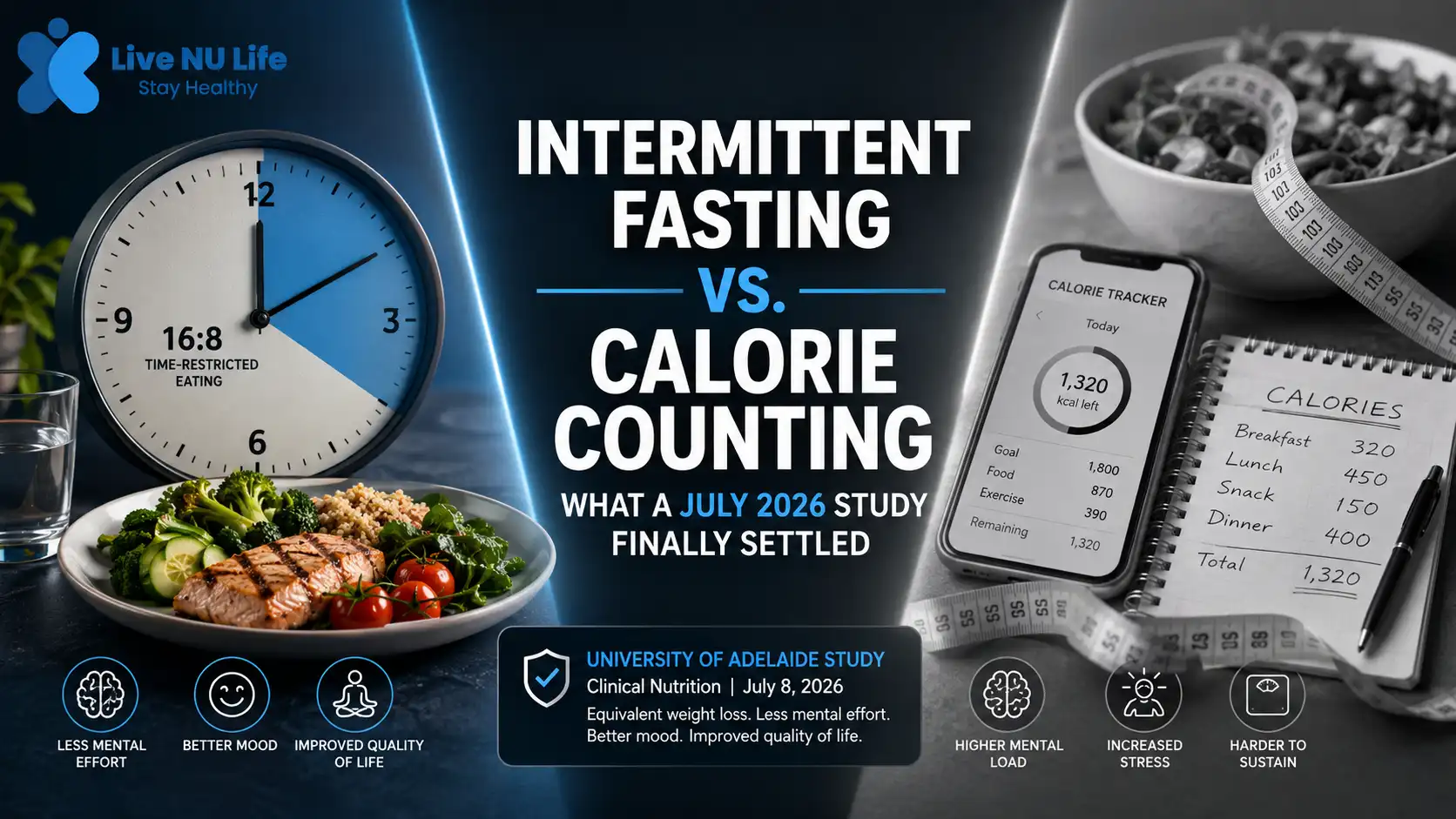
KEY TAKEAWAY: A University of Adelaide study published in Clinical Nutrition on July 8, 2026 found that intermittent fasting produces equivalent weight loss to calorie restriction — but with significantly less mental effort, better mood, and improved quality of life. Here is what this means if you have ever struggled to stick to a diet.
The Question Every Dieter Eventually Asks
In more than 12 years of working as a certified trainer and nutrition coach, I have watched the same pattern play out hundreds of times. A client arrives motivated, armed with a calorie-counting app, a food scale, and a carefully calculated 500-calorie daily deficit. For three to four weeks, results are good. Then the tracking becomes exhausting. The mental load of logging every meal grows heavier. One busy week, the app gets neglected. The weight returns. The client concludes they lack willpower — when in reality, the method was the problem, not the person.
A study published in Clinical Nutrition on July 8, 2026, by researchers at the University of Adelaide has now provided the scientific framework for what I have been observing clinically. Led by Professor Leonie Heilbronn, a clinical research scientist in the School of Medicine, the team compared intermittent fasting combined with time-restricted eating against continuous calorie restriction — and the results change the conversation around sustainable weight management.
Read More: The Ancient Beverage That Science Is Proving More Powerful Than We Imagined
What the July 2026 Study Found
The Adelaide research team examined not only how much weight people lost, but how different dieting approaches affected eating habits, mood, sleep, and overall quality of life — variables that calorie-counting studies typically ignore.
Their primary finding: intermittent fasting and continuous calorie restriction produced similar amounts of weight loss. Neither approach beat the other on the scales. But the psychological and behavioural experience of the two approaches was strikingly different.
People who followed intermittent fasting reported that they felt they did not need to make major changes to their eating behaviours — such as monitoring overeating or constantly counting calories — in order to lose weight. The mental effort required was substantially lower. Mood outcomes and quality of life measures favoured the fasting group.
“Many chronic dieters become trapped in a cycle of constantly tracking, counting, restricting, and thinking about food,” said registered dietitian nutritionist Monique Richard, who reviewed the findings. “Intermittent fasting offers an alternative framework that may feel more natural for some people.”
Lead researcher Professor Heilbronn offered a critical insight into why this psychological difference matters: “Previous research shows that people who improve their relationship with food and gain better control over cravings lose more weight — regardless of the specific diet they undertake.”
In other words, if intermittent fasting makes the psychological experience of eating more manageable, it may produce better long-term outcomes even if the short-term weight loss numbers look identical.
Read More: Why Scrolling Your Phone at Night Is Ruining Your Sleep and How To Fix It?
Why Calorie Counting Fails So Many People
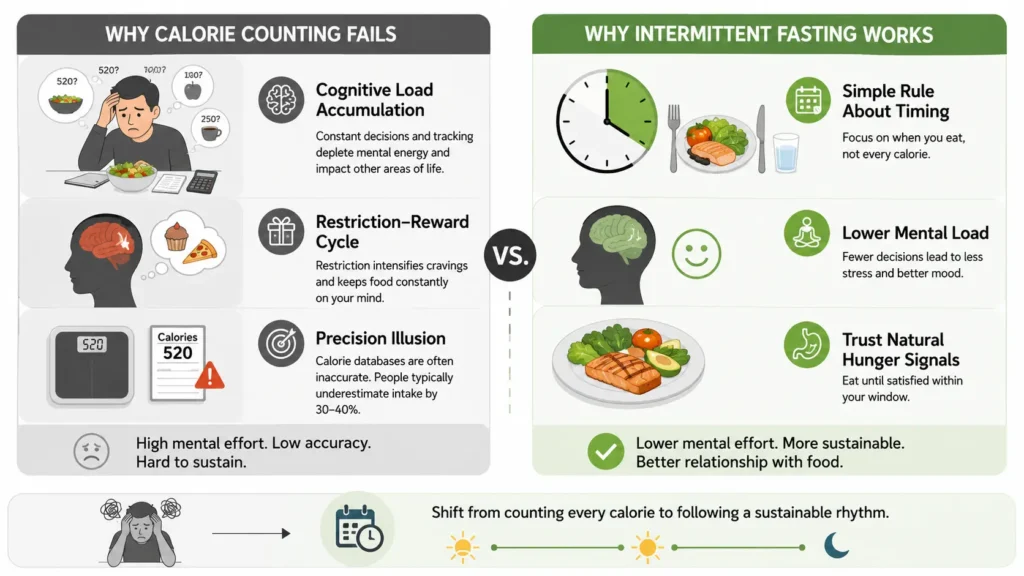
To understand why this July 2026 research matters, it helps to understand the specific ways continuous calorie restriction creates psychological burden.
Cognitive load accumulation. Counting calories requires constant decision-making. Every meal, every snack, every social occasion involves a calculation. The prefrontal cortex — the brain region responsible for executive decision-making — has a finite daily capacity. When it is depleted by food tracking, other areas of life suffer: work performance, emotional regulation, relationships.
The restriction-reward cycle. Sustained calorie restriction activates the brain’s reward systems around food. Studies consistently show that dieters think about food more than non-dieters, experience stronger cravings, and respond more intensely to food cues. The very act of restriction intensifies the psychological relationship with food.
The precision illusion. Food databases are estimated to have average errors of 20 to 30% in calorie values. Restaurant portions are even less reliable. People consistently underestimate their intake by 30 to 40% regardless of how carefully they track. The precision of calorie counting is largely illusory, which means the cognitive effort expended delivers less accuracy than it appears.
Intermittent fasting sidesteps many of these issues by replacing continuous decision-making about quantity with a simpler rule about timing. When you eat is governed by a clear framework; how much you eat within the eating window is guided by natural hunger signals rather than arithmetic.
The Science Behind Why Intermittent Fasting Works
The July 2026 Adelaide study confirmed equivalent weight loss — but the mechanisms by which intermittent fasting produces that loss are biologically distinct from simple calorie restriction, and worth understanding.
Insulin reduction and fat mobilisation. Insulin is the primary signal that tells fat cells to store energy. When you fast for 14 to 16 hours, insulin levels fall to their lowest daily point, allowing fat mobilisation — the release of stored fat for energy — to occur freely. Continuous calorie restriction reduces insulin somewhat, but the sustained presence of multiple daily meals keeps insulin elevated compared to fasting states.
Autophagy activation. Extended fasting periods — typically 16 to 18 hours — trigger autophagy, the cellular cleaning process in which the body breaks down and recycles damaged proteins, organelles, and cellular components. Autophagy is associated with reduced inflammation, improved metabolic function, and emerging evidence suggests benefits for neurological health and longevity.
Circadian rhythm alignment. The time-restricted eating component of the Adelaide study protocol is particularly interesting from a chronobiology perspective. Concentrating food intake within an 8 to 10 hour daytime window aligns eating with the body’s metabolic circadian rhythm — the biological clock that governs when metabolic processes are most efficient. Research consistently shows that the same meal produces a lower blood sugar spike and smaller insulin response when eaten at noon compared to midnight.
Gut microbiome benefits. Extended fasting periods allow the gut microbiome to cycle through phases of activity and rest that mirror the body’s natural circadian rhythm. Studies in 2026 have shown that time-restricted eating promotes greater microbial diversity and supports the production of beneficial short-chain fatty acids compared to continuous grazing patterns.
Read More: Top Benefits of Fennel Tea for Better Digestion
The Protocols: What the Research Actually Supports
Intermittent fasting is not a single protocol — it is a family of approaches with different structures, benefits, and appropriate populations. After 12 years of prescribing these approaches to clients, here is how I differentiate between them:
16:8 (Time-Restricted Eating). Fast for 16 hours, eat within an 8-hour window. This is the most studied and most broadly applicable protocol. The Adelaide study used a variation of this. For most healthy adults, I recommend an eating window of approximately 10am to 6pm or noon to 8pm, depending on work schedules and family commitments. This is sustainable indefinitely and compatible with social eating.
5:2 Protocol. Eat normally for five days per week; restrict to approximately 500 to 600 calories on two non-consecutive days. Well-studied in type 2 diabetes populations. Multiple trials have shown equivalent or superior outcomes to daily restriction for blood sugar management, with the psychological advantage that restriction is temporary and bounded rather than continuous.
Alternate Day Fasting. Fast every other day (or eat 25% of normal intake on alternate days). The most aggressive protocol and the one with the highest dropout rates in research settings. I rarely prescribe this approach because the psychological burden shifts back toward the chronic-dieter pattern the 16:8 protocol avoids.
The Fasting-Mimicking Diet (FMD). Developed by Professor Valter Longo at USC (whose July 2026 longevity diet research I discuss in another article this month), the FMD involves five days per month of calorie restriction to approximately 800 to 1,000 calories, designed to trigger autophagy benefits without full fasting. Growing evidence supports its use for metabolic health, immune system reset, and longevity markers.
Read More: Wellbeing Mastery: Science-Based Strategies to Thrive Every Day
What My 12 Years of Practice Adds
The July 2026 Adelaide research validates what I have observed consistently in practice, but I want to add several clinical nuances the study did not address.
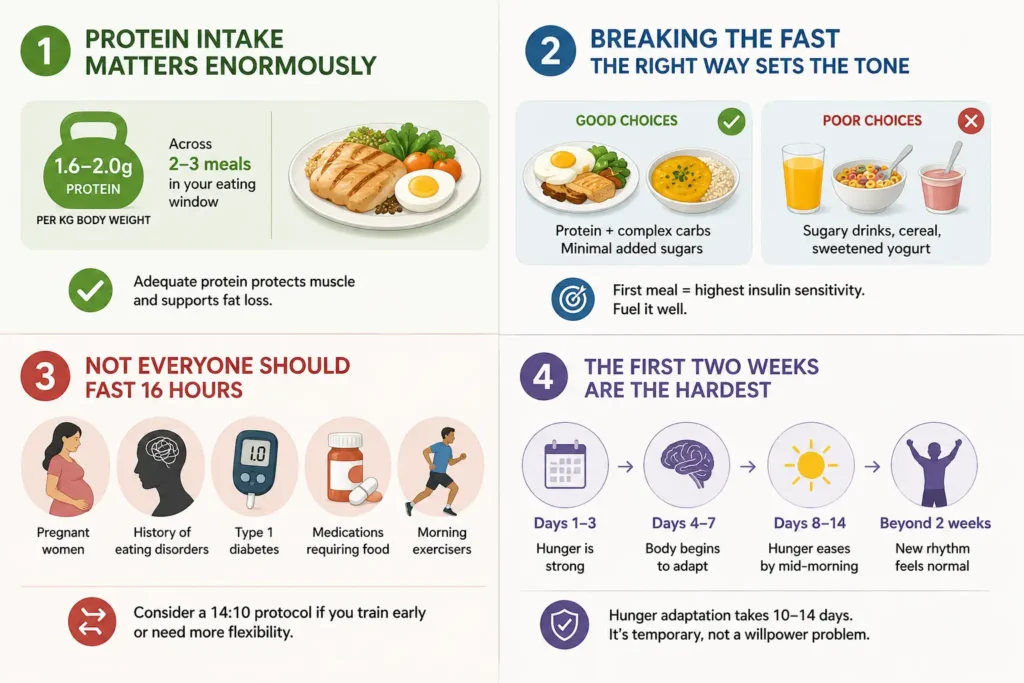
Protein intake during fasting matters enormously. The biggest mistake I see with intermittent fasting is inadequate protein within the eating window. When fasting, the body naturally increases protein turnover. If dietary protein is insufficient during the eating window — which is common when people simply compress their existing diet into fewer hours — muscle loss accelerates. I require clients doing 16:8 to hit 1.6 to 2.0 grams of protein per kilogram of body weight within their eating window, prioritised across two to three meals.
Breaking the fast with the right foods determines the day. The first meal after a fasting period is when insulin sensitivity is highest and the body is most receptive to nutrient partitioning. I design this meal around protein and complex carbohydrates with minimal added sugars — eggs with whole grain toast and vegetables, or dhal with brown rice, not juice, cereal, or commercially sweetened yoghurt.
Not everyone should fast 16 hours. Intermittent fasting is contraindicated for pregnant women, people with a history of eating disorders, those with type 1 diabetes, and anyone on medications requiring food. For individuals who exercise in the morning, extended fasting into the training window can impair performance and recovery. I often modify to a 14:10 protocol for active clients who train before noon.
The first two weeks are the hardest. Hunger adaptation takes 10 to 14 days in most people. During this period, clients experience genuine hunger in the morning that passes by mid-morning as the body adjusts to its new fuel-access pattern. Understanding that this is temporary and biological — not a failure of willpower — is essential for persistence.
A Sample 16:8 Day
Based on the Adelaide study protocol and my clinical experience, here is a practical day structure:
• 6:00–10:00am: Fasting period. Water, black coffee or plain green tea only. Light exercise before breaking the fast is acceptable and may enhance fat oxidation.
• 10:00am (Break fast): 3 eggs scrambled with vegetables and 2 whole wheat rotis or 1 cup oats with nuts and berries. Target: 30–40g protein.
• 1:30pm (Lunch): Large dal and vegetable meal with 1 cup brown rice or 2 rotis. Target: 35–40g protein.
• 4:30pm (Snack, optional): Greek yoghurt with nuts, or a boiled egg with fruit.
• 6:00–7:00pm (Dinner / last meal): Fish or paneer with vegetables and a small serving of complex carbohydrate. Target: 30–35g protein.
• 7:00pm onwards: Fasting begins. Herbal tea acceptable. No calorie-containing beverages.
The Takeaway
The July 2026 University of Adelaide research makes one thing clear: the best diet for weight loss is not the one with the most precise calorie deficit. It is the one you can actually sustain. Intermittent fasting produces equivalent weight loss to continuous calorie restriction — with less psychological burden, better mood outcomes, and a more sustainable relationship with food.
For the millions of people who have been trapped in the cycle of tracking, restricting, overeating, and restarting, this research offers a genuinely different framework. Not stricter discipline applied to the same approach. A different approach altogether.
Scientific References
1. Teong, X.T., Liu, K., Vincent, A.D., et al. (2026). Exploring the impact of intermittent fasting plus time-restricted eating versus calorie restriction on eating behavior, mood, sleep, quality of life in adults with obesity. Clinical Nutrition, 62: 106686. doi: 10.1016/j.clnu.2026.106686
2. ScienceDaily / Adelaide University. (July 8, 2026). Can’t stick to a diet? Intermittent fasting may be easier than counting calories for weight loss. www.sciencedaily.com
3. Healthline. (July 2026). Intermittent Fasting vs. Calorie Count: Which Is Best for Weight Loss? www.healthline.com