By Tanveer Ahmed Khan | K11-Certified Trainer & Dietitian-Nutritionist | REPS India Registered | August 2026 | 11 min read
KEY TAKEAWAY: A landmark randomised study from Columbia University — published in Annals of Internal Medicine, July 2026 — found that cutting sleep by just 80 minutes per night for six weeks caused participants to gain an average of one pound and spend 17 more minutes per day being sedentary. Extrapolated to a year, this represents clinically meaningful weight gain from a sleep habit that millions consider normal. Here is the complete metabolic science — and what to do about it.
The Study That Ends the “Sleep Is Optional” Argument
In more than 12 years of nutritional and fitness coaching, one of the conversations I have most consistently avoided with clients is sleep — because it always felt secondary to diet and exercise, and because the research connecting mild sleep loss to weight gain had been largely observational. You could always argue correlation rather than causation.
A study published in Annals of Internal Medicine on July 7, 2026 by researchers at Columbia University Vagelos College of Physicians and Surgeons has closed that door. This is a randomised crossover trial — the gold standard of clinical evidence — that directly tested what happens when real people cut their sleep by a realistic, not extreme, amount. The results are impossible to ignore.
Professor Marie-Pierre St-Onge, a professor of nutritional medicine and director of Columbia’s Sleep Center of Excellence, led a team that recruited 95 adults who normally slept 7 to 8 hours per night. Participants were assigned to two six-week phases in randomised order: one where they maintained their normal sleep, and one where they delayed their bedtime by 90 minutes, reducing nightly sleep to approximately 6 hours.
This was not extreme sleep deprivation. This was the kind of mild, chronic sleep reduction experienced by roughly 30% of adults globally — the person who stays up until midnight scrolling a phone and wakes at 6am for work.
📖 Also read: Sleep Hygiene Hacks for Better Rest Tonight — The evidence-based sleep optimisation protocol — now more important than ever given Columbia’s weight gain findings.
What the Study Found: The Weight, the Waist, the Sedentary Hours
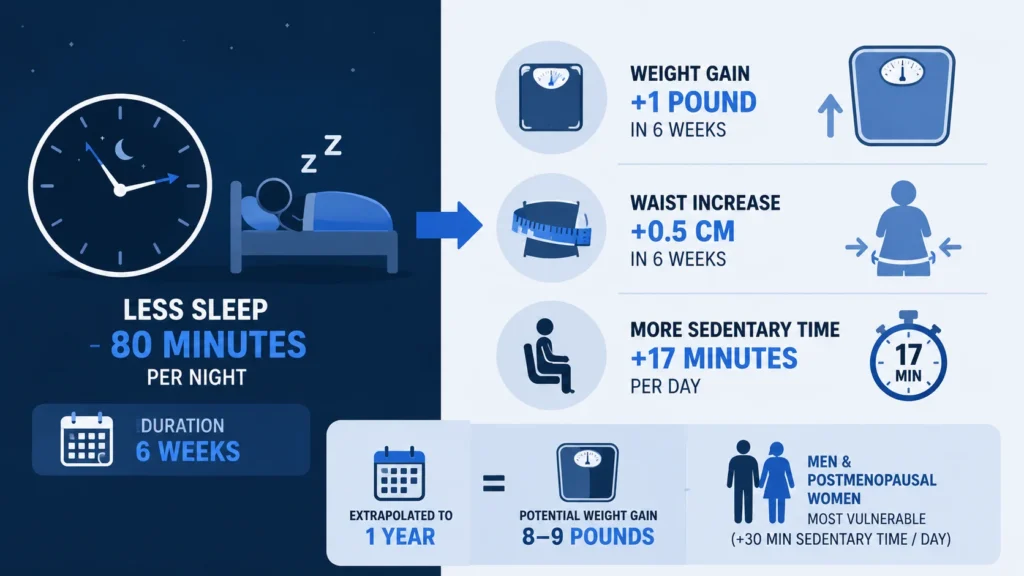
By the end of the six-week sleep-restricted phase, participants weighed an average of one pound more than during their adequate-sleep phase. Their waist circumference had grown by approximately half a centimetre. And critically, they spent an average of 17 additional minutes per day being sedentary — despite being awake for more hours.
“When extrapolated to a full year,” said first author Faris Zuraikat, assistant professor of nutritional medicine at Columbia, “we would expect that losing less than an hour and a half of sleep per night could result in clinically meaningful weight gain.”
One pound over six weeks becomes approximately 8 to 9 pounds over a year. Not from any change in diet. Not from any reduction in exercise. Purely from sleeping one hour less per night than the body requires.
Previous analyses of the same participant group found increased insulin resistance in women with elevated cardiometabolic risk, and signs of heart inflammation following chronic mild sleep restriction. The weight gain finding, combined with these metabolic consequences, builds the most complete causal picture to date of how mild sleep loss drives obesity and cardiovascular risk.
Men and postmenopausal women showed the most pronounced increase in sedentary time — nearly 30 additional minutes per day — making these groups particularly vulnerable to the compound effects of sleep restriction on physical activity.
Why Does Sleeping Less Make You Gain Weight?
This is the question I am most frequently asked when I discuss sleep with clients — and the mechanisms are well-established, multiple, and interacting.
Ghrelin rises, leptin falls. Ghrelin is the hunger hormone — it rises before meals and signals the brain to seek food. Leptin is the satiety hormone — it rises after eating and signals fullness. Sleep deprivation consistently increases ghrelin and decreases leptin, creating the biological equivalent of being permanently hungry regardless of how much you have eaten. The Columbia study found leptin levels increased during the sleep-restricted phase — an unexpected finding the authors suggest may represent a compensatory hormonal response that is insufficient to overcome the overall appetite dysregulation.
The reward system hijacks food choices. Sleep-deprived brains show increased activity in the amygdala (the brain’s reward and pleasure centre) and decreased activity in the prefrontal cortex (the brain’s rational decision-making centre). The result is a predictable pattern I see clinically: sleep-deprived clients reach for high-sugar, high-fat, hyper-palatable foods — not because they have weak willpower, but because their brain’s reward system has effectively overridden their rational food preferences.
Insulin resistance develops rapidly. Even one night of poor sleep measurably reduces insulin sensitivity the following day. Six weeks of mild sleep restriction produces clinically meaningful insulin resistance — the foundation of type 2 diabetes, metabolic syndrome, and accelerated fat storage, particularly in visceral (abdominal) fat depots.
Sedentary time increases despite more waking hours. This is perhaps the most counterintuitive finding. People who sleep less are awake for more hours — you would expect them to be more active. Instead, the Columbia study found the opposite: sleep-deprived participants spent more time sitting, not less. The biological explanation is that sleep restriction elevates cortisol and reduces thyroid function, reducing spontaneous physical activity even in people who are awake. The body conserves energy when sleep-deprived, but not in a useful way.
Cortisol drives fat storage and muscle breakdown. Chronic sleep restriction elevates cortisol — the body’s primary stress hormone. Chronically elevated cortisol promotes fat storage specifically in the abdomen, stimulates appetite for energy-dense foods, and drives the breakdown of muscle protein for energy — exactly the metabolic profile that makes weight gain both more likely and harder to reverse.
📖 Also read: Circadian Rhythm Healing: Reset Your Body Clock — The circadian biology behind why when you sleep matters as much as how long — directly relevant to why the Columbia study found such dramatic metabolic effects from mild timing shifts.
The Sleep-Nutrition Connection I See in Practice
After 12 years of conducting detailed lifestyle assessments alongside nutritional analysis, I can tell you that sleep quality is the single most underrated variable in weight management. Clients who are doing everything right with diet and exercise — but sleeping 5 to 6 hours regularly — consistently plateau, struggle with cravings, and show metabolic markers that do not respond to nutritional intervention as expected.
When I identify poor sleep as the issue and address it directly — often before making any dietary changes — metabolic markers frequently improve within 2 to 3 weeks. Fasting glucose comes down. Waist circumference begins to respond. Cravings reduce. Energy levels stabilise.
The Columbia study is the randomised evidence for what I have been observing clinically for years. Sleep is not a lifestyle choice you can deprioritise once nutrition and exercise are addressed. It is a co-equal pillar of metabolic health that, when inadequate, directly undermines everything else you are doing correctly.
For the full picture of sleep’s role in hormonal health and metabolic function — including why some people sleep 10 hours and still feel tired — see our guide on why you sleep 10 hours but are still tired and our comprehensive Natural Sleep Remedies guide.
The Practical Sleep Protocol I Prescribe
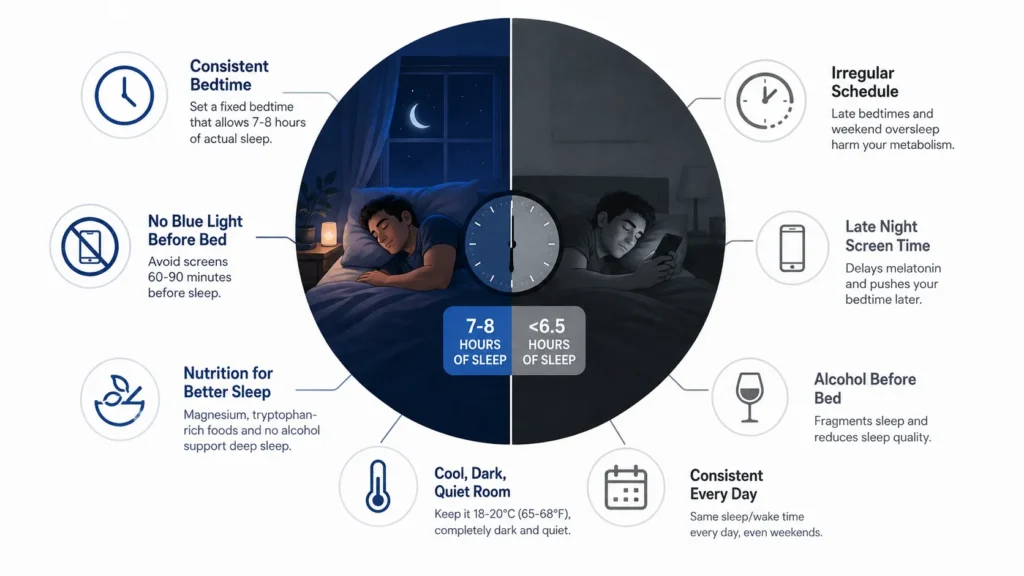
Target: 7 to 8 hours of actual sleep — not time in bed. The Columbia study participants were normal sleepers who needed 7 to 8 hours. The RDA for sleep is 7 hours minimum for adults aged 18 to 64, and 7 to 8 hours for adults 65 and older. Time in bed does not equal sleep time — a point Professor St-Onge emphasised: “Spending more time in bed is essential to achieving longer sleep but this is not beneficial if the person is lying awake in bed, trying to sleep.”
Set a consistent bedtime — not just a wake time. Most people focus on consistent wake times (correctly), but the Columbia findings show that bedtime delay is the primary mechanism of weight-gaining sleep restriction. Set a firm bedtime that allows 7 to 8 hours before your required wake time and treat it with the same non-negotiable status as a morning meeting.
Eliminate blue light 60–90 minutes before bed. Blue-wavelength light from screens — phones, tablets, laptops, televisions — suppresses melatonin production and delays sleep onset by approximately 45 minutes in most adults. The phone scroll that causes people to delay bedtime is itself chemically preventing the body from being sleepy when they finally put it down. See our guide on why scrolling at night ruins your sleep.
Nutrition for sleep: the pre-bed protocol. Several nutritional interventions directly improve sleep quality and duration. Magnesium — which we cover in depth in this issue — is directly involved in GABA neurotransmitter activity and melatonin synthesis. A magnesium-glycinate supplement 30 to 60 minutes before bed improves sleep onset and maintenance in many people. Tryptophan-rich foods (turkey, warm milk, banana) in the evening support serotonin and melatonin synthesis. Avoiding alcohol — which fragments sleep architecture despite inducing drowsiness — is essential.
Temperature, darkness, consistency. The sleep environment triad: room temperature of 18 to 20°C (65 to 68°F) — the range that optimises sleep architecture; complete darkness (blackout curtains or sleep mask); and the same sleep/wake schedule seven days per week. Social jet lag — the pattern of sleeping later on weekends and waking earlier on weekdays — produces the same metabolic disruption the Columbia study documented, in chronic real-world form.
For the complete technological approach to optimising sleep environment and tracking — including wearables and smart mattresses — see our Sleep Optimization Technology guide.
The Takeaway
The Columbia University 2026 randomised trial removes the last defensible argument that mild sleep restriction is metabolically harmless. Sleeping one hour less than you need, chronically, causes measurable weight gain, waist expansion, insulin resistance, and increased sedentary behaviour — not from any dietary choice, but from the sleep reduction alone. Sleep is not a lifestyle luxury that can be traded against productivity. It is a metabolic necessity with direct weight management consequences. If your diet is clean and your exercise is consistent but your weight will not move, check your sleep first. For a complete guide to the sleep-specific nutritional strategies that address the hormonal disruption documented in this research, see our Natural Sleep Remedies guide.
About the Author
Tanveer Ahmed Khan is a K11 School of Fitness Sciences-certified personal trainer and REPS India-registered dietitian-nutritionist with over 12 years of experience helping busy professionals achieve elite, sustainable health. Coaching: info@livenulife.com | Instagram: @fitwithtanveer | livenulife.com
Scientific References
1. Zuraikat, F.M., Scaccia, S.E., Cochran, J.A., et al. (2026). Prolonged Short Sleep and Its Effect on Body Weight and Composition: A Pooled Analysis of Randomized Trials. Annals of Internal Medicine. DOI: 10.7326/annals-25-01660
2. ScienceDaily / Columbia University Irving Medical Center. (July 13, 2026). Losing just 80 minutes of sleep a night could make you gain weight.
3. EurekAlert / Columbia University. (July 6, 2026). Skimping on sleep leads to weight gain.
4. Medical News Today. (July 2026). Missing just over one hour of sleep each night may lead to weight gain.
5. Time Magazine. (July 8, 2026). Losing Even an Hour of Sleep a Night Is Linked to Weight Gain.