KEY TAKEAWAY: A study of 130,828 adults with chronic insomnia — covered by ScienceDaily on August 29, 2026 and presented at the AHA Scientific Sessions — found that long-term melatonin users had approximately 90% higher risk of heart failure, 3.5x higher heart failure hospitalisation, and double all-cause mortality over five years. Findings are preliminary and observational, but raise urgent questions about chronic melatonin use.
The Supplement Everyone Assumed Was Harmless
Melatonin is one of the most widely used supplements on the planet. An estimated 6 million American adults take it regularly — most daily, most for months or years. In India, the supplement is widely available and consumed habitually by urban professionals, shift workers, and frequent travellers. The foundational assumption has always been the same: melatonin is a hormone the body naturally produces, so supplementing it is inherently safe.
Research presented at the American Heart Association’s Scientific Sessions and reported by ScienceDaily on August 29, 2026 has now delivered the most significant challenge to this assumption in the supplement’s history. Led by Dr Ekenedilichukwu Nnadi of SUNY Downstate/Kings County, the study analysed five years of health records from 130,828 adults with chronic insomnia in the TriNetX Global Research Network — one of the largest melatonin safety analyses ever conducted.
📖 Also read: Sleep Hygiene Hacks for Better Rest Tonight — The evidence-based sleep optimisation framework — more urgent than ever in light of the melatonin heart failure data.
The Numbers That Shocked the Cardiology Community
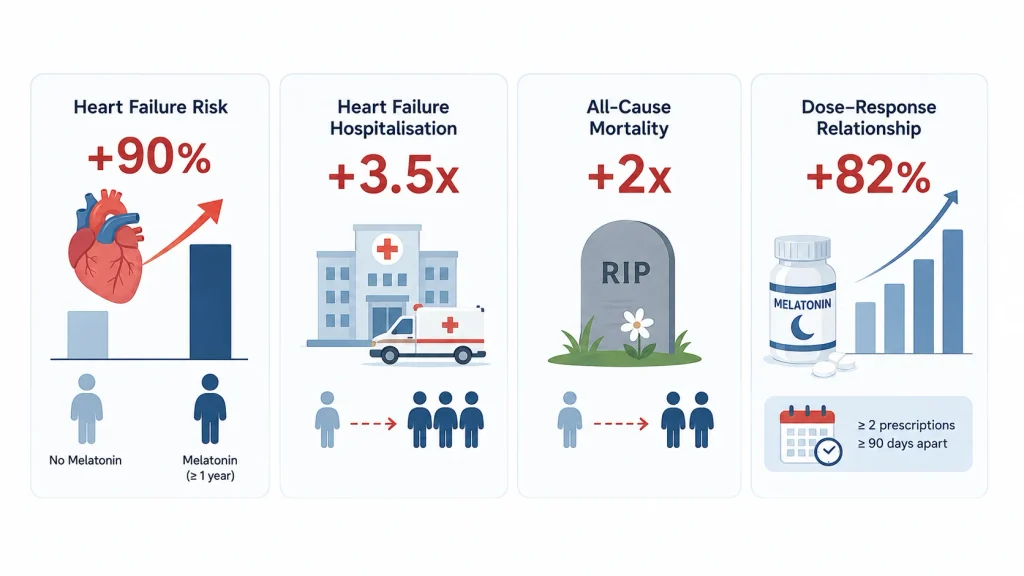
Heart failure risk: +90%. Participants using melatonin for at least one year had approximately 90% higher likelihood of developing heart failure over the five-year follow-up compared with insomnia patients who did not use melatonin.
Heart failure hospitalisation: +3.5x. Melatonin users were approximately 3.5 times more likely to be hospitalised for heart failure.
All-cause mortality: +2x. Melatonin users had approximately double the all-cause mortality rate over the five-year period.
Dose-response relationship. Participants who had filled at least two melatonin prescriptions at least 90 days apart had an 82% greater chance of developing heart failure — a dose-response signal that strengthens the causal plausibility, though it does not prove causation.
The Critical Caveats: What This Study Cannot Tell Us
Observational design. “Our study cannot prove a direct cause-and-effect relationship,” said Dr Nnadi explicitly. The study shows an association, not causation.
Confounding by indication. People who receive melatonin prescriptions may have more severe insomnia, more severe anxiety and depression, or be on other medications that independently elevate cardiovascular risk. As Dr Nnadi acknowledged: “Worse insomnia, depression/anxiety, or the use of other sleep-enhancing medicines might be linked to both melatonin use and heart risk.”
Not yet peer-reviewed. These findings were presented at a conference but had not yet been published in a peer-reviewed journal as of August 29, 2026.
Not applicable to short-term use. The study examined adults using melatonin for at least one year. It says nothing about occasional use for jet lag or one-time sleep disruption.
Why the Findings Are Biologically Plausible
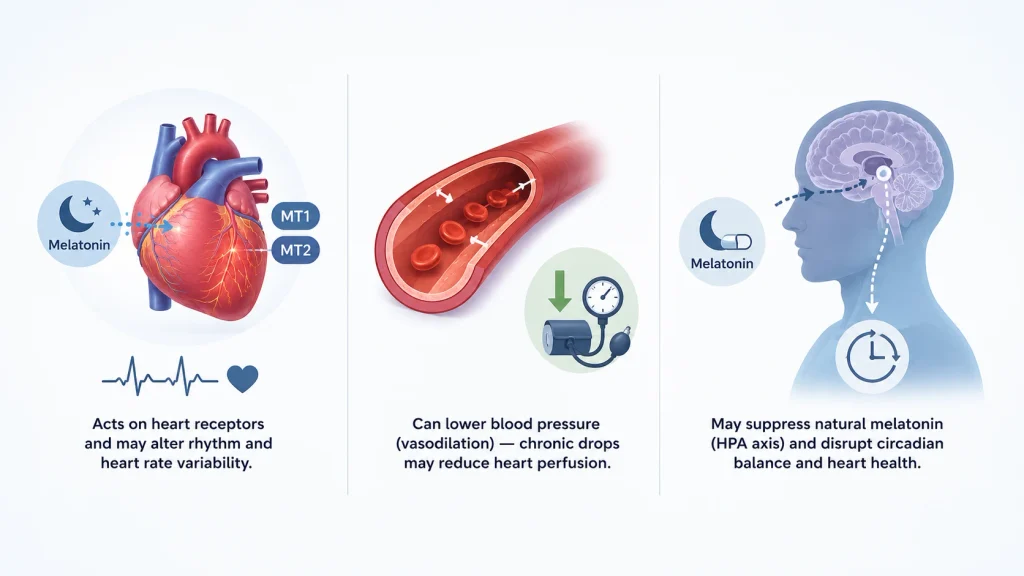
Cardiac autonomic system. Melatonin receptors (MT1 and MT2) are present in cardiac tissue. Animal studies have shown supraphysiological melatonin doses can alter cardiac rhythm and heart rate variability.
Blood pressure effects. Melatonin has vasodilatory effects — chronic nocturnal hypotension in people with pre-existing cardiac dysfunction could theoretically impair coronary perfusion.
HPA axis suppression. Chronic exogenous melatonin may suppress endogenous melatonin production through feedback inhibition, with downstream effects on circadian biology and cardiovascular function.
What I Recommend in Practice
Short-term situational use (jet lag, shift work): Continue recommending at 0.5–3mg doses. The safety concern applies to chronic use, not occasional application.
Long-term daily melatonin for chronic insomnia: Escalate priority of addressing underlying insomnia through non-pharmacological means. Cognitive Behavioural Therapy for Insomnia (CBT-I) has the strongest evidence base for chronic insomnia.
Evidence-based alternatives:
• Magnesium glycinate (300–400mg before bed) — supports GABAergic sleep induction through its role as a melatonin co-factor. See our August 2026 Magnesium article.
• Ashwagandha KSM-66 (300mg before bed) — reduces cortisol-driven hyperarousal that prevents sleep onset.
• Sleep hygiene: consistent bedtime, blue light elimination, cool dark environment. See our Sleep Hygiene guide.
For the complete evidence-based sleep optimisation framework, see our Sleep Hygiene Hacks guide and our Natural Sleep Remedies guide.
The Takeaway
The August 29, 2026 AHA data — 130,828 adults, 90% higher heart failure risk with long-term melatonin — is the largest and most alarming safety signal ever raised about this widely used supplement. Preliminary and potentially confounded, but impossible to dismiss. The appropriate response: reserve melatonin for short-term situational use, prioritise CBT-I and lifestyle approaches for chronic insomnia, and address underlying causes of poor sleep. See our Natural Sleep Remedies guide.
About the Author
Tanveer Ahmed Khan is a K11 School of Fitness Sciences-certified personal trainer and nutrition coach with 12+ years of strength training experience. Coaching: info@livenulife.com | Instagram: @fitwithtanveer | livenulife.com
Scientific References
1. Nnadi, E., et al. (2026). Long-term melatonin use and heart failure risk. Presented at AHA Scientific Sessions 2025. TriNetX Global Research Network, n=130,828.
2. ScienceDaily / American Heart Association. (August 29, 2026). Long-term melatonin use linked to 90% higher heart failure risk.
3. American College of Cardiology. (August 30, 2026). Research Suggests Long-Term Melatonin Use For Insomnia Increases HF Risk.
4. Medical News Today. (2025/2026). Long-term melatonin use linked to 90% greater heart failure risk.
5. Hackensack Meridian Health. (January 2026). Long-Term Use of Melatonin May Increase Risk of Heart Failure.