KEY TAKEAWAY: 2026 research has expanded the evidence that sleep chronotypes — whether you are a morning person (“lark”) or evening person (“owl”) — have measurable metabolic consequences independent of how much total sleep you get. Evening chronotypes show higher rates of insulin resistance, type 2 diabetes, cardiovascular disease, and depression. The mechanism is circadian misalignment — living against your biological clock. Here is the science and a practical approach.
Beyond Preference: What Your Body Clock Is Actually Controlling
When clients describe themselves as “not a morning person,” they typically frame it as a preference or habit — something cultural or social rather than biological. The accumulating chronobiology research of 2026 tells a fundamentally different story: your sleep chronotype is substantially genetically determined, reflects the timing of your body’s master biological clock, and is associated with measurable differences in metabolic, cardiovascular, and psychological health outcomes that persist even after controlling for total sleep duration.
The August 2026 research landscape on sleep chronotypes builds on a 2026 study we have covered in our Sleep Chronotypes and Productivity guide, extending the picture from productivity into the domains of metabolic health, cardiovascular risk, and the connections to dietary patterns that make chronotype clinically actionable for nutritional coaching.
The Columbia University August 2026 sleep study we covered in our August 2026 Vol I sleep-weight gain article found that losing even 80 minutes of sleep per night caused measurable weight gain and sedentary time increases. Chronotype research adds a complementary finding: not just how long you sleep, but when you sleep relative to your circadian biology determines metabolic outcomes.
📖 Also read: Sleep Hygiene Hacks for Better Rest Tonight — The practical sleep optimisation framework — especially relevant for evening chronotypes who need structural strategies to mitigate their metabolic risk.
What Is a Chronotype and Why Does It Differ Between People?
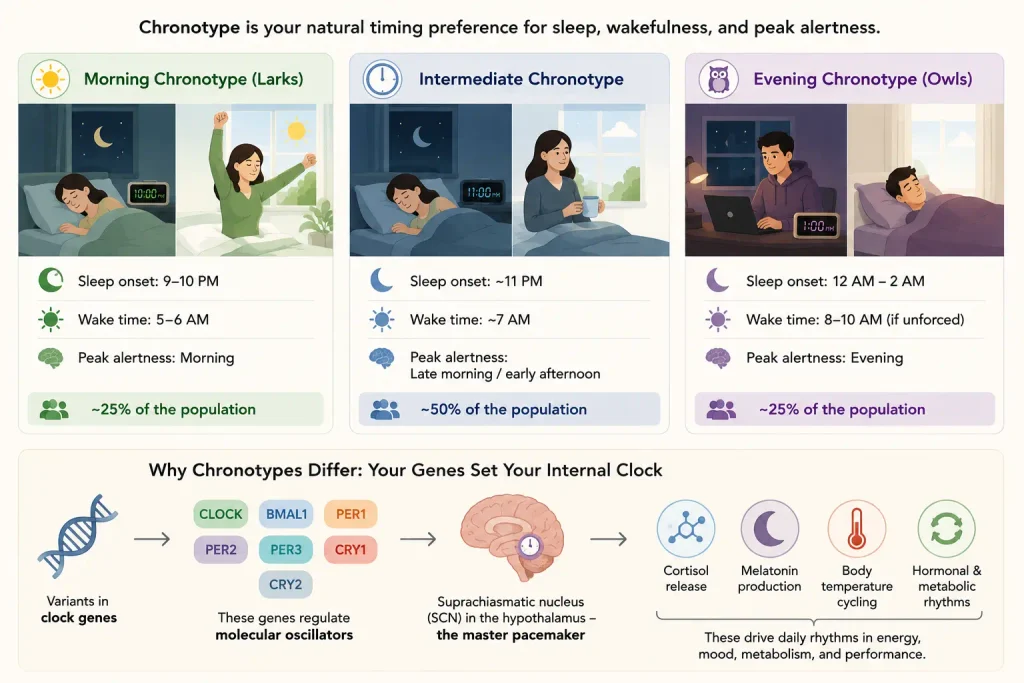
Chronotype is the natural timing preference for sleep and wakefulness that each person exhibits — when they feel most alert, when they naturally fall asleep, and when they naturally wake. The extremes are:
Morning chronotype (larks): Natural sleep onset around 9–10pm, natural wake around 5–6am, peak alertness and cognitive performance in the morning. Approximately 25% of the population.
Evening chronotype (owls): Natural sleep onset around midnight to 2am, natural wake around 8–10am if unforced, peak alertness in the evening. Approximately 25% of the population.
Intermediate chronotype: The majority — approximately 50% — fall between these extremes, with natural sleep onset around 11pm and natural wake around 7am.
Chronotype is determined primarily by variants in “clock genes” — genes that regulate the molecular oscillators driving the 24-hour biological clock. The CLOCK, BMAL1, PER1, PER2, PER3, CRY1, and CRY2 genes collectively determine when the master pacemaker in the suprachiasmatic nucleus (SCN) of the hypothalamus reaches its peak and trough activity — which in turn determines the timing of cortisol release, melatonin production, body temperature cycling, and the dozens of hormonal and metabolic processes that follow circadian patterns.
The Metabolic Consequences of the Evening Chronotype
Insulin resistance and type 2 diabetes. Multiple large-scale studies have found that evening chronotypes have significantly higher rates of insulin resistance and type 2 diabetes compared with morning chronotypes. A 2026 analysis of the UK Biobank found that evening types had approximately 72% higher odds of type 2 diabetes compared with intermediate types after controlling for sleep duration, BMI, and lifestyle factors. The mechanism involves circadian misalignment — the mismatch between the body’s natural biological timing and the social clock (work schedules, mealtimes, light exposure) that forces evening types to operate on a schedule that conflicts with their internal biology.
Cardiovascular disease. Evening chronotype is associated with higher rates of hypertension, elevated LDL cholesterol, and increased cardiovascular event risk. The mechanisms overlap with those of insulin resistance: circadian disruption impairs the normal nocturnal decline in blood pressure (the “dipping” pattern associated with cardiovascular protection), dysregulates lipid metabolism, and increases inflammatory markers.
Obesity and body composition. Evening types tend to have higher BMI and more visceral fat than morning types, even after controlling for total calorie intake and physical activity. The timing of eating — which evening types push later into the night due to their extended wakefulness — appears to be a significant contributor. Food consumed late in the evening when insulin sensitivity is at its daily nadir produces a metabolically different response than the same food consumed in the morning when insulin sensitivity is highest.
Depression and anxiety. Evening chronotype is associated with higher rates of depression and anxiety disorders. In part, this reflects the social jet lag that evening types chronically experience — the forced mismatch between their biological clock and social schedules that produces a state of perpetual mild jet lag. The cortisol dysregulation that accompanies circadian misalignment directly promotes anxiety and depressive states.
Social Jet Lag: The Hidden Metabolic Disruptor
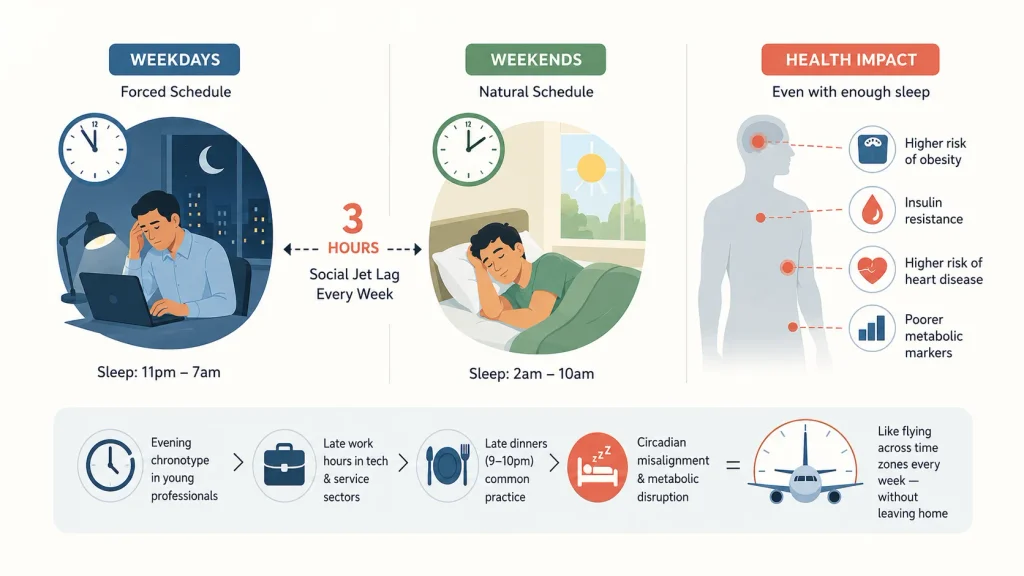
Social jet lag is the difference in sleep timing between weekdays and weekends — when people sleep on their natural schedule versus the socially imposed schedule. A person who sleeps 11pm to 7am on weekdays (forced by work) but 2am to 10am on weekends (natural rhythm) experiences 3 hours of social jet lag each week.
Research consistently shows that social jet lag — independent of total sleep duration — is associated with higher rates of obesity, insulin resistance, cardiovascular disease, and poorer metabolic markers. It is the equivalent of flying across time zones every week, without ever leaving home.
In the Indian urban professional context, social jet lag is endemic. The combination of evening chronotype prevalence in the young working population, late-working hours in the technology and service sectors, and the cultural practice of late evening meals (dinner at 9–10pm) creates a perfect storm of circadian misalignment that the metabolic consequences of chronotype research are only beginning to document in Indian cohorts.
The Nutritional Chronobiology Protocol: Eating by the Clock
Time-restricted eating aligned with chronotype and daylight hours. For both morning and evening types, concentrating the eating window within daylight hours — particularly the first 10 to 12 hours after waking — produces the best metabolic outcomes. The circadian insulin sensitivity peak occurs in the morning and declines progressively through the day, meaning the same meal produces a lower blood glucose spike and less fat storage when eaten earlier. This connects directly to our July 2026 intermittent fasting article, which found that time-restricted eating combined with the right meal timing produces better metabolic outcomes than calorie restriction alone.
Front-loading calories toward breakfast and lunch. For evening chronotypes who cannot easily shift their natural sleep timing, front-loading caloric intake toward earlier in the day — eating a larger breakfast and substantial lunch, and a smaller dinner before 7pm when possible — partially mitigates the metabolic disadvantage of late-night eating by ensuring most food is consumed during the body’s peak metabolic responsiveness window.
Strategic light exposure. Morning bright light exposure is one of the most powerful chronotype-moderating interventions available. 30 minutes of bright light (ideally natural sunlight, or a 10,000-lux light box) within 30 minutes of waking accelerates cortisol awakening response and advances the phase of the circadian clock — pushing the evening type slightly earlier. This is particularly effective for the intermediate-to-evening type range. See our Circadian Rhythm Healing guide for the complete light-timing protocol.
Evening type-specific magnesium timing. Magnesium glycinate — which we covered in our August 2026 magnesium deficiency article — supports GABAergic sleep induction and melatonin synthesis. For evening types, taking 300–400mg of magnesium glycinate 60 minutes before target bedtime supports the earlier sleep onset that partially corrects circadian misalignment.
The Takeaway
The 2026 chronotype research builds a compelling case that when you sleep — not just how long — profoundly shapes your metabolic, cardiovascular, and psychological health. Evening chronotypes, who are forced by social schedules to live against their biological clock, experience chronically higher rates of insulin resistance, cardiovascular disease, obesity, and depression through measurable circadian misalignment mechanisms. The nutritional chronobiology response is strategic meal timing: front-load calories toward morning, avoid eating within 3 hours of sleep, and use time-restricted eating aligned with daylight hours. Combined with morning light exposure and sleep-supportive supplementation, these strategies partially compensate for the metabolic disadvantage of late chronotype biology. For the complete sleep health framework, see our Sleep Hygiene Hacks guide and our Natural Sleep Remedies guide.
About the Author
Tanveer Ahmed Khan is a K11 School of Fitness Sciences-certified personal trainer and nutrition coach with 12+ years of strength training experience. Coaching: info@livenulife.com | Instagram: @fitwithtanveer | livenulife.com
Scientific References
1. Our livenulife.com Sleep Chronotypes guide: the-impact-of-sleep-chronotypes-on-productivity-and-mental-well-being — foundational reference.
2. Vetter, C., et al. (2023). Social jetlag, chronotype, and cardiometabolic risk: a systematic review. Sleep Medicine Reviews.
3. UK Biobank chronotype and type 2 diabetes analysis (2026) — evening type 72% higher odds of T2D.
4. Our August 2026 Vol I article: Columbia sleep-weight gain study (Zuraikat, 2026). Sleep duration and metabolic consequences.
5. Our July 2026 intermittent fasting article — circadian-aligned time-restricted eating for metabolic health.