By Tanveer Ahmed Khan | K11-Certified Trainer & Dietitian-Nutritionist | REPS India Registered | August 2026 | 12 min read
KEY TAKEAWAY: A comprehensive scoping review in Current Nutrition Reports (July 22, 2026) and a Frontiers in Nutrition dementia study (2026) confirm that magnesium deficiency is linked to heart disease, type 2 diabetes, metabolic syndrome, osteoporosis, dementia, depression, and early death — and more than 40% of adults do not consume enough. Here is the definitive guide to magnesium: what it does, why you are likely deficient, and how to fix it.
The Most Under-Discussed Nutrient of 2026
If I were to design the single most important nutritional intervention for the majority of my clients — considering cost, accessibility, evidence base, and breadth of impact — it would not be a protein supplement, a probiotic, or an adaptogen. It would be magnesium.
A comprehensive review published in Current Nutrition Reports on July 22, 2026 — titled “Hypomagnesemia: A Clinical and Nutritional Update” — synthesised the accumulating evidence across multiple disease domains and reached a conclusion that is both remarkable in scope and alarming in its population-level implications: magnesium deficiency is associated with increased risk of heart disease, type 2 diabetes, metabolic syndrome, osteoporosis, neuropsychiatric conditions including depression, cognitive impairment and dementia, immune dysregulation, and adverse clinical outcomes in hospitalised patients.
A concurrent study in Frontiers in Nutrition (2026) added a specific and urgent dimension: among COVID-19 survivors aged 55 and older, low serum magnesium was significantly associated with increased long-term dementia risk — making magnesium status a potentially modifiable factor in one of the most feared sequelae of the pandemic.
And the epidemiological reality: more than 40% of American adults do not consume the recommended daily amount of magnesium from their diet. Indian population data suggest similar or higher rates of inadequacy, particularly in urban populations consuming processed and fast food-heavy diets that are naturally low in magnesium-rich whole foods.
📖 Also read: Gut Health Revolution: How Your Microbiome Controls Health — Gut microbiome alterations are one of the mechanisms through which modern diets deplete magnesium — the gut-magnesium axis explained.
Why Magnesium Is So Fundamental
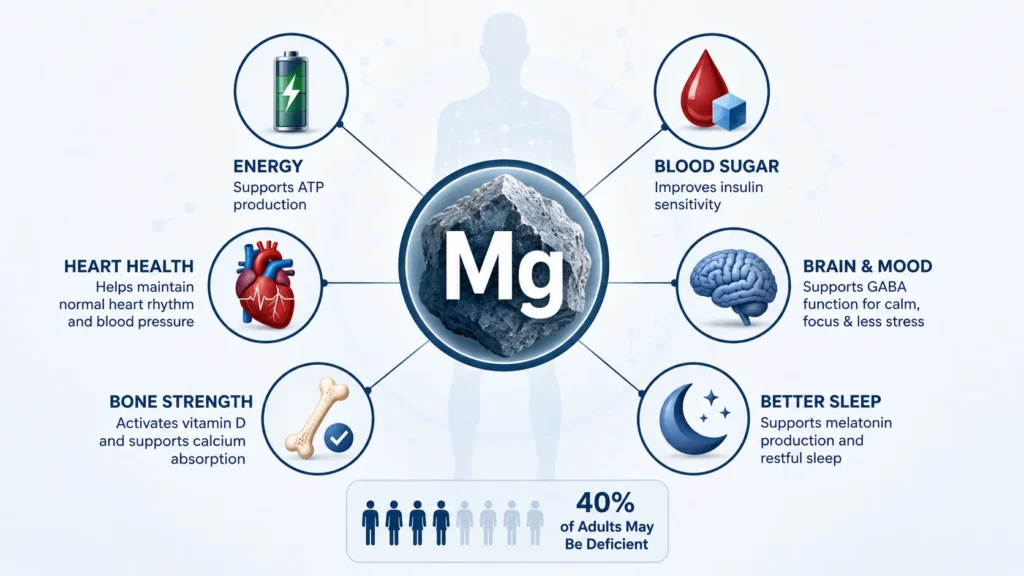
Magnesium is involved in more than 600 enzymatic reactions in the human body. This is not hyperbole — it is biochemical reality. No other mineral participates in as many fundamental biological processes.
Energy production. Every molecule of ATP — adenosine triphosphate, the universal energy currency of every cell — must be bound to a magnesium ion to be biologically active. Without adequate magnesium, cellular energy production fails at the most fundamental level. The chronic fatigue that millions of people experience daily is often, in part, a magnesium-mediated energy failure.
Blood glucose and insulin regulation. Magnesium is a cofactor for the enzyme tyrosine kinase, which activates insulin receptors. Without adequate magnesium, insulin receptors function poorly, contributing to insulin resistance even in the absence of other risk factors. The 2026 Current Nutrition Reports review specifically identified metabolic syndrome and type 2 diabetes as conditions in which magnesium deficiency plays a causal, not merely associative, role.
Cardiovascular function. Magnesium regulates the electrical activity of cardiac muscle cells through its actions on calcium channels — it is nature’s calcium channel blocker. Low magnesium is associated with cardiac arrhythmias, arterial hypertension, arterial stiffness, and increased cardiovascular event risk. The July 2026 review confirmed these associations across multiple cardiovascular risk domains.
Neurological and psychological function. GABA (gamma-aminobutyric acid) — the brain’s primary inhibitory neurotransmitter, responsible for calm, focused mental states — requires magnesium for receptor activation. Low magnesium reduces GABAergic tone, producing states of hyperexcitability, anxiety, insomnia, muscle twitching, and heightened stress reactivity. The review linked magnesium deficiency to migraine, depression, cognitive impairment, and dementia — all conditions where GABA and glutamate balance is critical.
Bone health. Approximately 60% of the body’s magnesium is stored in bone. Magnesium is required for the activation of vitamin D — which is required for calcium absorption. A client who takes calcium and vitamin D supplements but is magnesium-deficient cannot fully benefit from either supplement, because vitamin D activation depends on magnesium. Our recent Calcium and Vitamin D Supplements myth article identified this as a frequently missed co-factor in bone health optimisation.
Sleep regulation. Melatonin synthesis — the primary hormonal signal for sleep onset — requires magnesium as a cofactor. Magnesium also regulates the sleep-promoting neurotransmitter GABA. The Columbia 2026 sleep study we covered in Article 1 of this issue found that sleep loss drives weight gain and metabolic dysregulation. Magnesium deficiency compounds sleep difficulty in a self-reinforcing cycle: poor sleep reduces magnesium utilisation efficiency; low magnesium disrupts sleep quality.
Why Modern Life Depletes Magnesium — Even in People Who Try to Eat Well
Here is the dimension of magnesium insufficiency that most people miss: you can be eating a nominally healthy diet and still be running chronically low on magnesium. Multiple mechanisms of the modern lifestyle actively deplete magnesium beyond dietary inadequacy alone.
Food processing. Magnesium is concentrated in the outer layers of whole grains and in the chlorophyll of leafy vegetables. Industrial food processing — milling wheat into refined flour, processing vegetables through high-temperature industrial cooking — removes 80 to 90% of magnesium. A person who eats refined grain products, commercially processed vegetables, and packaged snacks can be consuming a diet that appears adequate on a food label but is profoundly magnesium-poor.
Soil depletion. Magnesium concentration in commercially grown produce has declined by 20 to 30% over the past 50 years due to soil depletion from industrial farming practices. The green leafy vegetables that were reliably magnesium-rich in your grandparents’ era contain significantly less today unless they are grown in mineralised soil.
Chronic stress. Cortisol — the primary stress hormone — directly promotes urinary magnesium excretion. Every episode of acute or chronic stress causes the body to lose more magnesium than it is gaining. Given that chronic stress is essentially universal in modern professional life, stress-mediated magnesium depletion is a major and underappreciated contributor to the epidemic of insufficiency. Our guide on why chronic stress is hard to detect in early stages covers the nutritional toll of stress in detail.
Medications. The July 2026 Current Nutrition Reports review specifically identified medication use as a contributor to widespread subclinical deficiency. Proton pump inhibitors (PPIs — omeprazole, pantoprazole, widely prescribed for acid reflux) reduce gastric acid and impair magnesium absorption. Diuretics (thiazide and loop diuretics, prescribed for blood pressure) increase urinary magnesium excretion. Metformin (the most widely prescribed diabetes medication in India) reduces magnesium absorption. Many people on these medications are unknowingly compounding their magnesium insufficiency.
Alcohol consumption. Alcohol is directly diuretic for magnesium — it promotes urinary magnesium excretion and impairs intestinal absorption. Even moderate regular alcohol consumption contributes to magnesium depletion over time.
Gut microbiome disruption. The 2026 review specifically identified gut microbiome alterations as a mechanism underlying widespread subclinical deficiency. A healthy, diverse gut microbiome enhances mineral absorption, including magnesium. Dysbiosis — the gut imbalance we have covered extensively in our series on artificial sweeteners and gut bacteria and the Gut Health Revolution — impairs magnesium absorption directly.
📖 Also read: Why Your Gut Microbiome Controls More Than You Think — The gut-magnesium absorption link: how microbiome diversity determines how much magnesium you actually absorb from food.
The Dementia Connection: Magnesium and Post-COVID Cognitive Risk
The 2026 Frontiers in Nutrition study on COVID-19 survivors adds a dimension of particular urgency. The research used the TriNetX Global Collaborative Network to examine hospitalised COVID-19 survivors aged 55 and older, comparing those with low serum magnesium (below 1.7 mg/dL on two measurements) against matched controls.
The finding: low magnesium status in COVID-19 survivors was significantly associated with increased long-term incident dementia risk. Given that tens of millions of people globally experienced COVID-19 hospitalisations, and that long-COVID cognitive symptoms — brain fog, memory impairment, concentration difficulties — are among the most common and debilitating post-COVID complaints, magnesium status is now a potentially modifiable factor in a major public health challenge.
The mechanism is consistent with what we know about magnesium’s roles in neurological function: NMDA receptor regulation, reduction of neuroinflammation, protection against glutamate excitotoxicity, and support for the blood-brain barrier integrity that prevents inflammatory molecules from reaching brain tissue. These are the same pathways damaged by the neuroinflammation of acute COVID-19 infection. Magnesium deficiency removes a protective buffer at precisely the moment when neurological protection is most needed. For the full picture of how nutrition shapes brain health and ageing, see our recent Vitamin C and Brain Health article from July 2026.
My Clinical Magnesium Protocol
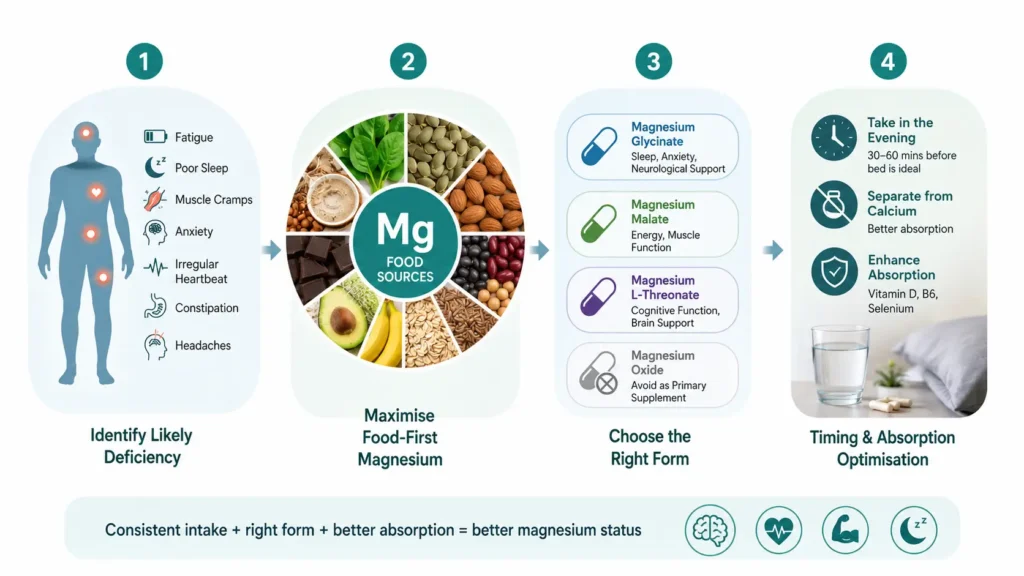
Step 1: Identify likely deficiency. Standard serum magnesium tests miss magnesium deficiency in most cases because less than 1% of total body magnesium is in the blood — the vast majority is in bone and intracellular compartments. A “normal” serum magnesium does not rule out tissue magnesium insufficiency. I use symptom assessment — persistent fatigue, poor sleep, muscle cramps and twitching, anxiety, irregular heartbeat, constipation, frequent headaches — as clinical indicators of likely insufficiency, particularly in clients on medications that deplete magnesium or under high chronic stress.
Step 2: Maximise food-first magnesium. The richest dietary sources of magnesium:
• Dark leafy greens — spinach (157mg/100g cooked), amaranth leaves (65mg/100g) — widely consumed in India and among the most accessible magnesium sources.
• Nuts and seeds — pumpkin seeds (592mg/100g — the single richest food source), almonds (270mg/100g), cashews (260mg/100g), sesame seeds (351mg/100g, including sesame chutney and tahini).
• Legumes — black beans (171mg/100g cooked), edamame, rajma, chana — the staple dals of Indian cuisine are magnesium-rich when prepared from whole, unprocessed legumes.
• Whole grains — brown rice (44mg/100g cooked), whole wheat (138mg/100g dry), oats (138mg/100g dry).
• Dark chocolate (70%+ cacao) — 228mg per 100g. One 30g serving provides approximately 68mg magnesium with significant polyphenol benefit.
• Avocado — 29mg per 100g; banana — 27mg per 100g. Not highest in absolute magnesium but highly bioavailable and widely consumed.
Step 3: Choose the right supplement form. Not all magnesium supplements are equal. The oxide form — the most common and cheapest — has poor bioavailability (approximately 4%) and primarily acts as a laxative. My preferred forms:
• Magnesium glycinate (bisglycinate): highest bioavailability, minimal laxative effect, crosses the blood-brain barrier well — best for sleep, anxiety, and neurological applications. 200–400mg elemental magnesium daily.
• Magnesium malate: well-tolerated, good for energy and muscle function — appropriate for fatigue and exercise recovery.
• Magnesium L-threonate: specifically studied for cognitive function and brain magnesium elevation — appropriate for clients with cognitive performance or neurological concerns.
• Magnesium oxide: avoid as a primary supplement — use only if laxative effect is desired for constipation.
Step 4: Timing and absorption optimisation. Magnesium competes for absorption with calcium. Take magnesium supplements separately from calcium supplements, ideally in the evening. Vitamin D, vitamin B6, and selenium all enhance magnesium absorption and utilisation. Taking magnesium glycinate 30 to 60 minutes before bed exploits its sleep-supporting GABAergic effects.
The Takeaway
The 2026 research is unambiguous: magnesium insufficiency is widespread, multifactorial, and consequential at a level that spans metabolic, cardiovascular, neurological, and psychological health. The July 22, 2026 Current Nutrition Reports review and the Frontiers in Nutrition dementia study together make the strongest evidence-based case yet for magnesium optimisation as a cornerstone of preventive health. In 12 years of practice, magnesium is the supplement I have recommended most consistently, with the widest benefit profile, across the broadest client population. Maximise food-first sources. Choose glycinate form if supplementing. Take it in the evening. And test your symptom profile against the clinical indicators of insufficiency — because your blood test is likely not telling you the full story. For the complete nutritional context of supporting energy, metabolic function, and cellular health through micronutrient optimisation, see our Cellular Health Optimization guide.
About the Author
Tanveer Ahmed Khan is a K11 School of Fitness Sciences-certified personal trainer and REPS India-registered dietitian-nutritionist with over 12 years of experience helping busy professionals achieve elite, sustainable health. Coaching: info@livenulife.com | Instagram: @fitwithtanveer | livenulife.com
Scientific References
1. Current Nutrition Reports. (July 22, 2026). Hypomagnesemia: A Clinical and Nutritional Update. Springer Nature. doi: 10.1007/s13668-026-00745-5
2. Frontiers in Nutrition. (2026). Magnesium deficiency and long-term incident dementia among COVID-19 survivors: a propensity score-matched cohort study. doi: 10.3389/fnut.2026.1871623
3. Costello, R.B., Fan, Z., Wallace, T.C. (2025). Magnesium Depletion Score as an Indicator of Health Risk and Nutritional Status — A Scoping Review. Nutrients, 17(20): 3286.
4. The Healthy (January 25, 2026). Being Deficient in This Mineral May Shorten Lifespan, Says New Research.
5. Medical Daily (2026). Magnesium Deficiency in 2026 in the U.S.: Signs, Risks, and Solutions.