By Tanveer Ahmed Khan | K11-Certified Trainer & Dietitian-Nutritionist | REPS India Registered | July 2026 | 11 min read
KEY TAKEAWAY: A study of 2,044 older adults published in PLOS One in June/July 2026 found that lower vitamin C levels in the blood are directly associated with reduced gray matter volume and weaker brain network connectivity — even after accounting for age, health conditions, and lifestyle. Here is why vitamin C may be the most underrated brain nutrient of 2026.
The Most Overlooked Nutrient in Brain Health
When clients ask me which nutrients are most important for brain health, they expect to hear about omega-3 fatty acids, B12, or magnesium. Vitamin C almost never comes up in that conversation — on their end or, historically, in mainstream nutritional science.
That may be about to change. Research published in PLOS One on June 10, 2026, led by Haruka Nagaya of Hirosaki University in Japan, has produced what researchers describe as the first study directly linking plasma vitamin C levels to brain structural networks measured by MRI — and the findings are compelling.
This is not research about scurvy prevention or catching fewer colds. This is research about whether the amount of vitamin C in your blood right now is shaping the physical structure of your brain and the strength of its internal communication networks — and the evidence suggests it is.
Read More: Personalised Nutrition Based on Your Gut Bacteria
What the Research Found
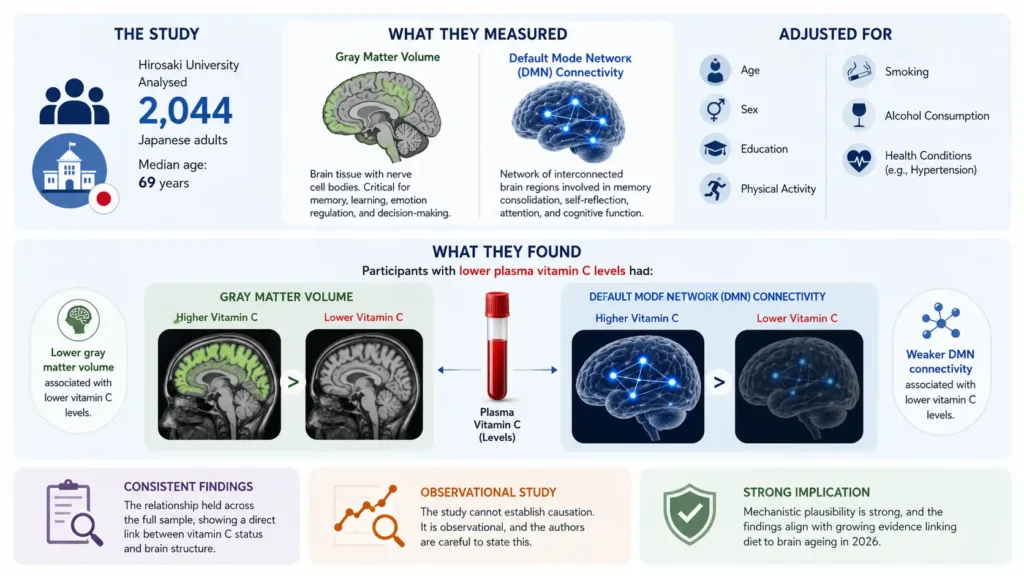
The Hirosaki University team analysed blood samples and brain MRI scans from 2,044 Japanese adults with a median age of 69 years. They measured two critical indicators of brain health:
• Gray matter volume — the brain tissue that contains nerve cell bodies and is critical for memory, learning, emotion regulation, and decision-making.
• Connectivity within the default mode network (DMN) — a collection of interconnected brain regions involved in memory consolidation, self-reflection, attention, and cognitive function.
After adjusting for age, sex, education, physical activity, smoking, alcohol consumption, and common health conditions including hypertension, the findings were consistent: participants with lower plasma vitamin C levels had lower gray matter volume and weaker DMN connectivity.
The relationship held across the full sample, making it one of the most direct demonstrations to date that vitamin C status — measurable in blood right now — corresponds to physically observable differences in brain structure.
The study cannot establish causation — it is observational, and the authors are careful to state this. But the mechanistic plausibility is strong, and the pattern aligns with a broader body of evidence linking diet to brain ageing that has been accumulating throughout 2026.
Read this also- The Calcium and Vitamin D Supplement Myth: What a Study of 154,000 People Just Revealed
Why Vitamin C Concentrates in the Brain
One of the most surprising facts about vitamin C that most people — including many health professionals — do not know: the concentration of vitamin C in cerebrospinal fluid (the fluid that surrounds and cushions the brain and spinal cord) is more than twice as high as its concentration in blood plasma.
This is not accidental. The brain actively concentrates vitamin C against the concentration gradient, using specialised transport proteins to move it from blood into cerebrospinal fluid and then into neurons. The brain prioritises vitamin C supply even when the rest of the body is depleted — which tells us something important about how essential this nutrient is to neurological function.
What is the brain using all this vitamin C for? The mechanisms are well-established in neuroscience:
Antioxidant protection. The brain consumes approximately 20% of the body’s total oxygen despite comprising only 2% of body weight. This disproportionate oxygen consumption produces enormous quantities of reactive oxygen species (free radicals) that can damage neurons, mitochondria, and DNA. Vitamin C is the primary water-soluble antioxidant defending against this oxidative damage. When vitamin C levels fall, this protection is compromised.
Collagen synthesis in blood vessel walls. The brain’s blood supply depends on healthy vascular walls. Collagen is the structural protein of blood vessels, and vitamin C is an essential co-factor for the enzymes that synthesise collagen. Without adequate vitamin C, cerebrovascular integrity is compromised — potentially reducing blood flow and oxygen delivery to brain tissue. Gray matter loss and reduced connectivity are consistent with impaired cerebrovascular function.
Neurotransmitter synthesis. Vitamin C is directly required for the synthesis of norepinephrine from dopamine — a critical step in catecholamine neurotransmitter production. It also participates in the recycling of tetrahydrobiopterin, a co-factor for serotonin, dopamine, and nitric oxide synthesis. These neurotransmitters regulate mood, attention, motivation, and cognitive processing — the very functions associated with the default mode network the Hirosaki study examined.
Myelin maintenance. Myelin is the fatty sheath that insulates nerve fibres, enabling fast and efficient neural signal transmission. The connectivity measurements in the PLOS One study — particularly DMN connectivity — reflect how efficiently different brain regions communicate. Vitamin C supports myelin maintenance through its roles in both antioxidant protection and enzymatic co-factor activity.
Who Is Actually Vitamin C Deficient?
In my clinical practice, I conduct detailed dietary assessments before making any supplementation recommendations. What I consistently find is that vitamin C insufficiency — not frank scurvy-level deficiency, but sub-optimal blood levels — is far more common than most people assume.
The groups I see most commonly affected:
• Smokers — cigarette smoking depletes vitamin C rapidly through oxidative stress. Smokers need approximately 35mg more per day than non-smokers just to maintain equivalent blood levels.
• People who rely heavily on ultra-processed foods and cooked convenience meals — vitamin C is heat-sensitive and water-soluble, meaning cooking destroys significant portions of vitamin C in foods.
• Clients eating low fruit, low vegetable diets for weight loss — particularly those following very low-carbohydrate or elimination protocols without strategic vegetable choices.
• Stressed professionals — psychological and physiological stress depletes vitamin C through adrenal use (the adrenal glands are the highest vitamin C-containing tissue in the body; they use vitamin C to produce cortisol).
• Older adults — absorption efficiency declines with age, and older adults frequently have lower dietary variety.
The Indian context adds another layer: many traditional cooking practices (long boiling of vegetables, repeated reheating) destroy much of the vitamin C that was present in the raw ingredient. Many clients consuming nominally vitamin C-rich diets are actually absorbing significantly less than their dietary records suggest.
Read Also: Zinc Citrate vs Zinc Methionine: Which Form of Zinc Is Better?
The Brain Health Protocol: How I Apply This Research
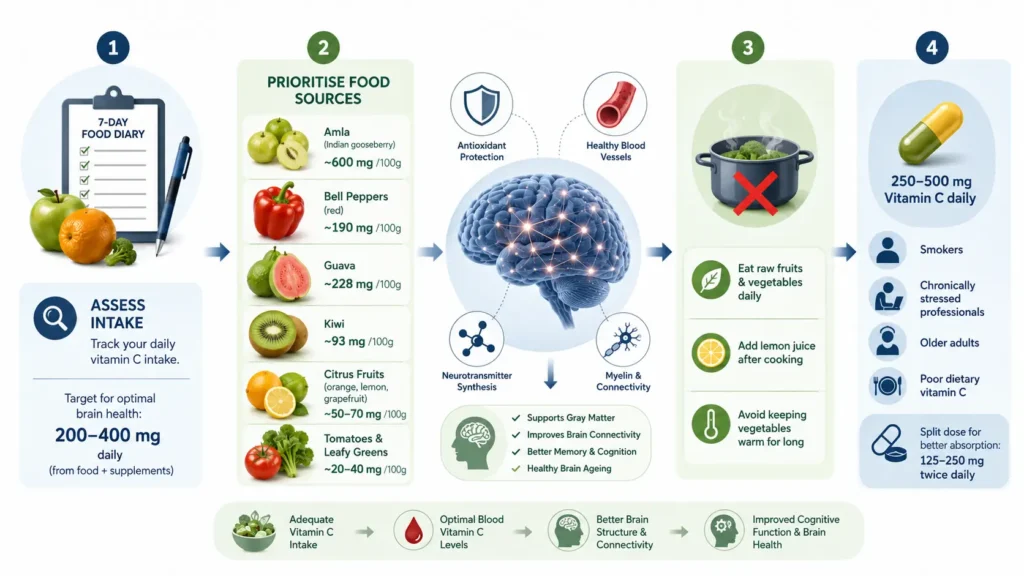
Based on the July 2026 PLOS One findings and the broader mechanistic understanding of vitamin C’s roles in neurological function, here is how I integrate vitamin C optimisation into brain health protocols for my clients.
Step 1: Assess dietary intake honestly. I use a 7-day food diary analysis to calculate average vitamin C intake. The recommended daily intake for adults is 65 to 90mg, with an upper tolerable limit of 2,000mg. However, growing evidence from brain health research suggests that blood levels associated with optimal cognitive function may correspond to intakes above the basic RDA — potentially 200 to 400mg daily from food and supplements combined.
Step 2: Prioritise food-first vitamin C sources. For most clients, vitamin C from food is both sufficient and preferable to supplementation. The richest sources include:
• Amla (Indian gooseberry) — the single richest known food source of vitamin C at approximately 600mg per 100g, making it extraordinarily valuable in the Indian dietary context.
• Bell peppers (capsicum), particularly red — 190mg per 100g when raw.
• Guava — 228mg per 100g; one of the most accessible high-vitamin C fruits in India.
• Kiwi fruit — 93mg per 100g.
• Citrus fruits (orange, lemon, grapefruit) — 50 to 70mg per 100g.
• Fresh tomatoes and raw leafy greens — approximately 20 to 40mg per 100g; significant when consumed in quantity.
Step 3: Protect vitamin C from cooking degradation. Vitamin C is destroyed by heat, oxygen, and water. Strategies I recommend: consume at least one serving of raw vegetables or fruit daily; add lemon juice to cooked dishes immediately before serving (adds vitamin C after the heat source is removed); avoid keeping vegetables warm for extended periods.
Step 4: Consider supplementation for higher-risk individuals. For smokers, chronically stressed professionals, older adults, and those with consistently poor dietary vitamin C, I recommend a moderate daily vitamin C supplement of 250 to 500mg. Vitamin C is water-soluble and non-toxic at these levels — excess is excreted in urine. Dose-splitting (125 to 250mg twice daily) improves absorption compared to single large doses.
The Bigger Picture: Nutrition and Brain Architecture
The July 2026 PLOS One research sits within a rapidly expanding landscape of evidence that the physical structure of the ageing brain is significantly shaped by nutritional status — not just genetics, not just age, not just exercise, but what we eat and what we absorb from what we eat.
This month alone, July 2026 has produced concurrent findings showing that the Mediterranean-longevity diet (from USC’s Cell Metabolism study) improves cardiometabolic markers and reduces frailty in ways that protect brain tissue; that intermittent fasting may support neurological health through autophagy; and that vitamin C levels correspond to measurable brain structural differences.
What this converging evidence tells me as a practitioner: brain health is not primarily a matter of cognitive exercises, crossword puzzles, or memory apps. It is primarily a matter of the metabolic and nutritional environment the brain operates in, day after day, year after year. That environment is largely determined by food choices.
Vitamin C — abundant in amla, guava, bell peppers, citrus, and fresh vegetables; destroyed by overcooking and ultra-processed food displacement — is now established as part of that foundational environment. The July 2026 research gives us one more specific, MRI-visible reason to ensure it is present in adequate supply.
Read Also: 10 Daily Habits to Extend Your Healthspan in 2025
The Takeaway
The 2026 Hirosaki University study is observational and human clinical trials are needed before specific supplementation advice can be formalised. But the evidence is directionally clear: maintaining healthy vitamin C levels is associated with measurable preservation of the brain’s gray matter and the connectivity networks that support memory, attention, and cognitive function.
The intervention this suggests is among the simplest, cheapest, and most accessible in nutritional medicine: eat more fresh fruit and raw vegetables, protect their vitamin C content through smart preparation, and consider targeted supplementation if your diet, age, or lifestyle places you at risk of insufficiency. Your brain — its volume, its connectivity, its capacity to process the world — may depend on it more than we previously understood.
Scientific References
1. Nagaya, H. et al. (2026). Plasma vitamin C levels are associated with brain structural networks on MRI: A large cohort study. PLOS One, 21(6): e0348504. doi: 10.1371/journal.pone.0348504
2. ScienceDaily / PLOS. (July 1, 2026). Scientists discover a surprising link between vitamin C and brain health. sciencedaily.com
3. Newsweek. (July 3, 2026). Low Vitamin C Levels Linked to Less Gray Matter in Brain. newsweek.com
4. Medical News Today. (June 12, 2026). Vitamin C may help preserve brain gray matter volume as we age. medicalnewstoday.com
5. Research Citrus Industry Magazine. (July 3, 2026). Vitamin C Linked to Better Brain Health in Older Adults. citrusindustry.net