By Tanveer Ahmed Khan | K11-Certified Trainer & Dietitian-Nutritionist | REPS India Registered | August 2026 | 12 min read
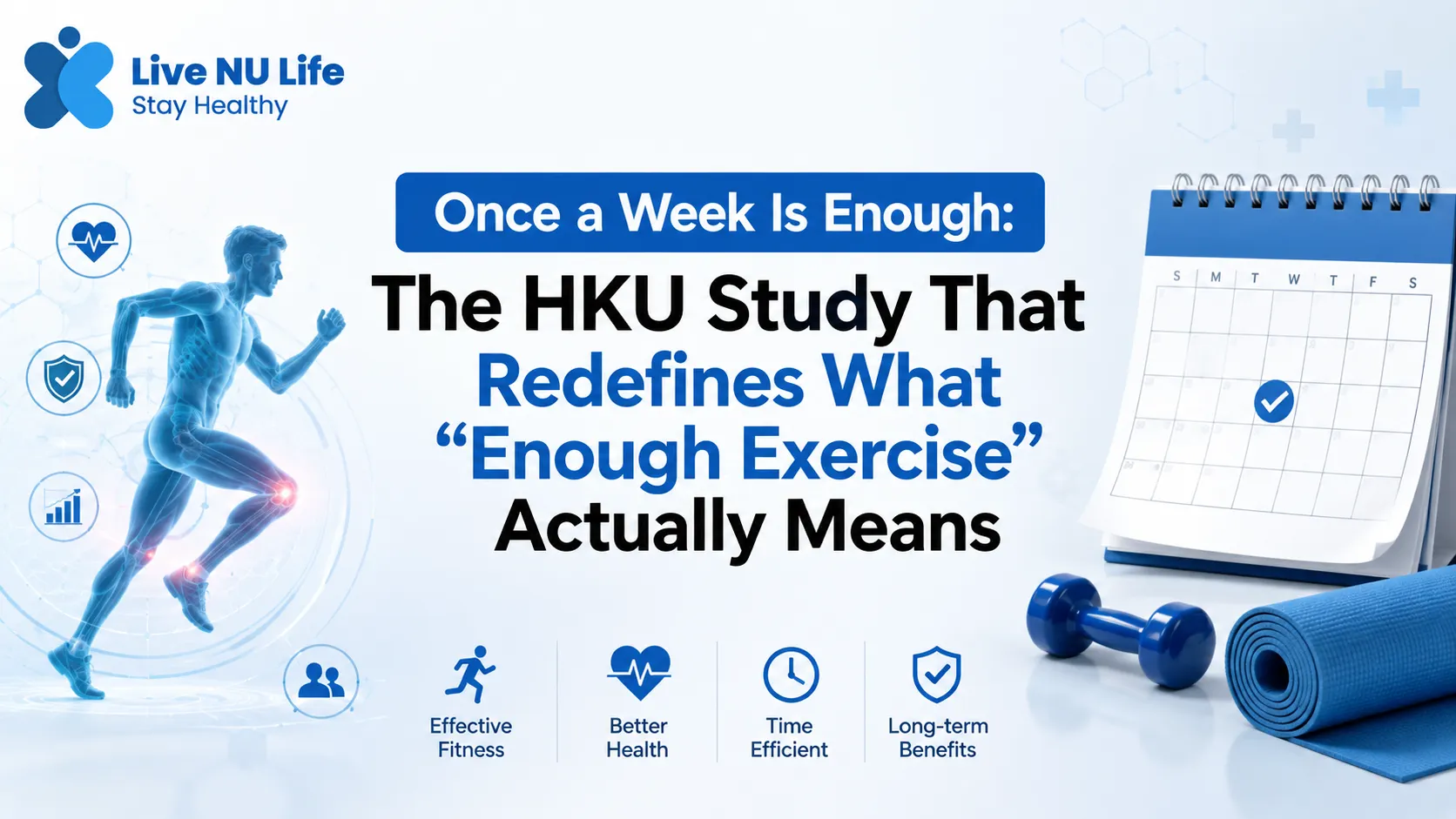
KEY TAKEAWAY: A randomised controlled trial of 315 adults published in Nature Communications and reported by ScienceDaily on August 2, 2026, found that one weekly session of 75-minute brisk interval walking reduced body fat, waist circumference, and cardiovascular fitness almost as effectively as splitting the same 75 minutes across three sessions per week. For adults who struggle to exercise regularly, this research changes the conversation from “how many days” to “how much total time” — and the answer may be less than you think.
The Study That Changes “How Often” to “How Much”
One of the most common barriers to regular exercise I hear from clients is frequency: “I can’t exercise three times a week — my schedule just doesn’t allow it.” For 15 years, health guidelines have recommended a minimum of 150 minutes of moderate activity per week, typically framed as 30 minutes on five days or 50 minutes on three days. The three-days-per-week standard feels like a minimum bar that many busy adults cannot consistently clear.
A randomised controlled trial led by Professor Parco Siu Ming-fai, Professor and Head of Division of Kinesiology at HKUMed’s School of Public Health, now provides the most direct evidence to date that the “how many days” framing may be less important than previously thought. The results, published in Nature Communications and reported by ScienceDaily on August 2, 2026, found that completing the same total volume of exercise in one session per week was nearly as effective as spreading it across three sessions.
📖 Also read: Only One Exercise Helps Older Adults Lose Fat Without Losing Muscle — August 2026 Vol I — Our coverage of the Maturitas study finding that HIIT preserves muscle while losing fat in older adults — the exercise science context for the HKU once-weekly finding.
Study Design: 315 Adults, 16 Weeks, Three Groups
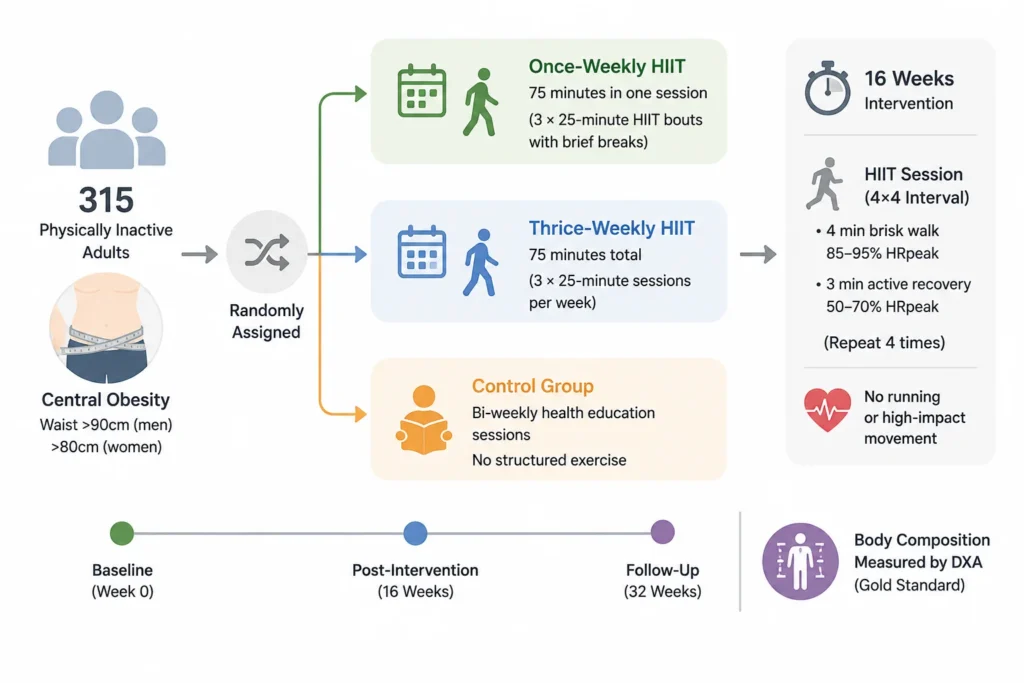
The HKUMed study enrolled 315 physically inactive Chinese adults aged 18 and older with central obesity — waist circumference above 90cm for men and 80cm for women, representing excess abdominal fat. Central obesity is a clinically meaningful risk factor because visceral fat (the fat surrounding internal organs) is metabolically active in ways that subcutaneous fat (the fat under the skin) is not, secreting pro-inflammatory cytokines and contributing directly to insulin resistance and cardiovascular disease risk.
Participants were randomly assigned to one of three groups:
• Once-weekly HIIT: 75 minutes of interval walking completed in a single session (comprising three consecutive 25-minute HIIT bouts with brief breaks between each bout).
• Thrice-weekly HIIT: the same total 75 minutes split across three separate 25-minute sessions.
• Control group: bi-weekly health education sessions, no structured exercise.
Each HIIT session used a 4×4 interval structure: four 4-minute periods of brisk walking at 85–95% peak heart rate, interspersed with 3-minute active recovery walks at 50–70% peak heart rate. This is a well-validated HIIT protocol that alternates high-effort bouts with recovery without requiring running or high-impact movement.
Outcome assessments were conducted at baseline, 16 weeks (post-intervention), and 32 weeks (follow-up — to assess whether benefits were maintained). Body composition was measured by dual-energy X-ray absorptiometry (DXA) — the gold standard for body fat measurement.
The Results: Nearly Identical Outcomes
Total body fat reduction: equivalent. Both the once-weekly and thrice-weekly HIIT groups experienced similar reductions in total body fat percentage compared with the control group. The difference between the two exercise groups was not statistically significant.
Waist circumference reduction: equivalent. Both exercise groups showed comparable reductions in waist circumference — a clinically significant finding because waist circumference reduction reflects visceral fat loss, which carries direct cardiovascular and metabolic protective effects.
Cardiorespiratory fitness improvement: equivalent. Both groups achieved comparable improvements in VO2 peak (maximum oxygen uptake capacity) — the primary measure of cardiovascular fitness. Fitness improvement was not proportional to exercise frequency; once weekly produced similar gains to three times weekly when total volume was matched.
Benefits maintained at follow-up: positive trend. At the 32-week follow-up assessment — 16 weeks after the intervention ended — both exercise groups retained meaningful portions of their fat loss and fitness gains. The once-weekly group maintained their outcomes comparably to the thrice-weekly group, suggesting that the frequency difference did not affect the durability of adaptations.
“While thrice-weekly interval training remains a commonly recommended approach for the therapeutic management of excess adiposity, our findings show that once-weekly interval training offers similar benefits and represents a practical exercise strategy,” said Professor Siu.
Why Equal Volume Produces Equal Results: The Physiology
The finding that once-weekly and thrice-weekly exercise produce similar outcomes when total volume is matched challenges intuitions about exercise frequency — but it is mechanistically coherent.
The primary stimulus is cumulative load. Cardiovascular and metabolic adaptations from exercise respond to total training load — the sum of intensity × duration × frequency. When intensity and total duration are held constant, reducing frequency while increasing per-session duration maintains the same total load. The body does not “remember” how many days the stress was applied; it responds to the cumulative physiological stress and the recovery that follows.
Recovery between sessions may be sufficient at once-weekly. Exercise produces physiological adaptation during the recovery period following a session, not during the session itself. When 7 days separate sessions, complete recovery and full supercompensation (the adaptation overshoot that drives fitness improvement) can occur before the next stimulus. In some cases, the extended recovery of once-weekly training may allow more complete adaptation than more frequent training that limits recovery time.
Interval walking specifically may be particularly robust to frequency changes. The HIIT protocol used in this study — brisk interval walking — is a lower-intensity form of interval training than the running or cycling protocols typically used in exercise research. Its lower mechanical impact means recovery is faster, and the cardiovascular and metabolic adaptations it produces may be less frequency-dependent than high-impact HIIT.
What This Means for Real People — My Clinical Translation
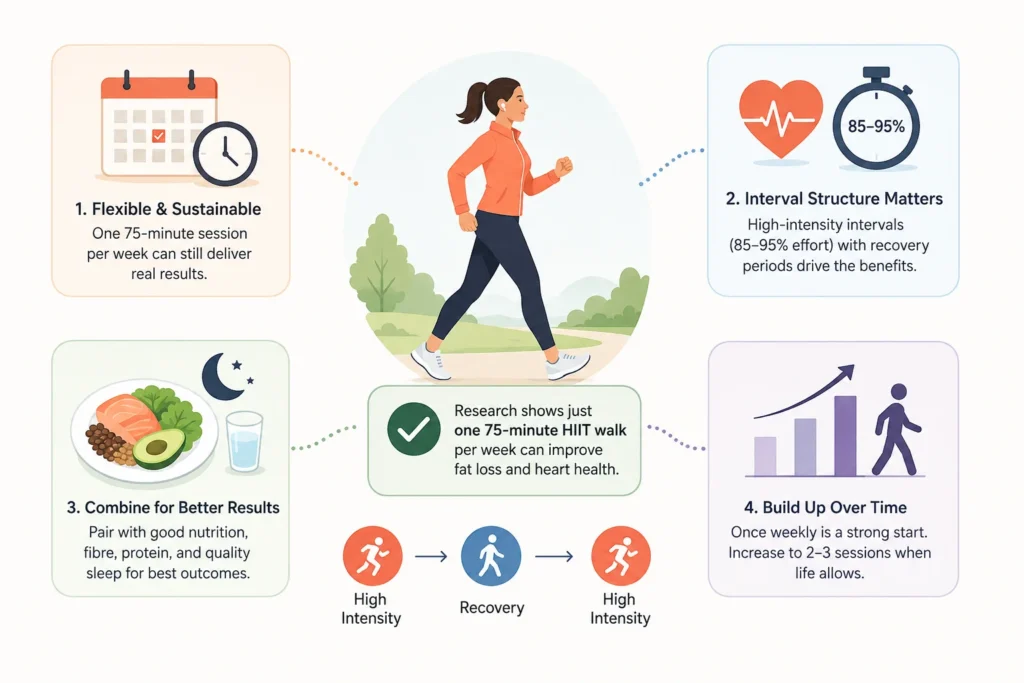
After 12 years of working with busy professionals, parents, and individuals with demanding schedules, the most common reason for exercise programme failure is frequency inflexibility. People start a three-days-per-week programme, miss a week during a busy period, feel like they have failed, and stop. The HKUMed study provides scientific permission to restructure exercise programmes around what is actually sustainable.
For clients who cannot commit to three sessions weekly: One 75-minute brisk interval walking session per week — on a weekend morning, perhaps — is now evidence-supported as producing meaningful fat loss and cardiovascular fitness improvement. This is not the ideal; it is the sustainable. The best exercise programme is the one a person actually does, sustained over months and years.
The interval structure matters — not just walking. The study protocol used timed high-intensity intervals (85–95% peak heart rate) alternating with recovery periods. This is fundamentally different from a casual 75-minute walk. The high-intensity intervals are what drive the metabolic adaptations. A practical approximation for clients without heart rate monitors: during high-intensity intervals, you should be breathing too hard to speak more than 3–4 words comfortably. During recovery, you should be able to hold a short conversation.
Combine with nutrition for amplified results. The HKUMed study tested exercise alone. In clinical practice, pairing even once-weekly HIIT with the nutritional interventions we have covered throughout 2026 — adequate protein (our protein guidelines article), fibre diversity (our Fibermaxxing guide), and sleep quality (our Columbia sleep study article) — produces synergistic outcomes that the exercise study alone cannot capture.
Progress toward more frequency when life allows. Once weekly is a viable minimum, not an optimal target. As schedule demands ease — as a new job stabilises, as children’s routines settle — progressing toward two or three sessions per week remains worthwhile. The HKUMed data shows that three sessions is not dramatically superior, but more movement is generally better for long-term metabolic and cardiovascular health.
For the complete exercise and recovery framework, including how to structure once-weekly HIIT alongside daily movement practices, see our Recovery Tools guide and our 30-Day Steps Challenge for everyday movement outside dedicated exercise sessions.
The Belly Fat Significance: Why Central Obesity Is the Priority
The HKUMed study specifically targeted adults with central obesity — excess abdominal fat — for good reason. Central obesity is not merely an aesthetic concern. It is a metabolic emergency in slow motion.
Visceral adipose tissue — the fat stored around internal organs — is metabolically active in a way that subcutaneous fat is not. It secretes pro-inflammatory cytokines including interleukin-6 (IL-6), tumour necrosis factor-alpha (TNF-α), and leptin at chronically elevated levels. It promotes insulin resistance in the liver by releasing excessive free fatty acids directly into the portal vein. And it is independently associated with cardiovascular disease, type 2 diabetes, non-alcoholic fatty liver disease, and certain cancers.
For the comprehensive approach to fatty liver disease — one of the most significant consequences of central obesity — see our Fatty Liver Causes, Symptoms, Treatment & Diet guide. And for the nutritional strategies that directly target visceral fat reduction — including GLP-1 activation, fibre diversity, and sleep optimisation — our Boost GLP-1 Naturally guide provides the complete dietary protocol.
The Takeaway
The HKUMed Nature Communications study provides what may be the most practically important exercise finding of August 2026: for adults with central obesity who struggle to exercise three times weekly, one 75-minute session of brisk interval walking delivers comparable fat loss, waist circumference reduction, and cardiovascular fitness improvement to the same volume split across three sessions. The “how many days” question matters less than the total volume and intensity of exercise performed. For the millions of adults who have abandoned exercise programmes because they could not maintain three-days-per-week consistency, this research offers a genuine alternative: one committed, well-structured session per week is enough to begin reversing central obesity. For the nutritional strategies that amplify exercise outcomes, see our Functional Nutrition guide and our protein guidelines article.
About the Author
Tanveer Ahmed Khan is a K11 School of Fitness Sciences-certified personal trainer and REPS India-registered dietitian-nutritionist with over 12 years of experience. Coaching: info@livenulife.com | Instagram: @fitwithtanveer | livenulife.com
Scientific References
1. Siu, P.M., et al. (2026). Once and thrice weekly interval training in adults with central obesity: a randomized controlled trial. Nature Communications, 17(1). DOI: 10.1038/s41467-025-68149-7
2. ScienceDaily / HKUMed. (August 2, 2026). This once-a-week workout may help cut belly fat, study shows.
3. GIGAZINE. (August 2026). A study found that exercising once a week can reduce body fat.
4. MedicalDialogues. (August 2026). New Study Suggests Just One Weekly Workout Could Help Reduce Belly Fat.
5. HKU Press Release. HKUMed finds once-weekly brisk interval walk rivals thrice-weekly for fat loss with the same total workout time.