KEY TAKEAWAY: A 2026 meta-analysis and accompanying August research coverage synthesises evidence from 18 studies showing that ultra-processed food consumption in teenagers is consistently associated with depressive symptoms — and earlier junk food exposure in childhood rewires brain reward circuits in ways that persist into adulthood. This is not about willpower. It is about neurological architecture. Here is the complete picture and what to do about it.
From Plates to Moods: The Hidden Mental Health Crisis
For most of the 20th century, the relationship between food and mental health was understood in broad strokes: people in poverty eat poor diets and experience more depression, but the causation runs from poverty to both problems, not from food to mood. The idea that specific dietary patterns could independently cause depression — through measurable neurological mechanisms — was considered speculative at best.
In 2026, that position is no longer tenable. A March 2026 review published by ScienceDaily and a subsequent wave of August 2026 coverage have synthesised evidence from 18 independent studies examining the relationship between ultra-processed food consumption and depressive symptoms across adolescent populations — and the findings are consistent enough to be clinically significant.
A separate line of 2026 research, reported in May 2026, found that high-fat, high-sugar diets early in life may rewire the brain in ways that last into adulthood even after switching to a healthier diet. Combined with our June 2026 Monash University finding that ultra-processed foods erode brain attention capacity — and the July 2026 Circulation study showing childhood beverage choices predict adult hypertension — the picture of early dietary patterns creating lasting neurological consequences has become remarkably consistent and concerning.
📖 Also read: Ultra-Processed Foods Are Stealing Your Focus — June 2026 Monash Study — The 2,100-adult study showing that each 10% increase in UPF intake produces measurable drops in attention — the cognitive companion to this depression research.
What 18 Studies Show About Ultra-Processed Food and Teen Mental Health
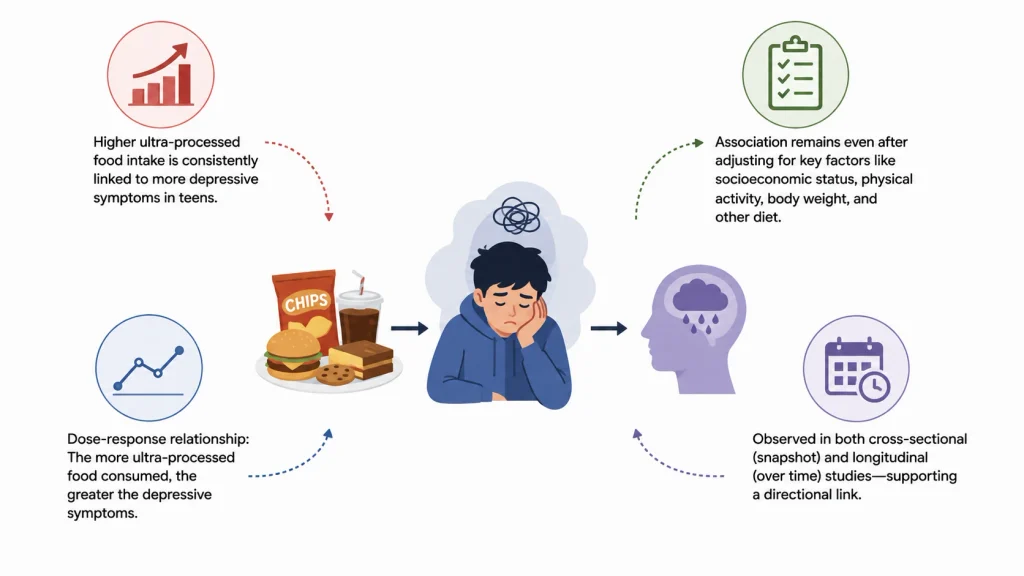
The meta-analysis synthesising 18 studies across multiple countries and populations found:
• A consistent positive association between higher ultra-processed food consumption and greater depressive symptoms across all study populations examined.
• The association held after controlling for socioeconomic status, physical activity, body weight, and other dietary factors — ruling out the most common confounds.
• A dose-response relationship was observed in most studies: more ultra-processed food was associated with more depressive symptoms.
• The relationship was observed in both cross-sectional (snapshot) and longitudinal (over time) study designs — supporting a directional interpretation that UPF consumption precedes or accompanies worsening mental health rather than being simply correlated with it.
“What teens eat might matter more for their mental health than previously thought,” summarised ScienceDaily’s reporting on the March 2026 review.
The Brain Mechanisms: How Ultra-Processed Foods Promote Depression
1. The neuroinflammation pathway. Ultra-processed foods are characterised by high concentrations of pro-inflammatory ingredients: omega-6-dominant refined oils, emulsifiers that disrupt the gut barrier, artificial additives that activate inflammatory signalling, and very high sugar loads that drive advanced glycation end products (AGEs). All of these promote systemic inflammation — and neuroinflammation is now one of the most established biological correlates of depression. Elevated blood markers of inflammation (interleukin-6, C-reactive protein, tumour necrosis factor-alpha) are found consistently in people with depression, and anti-inflammatory interventions have demonstrated antidepressant effects in clinical trials.
2. The gut-brain axis disruption. As we covered in our August 2026 Vol III article on the gut-brain axis, approximately 90% of the body’s serotonin is produced in the gut, and the gut microbiome directly regulates the neurotransmitter pathways that govern mood, stress response, and emotional regulation. Ultra-processed foods systematically destroy the gut bacteria (particularly Lactobacillus and Akkermansia species) that support serotonin production and GBA (gut-brain axis) function. As we covered in our July 2026 sweeteners and gut bacteria article, even the sweeteners used in UPFs specifically suppress the bacteria most associated with mood regulation.
3. The nutrient depletion pathway. Depression is associated with deficiencies of multiple micronutrients: omega-3 fatty acids, zinc, magnesium, folate, vitamin B12, and vitamin D. Ultra-processed foods are nutritionally empty — high in calories but low in all of these micronutrients. A diet dominated by UPFs systematically depletes the nutritional substrate required for neurotransmitter synthesis, myelin maintenance, and the hundreds of enzymatic reactions involved in brain function. As our August 2026 coverage of magnesium deficiency and vitamin B12 documented, these deficiencies are already widespread in populations eating modern diets.
4. The reward circuit rewiring. Ultra-processed foods are specifically engineered to trigger dopamine release in the brain’s reward centres — the combination of sugar, fat, salt, and flavour enhancers activates the same neural pathways as addictive substances, though to a lesser degree. Over time, this repeated artificial dopamine stimulation desensitises the reward system — requiring ever-greater stimulation to produce the same response, while reducing the reward signal from natural activities and foods. This desensitisation of the reward system is structurally similar to the hedonic dysregulation seen in depression, where activities that once produced pleasure no longer do.
The Early-Life Rewiring: Why Childhood Exposure Is Particularly Concerning
The May 2026 ScienceDaily coverage of research on early-life diet and brain development adds the most alarming dimension to this picture: high-fat, high-sugar diets in childhood appear to create neurological changes that persist even after switching to a healthier diet in adulthood.
This finding has profound implications. It suggests that the window during which UPF exposure causes the most lasting neurological damage is childhood and adolescence — exactly the period when brand loyalty is established, food preferences are shaped, and the developing brain’s reward circuits are most plastic and susceptible to long-term architectural changes.
This connects directly to our July 2026 coverage of ultra-processed toddler foods — the NUTRITION 2026 finding that 81% of toddler foods are ultra-processed and 49% fail WHO nutritional standards. The mechanism that the 2026 brain rewiring research identifies explains why these early exposures are not simply nutritional problems but neurological ones — setting children on a trajectory toward altered reward processing, reduced emotional regulation capacity, and higher depression risk that persists into adulthood.
The Indian Mental Health Context
India is experiencing what mental health researchers are calling a silent epidemic. Depression prevalence is estimated at 7.5% of the Indian population — and surveys consistently suggest that actual rates are higher, because stigma around mental health significantly suppresses self-reporting and help-seeking.
Simultaneously, ultra-processed food consumption in urban India has been growing at roughly 15 to 20% annually for the past decade. The specific products most associated with the neurological mechanisms described above — high-HFCS beverages, processed snacks with artificial flavourings and emulsifiers, commercial sweet products — are now omnipresent in Indian urban food environments and increasingly in rural areas.
The research does not establish that UPF consumption is the primary driver of India’s depression burden — the causes of depression are multiple and complex, including socioeconomic factors, life events, genetic predisposition, and healthcare access. But it does suggest that dietary quality is a modifiable factor in mental health outcomes that is being systematically overlooked in both clinical care and public health policy.
The Dietary Approach to Mental Health: What I Recommend
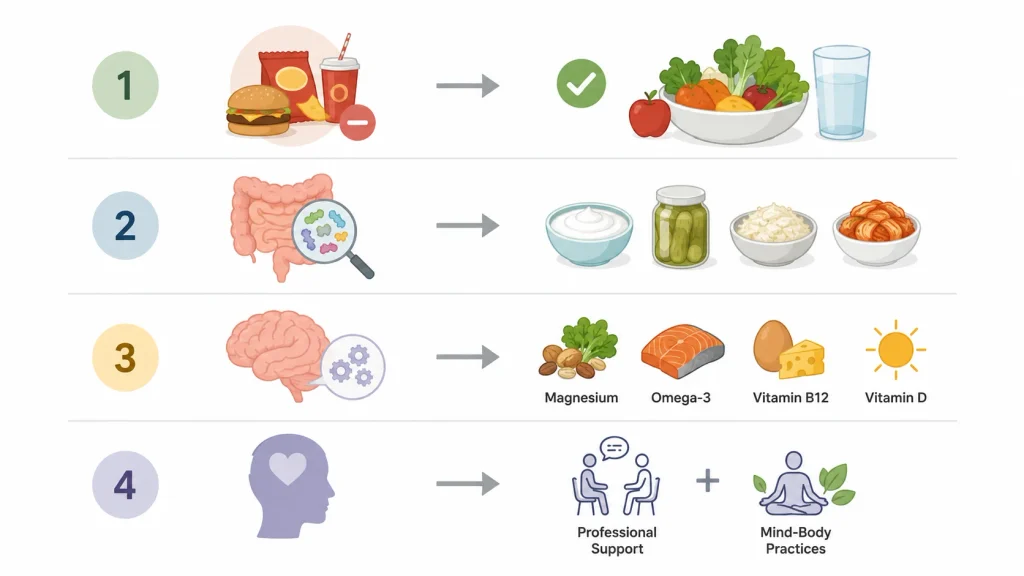
First: reduce ultra-processed food exposure systematically. The single most actionable step is reducing the proportion of daily calories from ultra-processed sources — not through sudden elimination but through the energy density approach we covered in our JAMA vegan diet August 2026 article: replace high-energy-density processed foods with low-energy-density whole foods that also happen to be rich in the micronutrients, fibre, and gut-protective Prifs that support brain health.
Second: build gut microbiome diversity deliberately. The gut-brain axis connection makes microbiome health central to mental health support. Our complete framework is in the Gut Health Revolution guide, the Fibermaxxing guide, and the Top 15 Probiotic Foods guide.
Third: address the micronutrient foundations of neurotransmitter synthesis. Magnesium (for GABA and serotonin synthesis), vitamin B12 (for SAM-e and neurotransmitter methylation), omega-3 from fatty fish (for neuroplasticity and anti-inflammatory signalling), and vitamin D (for BDNF and serotonin synthesis) are the primary micronutrient pillars of neurological health that UPF-dominant diets deplete.
Fourth: acknowledge the psychological dimension. Dietary change alone is not sufficient treatment for clinical depression. If a client presents with significant depressive symptoms, dietary counselling is a complementary component of care alongside professional psychological support. Our Stress Management guide and Mindfulness guide cover the mind-body practices that complement dietary intervention for mental health.
The Takeaway
The 2026 synthesis of 18 studies on ultra-processed food consumption and teen depression, combined with the May 2026 brain rewiring research and our June 2026 UPF attention study, builds a compelling and mechanistically coherent case: ultra-processed foods are not just empty calories — they are neurologically active substances that promote systemic inflammation, disrupt gut-brain serotonin signalling, deplete the micronutrients required for neurotransmitter synthesis, and rewire reward circuits in ways that persist into adulthood. The dietary response is not a special mental health diet — it is the same whole-food, fibre-diverse, nutrient-dense pattern we have been advocating throughout our 2026 series. The mental health benefits are a direct consequence of the same foods that protect the gut, the liver, the cardiovascular system, and the brain’s physical structure. For the complete framework, see our Functional Nutrition guide.
About the Author
Tanveer Ahmed Khan is a K11 School of Fitness Sciences-certified personal trainer and nutrition coach with 12+ years of strength training experience. Coaching: info@livenulife.com | Instagram: @fitwithtanveer | livenulife.com
Scientific References
1. ScienceDaily. (March 29, 2026). What Teens Eat Could Be Affecting Their Mental Health More Than We Thought — review of 18 studies.
2. ScienceDaily. (May 21, 2026). Eating too much junk food early in life may rewire the brain in ways that last into adulthood.
3. Our June 2026 coverage: Monash University UPF attention study. ultra-processed-foods-brain-focus article series.
4. Our July 2026 coverage: Cambridge sweeteners gut bacteria study — Lactobacillus suppression and mood implications.
5. Our July 2026 toddler food coverage: NUTRITION 2026 audit finding 81% of toddler foods ultra-processed.