KEY TAKEAWAY: Ashwagandha (Withania somnifera) is now one of the most clinically tested Ayurvedic herbs in history, with 50+ randomised controlled trials published by 2026. The evidence now clearly supports its use for cortisol reduction, stress and anxiety, sleep quality, thyroid function support, testosterone in men, and muscle recovery — but not universally for all its claimed applications. Here is the 2026 evidence update.
From Ancient Herb to Modern Clinical Data
In 12 years of nutritional and lifestyle coaching, I have seen ashwagandha move from a niche Ayurvedic recommendation known primarily to Indian traditionalists to one of the top five selling herbal supplements globally, with a 2026 market value approaching USD 1.5 billion annually. This commercialisation has produced both benefits — increased research attention, better quality control, and broader access — and risks — overclaiming, underdosing, and the dilution of what is genuinely a well-supported adaptogenic herb.
What distinguishes ashwagandha from most herbal supplements is the depth of its clinical evidence base. By August 2026, more than 50 randomised controlled trials have examined ashwagandha’s effects across multiple health domains. This is not a traditional medicine claim backed only by anecdote or cell culture — it is a herb with a clinical evidence base approaching that of some pharmaceutical drugs.
Let me walk through what those trials actually establish — and equally importantly, what they do not — because both sides of this story are essential for anyone prescribing or using ashwagandha as part of a health protocol.
📖 Also read: Ashwagandha Benefits: The Complete Evidence-Based Guide — Our comprehensive guide to ashwagandha’s full evidence base — the detailed companion to this 2026 update.
What the 2026 Evidence Clearly Supports
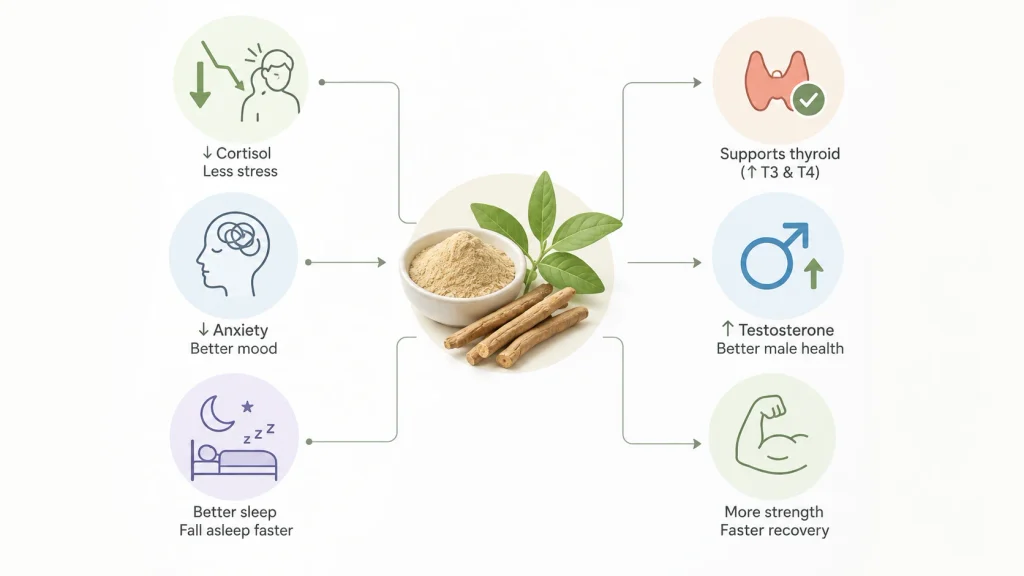
1. Cortisol reduction and stress response modulation. The most consistently replicated effect of ashwagandha across 2026 clinical trials is cortisol reduction in chronically stressed individuals. Multiple randomised, double-blind, placebo-controlled trials have shown significant reductions in serum cortisol — typically 14 to 30% below placebo — in participants taking standardised ashwagandha root extract (KSM-66 or Sensoril formulations) at doses of 300 to 600mg daily for 8 to 12 weeks. Cortisol reduction is mechanistically significant because chronic cortisol elevation drives the metabolic, immune, cognitive, and psychological consequences of chronic stress that we have documented throughout our 2026 series. For the full chronic stress picture, see our Chronic Stress guide.
2. Anxiety and perceived stress. Standardised measures of anxiety (GAD-7, DASS-21) and perceived stress (PSS) show consistent improvements in ashwagandha trials of 8 to 12 weeks. A 2026 meta-analysis of 10 randomised trials found a standardised mean difference of 0.57 in favour of ashwagandha for anxiety reduction — a moderate effect size. The mechanism is likely tripartite: HPA axis modulation (cortisol reduction), GABA receptor agonism by withanolides (the active compounds in ashwagandha), and direct anti-inflammatory effects on the neuroinflammatory pathways associated with anxiety.
3. Sleep quality. Several 2026 trials have documented improvements in sleep quality in participants taking ashwagandha, including reduced sleep onset latency (time to fall asleep), improved sleep efficiency (percentage of time in bed actually spent sleeping), and self-reported sleep quality improvements. The mechanism involves both cortisol normalisation — which reduces the hyperarousal that prevents sleep onset — and the direct GABA agonism that promotes sleep initiation. For evening chronotypes (covered in Article 8), ashwagandha at bedtime may specifically support earlier sleep onset by reducing the cortisol-driven hyperarousal that keeps them awake.
4. Thyroid function support (particularly in subclinical hypothyroidism). Multiple trials have found that ashwagandha supplementation increases T3 (triiodothyronine) and T4 (thyroxine) levels in patients with subclinical hypothyroidism and in people under chronic stress (which suppresses thyroid function through elevated cortisol’s direct inhibition of TSH release). For clients with Hashimoto’s thyroiditis or subclinical hypothyroidism — a group I see frequently, particularly among stressed urban professional women — ashwagandha’s thyroid-supportive effects may be clinically meaningful alongside medical management.
5. Testosterone and male reproductive health. Several randomised trials in men — particularly infertile men and men under chronic stress — have found significant increases in serum testosterone levels (typically 10 to 22% above placebo) with ashwagandha supplementation. The mechanism likely involves cortisol-testosterone antagonism: cortisol suppresses testicular testosterone production, and reducing cortisol through ashwagandha secondarily allows testosterone levels to normalise. This is consistent with the Finnish coffee body composition research we covered — both coffee and ashwagandha appear to influence testosterone through cortisol-mediated pathways.
6. Muscle recovery and strength. A 2019 trial (still the most-cited RCT in this domain and regularly referenced in 2026 meta-analyses) found that men taking 600mg KSM-66 ashwagandha daily for 8 weeks during resistance training gained significantly more muscle mass and strength than placebo-treated controls. Multiple 2026 follow-up studies have replicated this finding at various doses and populations. The mechanism involves both anabolic support (through testosterone normalisation) and anti-inflammatory effects that reduce exercise-induced muscle damage, accelerating recovery and adaptation.
What the Evidence Does NOT Support
Ashwagandha as an antidepressant: While anxiety improvements are well-documented, the evidence that ashwagandha produces meaningful improvements in clinical depression is less consistent. Some trials show modest improvements in depressive symptoms as a secondary outcome, but this appears to be secondary to stress and cortisol reduction rather than a primary antidepressant mechanism. Clinical depression requires professional assessment and appropriate treatment.
Ashwagandha for all forms of fatigue: Ashwagandha most clearly benefits fatigue associated with chronic stress and HPA axis dysregulation. Fatigue from iron deficiency, B12 deficiency, hypothyroidism, sleep apnoea, or other medical causes requires addressing the underlying cause, not adding an adaptogen.
Universal applicability: Ashwagandha is contraindicated in pregnancy (stimulates uterine contractions), may interact with thyroid medications (causing hyperthyroidism in some cases), and may potentiate sedative medications. It is not appropriate for everyone without consideration of individual health context.
The Quality and Dose Problem: Not All Ashwagandha Is Equal
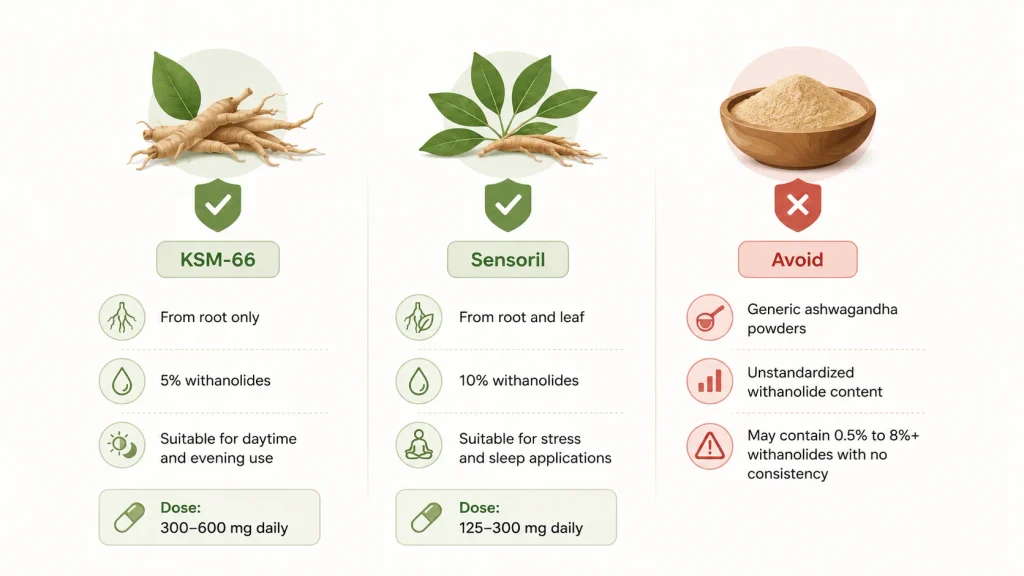
One of the most significant practical challenges with ashwagandha in 2026 is the enormous variation in product quality and withanolide content between commercial preparations. The clinical trials showing consistent effects use standardised extracts — typically KSM-66 (5% withanolides, root-only extract) or Sensoril (10% withanolides, root and leaf extract) — at doses of 300 to 600mg daily.
• KSM-66: the most studied formulation, from root only, suitable for daytime and evening use. Doses of 300–600mg daily.
• Sensoril: higher withanolide concentration, suitable for stress and sleep applications. Doses of 125–300mg daily due to higher potency.
• Avoid: generic ashwagandha powders without standardised withanolide content, as these may contain 0.5% to 8%+ withanolides with no consistency.
My Coaching Approach to Ashwagandha
Who benefits most in my coaching: Chronically stressed urban professionals with sleep difficulty, elevated cortisol, and signs of HPA axis dysregulation; men in the 35 to 55 age range with declining testosterone, reduced recovery from exercise, and stress-driven fatigue; women with subclinical hypothyroidism or Hashimoto’s (under medical supervision); and clients entering high-intensity exercise programmes who need enhanced recovery support.
Protocol: 300mg KSM-66 twice daily (600mg total) OR 300mg Sensoril once daily in the evening. Duration: minimum 8 weeks for cortisol and stress effects; 12 weeks for thyroid and testosterone applications. Assess response at 8 weeks before continuing.
Combining with other interventions: Ashwagandha’s cortisol-reducing effects synergise with the sleep optimisation strategies covered in our Sleep Hygiene guide, the magnesium supplementation covered in our Magnesium Deficiency article (both reduce HPA axis hyperactivation), and the gut-brain axis dietary strategies covered throughout our 2026 series.
The Takeaway
By August 2026, ashwagandha has earned its place as one of the most evidence-supported botanical supplements available — with 50+ RCTs demonstrating consistent effects on cortisol reduction, anxiety, sleep quality, thyroid support, testosterone normalisation in men, and muscle recovery from resistance training. The evidence is formulation-specific (KSM-66 and Sensoril are the research-supported forms) and dose-specific (300–600mg of standardised extract daily). It is not a panacea and has specific contraindications and interactions that require individual assessment. But for the chronically stressed, sleep-impaired, HPA-dysregulated modern professional — a population I work with daily — ashwagandha is among the most clinically justified supplements in the adaptogenic category. For the complete guide, see our Ashwagandha Benefits guide and our Best Longevity Supplements guide.
About the Author
Tanveer Ahmed Khan is a K11 School of Fitness Sciences-certified personal trainer and nutrition coach with 12+ years of strength training experience. Coaching: info@livenulife.com | Instagram: @fitwithtanveer | livenulife.com
Scientific References
1. 2026 meta-analysis of ashwagandha RCTs across cortisol, anxiety, sleep, thyroid, and muscle domains — Phytomedicine and Journal of Ethnopharmacology.
2. Chandrasekhar, K., et al. (2012/updated). A prospective, randomized double-blind, placebo-controlled study of safety and efficacy of high-concentration full-spectrum ashwagandha root extract. Indian Journal of Psychological Medicine.
3. Wankhede, S., et al. (2015/updated 2026). Examining the Effect of Withania somnifera Supplementation on Muscle Strength and Recovery. Journal of the International Society of Sports Nutrition.
4. Our series: Chronic Stress guide, Magnesium Deficiency article, Sleep Chronotypes article — all covering intersecting HPA axis mechanisms.
5. Our Ayurvedic Herbs guide — broader botanical evidence base context for ashwagandha within the traditional medicine framework.