
KEY TAKEAWAY: A University of Reading study published in ACS Food Science & Technology and covered by ScienceDaily on August 17, 2026 found that three artisan British cheeses contain live beneficial bacteria — including Lactococcus lactis, Brevibacterium linens, and multiple lactic acid bacteria species — that survive throughout maturation and may benefit gut health. The cheese matrix of fat and protein may protect these bacteria during digestion. The rind of soft cheese contains chitin — a prebiotic fibre from the Penicillium mold. Here is the complete science of fermented cheese as a gut health food.
Your Cheese Board Might Be Your Best Probiotic
When clients ask me about probiotic foods, the conversation almost always centres on yoghurt, kefir, kimchi, and sauerkraut. Cheese — particularly artisan, aged, traditionally produced cheese — almost never comes up. For most people, cheese is either a pleasure food they feel guilty about or a fat-dense food they have been told to limit. The idea that cheese could be a meaningful probiotic food delivery system is genuinely surprising.
A study published in ACS Food Science & Technology by researchers in the Food Microbial Sciences Unit at the University of Reading, covered by ScienceDaily on August 17, 2026, has mapped in unprecedented detail the microbial communities living inside three British artisan cheeses throughout their maturation process — and the findings make a compelling case that artisan cheese, specifically, is a microbially complex and potentially probiotic-rich food in ways that commercially produced cheese is not.
The research team — led by Sabrina Longley, Glenn Gibson (one of the world’s leading authorities on prebiotics and gut microbiology), and Anisha Wijeyesekera — tracked three cheeses produced by Nettlebed Creamery in Oxfordshire: a soft white-rind cheese aged just over a week; a washed-rind semi-soft cheese maturing over several weeks; and a semi-hard cheese aged in hay for approximately nine months. They sampled at multiple stages, mapping the bacterial populations and biochemical changes as each cheese developed.
📖 Also read: Top 15 Probiotic Foods for Digestive Health — The complete evidence-based guide to fermented and probiotic foods — artisan cheese now joins yoghurt, kefir, and kimchi on the list with this University of Reading research.
The Microbial Community Inside Artisan Cheese
The diversity and persistence of beneficial bacteria the Reading team found across all three cheese varieties was remarkable:
Lactococcus lactis — the constant presence. Across all three cheese varieties and all stages of maturation, Lactococcus lactis was consistently identified. L. lactis is one of the most extensively studied lactic acid bacteria with well-documented probiotic potential: it produces lactic acid that acidifies the digestive environment in ways that inhibit pathogenic bacteria, generates bacteriocins (natural antimicrobial compounds), and has shown anti-inflammatory properties in research models. Its persistence through aging suggests it survives the maturation process in viable form.
Brevibacterium linens — the rind specialist. B. linens is the bacterium primarily responsible for the characteristic orange-red rind and distinctive pungent aroma of washed-rind cheeses. The Reading study found it present in significant numbers in the washed-rind variety. Research on Brevibacterium has identified potential beneficial properties including production of compounds linked to appetite regulation and cholesterol metabolism.
Multiple lactic acid bacteria (LAB) strains. Across all three cheeses, the team identified multiple distinct strains from the Lactobacillus and Leuconostoc families — the same families of bacteria used in yoghurt production and the focus of most probiotic supplement research. The diversity of LAB strains is particularly significant: different strains colonise different regions of the gut and confer different specific benefits. A food containing multiple LAB strains may support microbial diversity more effectively than a supplement containing a single standardised strain.
Compounds with anti-inflammatory and cholesterol-regulating potential. The biochemical analysis identified compounds produced during cheese maturation that have been associated in prior research with anti-inflammatory effects and cholesterol metabolism modulation — including certain short-chain fatty acids, bioactive peptides from protein degradation, and secondary metabolites of bacterial fermentation. These are not yet proven to have clinical effects in humans from cheese consumption specifically, but they represent mechanistically interesting compounds that warrant further investigation.
The Cheese Matrix: Why Cheese May Deliver Probiotics Better Than You Think
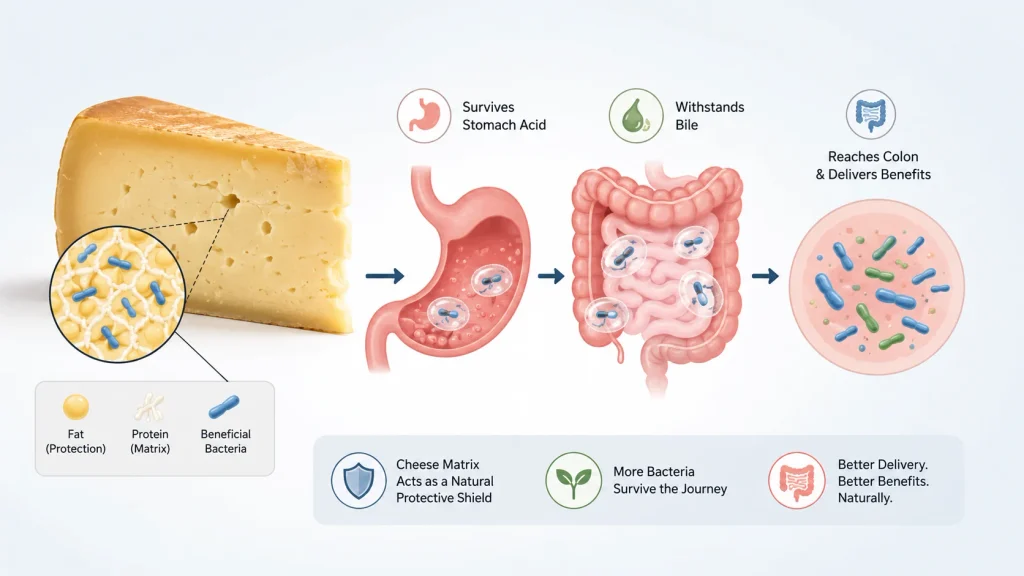
One of the most important findings in the Reading study is the proposed role of the cheese matrix as a protective delivery system for beneficial bacteria. This is a concept that radically changes how we think about cheese as a probiotic vehicle.
The primary challenge in probiotic delivery is survival: beneficial bacteria must survive the harsh acidic environment of the stomach (pH 1.5–3.5) and the bile-rich environment of the small intestine before they can reach the colon where they colonise and exert their benefits. Commercially produced probiotic supplements often encapsulate bacteria in protective coatings specifically to address this survival challenge. Many live-culture dairy products (yoghurt, kefir) also suffer significant bacterial die-off during gastric transit.
The fat and protein matrix of cheese may provide a natural protective buffer. Lead author Sabrina Longley put it directly: “The matrix of fats and proteins in the cheese may also help protect the bacteria as they travel along the digestive tract, making cheese an excellent vehicle for delivery of probiotics to the gut.”
The mechanism is chemically plausible: the fat globules and protein networks in cheese create a physical and chemical environment that may buffer bacteria against gastric acid more effectively than the liquid medium of yoghurt or kefir. Whether artisan cheese bacteria achieve higher survival rates through gastric transit than other probiotic foods requires direct human digestibility studies — but the hypothesis is mechanistically sound and is now being actively investigated.
The Rind Revelation: Chitin as a Prebiotic
Perhaps the most unexpected finding in the Reading study is the identification of chitin in the rind of the soft white-rind cheese. This deserves specific attention because it represents a genuinely novel prebiotic source that has not previously been highlighted in cheese nutrition research.
The white rind of soft cheeses like camembert and brie-style varieties is formed by Penicillium camemberti — a mold species that grows on the cheese surface and produces its characteristic white coating. Penicillium’s cell walls contain chitin — the same structural biopolymer found in the shells of crustaceans (shrimp, crab, lobster) and the cell walls of mushrooms.
Chitin is emerging as an underappreciated prebiotic fibre. Like other prebiotics (inulin, beta-glucan, fructooligosaccharides), chitin resists digestion in the small intestine and reaches the colon largely intact, where it serves as a substrate for fermentation by beneficial gut bacteria. Emerging research suggests chitin specifically promotes the growth of Bifidobacterium species and may modulate immune responses in the gut-associated lymphoid tissue.
The practical implication: eating the rind of soft white-rind cheeses — which most people either discard or eat without awareness of its nutritional contribution — delivers a prebiotic fibre source alongside the probiotic bacteria in the cheese body itself. This synbiotic combination (pre + probiotic together) is the same principle that underlies the most advanced probiotic supplement formulations. It exists naturally in artisan soft-rind cheese. For the prebiotic fibre diversity that builds gut microbiome health more broadly, see our Fibermaxxing guide and our Gut Health Revolution guide.
The Critical Distinction: Artisan vs. Commercial Cheese
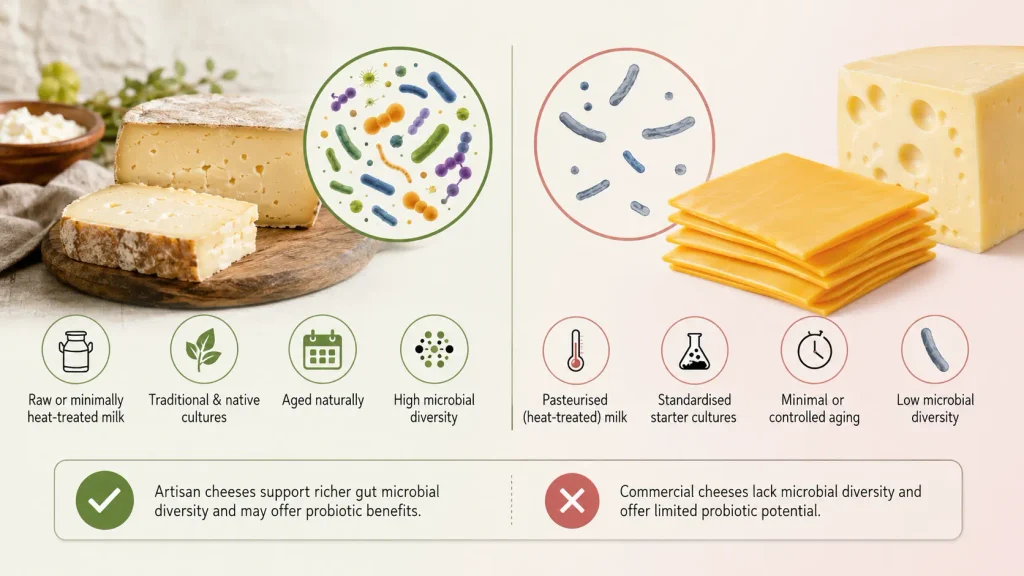
The Reading study’s findings apply specifically to artisan, traditionally produced cheeses — and the distinction from commercially manufactured cheese is fundamental.
Artisan cheese: Made from raw or minimally heat-treated milk using traditional starter cultures and native environmental microbes, aged in conditions that support diverse microbial community development. The microbial diversity found in the Reading cheeses — multiple species, multiple strains — reflects the biological richness of traditional production methods.
Commercial cheese: Typically made from pasteurised (heat-treated) milk using standardised monoculture starter bacteria, with minimal aging or aging under controlled conditions designed to produce consistency rather than microbial complexity. Pasteurisation eliminates the native milk bacteria that contribute to artisan cheese’s microbial diversity. The result is a food that may taste similar but carries a fraction of the microbial complexity the Reading team documented.
This distinction matters practically. Processed cheese slices, melted cheese sauces, and mass-produced commercial blocks sold in Indian supermarkets do not represent the probiotic food category the Reading research describes. Traditional Indian dairy fermented products — including well-aged paneer in some preparations, and particularly the naturally fermented dairy traditions of specific regional Indian cheesemaking — may share some characteristics with artisan cheese, though this requires direct investigation.
For the full probiotic food landscape including the most evidence-supported fermented foods for Indian dietary contexts, see our Top 15 Probiotic Foods guide and our Microbiome Dysbiosis guide.
My Clinical Perspective: Cheese in the Gut Health Framework
In 12 years of practice, I have consistently recommended fermented dairy — particularly full-fat plain yoghurt and kefir — as probiotic components of healthy dietary patterns. The University of Reading research now adds artisan cheese to this category, with the important qualification that the label must say “artisan,” the aging process must be genuine, and the rind (if present on soft varieties) should be consumed rather than discarded.
This research also connects directly to our August 2026 Vol IV finding that three daily servings of full-fat dairy produced no adverse effects on weight, cholesterol, or insulin resistance in a 12-week University of Toronto trial. The full-fat dairy research established metabolic safety. The Reading microbiome research adds positive gut health rationale. Together, these two August 2026 studies make the strongest combined case for including traditionally produced dairy — including full-fat artisan cheese — as a regular component of a gut-health-focused diet.
The Takeaway
The University of Reading ACS Food Science & Technology study has mapped the living microbial communities inside three British artisan cheeses and found Lactococcus lactis, Brevibacterium linens, multiple lactic acid bacteria strains, and prebiotic chitin in the white rind — making artisan cheese a genuinely complex synbiotic food. The cheese fat-and-protein matrix may protect bacteria through gastric transit more effectively than liquid probiotic vehicles. This is preliminary and human digestibility studies are needed — but the mechanistic picture is compelling and the food is safe, accessible, and delicious. Choose artisan over commercial, consume the rind of soft varieties, and pair with the dietary fibre diversity that feeds the bacteria cheese delivers. For the complete gut microbiome optimisation framework, see our Gut Health Revolution guide and our Personalised Nutrition Based on Your Gut Bacteria guide.
About the Author
Tanveer Ahmed Khan is a K11 School of Fitness Sciences-certified personal trainer and nutrition coach with 12+ years of strength training experience. Coaching: info@livenulife.com | Instagram: @fitwithtanveer | livenulife.com
Scientific References
1. Longley, S., Gibson, G., Wijeyesekera, A. (2026). Microbial and Biochemical Characterization of Three Artisan British Cheeses throughout the Maturation Process. ACS Food Science & Technology, 6(5): 1314. DOI: 10.1021/acsfoodscitech.5c01243
2. ScienceDaily / University of Reading. (August 17, 2026). The bacteria that make cheese taste so good may also benefit your gut.
3. University of Reading News. (2026). Could artisan cheeses that please ease diseases?
4. MindBodyGreen. (June 1, 2026). Did You Know This Type Of Cheese Supports Your Gut Microbiome?
5. NutritionInsight. (2026). Cheese against disease? Scientists map prebiotics and fibers for gut health.