
By Tanveer Ahmed Khan | K11-Certified Trainer & Dietitian-Nutritionist | REPS India Registered | August 2026 | 11 min read
KEY TAKEAWAY: Researchers at the University of Illinois Urbana-Champaign have developed a microwave-assisted frying method that reduces oil absorption in fried foods by 3–33% while cutting frying time by 33–76%. Reported by ScienceDaily on July 29, 2026. The breakthrough is clinically significant for populations where frying is a dietary staple — including India. Here is the full science, practical implications, and what actually matters most for cooking-method-based nutrition in 2026.
The Fried Food Problem — And Why a Solution Matters
Fried foods are a permanent fixture of global dietary culture. In India, this reality is particularly pronounced: pakoras, samosas, puri, bhatura, poori, vada, murukku, and dozens of regional fried snacks and preparations are not occasional indulgences for most people — they are embedded in daily meals, family occasions, and street food culture. Telling Indian clients to simply “avoid fried food” is neither realistic nor culturally appropriate advice.
This is why the research from the University of Illinois Urbana-Champaign — reported by ScienceDaily on July 29, 2026 and published in Current Research in Food Science and The Journal of Food Science — is practically significant in a way that most nutrition research is not. It does not ask people to stop eating fried food. It asks how we can make the fried food they are going to eat anyway substantially less harmful.
The answer, according to the Illinois team led by researcher Pawan Singh Takhar and colleagues: combining conventional frying with microwave energy at specific frequencies produces fries that absorb 3 to 33% less oil and cook 33 to 76% faster, without meaningful loss of crispiness, texture, or flavour.
📖 Also read: Why Going Completely Sugar-Free May Backfire — June 2026 — The ENDO 2026 finding that extreme dietary restriction creates unintended metabolic consequences — the same principle of “smart reduction over elimination” that the microwave frying research embodies.
The Physics of Why Microwave Frying Reduces Oil Absorption
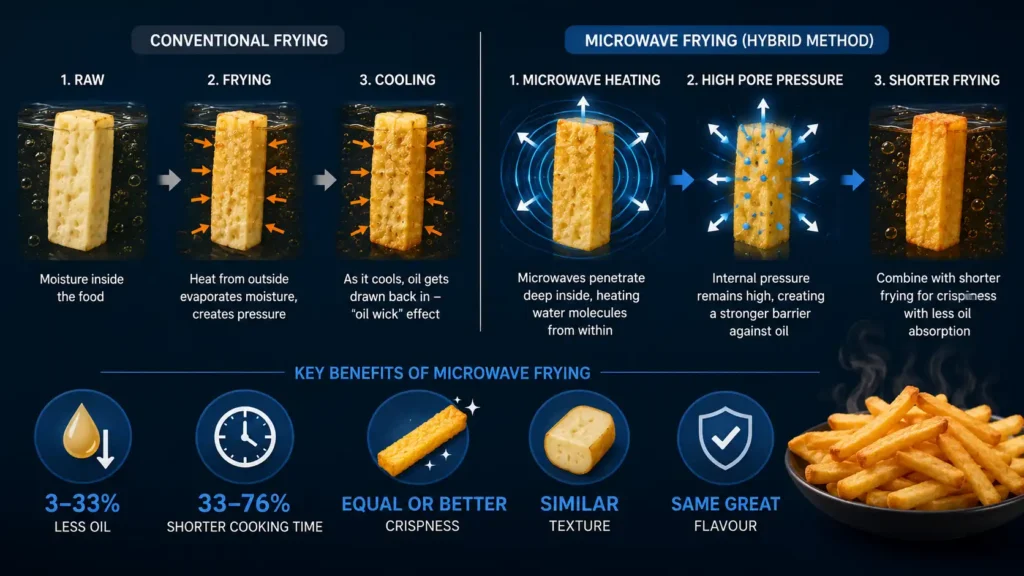
Understanding the mechanism makes it clear why this works — and why it matters more than switching to “air frying,” which the media frequently conflates with this research.
In conventional deep frying, raw potato (or any food) is immersed in hot oil at approximately 180°C. Heat penetrates from the outside in, gradually cooking the food. During this process, moisture inside the food escapes as steam, creating pressure that temporarily keeps oil out. But as the food cools and moisture equilibrates, oil is drawn back in to fill the void — this is the “oil wick” effect that accounts for the majority of fat content in fried food.
Microwave energy works differently. Microwaves penetrate into the food matrix itself, heating water molecules from within. This internal heating creates higher internal pore pressure than conventional surface-only heating — and this pressure is the key mechanism. Higher pore pressure inside the food during frying creates a more sustained barrier against oil penetration, reducing the amount of oil that enters the food matrix.
The Illinois research modelled microwave frying at two frequencies — 2.45 GHz and 5.8 GHz. The 2.45 GHz frequency (the frequency used in standard domestic microwaves) penetrated deeper into the food matrix and created higher pore pressures, producing greater oil reduction than the 5.8 GHz frequency. Combined with conventional frying to achieve the crispiness that microwave-only cooking cannot produce, the hybrid method produced fries with:
• 3 to 33% less oil than conventionally fried equivalents, depending on protocol specifics
• 33 to 76% shorter frying time — significant for commercial operations and meaningful for home cooking
• Equivalent or superior crispiness to conventional deep frying
• Similar internal texture and flavour profile
Is This the Same as Air Frying? No — And the Difference Matters
I need to address this directly, because I know the first question many readers will have. This is not air frying. Air frying uses forced hot air circulation to cook food with minimal oil — it is essentially a compact convection oven. It produces a different texture profile and works through a different mechanism entirely.
The Illinois microwave-frying technology maintains the food in hot oil — producing the traditional fried texture and flavour profile — while using microwave energy to reduce oil penetration during the process. The output is a food that has been genuinely deep-fried, not air-baked, but that absorbs substantially less oil in the process.
This distinction is important for two reasons. First, for the large population that finds air-fried versions of traditional fried foods texturally and gastronomically unsatisfactory, the microwave frying alternative maintains the authentic experience. Second, the health benefit profile is different: air frying essentially eliminates oil from the cooking process (though many users add oil separately), while microwave frying reduces oil absorption in a genuine frying process.
In my practice, I have had clients who enthusiastically purchased air fryers and found them helpful for some foods (nuggets, frozen vegetables) but unsatisfactory for traditional Indian preparations where the frying process is fundamental to the dish. The microwave frying technology, when it reaches consumer applications, addresses a different need.
The Broader 2026 Context: Cooking Methods Matter More Than We Acknowledge
The Illinois microwave frying research is one of several 2026 developments that collectively emphasise cooking method as a significant — and frequently overlooked — nutritional variable.
Acrylamide and high-heat cooking. Research published in 2026 has continued to document the formation of acrylamide — a potentially carcinogenic compound — in foods cooked at high temperatures through the Maillard reaction. This affects fried, roasted, grilled, and baked foods containing starch and certain amino acids. Potato products cooked at lower temperatures or for shorter durations produce significantly less acrylamide. The oil reduction and shorter frying time of microwave-assisted frying reduces acrylamide formation — a secondary benefit the Illinois team noted.
The oxidation question in reused cooking oils. In Indian kitchen practice — and in commercial street food operations — cooking oils are frequently reused across multiple frying cycles. Each cycle increases the concentration of oxidised lipids, trans fatty acids, and toxic aldehydes (4-hydroxynonenal, malondialdehyde) in the oil. Microwave-assisted frying’s shorter frying times reduce cumulative oil degradation per cooking cycle. But the more important intervention is oil hygiene: discarding oil after 3 to 4 uses, using more heat-stable oils (cold-pressed coconut oil, ghee, mustard oil) rather than refined vegetable oils, and never heating oil to smoking point.
Vitamin C and nutrient retention. Shorter cooking times — one of the direct outputs of microwave-assisted frying — reduce nutrient destruction. Vitamin C, B vitamins, and heat-sensitive polyphenols are all destroyed by prolonged high-heat exposure. This links directly to our July 2026 research on vitamin C and brain gray matter — cooking methods that protect vitamin C content matter for neurological as well as dietary reasons.
What This Means for Indian Kitchens Today
The commercial microwave-frying technology described in the Illinois research is not yet a consumer product — it requires specialised equipment that combines conventional frying chambers with microwave energy delivery systems. Home applications are not currently available in the form described in the research.
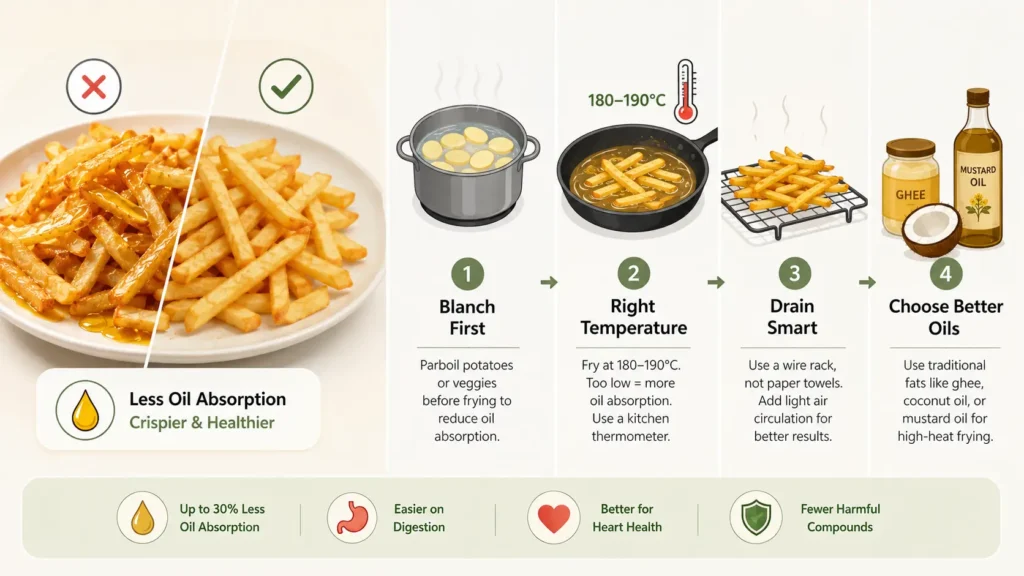
However, the underlying principle — reducing oil absorption through pressure management during frying — can be partially replicated through established cooking techniques that I recommend to clients today:
Blanching before frying. Pre-cooking potatoes or other vegetables in boiling water until partially cooked before deep frying reduces frying time substantially and reduces oil absorption by initiating the steam pressure that the Illinois research identifies as the key oil-reduction mechanism.
Frying at the correct temperature. Frying at too-low temperatures (below 165°C) extends immersion time and dramatically increases oil absorption. Maintaining oil at 180 to 190°C for the frying process is essential. A kitchen thermometer is a worthwhile investment for anyone who fries regularly — guessing oil temperature is one of the most common causes of excessively oily fried food.
Post-frying draining on absorbent surfaces. Draining fried food on a wire rack rather than paper towels allows more efficient oil drainage — paper towels reabsorb some of the oil from the food surface as it sits. Immediately applying light air circulation (a fan or elevated rack) accelerates surface oil drainage.
Oil selection for Indian cooking. For frying, the most heat-stable traditional Indian fats — ghee (clarified butter, smoke point 252°C), cold-pressed coconut oil (smoke point 177°C), and cold-pressed mustard oil (smoke point 250°C) — produce fewer toxic byproducts at frying temperatures than refined polyunsaturated vegetable oils (sunflower, safflower, corn), which oxidise rapidly above 160°C. The nutritional science supports returning to traditional fats for high-heat cooking, which modern marketing away from these fats has disrupted.
For the complete nutritional framework around reducing ultra-processed food while maintaining cultural food practices — including specific guidance on making Indian dietary patterns healthier without eliminating traditional foods — see our Fibermaxxing and gut health guide and our Functional Nutrition guide.
📖 Also read: Superfoods to Add to Your Breakfast for a Healthier Day — While reducing oil in cooking matters, what you eat alongside traditional foods matters equally — breakfast nutrition framework for Indian-context eating patterns.
My Practitioner Perspective: The “Perfect vs. Practical” Framework
In 12 years of nutritional coaching, the single biggest mistake I see in how nutrition advice is communicated to clients is the perfect-as-the-enemy-of-good fallacy. Clients are told to eliminate fried food completely, avoid all oils, cook everything by steaming or baking. They comply for two weeks and then abandon the entire intervention because it is incompatible with their food culture, family life, and social eating.
The microwave frying research embodies a principle I apply constantly in practice: harm reduction through intelligent modification is more powerful than elimination that nobody maintains. A household that fries samosas twice per week using correct oil temperature, high-stability fat, proper draining, and eventually microwave-assisted technology will have significantly better nutritional outcomes than a household that attempts to eliminate fried food completely, fails at month two, and returns to previous patterns.
The goal is not nutritional perfection. It is systematic improvement in the direction of better health, maintained sustainably within the reality of actual food culture. The Illinois research is valuable not only for its technical findings but for the principle it represents: food science should be working to make the foods people actually eat healthier, not designing theoretical dietary utopias that no one inhabits.
The Takeaway
The University of Illinois microwave frying research, reported in July 2026, demonstrates that a 3 to 33% reduction in oil absorption and a 33 to 76% reduction in frying time are achievable through a hybrid microwave-conventional frying approach — without compromising texture or flavour. This technology is not yet available for home use, but the principles it identifies — internal pressure during frying as the mechanism of oil exclusion, shorter frying times as nutritionally superior — have immediate practical applications in temperature management, oil selection, and blanching technique. For populations where frying is a dietary staple, this research matters more than abstract dietary guidelines that ask for food culture changes that are not occurring. Smart harm reduction, applied consistently, delivers better real-world outcomes than elimination that nobody maintains.
About the Author
Tanveer Ahmed Khan is a K11 School of Fitness Sciences-certified personal trainer and REPS India-registered dietitian-nutritionist with over 12 years of experience helping busy professionals achieve elite, sustainable health. Coaching: info@livenulife.com | Instagram: @fitwithtanveer | livenulife.com
Scientific References
1. Shah, Y., Takhar, P.S. (2026). Predicting the quality changes during microwave frying of food biopolymers by solving the hybrid mixture theory-based unsaturated transport, and electromagnetics equations. Current Research in Food Science, 12: 101264. doi: 10.1016/j.crfs.2025.101264
2. ScienceDaily / University of Illinois College of ACES. (July 29, 2026). New microwave frying method could make french fries much healthier.
3. ScienceDaily / University of Illinois. (April 2, 2026). New Microwave Frying Technique Could Make French Fries Much Healthier.
4. Yahoo News / Associated Press. (April 2026). Scientists have discovered a way to make french fries healthier – without losing their crispiness.
5. BioEngineer.org. (2026). Microwave Frying Technique Reduces Oil Content for Healthier French Fries.