By Tanveer Ahmed Khan | K11-Certified Trainer & Dietitian-Nutritionist | REPS India Registered | August 2026 | 11 min read
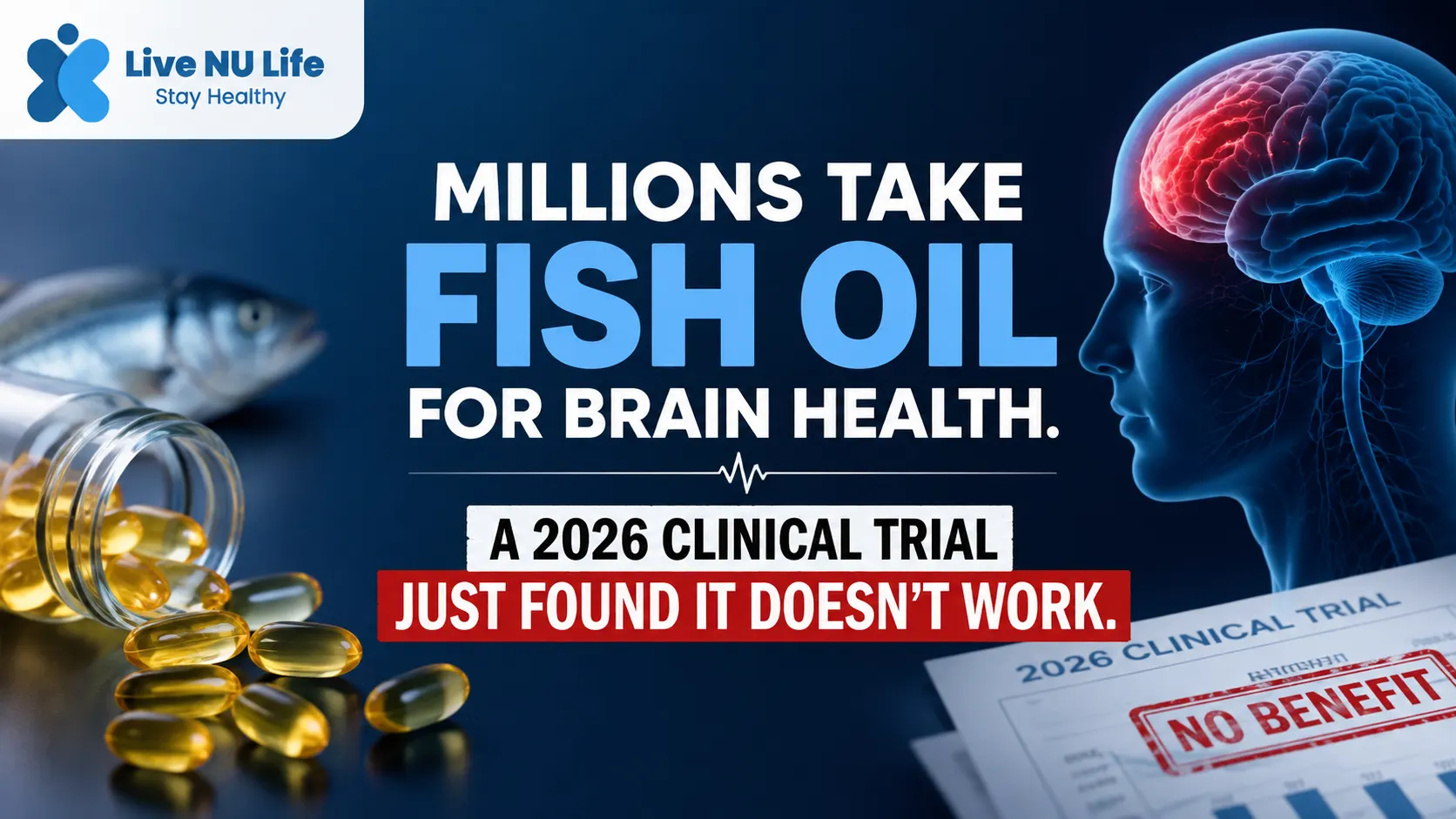
KEY TAKEAWAY: A two-year, double-blind, placebo-controlled clinical trial from USC Keck School of Medicine — published in eBioMedicine (June 2026) — found that high-dose DHA fish oil supplements failed to improve memory, cognitive performance, or brain cell preservation in older adults at elevated Alzheimer’s risk — even though omega-3s successfully reached the brain. The supplement category is worth over $1 billion annually. Here is what the evidence actually supports.
The Most Rigorous Test Yet — And the Result Nobody Wanted
For years, the defence against research showing that fish oil supplements do not improve brain health has been the same: the omega-3 did not actually get into the brain. Earlier studies relied on blood markers of omega-3 status as a proxy for brain delivery, leaving open the argument that inadequate brain penetration explained the null results.
The USC Keck School of Medicine study, published in eBioMedicine on June 18, 2026 and reported by ScienceDaily on June 29, 2026, closed that escape route definitively. Lead investigator Hussein Naji Yassine, MD, director of the USC Center for Personalized Brain Health, designed the study specifically to first verify that DHA from supplements reached the brain — and then to test whether it made a difference.
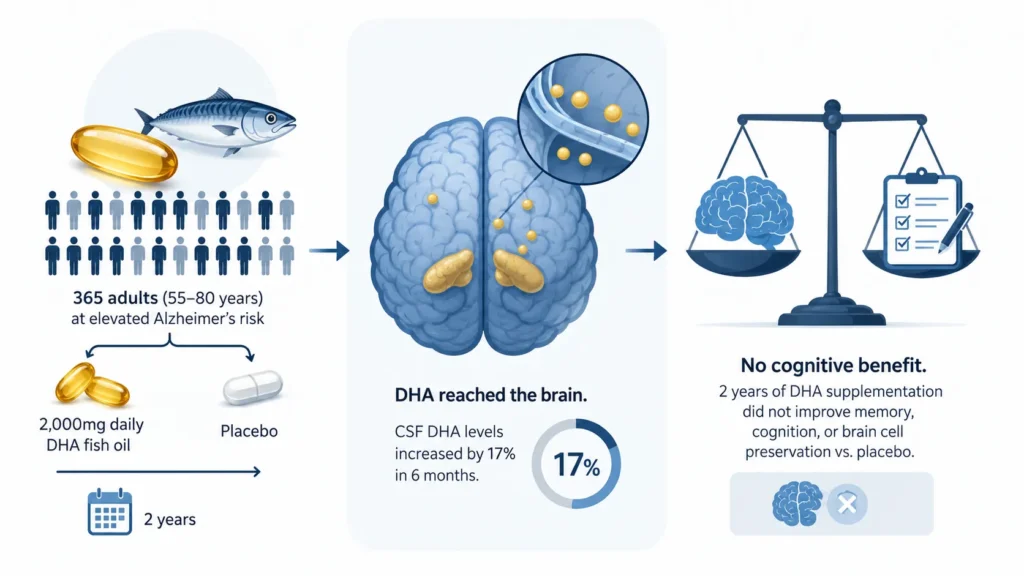
The design: 365 adults aged 55 to 80 who rarely consumed fish, at elevated Alzheimer’s risk, randomised to either 2,000mg daily DHA fish oil supplement or placebo for two years — a randomised, double-blind, placebo-controlled trial, the gold standard of clinical evidence.
First finding: DHA successfully reached the brain. After six months, cerebrospinal fluid (CSF) DHA levels in the supplement group had increased by an average of 17%, confirming brain penetration. The supplement worked as a delivery mechanism.
Second finding: brain delivery produced no cognitive benefit. Two years of DHA supplementation failed to improve memory, cognitive performance, or brain cell preservation in regions associated with Alzheimer’s disease compared to placebo. The supplement did what it claimed — it raised DHA in the brain — and it still made no measurable difference to brain health outcomes.
“We all wish there was a silver bullet for preventing Alzheimer’s,” said Yassine, “but our findings showed that fish oil supplements do not appear to protect brain health. While omega-3s play an important role in forming brain cell connections needed for cognition, our results do not support fish oil supplements as a preventive measure against Alzheimer’s.”
📖 Also read: Vitamin C and Your Brain — The July 2026 Research — While fish oil supplements underdeliver, vitamin C blood levels show direct correlation with brain gray matter volume and network connectivity — the food-first brain nutrition story.
Why This Matters — And Why You Should Not Simply Accept It
Before we go further, I want to provide important scientific context that the popular media coverage of this study frequently omits.
The USC trial studied a specific population: adults aged 55 to 80, at elevated Alzheimer’s risk, who rarely ate fish. This is important context. Omega-3 supplements may work differently in different populations, at different life stages, and with different baseline omega-3 status. A supplement study in people who already rarely eat fish — meaning their baseline omega-3 intake was low — may not represent what supplementation does in an otherwise well-nourished person.
The study also used a very high dose: 2,000mg of DHA daily, well above typical fish oil supplement doses. Whether lower doses behave similarly, or whether the high dose produced some compensatory effect, is not known from this trial alone.
And critically — this study measured brain outcomes in the context of Alzheimer’s disease prevention specifically. There is a separate literature on omega-3s and cardiovascular health, inflammation, depression, joint health, and eye health that this trial does not address. The finding that fish oil does not prevent Alzheimer’s in a high-risk elderly population does not invalidate omega-3s for other purposes.
What it does do, unambiguously, is end the specific claim that fish oil supplements protect the ageing brain or prevent Alzheimer’s — the very claim that drives the majority of the $1 billion annual market for this product category.
What This Means for Omega-3 Recommendations in 2026
As a practitioner with 12 years of recommending nutrition strategies to clients, here is how I am adjusting my approach in light of the 2026 USC findings — and what I think the evidence now actually supports.
Omega-3s from food remain strongly supported. The USC study tested a supplement, not food. Dietary omega-3s — from fatty fish, flaxseeds, walnuts, and chia seeds — arrive embedded in a complete food matrix that includes phospholipid-bound forms of DHA and EPA, vitamin D, selenium, and other bioactive compounds. The biological behaviour of food-matrix omega-3s and isolated supplement omega-3s is demonstrably different. Epidemiological research consistently shows that people who eat fish regularly have lower rates of cognitive decline and cardiovascular disease — research that is not overturned by a trial of isolated DHA capsules.
The “phospholipid” form may be the key variable. DHA in fish occurs primarily as phospholipid-bound DHA, which crosses the blood-brain barrier more efficiently than the triglyceride-bound DHA in most fish oil supplements. Some researchers — including Yassine himself — have suggested that future trials using phospholipid-form omega-3 supplements (found in krill oil, for example) may produce different results. This is a hypothesis, not established fact, but it is a mechanistically sound one.
The APOE4 subgroup finding is worth watching. Approximately 47% of the USC study participants carried the APOE4 gene variant — the strongest genetic risk factor for late-onset Alzheimer’s. Subgroup analyses suggested the null result held across genetic profiles, but some researchers have proposed that APOE4 carriers may have fundamentally different omega-3 metabolism that makes supplementation less effective. More targeted research on this question is ongoing.
Cardiovascular omega-3 benefits remain well-supported. The REDUCE-IT trial (2019) and subsequent research have demonstrated that high-dose prescription-grade EPA (icosapentaenoic acid — a different omega-3 from DHA) significantly reduces cardiovascular events in high-risk patients. This finding is not affected by the USC brain study. Omega-3s for cardiovascular risk reduction, triglyceride lowering, and inflammation management retain their evidence base.
What Actually Works for Brain Health in 2026
The USC fish oil finding, when placed alongside the calcium-and-vitamin-D supplement research we covered in June 2026 and the July 2026 data on vitamin C and brain gray matter, contributes to a consistent pattern in 2026 nutritional science: isolated nutrients in capsule form consistently underperform whole dietary patterns.
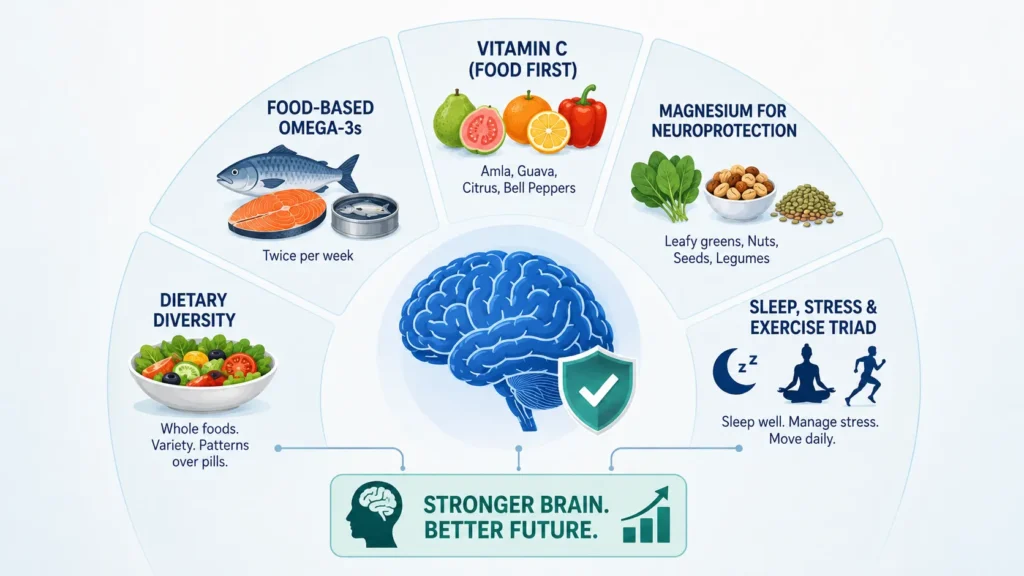
Here is the evidence-supported brain health framework I use with clients, in light of all the 2026 research:
Food-based omega-3s, twice per week minimum. Fatty fish — mackerel, sardines, salmon, rohu, katla — provide phospholipid-bound DHA, vitamin D, selenium, and complete protein. Two to three servings per week is the dietary pattern associated with lower dementia risk in prospective studies, regardless of what supplement trials show.
Vitamin C optimisation — food first. The July 2026 PLOS One research documented that lower plasma vitamin C directly correlates with reduced brain gray matter volume and weaker default mode network connectivity. Amla, guava, bell peppers, and citrus fruits are the most accessible sources. This is a food-first brain health intervention supported by MRI-level structural evidence that the fish oil trial cannot match.
Magnesium for neuroprotection. As covered in Article 2 of this issue, magnesium deficiency is associated with dementia, depression, and cognitive impairment across multiple 2026 studies. Leafy greens, nuts, seeds, and legumes are the food sources; magnesium glycinate is the preferred supplement form for neurological applications.
Dietary diversity over single-nutrient supplementation. The USC brain study’s most important implication is methodological: we keep studying single nutrients in isolation and finding that they fail. The interventions that consistently produce brain health benefits — the Mediterranean diet, the MIND diet, the longevity diet covered in our USC Cell Metabolism article — are characterised by dietary pattern diversity, not single-nutrient loading.
Sleep, stress, and exercise — the non-nutritional triad. The Columbia 2026 sleep study documented direct metabolic consequences of mild sleep loss. Chronic stress depletes magnesium and impairs the same neurological pathways supplementation is trying to protect. And the HIIT exercise research covered in Article 4 of this issue documents direct muscle and metabolic preservation benefits in older adults. Brain health is a whole-lifestyle outcome, not a supplement outcome.
📖 Also read: The USC Longevity Diet That Outperformed Keto — July 2026 — The dietary pattern that outperformed all others for metabolic and brain health — the food-first approach that the fish oil supplement trial failure points toward.
The Takeaway
The USC eBioMedicine trial is not evidence that omega-3s are unimportant. It is evidence that isolated DHA in capsule form does not protect the ageing brain — and that the billion-dollar fish oil supplement market, insofar as it is driven by Alzheimer’s prevention and cognitive health claims, is not supported by the best available evidence. Eat fatty fish twice a week. Diversify your dietary patterns toward whole, plant-forward foods. Address the specific micronutrient gaps — magnesium, vitamin C — that 2026 research has documented with structural brain health evidence. And invest your supplement budget, if you use one, in forms of nutrients with demonstrated efficacy: magnesium glycinate for sleep and neuroprotection, vitamin D3 + K2 for bone and immune health, not fish oil capsules for Alzheimer’s prevention. For the complete framework of evidence-based supplementation in 2026, see our Best Longevity Supplements Evidence-Based Guide.
About the Author
Tanveer Ahmed Khan is a K11 School of Fitness Sciences-certified personal trainer and REPS India-registered dietitian-nutritionist with over 12 years of experience helping busy professionals achieve elite, sustainable health. Coaching: info@livenulife.com | Instagram: @fitwithtanveer | livenulife.com
Scientific References
1. Yassine, H.N., et al. (2026). CNS target engagement of high-dose DHA supplementation in older adults at risk for dementia: a randomized, double-blind, placebo-controlled trial. eBioMedicine. DOI: 10.1016/j.ebiom.2026.106316
2. ScienceDaily / USC Keck. (June 29, 2026). Millions take omega-3 fish oil for brain health but a new study found no benefit.
3. Medical Daily. (2026). Fish Oil Supplements Do Not Improve Memory or Brain Health, a Two-Year Study Found.
4. Keck Medicine of USC News. (June 18, 2026). Fish oil supplements may not prevent Alzheimer’s-related decline.
5. ScienceDaily. (June 21, 2026). Fish oil may be hurting your brain in TBI context. Medical University of South Carolina / Cell Reports.