By Tanveer Ahmed Khan | K11-Certified Trainer & Dietitian-Nutritionist | REPS India Registered | August 2026 | 12 min read
KEY TAKEAWAY: A series of breakthrough 2026 studies from Cornell University, the University of Alabama at Birmingham, and UCSF has overturned the conventional view of vitamin B12 — showing it is a mitochondrial powerhouse whose “normal” blood ranges may be leaving millions of older adults with declining brain white matter, slower cognition, and impaired muscle energy production. For vegetarians and metformin users in India, this is the most important nutritional finding of the year.
The Vitamin We Thought We Understood
For over a century, vitamin B12 has been associated with two primary functions: the production of healthy red blood cells and the maintenance of nerve myelin sheaths. Clinically, B12 deficiency has been defined almost entirely by what happens when these functions fail dramatically — megaloblastic anaemia and peripheral neuropathy.
In 2026, a series of breakthrough studies published in The Journal of Nutrition and GeroScience by researchers at Cornell University, the University of Alabama at Birmingham (UAB), and the University of California San Francisco (UCSF) has fundamentally expanded this picture. Vitamin B12 is not merely a haematological nutrient. It is a mitochondrial health molecule — and its insufficiency, even within the ranges doctors consider “normal,” may be silently degrading the energy production of every skeletal muscle cell in your body while simultaneously eroding the white matter connections of your brain.
For a country where vegetarianism is a cultural and religious practice for an estimated 30 to 40% of the population, where B12 is present almost exclusively in animal foods, and where metformin — the most widely prescribed diabetes medication — is known to impair B12 absorption in tens of millions of patients, these 2026 findings carry urgent clinical relevance.
📖 Also read: Magnesium Deficiency: The Mineral Shortening Lifespans — August 2026 — Magnesium and B12 share a pattern: both are deficient in large proportions of the population, both are measured by tests that miss true tissue insufficiency, and both are critical for mitochondrial energy production.
The Cornell-UAB Discovery: B12 and the Mitochondria
The 2026 work, led by Dr Martha Field and colleagues at Cornell in collaboration with UAB researchers, addressed a question that had been circulating in nutritional biochemistry for decades without definitive resolution: does vitamin B12 directly support mitochondrial function in skeletal muscle?
The answer, now documented in experimental models and aged female mice, is yes — and the mechanism is specific and well-characterised.
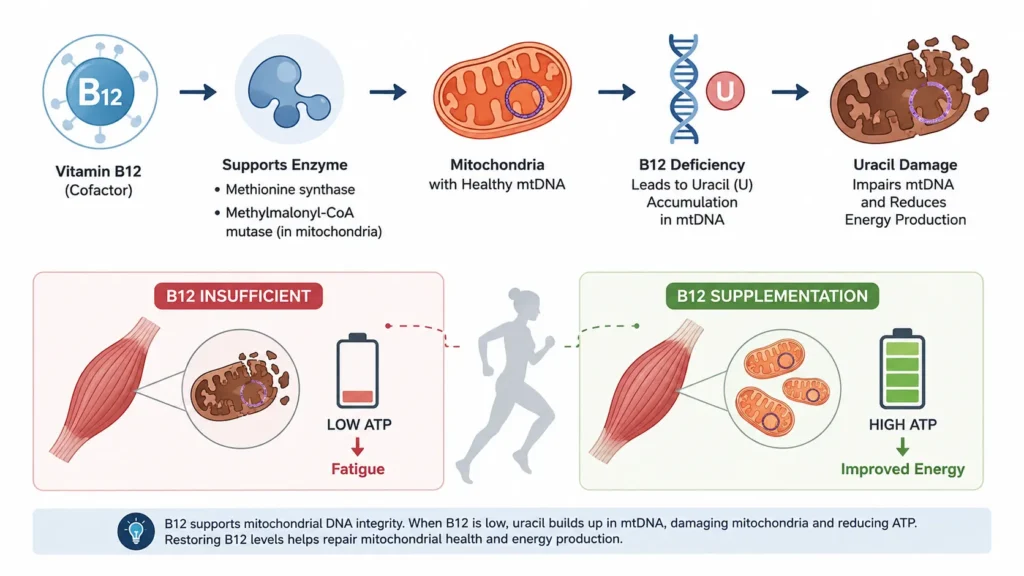
The mechanism: uracil accumulation in mitochondrial DNA. Every cell in the body contains mitochondria — the organelles responsible for producing ATP, the universal energy currency of cellular life. Mitochondria have their own separate DNA (mtDNA), distinct from the nuclear DNA in the cell’s nucleus. This mtDNA is particularly vulnerable to damage because it lacks the protective proteins that shield nuclear DNA.
Vitamin B12 is a cofactor for two enzymes. The first (methionine synthase) is involved in DNA synthesis and methylation. The second (methylmalonyl-CoA mutase) operates inside the mitochondria in fatty acid and amino acid metabolism. When B12 is insufficient, the methionine synthase pathway is impaired, causing accumulation of uracil in DNA — a form of DNA damage that, when it occurs in mtDNA, impairs the mitochondria’s ability to produce energy efficiently.
The finding: Low B12 caused uracil accumulation in mitochondrial DNA, halting energy production in skeletal muscle cells in laboratory models. A related study in aged female mice found that B12 supplementation improved several markers of mitochondrial health — including the number and structure of mitochondria — suggesting that correcting B12 insufficiency can restore mitochondrial integrity.
This is a paradigm shift. It means that the fatigue reported by B12-insufficient people is not merely a downstream effect of anaemia or nerve damage. It has a direct cellular explanation: mitochondria in muscle cells are producing less ATP because their DNA has been damaged by uracil accumulation.
The UCSF Finding: “Normal” B12 Is Not Protecting Your Brain
Simultaneously, researchers at UCSF published findings from the Brain Aging Network for Cognitive Health (BrANCH) study that challenge the adequacy of current B12 reference ranges for neurological protection.
The team enrolled 231 healthy older adults with an average age of 71. None had dementia or mild cognitive impairment. Their average blood B12 level was 414.8 pmol/L — far above the US minimum clinical threshold of 148 pmol/L, well within what any laboratory would report as “normal.”
What they found: Participants with lower but still technically normal B12 levels showed signs of slower thinking, delayed visual processing, and more damage to the brain’s white matter — the network of myelinated nerve fibres that carries signals between different brain regions. These effects were dose-dependent: even within the normal range, lower was worse for brain function.
Co-first author Alexandra Beaudry-Richard stated that the findings suggest “low but technically normal B12 could have broader effects than previously recognised” and that clinicians may want to consider B12 supplementation in some older adults with neurological concerns, even before levels fall below traditional thresholds.
This connects directly to our July 2026 research on Vitamin C and brain gray matter volume and our August 2026 coverage of fish oil supplements failing brain health trials — a consistent pattern emerging in 2026 nutritional neuroscience: single-nutrient isolated supplementation underperforms, while ensuring adequate status of multiple essential nutrients through diet and targeted correction is far more protective than any supplement marketed for brain health.
The Indian Context: Why This Is a Crisis
In 12 years of conducting detailed nutritional assessments of Indian clients, vitamin B12 deficiency is the single most common micronutrient problem I identify. And the epidemiology confirms this is not unique to my practice.
Studies consistently show B12 deficiency prevalence of 47% or higher in Indian vegetarian populations. A hospital-based study in Jamshedpur found 22.9% of all patients tested were B12 deficient — and this was in a population that agreed to testing, likely representing more health-conscious individuals. Community surveys in vegetarian communities in western India have found deficiency rates above 60%.
Why Indian vegetarians are at extreme risk: Vitamin B12 exists almost exclusively in animal products. Plants produce no B12 whatsoever. The traditional Indian vegetarian diet — even when protein-sufficient through dairy, dal, and legumes — contains B12 only from dairy products and, to a very small extent, fermented foods. Strict vegans who avoid dairy receive essentially zero dietary B12.
Why metformin users are at high risk: Metformin — the most widely prescribed diabetes medication in India, used by tens of millions of patients — is known to impair vitamin B12 absorption by competing with intrinsic factor (the protein required to absorb B12) in the terminal ileum. Multiple studies confirm that 10 to 30% of long-term metformin users develop significant B12 deficiency. Given that India has the second-largest diabetic population in the world, this represents an enormous number of people whose B12 status is being actively depleted by their diabetes medication.
Why the “normal” range is particularly misleading in India: The UCSF finding that neurological harm occurs at levels within the normal range is compounded in India by the fact that Indian laboratory reference ranges for B12 are frequently set using Western population data. The actual dietary intake patterns of Indian populations mean that what counts as “normal” may not represent the same functional B12 status as in populations with higher habitual B12 intake.
The Symptoms That Are Being Missed
The 2026 Cornell and UCSF studies help explain a pattern of symptoms I see consistently in B12-insufficient clients that fall below the threshold of traditional diagnosis:
• Persistent fatigue despite adequate sleep — now understood as potentially reflecting direct mitochondrial energy impairment in muscle cells, not simply anaemia.
• Cognitive sluggishness and “brain fog” — consistent with the UCSF finding of impaired processing speed and white matter integrity at sub-deficiency B12 levels.
• Muscle weakness and reduced exercise capacity — directly linked by the Cornell research to mitochondrial dysfunction in skeletal muscle.
• Tingling or numbness in hands and feet — the classic neurological presentation, often appearing later in B12 insufficiency as peripheral nerve damage progresses.
• Low mood and anxiety — B12 is required for the synthesis of SAM-e (S-adenosylmethionine), the body’s primary methyl donor, which is critical for serotonin and dopamine production.
• Mouth ulcers (aphthous ulcers) and a smooth, red, painful tongue (glossitis) — often the earliest visible signs of B12 insufficiency.
The clinical tragedy is that many of these symptoms are attributed to “stress,” “ageing,” “overwork,” or “iron deficiency” without B12 testing. And when B12 is tested, results in the low-normal range are frequently dismissed without the functional assessment — measuring active B12 (holotranscobalamin) and methylmalonic acid — that would reveal true tissue insufficiency.
Food Sources and the Absorption Problem
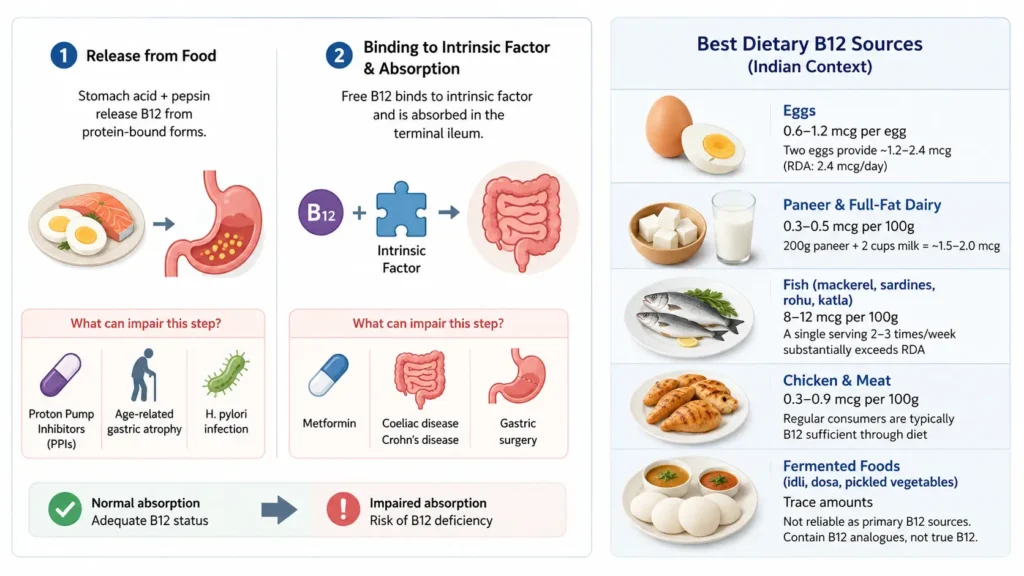
Vitamin B12 absorption is a two-step process with multiple potential failure points — which is why dietary intake alone does not guarantee adequate status.
Step 1: Release from food. In food, B12 is bound to proteins. Stomach acid and the enzyme pepsin must release it from these protein-bound forms before absorption can proceed. Any condition that reduces stomach acid — including the proton pump inhibitors (PPIs) widely prescribed for acid reflux, age-related gastric atrophy, and H. pylori infection (extremely prevalent in India) — impairs this release step.
Step 2: Binding to intrinsic factor and absorption. Free B12 must bind to intrinsic factor — a protein produced by stomach parietal cells — and this complex is then absorbed in the terminal ileum. Metformin, as mentioned, competes with this step. Coeliac disease, Crohn’s disease, and prior gastric surgery can also impair this absorption pathway.
Best dietary B12 sources (relevant to Indian context):
• Eggs: 0.6–1.2 mcg per egg. Two eggs provide approximately 1.2–2.4 mcg of the recommended 2.4 mcg daily. A regular egg consumer with normal absorption should be covering much of their requirement.
• Paneer and full-fat dairy: approximately 0.3–0.5 mcg per 100g. A person consuming 200g of paneer and 2 cups of milk daily receives approximately 1.5–2.0 mcg — close to the RDA but leaving little margin.
• Fish (particularly mackerel, sardines, rohu, katla): 8–12 mcg per 100g serving — exceptionally rich. A single serving of fatty fish 2–3 times per week substantially exceeds the B12 RDA.
• Chicken and meat: 0.3–0.9 mcg per 100g. Regular meat consumers are typically B12 sufficient through diet alone.
• Fermented foods (idli, dosa, pickled vegetables): trace amounts — not reliable as primary B12 sources despite traditional beliefs about their B12 content. The B12 in fermented plant foods is primarily B12 analogues that do not function like true B12 in the human body.
My Clinical B12 Protocol: Testing and Supplementation
Step 1: Test the right markers. A standard serum B12 test is insufficient to detect functional insufficiency. I request: serum B12 (for baseline), holotranscobalamin (active B12 — reflects actually usable B12), and methylmalonic acid (MMA — rises when cells are functionally B12 deficient even when total serum B12 appears normal). This trifecta gives a complete picture of B12 status at the cellular level.
Step 2: Identify absorption risk factors. Are they on metformin? PPIs? Do they have a history of H. pylori? Do they have coeliac disease, Crohn’s, or prior gastric surgery? Any of these require higher supplementation doses and more frequent monitoring.
Step 3: Choose the right supplement form. Most commercial B12 supplements contain cyanocobalamin — the most chemically stable but metabolically least active form. For clients with known absorption issues or who need rapid repletion, I prefer methylcobalamin or hydroxocobalamin, which are more directly bioavailable forms. For those with confirmed absorption impairment (metformin, PPIs, gastric conditions), high-dose oral supplementation (1,000 mcg daily) can bypass the intrinsic factor pathway through passive absorption, or sublingual or injectable forms can be used.
Step 4: Retest and adjust. I retest at three months after starting supplementation, using all three markers. Serum B12 often rises dramatically with supplementation even when tissue repletion is incomplete — MMA and holotranscobalamin are more reliable indicators of genuine cellular repletion.
For the complete nutritional supplement framework that addresses B12 alongside magnesium, vitamin C, and the other micronutrients that 2026 research has identified as critical, see our Best Longevity Supplements Evidence-Based Guide and our Cellular Health Optimization guide.
The Takeaway
The 2026 Cornell, UAB, and UCSF research on vitamin B12 has fundamentally expanded our understanding of what this vitamin does and how much we need. It is not simply a blood cell and nerve nutrient — it is a mitochondrial health molecule whose insufficiency, even at levels currently considered normal, causes measurable brain white matter damage and cognitive slowing while impairing muscle energy production at the cellular level. For the large proportion of Indian vegetarians, vegans, and the tens of millions on metformin, vitamin B12 is the most urgent micronutrient to assess and address. Test comprehensively. Supplement strategically. And pair B12 optimisation with the broader nutritional framework covered in our Functional Nutrition guide.
About the Author
Tanveer Ahmed Khan is a K11 School of Fitness Sciences-certified personal trainer and REPS India-registered dietitian-nutritionist with over 12 years of experience. Coaching: info@livenulife.com | Instagram: @fitwithtanveer | livenulife.com
Scientific References
1. Field, M. et al. (2026). Vitamin B12 deficiency triggers uracil accumulation in mitochondrial DNA and impairs skeletal muscle energy production. The Journal of Nutrition. Cornell University / UAB collaboration.
2. Beaudry-Richard, A. et al. (2026). Active vitamin B12 levels and neurological function in healthy older adults: findings from the BrANCH study. GeroScience. UCSF.
3. ScienceDaily. (June 25, 2026). This common vitamin deficiency can mimic normal aging.
4. ScienceDaily / UCSF. (May 22, 2026). Scientists warn that current vitamin B12 guidelines may be putting your brain at risk.
5. Newsweek. (June 26, 2026). Vitamin B12 Deficiency Can Mimic Aging.