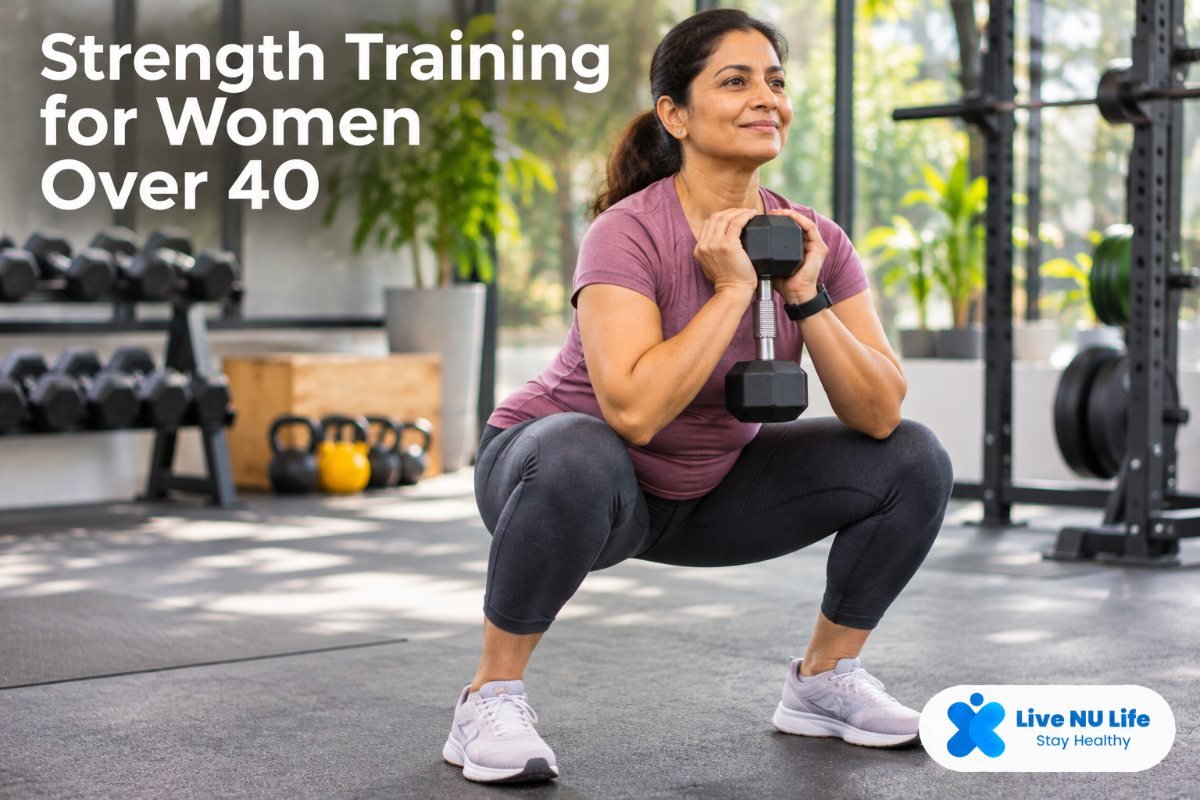
Strength training is one of the most useful things a woman over 40 can do for her health. It helps you keep muscle, supports bone strength through menopause, and makes everyday tasks easier. You need just two or three 30–45 minute sessions a week. The 12-week plan below starts with light weights and builds up gradually.
You do not need to have lifted before. Many of the women in the best-known bone study on heavy lifting were in their sixties and had low bone mass when they started.
Why strength training matters more after 40
Muscle
Adults slowly lose muscle and strength with age unless they use it, and the decline speeds up later in life. Less muscle means less strength for carrying shopping, climbing stairs or getting up from the floor, and a higher risk of falls later on. Regular resistance training is the most reliable way to slow that loss.
Bone and menopause
Estrogen helps protect bone. As it falls during perimenopause and menopause, bone loss speeds up, which is why women are more likely than men to develop osteoporosis.
The LIFTMOR trial tested whether heavy lifting was safe and useful for women who already had low bone mass (Watson et al., 2018):
- Who: 101 postmenopausal women, average age 65, with osteopenia or osteoporosis
- What: 30 minutes twice a week for 8 months of supervised heavy lifting (5 sets of 5 reps at over 85% of maximum) plus jumping-type impact work, compared with a light home program
- Result: lumbar spine bone density rose 2.9% in the lifting group and fell 1.2% in the control group. Femoral neck (hip) bone density was maintained in the lifting group but fell in the control group. Physical function also improved.
- Safety: only one minor adverse event (a back spasm), under close supervision
That trial was supervised by trained staff and built up carefully. It does not mean you should start with heavy weights on day one, but it shows that progressive strength training is not fragile territory once you build up to it.
Everyday benefits
Strength training also helps with blood sugar control, body composition, joint support, balance and confidence. The World Health Organization recommends muscle-strengthening activity for all major muscle groups on two or more days a week for adults of every age.
Before you start
- Check with your doctor first if you have osteoporosis, heart disease, high blood pressure, a recent injury or surgery, or you are pregnant.
- Find a coach for a few sessions if you can. A physiotherapist or qualified trainer can check your form on squats and hinges, which pays off for years.
- Mind your pelvic floor. If you leak urine when you lift, jump or cough, see a pelvic floor physiotherapist. You can usually keep training with some changes.
- Start lighter than you think. The first four weeks are for learning the movements.
The 12-week beginner plan
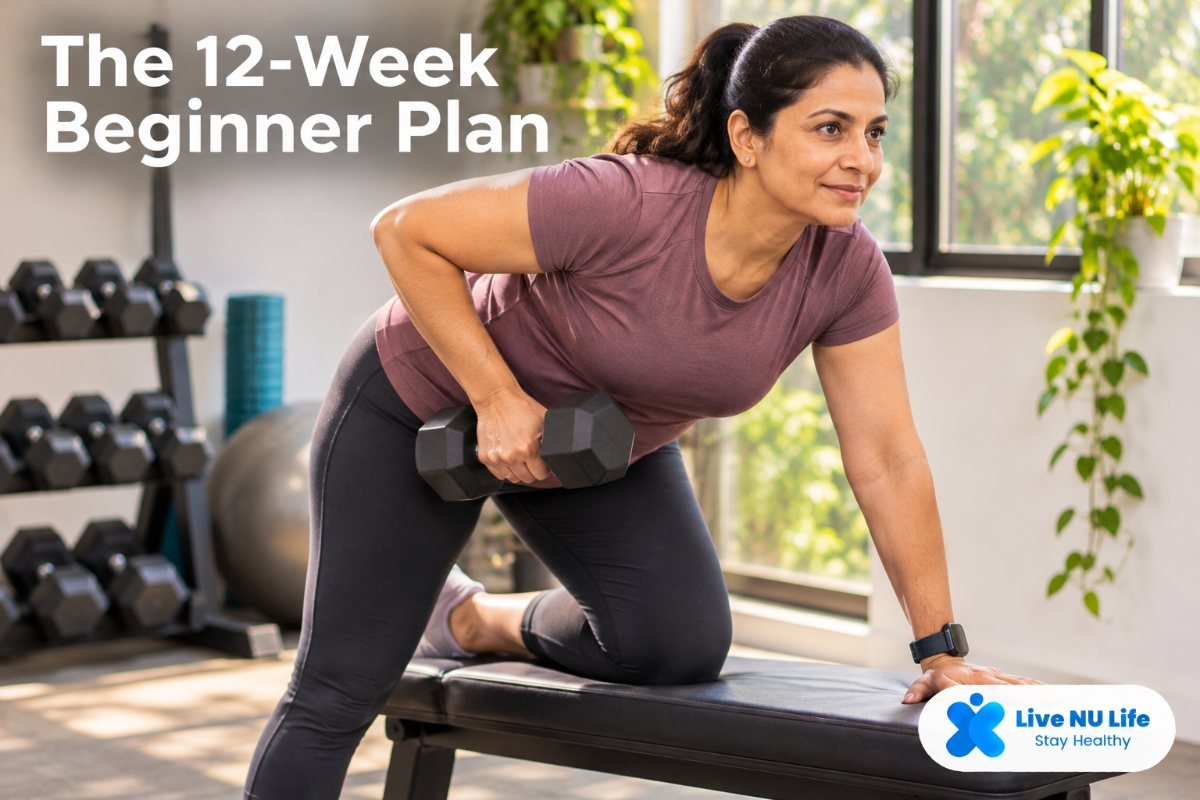
Train three days a week on non-consecutive days, for example Monday, Wednesday and Friday. Each session takes 35–45 minutes including a 5-minute warm-up of brisk walking and gentle mobility.
The exercises
| Workout A | Workout B |
|---|---|
| Goblet squat (to a box or chair at first) | Romanian deadlift with dumbbells |
| Dumbbell bench press or push-up (on a bench or wall) | One-arm dumbbell row |
| Glute bridge or hip thrust | Step-ups onto a low step |
| Lat pulldown or band pulldown | Seated or standing dumbbell shoulder press |
| Farmer’s carry (walk holding dumbbells) | Dead bug or plank |
Alternate them: A, B, A one week, then B, A, B the next.
Sets, reps and effort
| Weeks | Sets × reps | How hard it should feel |
|---|---|---|
| 1–4 | 2 × 10–12 | You could do 3–4 more reps at the end of each set. Focus on form. |
| 5–8 | 3 × 8–10 | You could do 2–3 more reps. Add weight when all sets feel easy. |
| 9–12 | 3–4 × 6–8 on squats, deadlifts, presses and rows; 3 × 10 on the rest | You could do 1–2 more reps. The last reps should feel hard but clean. |
Rest 60–90 seconds between sets in weeks 1–8 and up to 2 minutes on the main lifts in weeks 9–12. For carries and planks, use time instead of reps: start with 20–30 seconds and build up.
How to progress
When you can complete every set at the top of the rep range with good form, increase the weight slightly the next session. Small jumps work best: 1–2 kg for upper-body exercises and 2–4 kg for lower-body exercises. Progress will not be linear. Some weeks you will repeat the same weights, and that is fine.
What to do after week 12
Keep the same structure and keep adding weight slowly, or move to a four-day upper/lower split. With steady training, most beginners keep getting stronger for well over a year.
Strength training around perimenopause symptoms
- Poor sleep: train earlier in the day if late sessions keep you awake, and keep a consistent bedtime.
- Joint aches: a longer warm-up and slower lowering phases often help. Switch painful exercises for alternatives rather than stopping altogether.
- Hot flushes: a cooler room, a fan and water nearby make sessions more comfortable.
- Low energy days: do a shorter session with one set less per exercise. Showing up matters more than a perfect workout.
Nutrition that supports your training
- Protein: eat a good protein source at every meal. The Indian minimum is 0.83 g per kg of body weight a day, and active women and older adults often do better with more. See our 2026 protein guidelines and our list of high protein foods for vegetarians.
- Calcium and vitamin D: both matter for bone. Dairy, ragi, til and fortified foods help with calcium. Read about vitamin D deficiency if you rarely get midday sun.
- Creatine: creatine monohydrate is one of the most studied supplements for strength and muscle and is generally safe for healthy adults. Read is creatine bad for you? before you start.
Add cardio and balance too
Strength training does not replace cardio. Aim for 150 minutes of moderate activity a week alongside your lifting. Easy walking or cycling works well. See our guide to zone 2 cardio. A minute or two of single-leg balance practice at the end of each session also helps.
For more on staying strong as you age, read the best exercise for older adults to lose fat and keep muscle and our 10 daily habits to extend your healthspan.
Frequently asked questions
Is it too late to start strength training at 40, 50 or 60?
No. Women in their 60s with low bone mass improved bone density and function in the LIFTMOR trial. You can start at any age with a suitable plan.
Will lifting weights make me bulky?
Very unlikely. Women have much lower testosterone than men, and building large muscles takes years of focused training and eating. Most women find they look leaner and firmer.
How many days a week should a woman over 40 lift weights?
Two to three days a week is enough for most beginners. The WHO recommends at least two.
Can I do strength training at home?
Yes. A pair of adjustable dumbbells, a resistance band and a sturdy step or bench cover every exercise in this plan.
Is strength training safe if I have osteoporosis?
For many people it is, and it can help, but the exercises need to be chosen and progressed carefully. Get advice from your doctor and a physiotherapist before you start.
Sources
- Watson SL, Weeks BK, Weis LJ, Harding AT, Horan SA, Beck BR. High-intensity resistance and impact training improves bone mineral density and physical function in postmenopausal women with osteopenia and osteoporosis: the LIFTMOR randomized controlled trial. J Bone Miner Res. 2018;33(2):211–220. doi:10.1002/jbmr.3284
- World Health Organization. WHO guidelines on physical activity and sedentary behaviour. 2020.
- ICMR-National Institute of Nutrition. Nutrient Requirements for Indians. 2020.
Check with your doctor before starting a new exercise program if you have a medical condition. See our medical disclaimer.