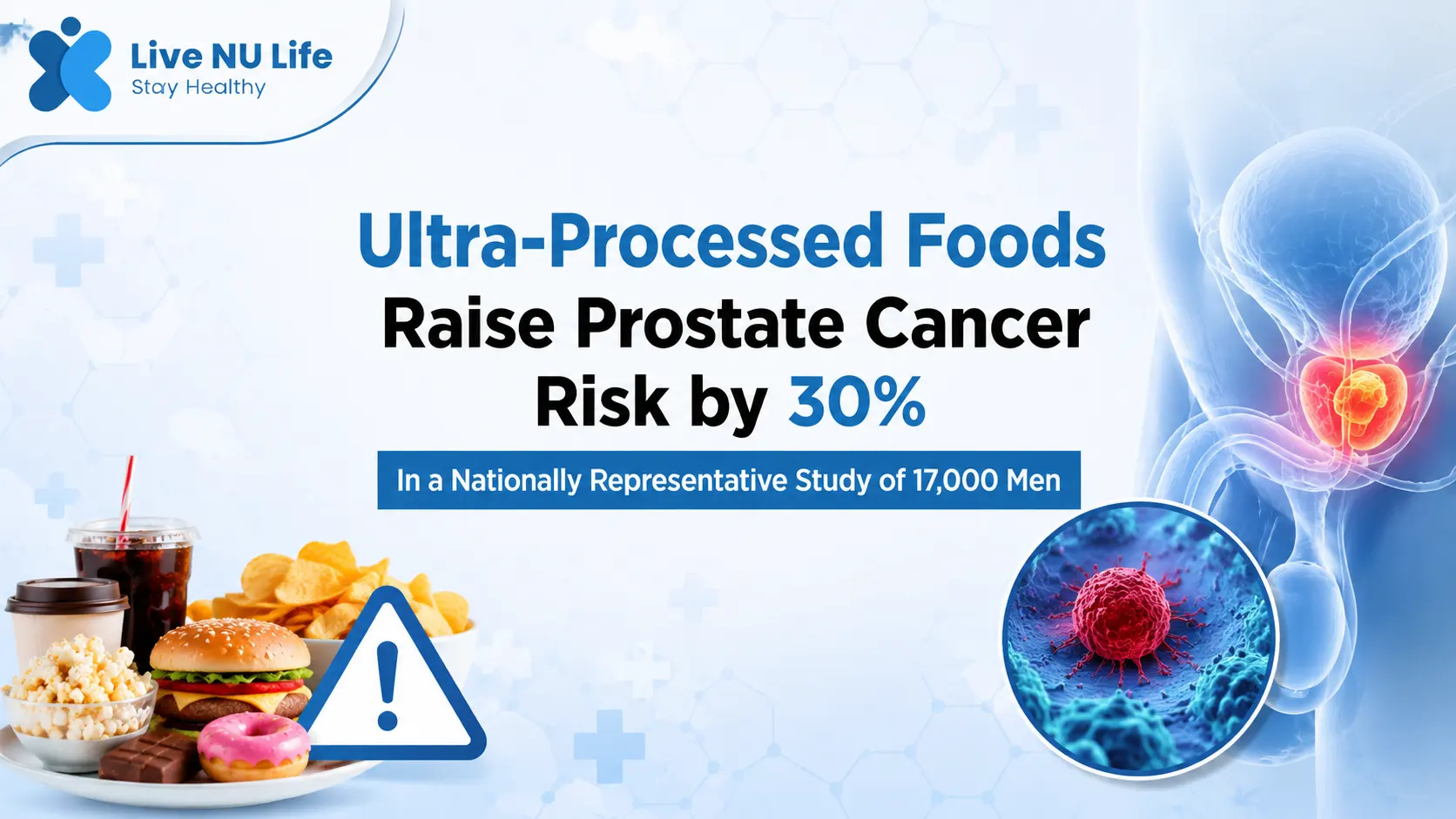
KEY TAKEAWAY: A study published in The American Journal of Medicine (August 7, 2026) by Florida Atlantic University found that men in the three highest ultra-processed food consumption quartiles had 29–31% greater risk of prostate cancer in a nationally representative sample of 17,134 US men. The association held after adjusting for age, race, smoking, and poverty status.
The Expanding Ultra-Processed Food Health Crisis — Men’s Edition
Every volume of our 2026 health and nutrition series has addressed some dimension of the ultra-processed food evidence — from brain attention impairment (June 2026) to teenage depression rewiring (August Vol VI) to the 81% ultra-processed rate among toddler foods (July 2026). The August 7, 2026 publication in The American Journal of Medicine by Charles H. Hennekens and colleagues at Florida Atlantic University adds prostate cancer — the most commonly diagnosed cancer in men globally — to this expanding landscape.
In a nationally representative study of 17,134 US men from NHANES, men in the higher UPF consumption quartiles had 24 to 31% greater risk of prostate cancer. Prostate cancer affects more than 333,000 American men annually in 2026. A modifiable dietary risk factor increasing risk by nearly a third has enormous public health implications.
📖 Also read: Ultra-Processed Foods Are Stealing Your Focus — June 2026 — The comprehensive Monash University UPF attention study — the foundational article in our 2026 UPF series that this prostate cancer research extends.
Study Design and Results
Hennekens and colleagues analysed NHANES data from 17,134 adult men. UPF consumption was classified using the NOVA food classification system and divided into quartiles:
• Men in the three higher quartiles had 29% greater risk of prostate cancer (RR 1.29; P = 0.031).
• Men in the two highest quartiles had 30% greater risk (RR 1.30; P = 0.035).
• After adjustments for age, race, smoking, and poverty status: risk remained significant at 24–31%.
• Men with the highest UPF intake alone showed a possible 34% higher risk (not statistically significant, likely due to smaller case numbers in that subgroup).
The Biological Mechanisms
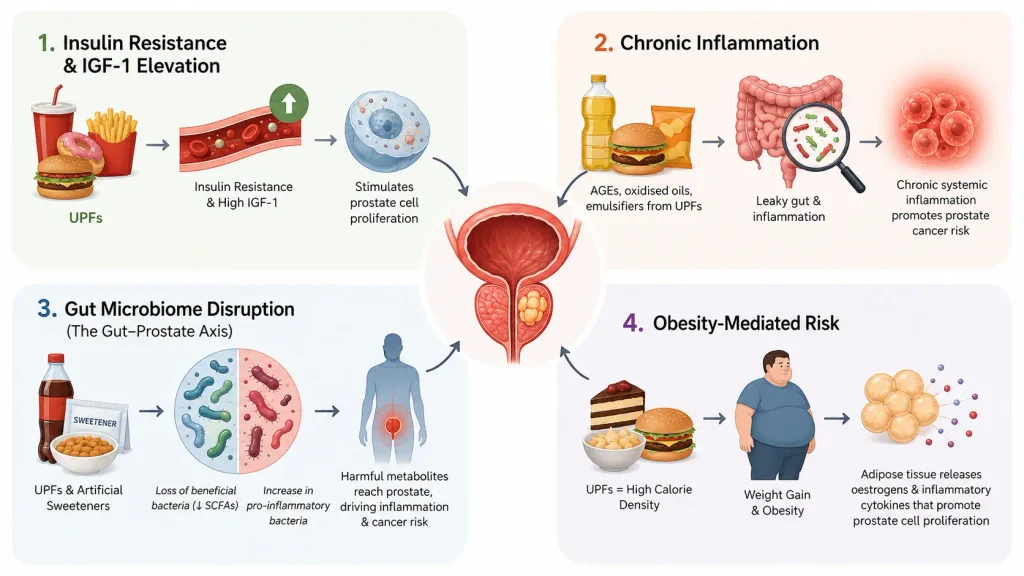
Insulin resistance and IGF-1 elevation. Prostate cancer cells express insulin and IGF-1 receptors that stimulate cellular proliferation. UPFs — through high refined carbohydrate, HFCS, and low-fibre content — systematically promote insulin resistance and chronically elevated IGF-1.
Chronic inflammation. Pro-inflammatory compounds in UPFs — AGEs, oxidised vegetable oils, emulsifiers disrupting intestinal barrier integrity — create chronic low-grade systemic inflammation. Prostatic inflammation is now recognised as a key initiating factor in prostate carcinogenesis.
Gut microbiome disruption and the gut-prostate axis. UPF consumption disrupts gut bacteria that produce short-chain fatty acids with anti-proliferative effects on prostate cells, while promoting pro-inflammatory bacteria whose metabolites reach prostatic tissue systemically. As documented in our sweeteners and gut bacteria article, even UPF sweeteners suppress beneficial bacteria.
Obesity-mediated risk. Adipose tissue produces oestrogens and inflammatory cytokines that promote prostate cell proliferation. UPFs — as the highest-calorie-density food category — are the primary dietary driver of the obesity that amplifies these risks.
My Coaching Protocol for UPF Reduction in Men
The 10% UPF energy rule. Target reducing UPF to below 10% of total daily calorie intake — at 2,000 calories, fewer than 200 calories from ultra-processed sources.
Identify and replace top UPF sources. For most Indian professional men: commercial biscuits with tea, packaged chips and snacks, soft drinks, instant noodles. Replace systematically with whole-food alternatives.
Whole food protein replacements. Roasted chana, mixed nuts, boiled eggs, fermented yoghurt. See our 5 High-Protein Snacks Under 150 Calories.
The Takeaway
The FAU American Journal of Medicine 2026 study adds prostate cancer to the growing list of conditions for which UPF consumption is a documented risk factor. A 24–31% elevated risk, adjusted for major confounders, in 17,134 nationally representative men warrants immediate dietary action. The intervention: reduce UPF through systematic whole-food replacement. See our June 2026 UPF article and our Fibermaxxing guide.
About the Author
Tanveer Ahmed Khan is a K11 School of Fitness Sciences-certified personal trainer and nutrition coach with 12+ years of strength training experience. Coaching: info@livenulife.com | Instagram: @fitwithtanveer | livenulife.com
Scientific References
1. Scott, H., Willett, Y., Dunn, J., Dye, T.D., Hennekens, C.H. (2026). Consumption of Ultra-Processed Foods and Increased Risks of Prostate Cancer. The American Journal of Medicine. DOI: 10.1016/j.amjmed.2026.07.043
2. ScienceDaily / FAU. (August 27, 2026). Eating More Ultra-processed Foods May Raise Prostate Cancer Risk by 30%.
3. FAU Newsdesk. (August 12, 2026). Ultra-Processed Foods Linked to Notably Higher Prostate Cancer Risks.
4. SciTechDaily. (August 27, 2026). Ultra-Processed Foods Linked to 30% Higher Prostate Cancer Risk.
5. American Journal of Medicine. (2026). DOI: 10.1016/j.amjmed.2026.07.043