KEY TAKEAWAY: 2026 research has crystallised the evidence that even 1-2% dehydration — below the threshold of perceived thirst in most adults — meaningfully impairs cognitive performance, mood, and energy levels. The mechanisms are specific and well-documented. In the Indian context of hot climate, heavily spiced food, and widespread underhydration, this research has immediate practical implications.
The Dehydration Threshold You’ve Never Been Told About
Most people understand that severe dehydration is dangerous. What most people do not know — and what 2026 research has made increasingly precise — is that cognitive impairment from dehydration begins long before any sense of thirst or physical symptoms appears.
The threshold: a body water deficit of just 1 to 2% of body weight produces measurable and clinically meaningful impairments in cognitive function, mood, and physical performance. For a 70-kilogram adult, that is 700 to 1,400 millilitres of water — roughly equivalent to the amount you might lose during 2 hours of moderate outdoor activity in Indian summer heat, or simply through respiration and urination over several hours in an air-conditioned office without drinking.
By the time you feel thirsty, you are already at approximately 2% dehydration. Thirst is not an early warning signal — it is a delayed indicator that cognitive impairment has already begun.
In 12 years of practice, I have asked clients to track their water intake for one week before making any dietary changes. The consistent finding: most urban professionals consume 800 to 1,200ml of water daily — when the minimum for basic physiological function is approximately 2,000 to 2,500ml, and for the heat and physical activity common in India, 2,500 to 3,500ml is optimal. Chronic mild dehydration is not a dramatic health crisis in the moment — it is a quiet, daily drag on cognitive and physical performance that most people have normalised as “just how I feel.”
📖 Also read: Fibermaxxing in 2026: Gut Health and Fibre Diversity — Adequate hydration is the essential partner to fibre intake — fibre without water causes constipation rather than gut benefit. The two must be optimised together.
How Dehydration Impairs the Brain — The Mechanisms
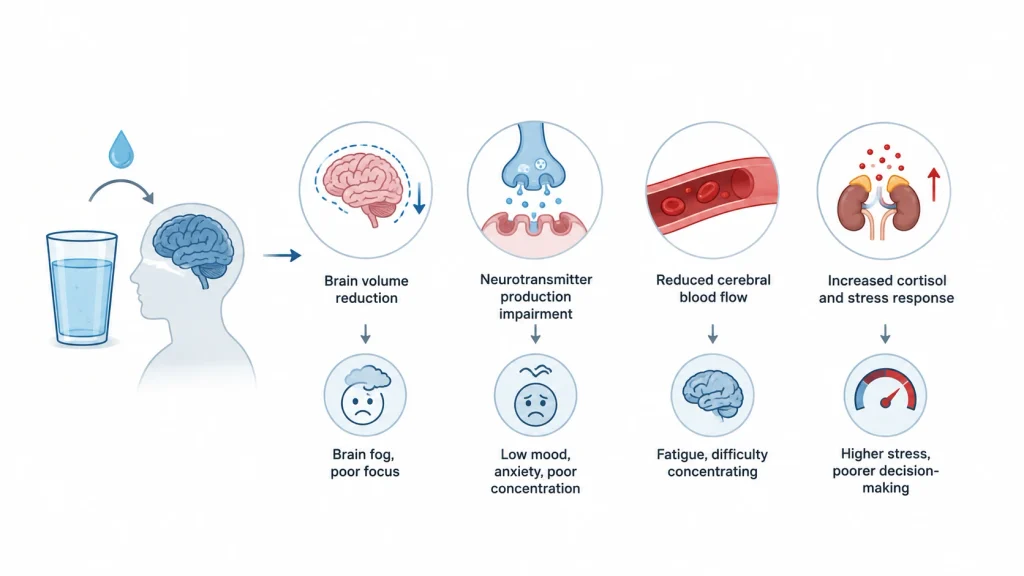
Brain volume reduction. The brain is approximately 75 to 80% water. When total body water falls even by 1 to 2%, brain volume decreases measurably — a change that MRI studies have confirmed produces structural changes in white matter and grey matter that correlate with cognitive impairment. The brain’s physical volumetric response to dehydration is one of the most compelling demonstrations that water is not simply a solvent but a structural component of brain tissue.
Neurotransmitter production impairment. Water is required for the production, transport, and receptor binding of virtually every neurotransmitter. Serotonin synthesis requires the enzyme tryptophan hydroxylase, which has an absolute water requirement. Dopamine and acetylcholine synthesis and receptor function are also compromised by dehydration. The mood effects of mild dehydration — increased anxiety, reduced positive affect, impaired concentration — reflect these neurotransmitter-level impairments.
Reduced cerebral blood flow. Dehydration reduces plasma volume, which reduces cardiac output and the volume of blood reaching the brain. Even mild reductions in cerebral perfusion impair the delivery of oxygen and glucose to neurons — producing the brain fog, fatigue, and difficulty concentrating that characterise mild dehydration. The brain has an extraordinarily high metabolic demand (20% of total oxygen consumption despite comprising 2% of body weight) and is disproportionately sensitive to any reduction in blood flow.
Increased cortisol and stress response. Dehydration activates the hypothalamic-pituitary-adrenal (HPA) axis, elevating cortisol. This is an adaptive response in genuine survival situations (cortisol mobilises glucose and suppresses non-essential functions to maintain blood pressure). But in the context of daily office work, chronically elevated cortisol from mild dehydration adds to the already-elevated stress burden documented in our Chronic Stress guide, further impairing prefrontal cortex function and decision-making capacity.
The Specific Cognitive Domains Most Affected
2026 research has become increasingly specific about which cognitive domains are most sensitive to mild dehydration:
• Attention and concentration: among the most sensitive to even 1% dehydration, with measurable declines in sustained attention task performance.
• Working memory: the capacity to hold information in mind while processing it — essential for complex reasoning, mathematics, writing, and decision-making.
• Psychomotor speed: reaction time and the speed of mental and physical responses. Impairments at 2% dehydration are comparable to the effect of mild alcohol intoxication.
• Mood: increased fatigue, tension, anxiety, and reduced vigour — even at 1.5% dehydration in women and 2% in men, mood deteriorates measurably.
• Short-term memory: ability to encode new information, relevant to learning effectiveness and professional performance.
The Indian Summer Context
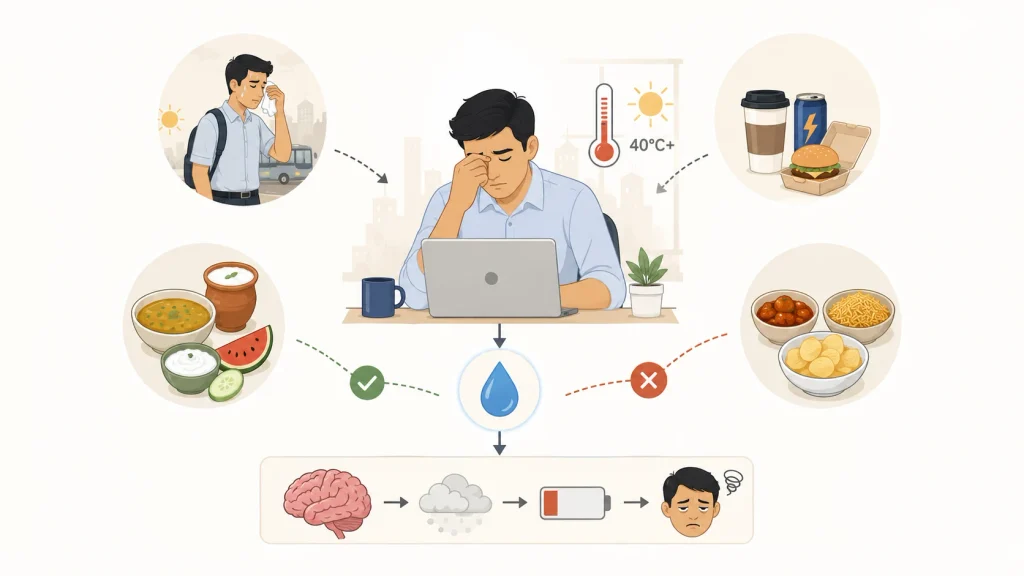
The practical relevance of this research is amplified dramatically by the Indian climate. Summer temperatures in many parts of India regularly exceed 40°C, and even in air-conditioned environments, sweat losses during commuting, lunch breaks, and outdoor activities can produce dehydration rates that office-based workers in temperate climates never experience.
The traditional Indian dietary pattern includes many naturally hydrating foods — dal (high water content from cooking liquid), curd, chaas (buttermilk), fresh vegetables, and fruits. But the modern urban dietary pattern — office work, packaged food, high caffeine and low water beverage choices — systematically reduces hydration status during the working day.
Additionally, many traditional Indian diets are high in sodium (salt, pickle preparations, processed snacks), which increases water requirements without necessarily increasing water intake. The net effect is that many urban Indian professionals are operating in a state of chronic mild dehydration that is directly impacting their professional cognitive performance — and attributing the resulting brain fog and fatigue to overwork, poor sleep, or stress.
The Hydration Protocol I Recommend
Target intake: 2,500 to 3,000ml (2.5 to 3 litres) daily for most adults in temperate conditions; 3,000 to 3,500ml in Indian summer conditions or for physically active individuals. This includes water from all sources: drinking water, tea and coffee (which do contribute to hydration despite mild diuretic effects), water from food (approximately 20 to 30% of daily intake for people eating adequate fruits and vegetables).
Timing strategy: The most evidence-based hydration timing for cognitive performance: 500ml on waking (replaces overnight losses and supports morning cortisol response), 250ml before each meal (reduces meal energy density by increasing stomach volume before eating — another application of the energy density principle from our JAMA vegan diet article), and 250ml at each movement break during the working day (pairs hydration with the desk-break strategy).
Electrolyte awareness: Plain water is appropriate for moderate conditions. In high heat or high physical activity conditions producing significant sweat, sodium, potassium, and magnesium are lost alongside water. Coconut water (natural electrolyte beverage with potassium, sodium, and magnesium) is an excellent Indian-context electrolyte supplement. Traditional chaas (buttermilk with rock salt and cumin) provides electrolytes, probiotics, and hydration simultaneously — one of the most nutritionally complete traditional hydration beverages available.
Coffee and tea contribution: Despite their caffeine content, coffee and tea in moderate amounts (3 to 5 cups daily) contribute positively to hydration — the diuretic effect of caffeine is exceeded by the volume of water delivered. The Finnish body composition research we covered in our August 2026 Vol V coffee body composition article found that heavy coffee drinkers (5+ cups daily) showed metabolic benefits including lower visceral fat — not the dehydration consequences that excessive caffeine fear-mongering would predict.
The Takeaway
The 2026 evidence on hydration and cognitive performance crystallises around a simple but underappreciated finding: at 1 to 2% body weight dehydration — below the threshold of perceived thirst — measurable and clinically meaningful impairments in attention, working memory, mood, and psychomotor speed occur. In the Indian context of hot climate, high-sodium traditional foods, and modern office working patterns, chronic mild dehydration is one of the most common and most overlooked performance-limiting factors. 2.5 to 3 litres daily, timed strategically, with electrolyte awareness during high-heat conditions — this is the foundational habit that amplifies every other nutritional intervention we cover. Proper hydration is not optional; it is the solvent in which all other nutritional strategies operate. For the complete nutrition and lifestyle framework, see our Functional Nutrition guide and our Wellbeing Mastery guide.
About the Author
Tanveer Ahmed Khan is a K11 School of Fitness Sciences-certified personal trainer and nutrition coach with 12+ years of strength training experience. Coaching: info@livenulife.com | Instagram: @fitwithtanveer | livenulife.com
Scientific References
1. 2026 systematic reviews on mild dehydration and cognitive performance — multiple meta-analyses in European Journal of Nutrition and Nutrients.
2. Ganio, M.S., et al. (2011). Mild dehydration impairs cognitive performance and mood of men. British Journal of Nutrition — foundational study regularly updated in 2026 reviews.
3. Armstrong, L.E., et al. (2012). Mild dehydration affects mood in healthy young women. Journal of Nutrition — updated and extended in 2026 meta-analyses.
4. Our August 2026 Vol V: Finnish coffee body composition study (Verroest et al., 2026, European Journal of Nutrition) — coffee’s net positive hydration contribution.
5. Our August 2026 Vol IV: Columbia sleep-weight gain study — cortisol-hydration-sleep interaction mechanisms.