By Tanveer Ahmed Khan | K11-Certified Trainer & Dietitian-Nutritionist | REPS India Registered | August 2026 | 12 min read
KEY TAKEAWAY: A 16-week randomised clinical trial of 244 adults published in JAMA Network Open (August 17, 2026) found that a low-fat vegan diet reduced dietary energy density by 30%, causing participants to lose an average of 5.9 kilograms and 355 calories per day MORE than the control group — without any instruction to count calories, reduce portions, or eat less food by weight. The mechanism is energy density: plant foods contain more water and fibre per gram, making them naturally less calorie-dense. Here is why this changes how we think about weight management.
The Weight Loss Question That Has Always Been Wrong
For at least 50 years, the dominant framing of weight management has been: eat less, move more. Consume fewer calories than you burn. Create a deficit. This advice is mechanistically correct at the thermodynamic level — you cannot violate the laws of physics — but it fails to address the most important practical question: how do you consistently eat fewer calories without feeling deprived, hungry, and cognitively exhausted by the constant calculation?
Calorie restriction as a primary strategy has a well-documented long-term failure rate that approaches 80 to 95% in most studies when follow-up extends beyond one year. The problem is not the science. The problem is that chronic calorie restriction produces escalating hunger hormones (ghrelin rises, leptin falls), decreasing metabolic rate, increasing psychological preoccupation with food, and eventually a rebound that overwhelms the initial deficit. People do not fail diets because they lack willpower. They fail because the biological systems designed to protect against starvation are working exactly as intended.
A study published in JAMA Network Open on August 17, 2026 — led by Dr Hana Kahleova, director of clinical research at the Physicians Committee for Responsible Medicine, and co-authored with Neal D. Barnard — offers a different framework entirely. Not eat less. Eat differently.
📖 Also read: Why Intermittent Fasting Beats Calorie Counting — July 2026 — The University of Adelaide study showing intermittent fasting produces equivalent weight loss to calorie restriction with less psychological burden — the same “eat differently, not less” principle that the JAMA vegan trial demonstrates.
The Study: 244 Adults, 16 Weeks, No Calorie Limit
The JAMA Network Open trial enrolled 244 adults between ages 25 and 75 with BMIs ranging from 28 to 40 — overweight to obese. Participants were randomly assigned to one of two conditions:
• Low-fat vegan diet group: instructed to follow an ad libitum (eat as much as you want) low-fat plant-based diet rich in fruits, vegetables, whole grains, and legumes. No calorie targets were given. No portion limits were set. Participants could eat until satisfied.
• Control group: asked to make no changes to their usual diet.
The study measured dietary energy density — calories per gram of food consumed — alongside total calorie intake, food weight consumed, and body weight changes.
After 16 weeks, the vegan group lost an average of 5.9 kilograms (approximately 13 pounds). Their daily calorie intake fell by approximately 355 calories more than the control group. And critically: the total weight of food they consumed did not decrease significantly. They were eating the same physical amount of food — just food that contained approximately 30% fewer calories per gram.
“You don’t have to eat less,” said Dr Kahleova. “You can eat more food, feel full, and still lose weight — by choosing foods that are naturally lower in energy density.”
Energy Density: The Key Concept
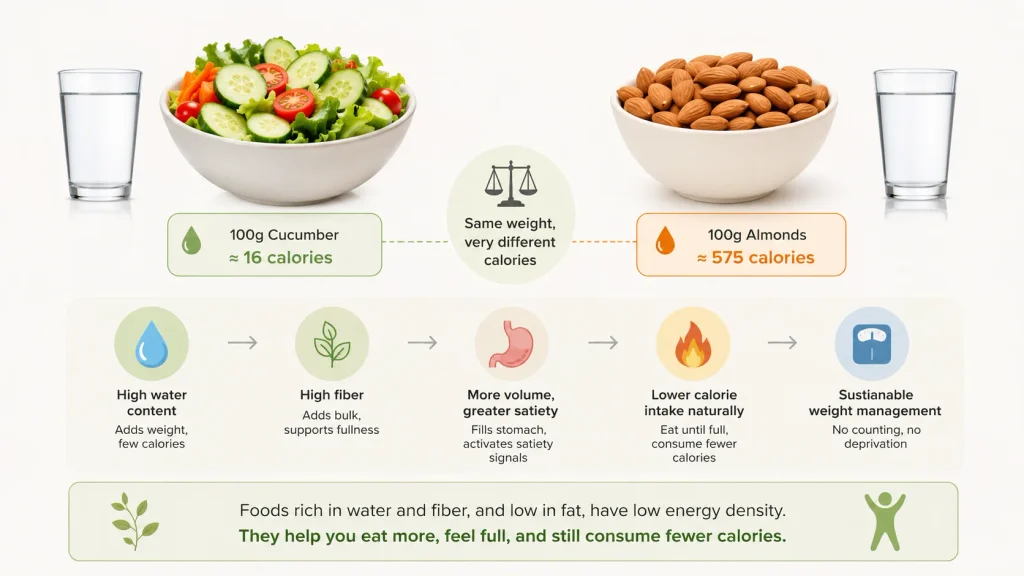
Energy density — calories per gram of food — is the central concept in the JAMA trial, and it is worth understanding precisely because it fundamentally reframes how food choices affect body weight.
Water and dietary fibre are the two components that lower a food’s energy density. Both add physical weight, volume, and satiety without contributing meaningfully to calorie content. When you eat a food high in water and fibre, you are consuming more grams, filling your stomach, activating stretch receptors that send satiety signals to the brain — all with relatively fewer calories than a calorie-dense food would deliver in the same gram quantity.
Consider a practical comparison: 100 grams of cucumber contains approximately 16 calories. 100 grams of almonds contains approximately 575 calories. If you eat 200 grams of food and half of that is cucumber, you will be consuming dramatically fewer calories than if you ate 200 grams of mixed nuts — even though the physical quantity (weight of food) is identical.
The low-fat vegan diet is naturally and dramatically lower in energy density than omnivorous diets because:
• Vegetables, fruits, and legumes have very high water content — often 70 to 95% water by weight.
• Whole plant foods are fibre-rich, and fibre adds bulk without calories.
• Low-fat vegan diets eliminate the highest-calorie-density foods in typical diets: cheese, processed meats, butter, and oils (fat contains 9 calories per gram versus 4 for carbohydrate or protein).
The result is that a person can eat until genuinely full — activating all the biological satiety mechanisms — while consuming fewer calories than their body requires, without the conscious restriction that drives calorie-counting failure.
Why This Works When Calorie Counting Doesn’t
The JAMA trial’s mechanism is distinct from calorie restriction in a clinically important way: it works with the body’s satiety systems rather than against them. Understanding this distinction explains why the outcomes are achievable without the failure patterns that plague explicit calorie counting.
Volume satiety: stretch receptors in the stomach. The stomach contains mechanoreceptors — stretch-sensing neurons — that fire when the stomach reaches a certain volume. These signals reach the hypothalamus within 20 to 30 minutes of eating and contribute meaningfully to meal termination. When you eat low-energy-density foods, you fill your stomach with the same physical volume that would have contained far more calories in a high-energy-density meal. Your stretch receptors fire. Your brain receives the fullness signal. You stop eating. Without having consciously restricted anything.
Hormonal satiety: GLP-1 and CCK. Dietary fibre in plant foods ferments in the gut to produce short-chain fatty acids that stimulate GLP-1 release — the appetite-regulating hormone also targeted by Ozempic and Wegovy. Protein from legumes and whole grains stimulates cholecystokinin (CCK) and peptide YY (PYY) — powerful satiety hormones produced in the small intestine. These are the same hormonal signals that drive satiety in the GLP-1 nutrition strategy we covered in our Boost GLP-1 Naturally article. The low-fat vegan diet activates this system through dietary fibre and plant protein, not pharmacological intervention.
Cognitive ease: no tracking, no calculation. The July 2026 University of Adelaide intermittent fasting trial we covered demonstrated that reducing the cognitive burden of dietary decisions is one of the most important factors in sustainable weight management. The low-fat vegan diet requires no calorie tracking — participants simply eat from a food category (whole plants, low fat) until satisfied. The reduced cognitive load may itself contribute to better dietary adherence and lower stress-related cortisol, which independently supports healthy body composition.
The Indian Application: Why This Research Is Particularly Relevant
The low-fat vegan dietary pattern described in the JAMA trial is not exotic or alien to Indian food culture. It is, in many respects, a description of the traditional Indian vegetarian dietary pattern before the ultra-processed food displacement of the past two decades.
A traditional South Indian lunch or North Indian dal-roti meal — dal (lentils), sabzi (vegetable preparation), roti (whole wheat flatbread), curd (yoghurt, excluded in the strict vegan framework but low-fat in the trial) — is naturally low in energy density, high in dietary fibre, and plant-forward. The problems with Indian dietary patterns in 2026 are not with the traditional whole-food component. They are with what has been added: refined oils used in ever-increasing quantities, packaged snacks, sweetened beverages, commercial biscuits, instant noodles, and processed sweets that dramatically raise the energy density of the diet.
The practical implication: one does not need to adopt a strict Western-style low-fat vegan diet to apply this research’s insight. Reducing the energy density of your existing Indian dietary pattern — by increasing the proportion of vegetables and legumes, reducing the oil quantity in cooking, and replacing high-energy-density snacks with whole fruit and raw vegetables — produces the same fundamental mechanism without requiring cultural dietary overhaul. For the specific fibre diversity that supports GLP-1-driven satiety in this approach, see our Fibermaxxing guide.
The Study’s Limitations — Important Context
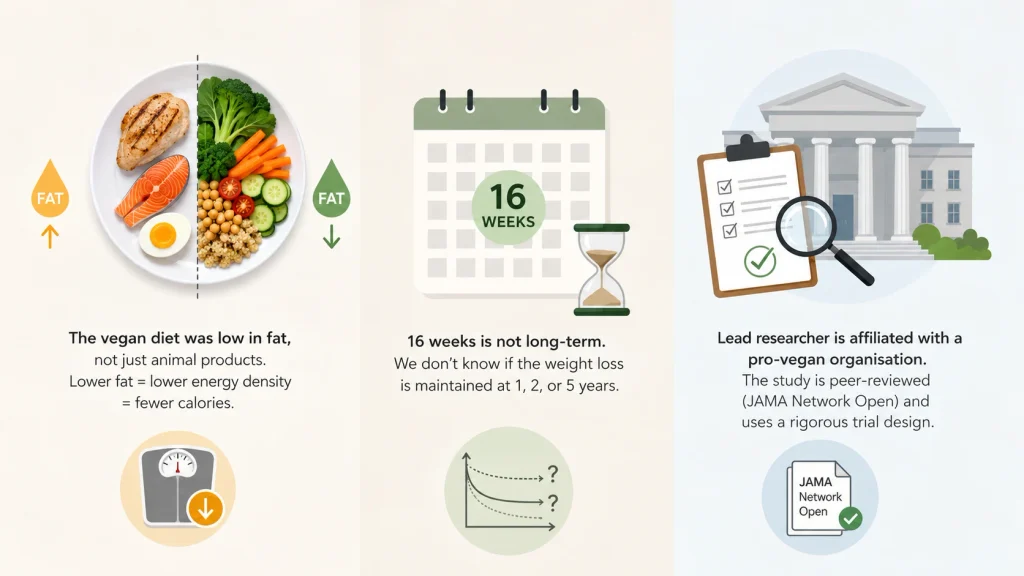
The vegan diet was also lower in fat, not just animal products. The trial specifically tested a low-fat vegan diet — not simply a vegan diet or a plant-based diet. The fat reduction contributes significantly to the energy density reduction, since fat contains more than twice as many calories per gram as carbohydrate or protein. Whether higher-fat plant-based diets (avocado, nuts, olive oil-heavy patterns) produce the same energy density and weight loss effects is a separate question this trial cannot answer.
16 weeks is not a long-term follow-up. Whether the 5.9kg weight loss is maintained at one year, two years, or five years — and whether energy density reduction is sustainable without dietary variety fatigue — requires longer-term research.
Lead researcher’s institutional affiliation. Dr Kahleova is director of clinical research at the Physicians Committee for Responsible Medicine — an organisation with an explicit pro-vegan stance. This does not invalidate the research, which was published in JAMA Network Open (peer-reviewed) and uses a randomised controlled design. But it is appropriate context for readers to have when interpreting the claims.
My Clinical Application: The Energy Density Protocol
After 12 years of weight management coaching, I have found that the energy density framework is one of the most practical and sustainable approaches for clients who find calorie counting demoralising or unsustainable. Here is how I apply it in practice — without requiring strict veganism:
Plate composition target: At least half of every plate by volume — not weight or calories — should be vegetables or raw salad. This ensures the physical volume of the meal is dominated by low-energy-density foods before adding higher-energy-density components like grain, protein, or fat.
Soup and broth first: Starting meals with a broth-based vegetable soup — tomato, dal shorba, rasam — activates gastric stretch receptors and GLP-1 release before the higher-energy-density components of the meal arrive. Studies show this simple practice reduces calorie intake from the main meal by 15 to 20% without reducing satisfaction.
Whole fruit over juice: As we covered in our August 2026 Vol II article on the fructose-glucose brain hunger research, whole fruit’s fibre content makes it dramatically lower in effective energy density than juice of the same fruit. An orange is 50 calories. A glass of orange juice (the equivalent of 3–4 oranges) is 120 calories — with none of the fibre-mediated satiety.
Oil quantity reduction — not elimination: Indian cooking traditions use significantly more oil than the traditional recipes call for, particularly in commercial and restaurant contexts. Reducing oil by 30 to 50% in home cooking while maintaining whole food diversity captures much of the energy density benefit without the cultural dietary disruption of strict veganism.
For the complete nutritional science of how plant-forward eating activates the body’s own satiety and weight regulation systems, see our GLP-1 Naturally article and our Functional Nutrition guide.
The Takeaway
The JAMA Network Open 2026 trial of 244 adults delivers the most direct randomised evidence to date of the energy density mechanism: eating the same physical weight of food — the same grams, the same volume, the same stomach fullness — but from low-energy-density plant sources produced 5.9kg of weight loss and 355 fewer calories per day, without any instruction to eat less. This is not magic. It is physics and physiology: plant foods contain water and fibre that fill the stomach without filling the calorie budget. The practical implication for anyone who has failed at calorie counting: stop trying to eat less and start eating differently. Choose higher-water, higher-fibre foods that fill your plate and your stomach while naturally containing fewer calories per gram. For the complete weight management framework that integrates energy density, GLP-1 activation, intermittent fasting, and protein optimisation, see our full Functional Nutrition guide.
About the Author
Tanveer Ahmed Khan is a K11 School of Fitness Sciences-certified personal trainer and REPS India-registered dietitian-nutritionist with over 12 years of experience. Coaching: info@livenulife.com | Instagram: @fitwithtanveer | livenulife.com
Scientific References
1. Kahleova, H., Znayenko-Miller, T., Maracine, C., Holubkov, R., Barnard, N.D. (2026). Vegan Diets and Dietary Energy Density: A Secondary Analysis of a Randomized Clinical Trial. JAMA Network Open, 9(8): e2627483. DOI: 10.1001/jamanetworkopen.2026.27483
2. ScienceDaily / Physicians Committee for Responsible Medicine. (August 17, 2026). Low-fat vegan diet helps people lose weight without eating less.
3. Newsweek. (2026). People Lost Weight Without Restricting Food on This One Diet, Study Finds.
4. SciTechDaily. (2026). How a Low-Fat Vegan Diet Helped People Lose Weight Without Counting Calories.
5. ZME Science. (2026). This Diet Helped People Lose Weight Without Eating Less Food.