By Tanveer Ahmed Khan | K11-Certified Trainer & Dietitian-Nutritionist | REPS India Registered | August 2026 | 12 min read
KEY TAKEAWAY: A randomised trial by researchers at Università Cattolica in Milan, published in the International Journal of Clinical and Health Psychology (June 2026), found that older adults who knowingly took placebo pills for three weeks improved short-term memory by a significant margin, reduced perceived stress, and improved physical performance by 9.2%. Even more remarkably, those who knew the pills were inactive showed equal or greater improvements than those deceived into thinking they were real. This overturns assumptions about how the mind-body connection works — and has profound implications for how we approach healthy ageing.
The Pill That Had No Active Ingredients — And Changed Everything
The placebo effect is medicine’s best-kept open secret. Every clinician knows it exists. Most assume it requires deception to work — that the patient must believe they are receiving a real treatment for the psychological response to materialise. A study published in the International Journal of Clinical and Health Psychology in March 2026 and covered widely through June 2026 challenges this assumption at its foundation.
Researchers at Università Cattolica in Milan — led by Diletta Barbiani, Alessandro Antonietti, and Francesco Pagnini — designed a three-arm randomised controlled trial with 90 healthy older adults. The three groups were:
• Control group: no intervention whatsoever.
• Deceptive placebo group: received placebo pills but were told they contained active ingredients effective for improving function and wellbeing.
• Open-label placebo group: explicitly informed that the pills were completely inert (inactive), but were told that placebos can still induce beneficial mind-body responses through expectation and attention.
After three weeks, both placebo groups showed measurable improvements compared to the control group. But the finding that has generated the most scientific attention is this: the open-label group — those who knew the pills were fake — showed equal or greater improvements than the deceived group on most measures. Knowing the treatment was inert did not eliminate the benefit. In some cases, it amplified it.
📖 Also read: Natural Anxiety Relief: 7 Proven Remedies — The mind-body mechanisms that produce placebo benefits — expectation, attention, and psychological safety — are the same mechanisms that make these evidence-based anxiety interventions work.
What Exactly Improved — The Measurements
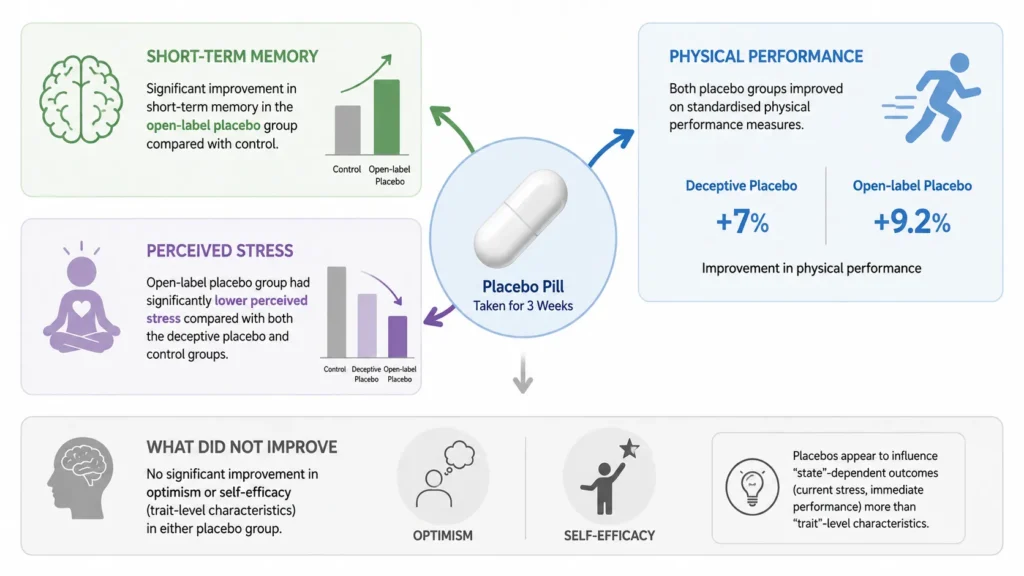
Short-term memory: The open-label placebo group showed significant improvements in short-term memory compared with the control group. This is a clinically relevant cognitive domain that declines with age and is one of the first functions affected by neurodegenerative disease. A non-pharmacological intervention improving memory in healthy older adults in three weeks, without any active ingredient, is a finding that demands explanation.
Physical performance: Both placebo groups improved on standardised physical performance measures. The deceptive placebo group improved physical performance by 7%, and the open-label group by 9.2%. This performance improvement, in the group that knew the pills were inactive, substantially exceeded the improvement in those who were deceived into thinking they were real.
Perceived stress: The open-label placebo group showed significantly lower levels of perceived stress compared with both the deceptive placebo and the control groups — making it the best-performing intervention on this measure. Given the enormous health consequences of chronic stress for ageing populations — its role in cortisol dysregulation, immune suppression, cardiovascular risk, and cognitive decline — a safe, accessible intervention that measurably reduces perceived stress in three weeks has meaningful clinical value.
What did not improve: Optimism and self-efficacy (trait-level psychological characteristics) did not improve significantly in either placebo group. The researchers interpret this as suggesting that placebos may more strongly influence “state”-dependent outcomes (current stress levels, immediate cognitive performance) than “trait”-level characteristics (enduring personality features). This is an important scientific nuance — the placebo is not a general cure for everything, but a targeted tool for specific modifiable outcomes.
Why Open-Label Placebo Works — And Why Knowing It’s Fake Doesn’t Kill It
The conventional understanding of placebo requires the patient to be deceived into believing the treatment is real. The Milan trial suggests this is wrong — and the researchers propose several mechanisms for why open-label placebo produces genuine biological effects even without deception.
1. Expectation activates real physiological pathways. When the Milan researchers explained to participants that “placebos can still trigger helpful mind-body responses,” they activated the expectation pathway — the same neural mechanism that operates in deceptive placebos. Research in placebo neuroscience has established that the mere expectation of improvement triggers the release of endogenous opioids, dopamine, and other neurotransmitters that produce real physiological changes. The expectation does not require deception; it requires a plausible framework for why something might help.
2. Attention and ritual create their own effects. Taking a pill — even a known placebo — involves a daily ritual: a deliberate, repeated act that signals to the body and brain that something is being done for one’s health. This act of attention and self-care has its own effects: it activates the parasympathetic nervous system, reduces cortisol, and increases the sense of agency and control over one’s health. These are not trivial biological changes.
3. The conditioning model. Placebo research pioneer Ted Kaptchuk at Harvard has proposed that placebo effects are partly conditioned responses — the body has learned over a lifetime that taking medicine produces improvement, and this conditioned response fires even when the medicine is inert. You do not need to believe the current pill is real; the deeply conditioned association between pill-taking and improvement is sufficient.
4. The therapeutic relationship effect. The Milan researchers provided participants with a framework for understanding why the placebo might work. This explanation — delivered by researchers who are credible authority figures — constitutes a form of therapeutic interaction that is itself beneficial. The quality of the explanatory framework may have been a significant contributor to the open-label group’s strong response.
What This Means for Healthy Ageing — And My 12 Years of Clinical Practice
The Milan 2026 trial has implications that extend far beyond its primary findings about placebo pills. It is fundamentally a study about the power of expectation, attention, and psychological framework in shaping physiological outcomes in older adults.
In my 12 years of coaching and clinical practice, I have observed this mechanism operating consistently in the exercise and nutrition context. Clients who approach their health programme with a belief framework — “I understand why this works, I expect this to help me, I am paying attention to it daily” — consistently outperform those who follow identical protocols without that psychological engagement.
The supplement parallel: The Milan trial speaks directly to the supplement industry. Hundreds of billions of dollars are spent globally on supplements that have weak or no evidence base. The placebo data suggests that some of what people experience as “benefit” from these supplements — improved energy, better mood, sharper focus — may reflect genuine placebo physiology rather than pharmacological action. This is not nothing: if taking a safe, inexpensive placebo genuinely reduces stress and improves memory, it has real value. But it should be understood as a psychological mechanism, not a pharmaceutical one.
The ritual medicine parallel: Many traditional Ayurvedic and naturopathic interventions embed their therapeutic recommendations within elaborate rituals — morning routines, specific preparation methods, sequential practices. The Milan data suggests that the ritual dimension of these practices may produce genuine biological effects through the attention, expectation, and conditioning mechanisms described above, independent of whatever pharmacological activity the specific herb or practice has. Our coverage of the Ayurvedic morning routine for energy and Ancient Wisdom Meets Modern Science explores this intersection further.
The mindset-performance connection: The 9.2% physical performance improvement in the open-label group is particularly striking from a trainer’s perspective. Physical performance in older adults is typically improved through exercise — weeks or months of progressive resistance and cardiovascular training. A placebo pill producing 9.2% improvement in three weeks through psychological mechanisms suggests that mindset and expectation play a larger role in physical performance than most exercise science acknowledges. The practical implication: how we frame exercise programmes, the narrative we build around them, and the sense of agency and expectation we help clients develop may be as important as the specific exercise prescription.
📖 Also read: Gratitude Journaling: How It Shapes Mood Stability and Daily Motivation — The daily attention ritual that activates similar psychological mechanisms to open-label placebo — expectation, self-care intention, and directed attention toward improvement.
The Ethical Dimension: Open-Label Placebos as Clinical Tools
The most practically significant finding in the Milan study is the demonstration that open-label placebos — administered with full transparency — can produce genuine benefits. This resolves the central ethical objection to therapeutic placebo use in clinical practice.
Using deceptive placebos in medicine violates informed consent — one of the foundational principles of medical ethics. This has largely prevented the explicit use of placebo as a therapeutic tool, even when clinicians believe it might help a patient.
Open-label placebo dissolves this ethical barrier. If transparent disclosure of inertness does not eliminate the beneficial effects — as the Milan trial demonstrates — then clinicians can offer placebo as an explicitly-labelled, ethically acceptable intervention. This could be particularly valuable in older populations where polypharmacy (taking many medications simultaneously) is a major health risk, and where the side effects of pharmaceutical interventions often significantly exceed their benefits for non-serious conditions.
The British Psychological Society, reviewing the study, noted: “These findings suggest the potential of open-label placebos as a promising, ethically acceptable approach for supporting healthy ageing.” The International Journal of Clinical and Health Psychology publication represents a peer-reviewed foundation for what may become a recognised therapeutic modality.
Practical Applications: What You Can Do Right Now
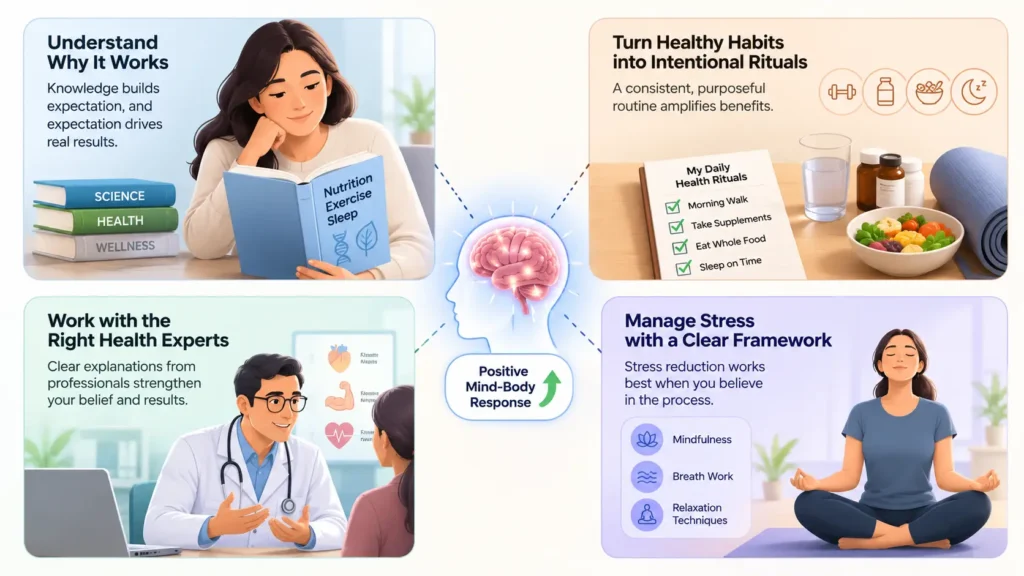
The Milan trial’s findings are not merely theoretical — they point to specific, immediately implementable practices that activate the same mechanisms responsible for placebo’s beneficial effects.
Build expectation frameworks around health behaviours. When starting any new health habit — dietary change, exercise programme, supplementation protocol, sleep hygiene improvement — invest time in understanding why it is expected to work. The depth of mechanistic understanding correlates with the strength of the expectation pathway. Read the research. Understand the biology. The understanding activates the expectation that activates the physiology.
Create health rituals with intentionality. The specific daily act of taking a placebo — a consistent, deliberate behaviour with clear health intention — produced measurable physiological benefits. The same principle applies to any health ritual: morning exercise, taking supplements, preparing whole-food meals, a daily walk. The ritualistic, intentional quality of these acts matters beyond their immediate pharmacological or physiological effects.
Leverage the therapeutic relationship. Work with health professionals who invest in explaining the mechanisms behind their recommendations. The quality of the explanatory framework is a therapeutic tool in itself — it shapes expectation, builds confidence, and activates the cognitive pathways that produce placebo-like enhancement of genuine interventions.
Use stress management practices with a clear belief framework. The Milan study found that perceived stress reduced most powerfully in the open-label placebo group. This mirrors what we know about evidence-based stress reduction practices: mindfulness-based stress reduction (MBSR), progressive muscle relaxation, and breath work produce the most powerful effects in people who approach them with a clear framework for why they work. See our Mindfulness for Stress Relief guide and our Stress Management Solutions guide.
Important Limitations and the Bigger Picture
The Milan study must be contextualised appropriately. It involved 90 healthy older adults over three weeks — a small sample and a short timeframe. The improvements, while statistically significant, are not so large that they eliminate the need for genuine pharmacological or lifestyle interventions for health conditions. Placebo is not a substitute for evidence-based treatment, exercise, nutrition, or medical management of disease.
What the study does provide is a scientific foundation for understanding that psychological engagement with health behaviours amplifies their effects — and that this amplification works even when the individual fully understands the mechanism. This is not a trivial finding. It suggests that the psychological dimension of any health intervention — the belief system, the expectation, the ritual, the therapeutic relationship — is not merely a confound to be controlled for, but a genuine mechanism to be leveraged.
The Takeaway
The Università Cattolica Milan 2026 trial reveals that the mind’s role in healthy ageing is more powerful and more accessible than previously understood. Placebo effects — improvements in memory, physical performance, and stress — occur even when participants know they are taking inactive pills, because the mechanisms responsible (expectation, attention, conditioning, therapeutic relationship) do not require deception to operate. For practitioners, clients, and individuals managing their own health, this finding argues for investing in the psychological architecture around every health behaviour: the belief framework, the ritual quality, the mechanistic understanding. These are not soft supplements to hard interventions. They are genuine physiological amplifiers. For the complete wellbeing framework that integrates these principles across nutrition, sleep, and stress, see our Wellbeing Mastery: Science-Based Strategies guide.
About the Author
Tanveer Ahmed Khan is a K11 School of Fitness Sciences-certified personal trainer and REPS India-registered dietitian-nutritionist with over 12 years of experience. Coaching: info@livenulife.com | Instagram: @fitwithtanveer | livenulife.com
Scientific References
1. Barbiani, D., Antonietti, A., Pagnini, F. (2026). Placebo mechanisms in aging: A randomized controlled trial comparing deceptive and open-label placebos on psychological, cognitive, and physical functioning in older adults. International Journal of Clinical and Health Psychology, 26(1): 100673. DOI: 10.1016/j.ijchp.2026.100673
2. ScienceDaily / Università Cattolica. (June 25, 2026). They knew the pill was fake but their memory still improved.
3. Inc. Magazine. (June 24, 2026). Scientists Told Healthy Adults This Memory Pill Was Fake. It Boosted Their Cognitive Performance Anyway.
4. British Psychological Society Research Digest. (2026). Honest placebos aid older adults’ memory more than deceptive ones.
5. MedicalXpress. (March 25, 2026). Sharper mind and body achieved in older adults with a fake supplement in just 3 weeks.