KEY TAKEAWAY: A King’s College London study published in the British Journal of Clinical Pharmacology (June 2026) found that chewing sugary gum after eating beetroot or other nitrate-rich vegetables increased nitrite production by 45% and blood pressure by almost 3 mmHg systolic — revealing that oral acidity is the hidden amplifier of dietary nitrate’s cardiovascular benefits. Here is the mechanism, what it means for your nitrate intake, and how to practically maximise the blood pressure benefits of the vegetables you are already eating.
Your Mouth Is More Important Than You Think for Heart Health
When clients ask me what they can eat to improve blood pressure naturally, beetroot almost always enters the conversation. Most people with any interest in nutrition have heard that beetroot juice is good for blood pressure. Fewer know exactly why. And almost nobody — until the King’s College London research published in June 2026 — knew that the mechanism behind beetroot’s cardiovascular benefits is mediated critically by the bacteria living in your mouth.
Researchers at King’s College London, led by Dr Andrew Webb, Clinical Senior Lecturer in the School of Cardiovascular and Metabolic Medicine and Sciences, have uncovered an unexpected new way to enhance this process. Published in the British Journal of Clinical Pharmacology, their study found that chewing sugary gum after drinking beetroot juice increased nitrite production by 45% and produced a temporary reduction in blood pressure of almost 3 mmHg systolic and 2 mmHg diastolic — compared with chewing sugar-free gum after the same beetroot intake.
The mechanism is both elegant and practically significant. Understanding it transforms how we think about the entire category of nitrate-rich vegetables — not just beetroot, but spinach, kale, rocket, celery, and lettuce.
📖 Also read: 6 Top Foods to Improve Heart Health — The complete evidence-based cardiovascular nutrition framework — beetroot and nitrate-rich vegetables are one of six key categories covered in depth.
The Nitrate-Nitrite-Nitric Oxide Pathway: How It Works
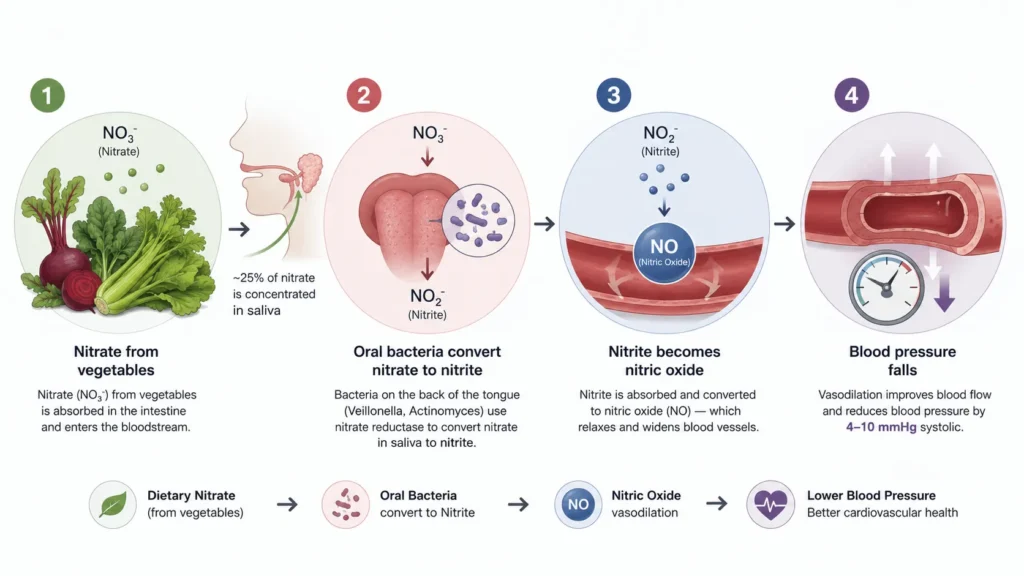
To understand the King’s College finding, you need to understand the biological chain reaction that turns dietary nitrate into cardiovascular protection.
Step 1: Nitrate from vegetables. Vegetables including beetroot, spinach, kale, rocket, celery, and lettuce naturally accumulate nitrate (NO3−) from soil. This nitrate is absorbed in the small intestine and enters the bloodstream. About 25% of circulating nitrate is then actively concentrated and secreted into saliva by the salivary glands.
Step 2: Oral bacteria convert nitrate to nitrite. This is the critical step that most people are unaware of. Beneficial bacteria living on the back of the tongue — primarily Veillonella and Actinomyces species — contain the enzyme nitrate reductase, which converts the nitrate-rich saliva into nitrite (NO2−). This conversion is the rate-limiting step in the entire pathway. Without adequate oral bacteria and conditions that support their enzyme activity, dietary nitrate passes through the body without producing its cardiovascular benefit.
Step 3: Nitrite becomes nitric oxide. Nitrite absorbed from saliva and the gastrointestinal tract is converted into nitric oxide (NO) — the molecule that relaxes and widens blood vessels, reduces arterial stiffness, improves blood flow, and lowers blood pressure. This is the same mechanism targeted by pharmaceutical nitrate medications like glyceryl trinitrate (GTN) used in angina treatment.
Step 4: Blood pressure falls. The increased nitric oxide production causes vasodilation — the relaxation and widening of blood vessel walls — which directly reduces the pressure of blood flow. Research consistently shows blood pressure reductions of 4 to 10 mmHg systolic from dietary nitrate, comparable to some antihypertensive medications.
The King’s College Breakthrough: Acidity as the Hidden Amplifier
Here is where the June 2026 research adds something genuinely new to our understanding of this pathway.
The Monell study question was: can we enhance the nitrate-to-nitrite conversion in the mouth? The King’s College team tested the hypothesis that making saliva more acidic — because nitrate reductase activity in oral bacteria is enhanced in an acidic environment — would increase the conversion efficiency.
Their vehicle for creating an acidic oral environment was, somewhat unexpectedly, sugary chewing gum. The fermentation of sugars by oral bacteria produces lactic acid as a byproduct, lowering salivary pH. When participants chewed sugar-containing gum (Hubba Bubba bubble gum was used in the study) after drinking beetroot juice, compared with sugar-free gum:
• Salivary nitrite concentration increased by 45%
• Systemic (blood) nitrite concentration increased by 25%
• Systolic blood pressure fell by almost 3 mmHg compared with the sugar-free gum condition
• Diastolic blood pressure fell by approximately 2 mmHg
These are not trivial changes. A sustained 3 mmHg reduction in systolic blood pressure corresponds to meaningful reductions in cardiovascular event risk at a population level. And these were short-term effects — the blood pressure reduction from the acidic salivary environment lasted several hours.
The researchers were careful to note — emphatically — that they are not recommending anyone start chewing sugary gum regularly. Frequent sugar consumption is harmful for dental health and cardiometabolic health when consumed in excess. The finding is a proof of concept, pointing toward future research on tooth-friendly, metabolically appropriate ways to create the same acidic oral environment.
“The challenge now is to identify alternative strategies that are both effective and appropriate for long-term use,” said co-author Dr Charlotte Mills, University of Reading.
What This Means for Athletes and Performance Nutrition
While the researchers explicitly caution against clinical application of sugary gum, they specifically noted the relevance for athletes already using beetroot for performance enhancement.
Dietary nitrate supplementation — primarily through beetroot juice — is one of the most extensively studied ergogenic aids in sports nutrition. Research consistently shows it improves exercise efficiency, reduces the oxygen cost of exercise at a given intensity, and delays fatigue in endurance exercise. This is one of the few natural nutritional strategies that actually works in the laboratory and in competition conditions.
As a certified trainer, this is a strategy I have used in practice with clients involved in endurance sports. The typical protocol is 500ml of concentrated beetroot juice consumed 2 to 3 hours before competition or intense training. The King’s College 2026 finding suggests that whatever is consumed to maintain an acidic oral environment in the hours after beetroot intake may amplify the performance benefit — though this requires direct investigation in an exercise context before specific protocols can be recommended.
For the complete exercise performance nutrition framework — combining nitrate strategies with protein timing, hydration, and recovery — see our Recovery Tools guide and our Health and Fitness Tips guide.
The Oral Microbiome: The Hidden Variable in Cardiovascular Nutrition
The King’s College study highlights something that most cardiovascular nutrition research completely ignores: the oral microbiome is a critical mediator of dietary nitrate’s cardiovascular benefits. If the oral bacterial community is disrupted or insufficient, dietary nitrate does not produce nitrite efficiently, and the blood pressure benefit is significantly diminished.
This has a direct practical implication that many people — including some health professionals — are unaware of: antibacterial mouthwash used regularly can substantially reduce dietary nitrate’s cardiovascular benefit by killing the oral bacteria responsible for nitrate reduction. Research published in prior years found that people who used antibacterial mouthwash twice daily had significantly reduced blood pressure-lowering response to beetroot juice.
This connects to the broader oral-systemic health axis that is emerging as a major theme in 2026 nutritional science. The mouth microbiome is not isolated — it communicates with the gut microbiome, the cardiovascular system, and systemic inflammation status. For the complete picture of how microbiome health extends beyond the gut, see our Gut Health Revolution guide and our Microbiome Dysbiosis guide.
Maximising Nitrate Benefits Without Sugary Gum: My Clinical Protocol
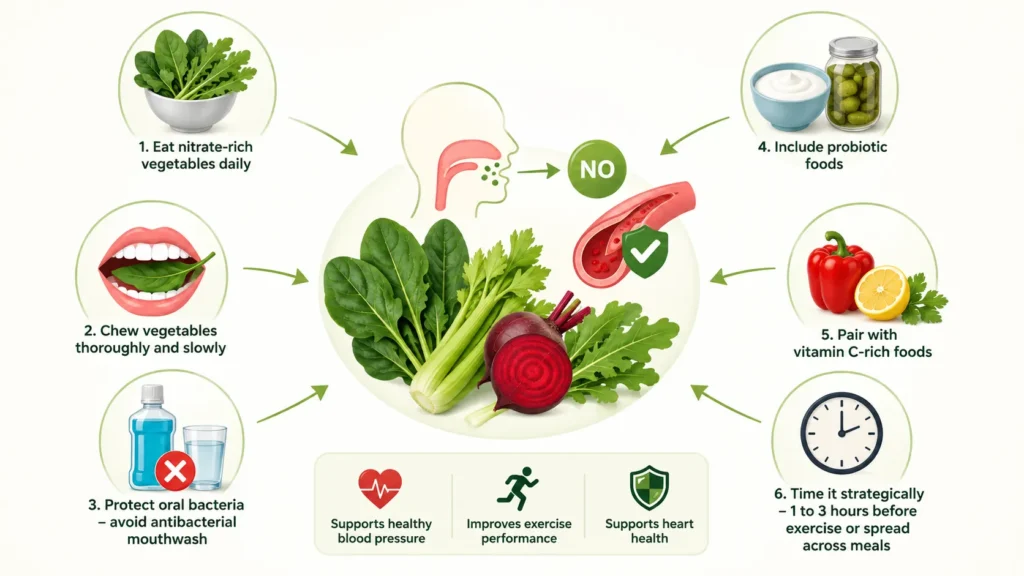
The immediately applicable insight from the June 2026 King’s College research is not about chewing sugary gum. It is about understanding that the oral environment determines how effectively your dietary nitrate is converted into cardiovascular-protective nitric oxide. Here is how I optimise this in practice:
Eat nitrate-rich vegetables daily — not just beetroot. While beetroot gets most of the attention, rocket (arugula) has among the highest nitrate concentrations of any vegetable at approximately 480mg per 100g. Spinach is next at approximately 300mg per 100g. Celery, kale, and lettuce all provide substantial nitrate. Rotating through these vegetables maximises both nitrate intake and dietary diversity. See our Superfoods to Add to Your Breakfast for specific breakfast integration ideas.
Chew vegetables thoroughly and slowly. The nitrate-to-nitrite conversion happens in the mouth, and adequate saliva-vegetable contact time allows oral bacteria more opportunity to reduce the nitrate. Chewing thoroughly is a simple, immediate, free way to improve nitrate conversion efficiency.
Protect oral bacteria from antibacterial mouthwash. If blood pressure management is a priority, consider replacing antibacterial mouthwash with alcohol-free, fluoride-based alternatives that clean without destroying the nitrate-reducing bacterial community on the back of the tongue.
Include probiotic foods to support oral microbiome diversity. The oral microbiome is part of the broader microbial ecosystem. Fermented foods — yoghurt, kefir, naturally fermented pickles — that support beneficial bacterial populations in the gut may also contribute to oral microbiome health. Our Top 15 Probiotic Foods guide covers the fermented food sources with the strongest evidence base.
Pair nitrate-rich vegetables with vitamin C. Vitamin C (ascorbate) enhances nitric oxide synthesis from nitrite and protects nitric oxide from oxidative degradation. Combining nitrate-rich vegetables with vitamin C-rich foods — lemon juice, tomatoes, bell peppers, fresh coriander — in the same meal amplifies the cardiovascular benefit. As we covered in our July 2026 Vitamin C and Brain Health article, vitamin C is significantly more impactful as a food-first strategy than as a supplement.
Time nitrate-rich vegetables strategically. Research shows peak nitrite production occurs 1 to 3 hours after nitrate-rich vegetable or juice consumption. If you are planning intense exercise, schedule beetroot or spinach-heavy meals 2 to 3 hours before training for maximal performance benefit. If you are managing blood pressure, consuming nitrate-rich vegetables at lunch and dinner distributes the blood pressure-lowering effect across the day.
Blood Pressure Numbers That Matter
The clinical significance of the King’s College finding is best understood in context. Hypertension affects an estimated 30% of Indian adults, and awareness, treatment, and control rates remain low. The majority of people with mildly elevated blood pressure (130–159 mmHg systolic) could meaningfully reduce their cardiovascular risk through dietary intervention alone, without requiring immediate pharmaceutical treatment.
Studies of dietary nitrate consistently show 4 to 10 mmHg reductions in systolic blood pressure from optimised intake — comparable to the effect of thiazide diuretics at standard doses. The King’s College finding that optimising the oral conversion environment adds another 3 mmHg reduction on top of baseline dietary nitrate suggests that the combined effect of nitrate-rich diet plus oral microbiome optimisation could be genuinely clinically significant.
This is not a replacement for medical management of hypertension — anyone with blood pressure above 160 mmHg systolic or with cardiovascular risk factors should be under medical care. But for the prevention category — adults with blood pressure in the 120–139 mmHg systolic range where lifestyle intervention is the appropriate first step — the 2026 nitrate research provides some of the most actionable evidence available. Combined with our 6 Top Foods to Improve Heart Health, the beetroot-nitrate protocol forms part of a comprehensive food-first cardiovascular strategy.
The Takeaway
The June 2026 King’s College research reveals that the cardiovascular benefits of dietary nitrate — from beetroot, spinach, rocket, and other nitrate-rich vegetables — are mediated by oral bacteria that convert nitrate to nitrite in an acidic salivary environment. Enhancing that oral acidity amplifies the blood pressure reduction by 45% in terms of nitrite production and 3 mmHg systolic in terms of blood pressure outcome. While sugary gum is not the clinical solution, the underlying principle is immediately actionable: protect your oral microbiome, chew vegetables thoroughly, pair nitrate-rich foods with vitamin C, and eat from the wide range of nitrate-rich vegetables daily.
About the Author
Tanveer Ahmed Khan is a K11 School of Fitness Sciences-certified personal trainer and REPS India-registered dietitian-nutritionist with over 12 years of experience. Coaching: info@livenulife.com | Instagram: @fitwithtanveer | livenulife.com
Scientific References
1. Webb, A.J., Clift, H., Hill, C., et al. (2026). Lowering salivary pH with sugar-containing gum augments salivary nitrite production and blood pressure reduction with dietary nitrate (beetroot juice). British Journal of Clinical Pharmacology. DOI: 10.1002/bcp.70640
2. ScienceDaily / King’s College London. (July 14, 2026). Chewing bubble gum after beetroot may help lower blood pressure.
3. Knowridge Science Report. (July 2, 2026). Unexpected Link Between Beetroot, Chewing Gum and Lower Blood Pressure.
4. MedicalXpress. (June 24, 2026). Chewing sugary gum may enhance the cardiovascular benefits of nitrate-rich vegetables.
5. King’s College London Newsroom. (June 2026). Chewing sugary gum after eating beetroot lowers blood pressure.