
By Tanveer Ahmed Khan | K11-Certified Trainer & Dietitian-Nutritionist | REPS India Registered | August 2026 | 12 min read
KEY TAKEAWAY: A systematic review of 57 studies covering 160,000 people, published in The Lancet Public Health and widely reported in 2025–2026, found that 7,000 steps per day is associated with a 47% lower risk of early death and a 25% lower risk of cardiovascular disease compared with walking only 2,000 steps per day — and delivers similar health benefits to the iconic 10,000-step goal. The 10,000-step target originated from a 1960s Japanese marketing campaign, not science. Here is what the evidence actually supports — and how to apply it.
Where the 10,000 Steps Myth Came From
If you wear a fitness tracker, your daily step goal is almost certainly set to 10,000 steps. If your phone counts steps, it probably measures you against that same target. The 10,000-step goal is one of the most globally recognised health targets in the modern wellness culture.
It originated from a 1965 Japanese marketing campaign for a pedometer called “Manpo-kei” — which translates, conveniently, as “10,000 steps meter.” The number was chosen because it sounded significant and aspirational. It was not based on any scientific evidence about what step count actually optimises health outcomes. For six decades, a marketing decision from a Japanese pedometer manufacturer has been the implicit foundation of global physical activity guidance.
The 57-study systematic review — published in The Lancet Public Health in August 2025 and covered extensively through 2025 and 2026 as the most comprehensive step-count research ever assembled — provides the evidence base that should have existed before the 10,000-step target became cultural dogma.
📖 Also read: 30-Day Steps Challenge: Turn Walking Into a Daily Win — Our practical walking challenge programme — now updated with the evidence-based step targets from the Lancet research instead of the marketing-derived 10,000-step goal.
What the 57-Study Review Found
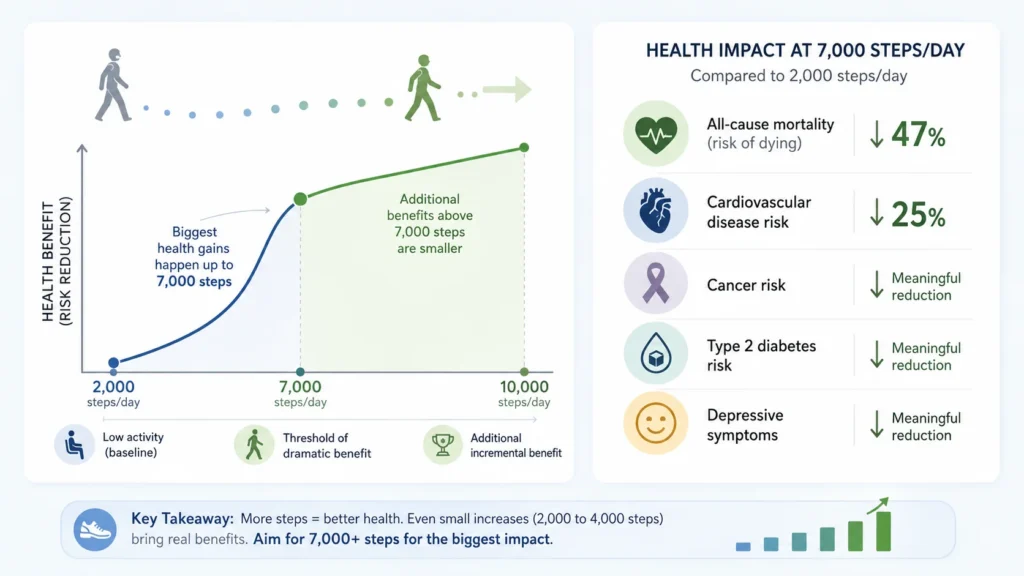
The review, led by the University of Sydney and including data from four continents and 160,000+ participants, examined the relationship between daily step count and multiple health outcomes: all-cause mortality, cardiovascular disease, cancer, type 2 diabetes, and depressive symptoms.
The primary finding: 7,000 steps per day is the threshold of dramatic benefit.
• Compared with walking only 2,000 steps daily, 7,000 steps per day was associated with a 47% lower risk of dying from any cause.
• 7,000 steps per day was associated with a 25% lower risk of developing cardiovascular disease.
• Meaningful reductions in cancer risk, type 2 diabetes risk, and depressive symptoms were also observed at the 7,000-step level.
The dose-response continues above 7,000, but diminishes. Walking from 7,000 to 10,000 steps daily does produce additional health benefits — but the gains are significantly smaller than the improvement from 2,000 to 7,000 steps. The most dramatic risk reduction happens in the first 7,000 steps. The additional 3,000 steps to reach 10,000 deliver incremental benefit.
Benefits appear from as low as 2,000 to 4,000 steps. Even moving from 2,000 to 4,000 steps per day is associated with meaningful improvements in health outcomes. The research confirms that any increase in step count above a sedentary baseline produces measurable benefit — there is no threshold below which walking does not help.
Harvard Health Publication summarised the finding clearly: “Compared to people who walked only 2,000 steps per day, those who clocked 7,000 daily steps had a 25% lower risk of cardiovascular disease and a 47% lower risk of dying from any cause during the study period.”
Why 10,000 Steps Became Impossible for Billions of People
10,000 steps corresponds to approximately 8 kilometres of walking for an average stride length. For the majority of working adults with desk jobs, family responsibilities, and limited time, achieving 10,000 steps consistently is genuinely difficult. Research consistently shows that fewer than 30% of adults in developed countries regularly achieve 10,000 steps per day.
The psychological consequence of a daily target that feels unachievable is, predictably, giving up. People who reach 4,000 or 5,000 steps and feel “far from the goal” are less likely to make incremental improvements than those who understand that 4,000 steps is already associated with meaningful health benefits.
The Lancet 57-study review transforms this dynamic. A person who currently walks 3,000 steps daily and increases to 7,000 steps — still 3,000 short of the mythologised 10,000 — has captured most of the available mortality and cardiovascular risk reduction. That is a genuinely achievable target for the vast majority of adults that makes a real clinical difference.
The Indian Context: Why This Research Is Especially Relevant
India presents a paradoxical step-count picture. Traditional Indian life — before the urban sedentary revolution of the past two to three decades — involved substantial daily walking. Small retailers walk between shops. Vendors, domestic workers, and farmers accumulate step counts that would satisfy any epidemiologist.
But urban professional India tells a different story. A software engineer in Bengaluru, a finance professional in Mumbai, or a lawyer in Delhi may walk from apartment door to car, from car park to elevator, from elevator to desk, and reverse the journey in the evening — accumulating fewer than 3,000 steps on a full working day.
The chronic disease burden that accompanies this sedentary shift is now well-documented. India has the second-highest absolute number of people with type 2 diabetes globally. Cardiovascular disease is the leading cause of death. Obesity rates in urban India have doubled in the past decade.
The Lancet review’s finding that 7,000 steps per day captures most of the available health benefit is directly relevant to this population: it sets a target that is ambitious enough to require genuine behavioural change but achievable enough that it is not self-defeating. For most urban Indian professionals, the gap between their current step count and 7,000 is smaller than the gap to 10,000.
📖 Also read: Walking Challenges That Actually Improve Your Mood — The psychological evidence for walking as a mood and mental health intervention — the motivational framework that makes step increases sustainable.
What 7,000 Steps Per Day Actually Looks Like — and How to Get There
For clients who currently walk fewer than 5,000 steps daily, here is how I structure a realistic escalation:
Baseline audit. Wear any step-counting device for one week without changing behaviour. This establishes the genuine baseline. Most clients are surprised — both those who thought they walked more than they do, and those whose active jobs mean they already approach or exceed 7,000.
The 1,000-step increment strategy. Add 1,000 steps per day per week. From 3,000 to 7,000 takes four weeks at this pace — slow enough to be sustainable, fast enough to feel like progress. Each increment takes approximately 8 to 10 minutes of walking time.
Embed steps into existing routines. The most sustainable step increases do not require finding additional exercise time — they involve replacing sedentary habits with movement within existing time blocks:
• Take stairs instead of lifts or escalators in every building: 200–400 additional steps per transit.
• Park at the far end of parking areas rather than the nearest space: 200–500 steps round trip.
• Walk during phone calls: 1,000–1,500 steps per 10-minute call — the single most impactful habit I know for desk workers.
• Get off public transport one stop early: 1,000–2,000 additional steps per commute.
• Walk to deliver messages in the office rather than sending emails or chat messages: 200–500 steps per message.
• After-meal walks of 10 minutes: approximately 1,000 steps while also improving post-meal blood glucose control (documented in multiple studies).
The desk-break strategy. For clients with sedentary office jobs, I recommend a timer for every 45 to 60 minutes, triggering a 3 to 5 minute walk around the office or building. Six to eight of these breaks per day add 1,500 to 2,000 steps and also interrupt the cardiovascular harms of prolonged sitting, which are independent of total daily step count.
The Step Count and Nutrition Connection: What My 12 Years of Practice Shows
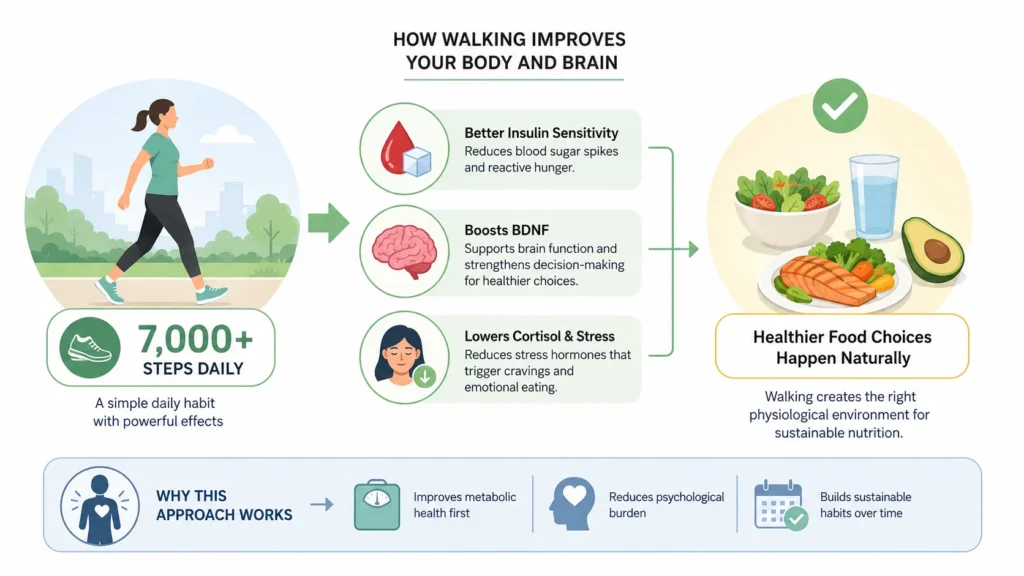
One of the most consistent observations in my clinical work is the interaction between step count and dietary quality. Clients who begin walking more do not just improve their cardiovascular and mortality risk markers — they spontaneously improve their food choices.
The mechanism is bidirectional and well-established: walking improves insulin sensitivity, which reduces blood sugar spikes and the reactive hunger they produce. Walking increases BDNF (brain-derived neurotrophic factor), which supports prefrontal cortex function and improves dietary decision-making. And walking reduces cortisol and stress hormones, which are primary drivers of stress eating and cravings for hyperpalatable foods.
For clients who are struggling with dietary change alone — particularly those who find food restriction demoralising or unsustainable — I frequently lead with the walking intervention rather than dietary prescription. The metabolic improvements from achieving 7,000 steps daily create a more receptive physiological environment for dietary change. Combined with the intermittent fasting research from July 2026 — which showed that the best diet is the one that reduces psychological burden — the walking-first approach makes sense for many clients who have had difficulty sustaining purely diet-based programmes.
Should You Still Aim for 10,000 Steps?
The answer is: it depends on your current step count and your health goals.
If you currently walk fewer than 7,000 steps per day, the evidence clearly indicates that reaching 7,000 steps should be your primary target. This is where the overwhelming majority of mortality and cardiovascular risk reduction sits. Setting 10,000 as the target is fine if it is motivating — but understanding that 7,000 is where most of the benefit lies is liberating for the many people who fall consistently short of 10,000.
If you already walk 7,000 to 8,000 steps consistently, continuing toward 10,000 offers incremental additional benefit — particularly for cancer risk reduction and cognitive health, where higher step counts show continued dose-response benefits in the Lancet data.
If you are already achieving 10,000+ steps most days, the research suggests there is no strong evidence to push substantially higher for general health outcomes, though highly active individuals may benefit from higher counts for specific performance or metabolic goals.
The Takeaway
The 10,000-step target is a 1960s marketing decision that has held outsized influence over global health behaviour for six decades. The Lancet 57-study review replaces it with evidence: 7,000 steps per day captures most of the available mortality and cardiovascular health benefit, corresponds to a 47% reduction in all-cause mortality risk compared with 2,000 steps, and is a genuinely achievable target for the majority of adults who currently fall short of 10,000. For the exercise science that complements daily walking — including how step count interacts with resistance training outcomes in older adults — see our August 2026 HIIT research article and our Walking Challenges guide.
About the Author
Tanveer Ahmed Khan is a K11 School of Fitness Sciences-certified personal trainer and REPS India-registered dietitian-nutritionist with over 12 years of experience. Coaching: info@livenulife.com | Instagram: @fitwithtanveer | livenulife.com
Scientific References
1. University of Sydney et al. (2025). Step count and health outcomes: systematic review of 57 studies involving 160,000+ participants. The Lancet Public Health. Covered by Harvard Health, ScienceDaily, and Medical News Today through 2025–2026.
2. Harvard Health Publishing. (2026). Just 7,000 daily steps reduces heart disease risk.
3. Medical News Today. (2026). Are 7,000 steps a day enough to see health benefits?
4. ScienceDaily / University of Sydney. (July 27, 2025). 7000 Steps a Day Cuts Death Risk by 47%—and That Might Be All You Need.
5. Noom Health Blog. (Updated March 2026). 7000 Steps vs. 10000: What’s Best for Your Health?