KEY TAKEAWAY: A 25-year study of 25,749 Americans published in the American Heart Association’s journal Circulation (June 22, 2026) found that children consuming two or more servings of sugary beverages — including soda, sports drinks, and fruit juice — per day had a 52% higher risk of developing high blood pressure as adults. Whole fruit was not associated with this risk. Replacing one daily sugary drink with water, milk, or whole fruit was associated with meaningful risk reduction. Here is what this means for every family’s beverage choices.
The Long Game: 25 Years of Following Children’s Drinks
The most powerful evidence in nutrition comes from the studies willing to follow people long enough to see consequences that take decades to manifest. A 25-year study does not generate the same clickable headline as a 12-week trial, but it captures something that short-term trials fundamentally cannot: the biological footprint of childhood habits that echoes into middle age.
Research published in Circulation — the American Heart Association’s flagship cardiovascular journal — on June 22, 2026, represents exactly this kind of long-view investment. Senior author Vasanti Malik, ScD, associate professor of nutrition at the University of Toronto and adjunct faculty at the Harvard T.H. Chan School of Public Health, led a team analysing dietary and health data from 25,749 participants recruited to the Growing Up Today Study as children.
Participants were enrolled as children aged approximately 9 to 12 years old and followed for 25 years — from childhood through to their mid-30s. Every 1 to 4 years, they completed dietary questionnaires and reported health outcomes. The researchers tracked who developed hypertension and examined whether childhood beverage patterns predicted this outcome.
The central finding was striking in its magnitude: children who consumed two or more 12-ounce servings of sugar-sweetened beverages per day had a 52% higher risk of developing high blood pressure as adults compared with those who drank fewer than three servings per week. A 52% elevated risk from a single dietary pattern, sustained over 25 years, is one of the strongest diet-disease associations in paediatric nutritional epidemiology.
📖 Also read: Why Going Completely Sugar-Free May Backfire — June 2026 — The ENDO 2026 finding that the type of sugar and its food source matter more than sugar quantity — directly relevant to understanding why whole fruit does not carry the same risk as fruit juice.
The Fructose Source Distinction: Why Whole Fruit Is Different
The most nuanced and scientifically important finding in the Circulation study is the differential effect of fructose sources on blood pressure risk. This detail has been underemphasised in popular coverage but is fundamental to understanding the mechanism.
Total fructose intake: no independent association. When the researchers analysed total fructose consumed — from all sources combined — they found no significant association with hypertension risk after controlling for lifestyle factors. Fructose per se is not the culprit.
Fructose from sugar-sweetened beverages and juice: significantly associated. Fructose arriving in liquid form — whether from soda, sports drinks, lemonade, fruit punch, or fruit juice — was significantly associated with higher hypertension risk. The type of beverage mattered, with both soda and sports drinks showing the strongest associations.
Fructose from whole fruit: not associated with risk. Whole fruit consumption — even high amounts — was not associated with increased hypertension risk. In fact, substituting whole fruit for sugary beverages in the statistical models was associated with meaningfully lower risk.
American Heart Association volunteer expert Amit Khera, MD articulated the mechanism directly: “The total amount of fructose seems less important for the development of hypertension than the type of food where it is consumed — sugar-sweetened beverages and fruit juice relate to increased risk, while whole fruit does not.”
This fructose-source distinction is consistent with the Neuron June 2026 research we covered in our August 2026 Vol II series: that fructose and glucose send different hunger signals to the brain, and that the fibre context of whole fruit fundamentally changes the metabolic behaviour of its fructose content. The same principle operates in blood pressure: liquid fructose from beverages (rapidly absorbed, no fibre buffering) produces different vascular consequences than fructose from whole fruit (slowly absorbed, fibre-mediated, complete food matrix). For the fructose-glucose brain signalling research, see our August 2026 Vol II coverage.
The Mechanisms: How Childhood Sugary Drinks Raise Adult Blood Pressure
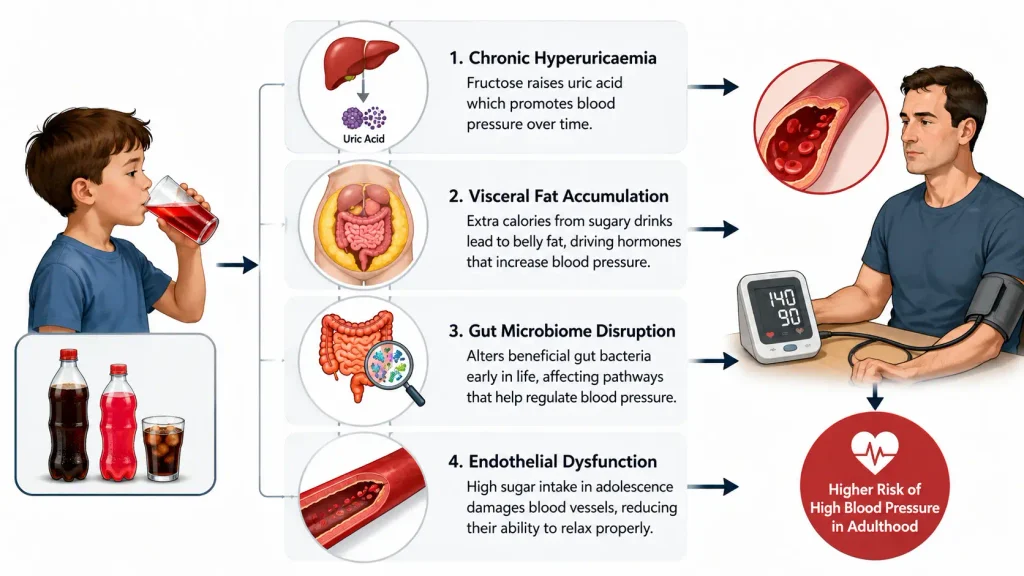
A 52% elevated risk of adult hypertension from childhood sugary beverage consumption requires biological explanation. Several mechanisms have been proposed and partially validated:
Chronic hyperuricaemia. Fructose metabolism in the liver produces uric acid as a byproduct — a mechanism that glucose metabolism does not share. Chronic elevated blood uric acid (hyperuricaemia) is independently associated with hypertension through multiple mechanisms including reduced nitric oxide bioavailability (nitric oxide relaxes blood vessel walls), impaired kidney function, and activation of the renin-angiotensin system. Childhood habitual consumption of fructose-containing beverages may establish chronically elevated uric acid that accumulates over decades.
Visceral fat accumulation. As we covered in our August 2026 series on the fructose-glucose brain research, liquid fructose produces a weaker satiety signal than glucose. Children who consume large quantities of sugary beverages experience inadequate satiety signalling and eat more total calories over time, promoting visceral fat accumulation. Visceral fat is an independent driver of hypertension through its effects on the renin-angiotensin-aldosterone system and sympathetic nervous system activation.
Gut microbiome disruption beginning in childhood. The gut microbiome undergoes its most critical development in the first 3 to 5 years of life. Sugar-sweetened beverages — particularly those containing HFCS and artificial sweeteners — disrupt beneficial Lactobacillus and Akkermansia populations from an early age. As our July 2026 sweeteners and gut bacteria article documented, specific sweeteners suppress the bacteria that regulate blood pressure through the nitrate-nitrite-nitric oxide pathway and the gut-cardiovascular axis.
Endothelial dysfunction from adolescent sugar exposure. Chronic high sugar intake in adolescence impairs endothelial function — the ability of blood vessel walls to dilate appropriately in response to blood flow. Endothelial dysfunction is one of the earliest and most consequential steps in cardiovascular disease progression, and evidence suggests that patterns established during adolescent vascular development have lasting consequences for adult vascular health.
The India Context: A Hidden Epidemic in Plain Sight
India is in the midst of a silent childhood beverage revolution that mirrors the conditions the Circulation study tracked in American children — with potentially worse outcomes given the compounding factors of genetic cardiovascular risk and dietary transition.
Packaged fruit juice consumption has grown dramatically among Indian children, marketed aggressively as a “healthy” alternative to soda. The parent who replaces a cola with a commercial fruit juice at their child’s birthday party believes they are making a better choice. The Circulation data suggests this substitution carries the same blood pressure risk — both liquid fructose sources are associated with elevated risk, while neither soda nor juice carry the risk profile of the whole fruit both parents and children would actually prefer to eat.
Sports drinks — marketed in India alongside cricket and fitness culture — have exploded in sales among adolescents and young adults who use them as everyday hydration rather than athletic electrolyte replacement. At the consumption pattern associated with 52% elevated hypertension risk in the Circulation study, sports drink consumption among Indian adolescents is already at or above that threshold in many urban markets.
“Dietary habits in early life can have lasting health consequences,” said senior author Vasanti Malik. “These findings underscore the importance of addressing sugary beverage intake as early as possible.”
For the complete framework of childhood and adolescent nutrition — including practical guidance on establishing healthy dietary habits from infancy — see our Healthy Habits for New Moms guide and our toddler food research from July 2026.
The Beverage Substitution Data: What Works
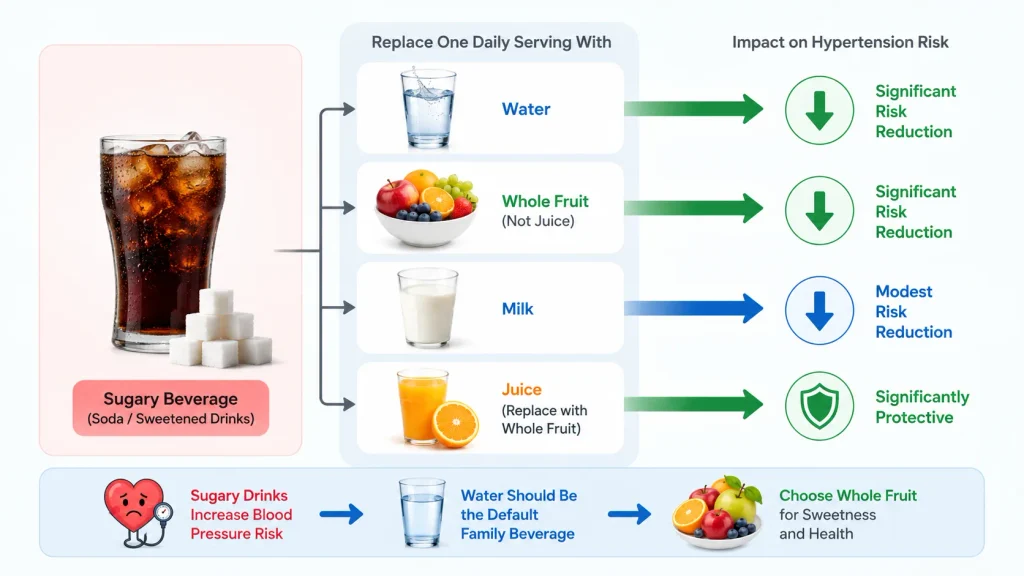
The Circulation study went beyond identifying the risk to testing what happens when beverages are substituted. The statistical substitution models found:
• Replacing one daily serving of a sugary beverage with water was associated with meaningful reduction in hypertension risk — the single most impactful swap available.
• Replacing one daily serving of a sugary beverage with whole fruit (not juice) was associated with significant risk reduction — the fructose in whole fruit did not carry the same risk as liquid fructose.
• Replacing one daily serving of a sugary beverage with milk was associated with modestly lower risk — the calcium, potassium, and protein in milk appear to partially offset the absence of the vasodilatory harm from liquid fructose.
• Replacing juice with whole fruit was significantly protective — even juice, despite being marketed as healthy, carries the same liquid-fructose risk profile as soda in this dataset.
The practical message is clear and actionable: the default family beverage should be water. Whole fruit at meals satisfies the desire for sweetness and the nutritional intention behind juice while delivering fibre and avoiding liquid-fructose vasopressor effects.
My Clinical Message to Parents
After 12 years of working with families on dietary habits, the beverage conversation is one I have consistently underweighted relative to its importance. The Circulation 2026 study justifies making it a central part of paediatric nutrition counselling.
Here is the framework I now use with families:
• Default drinks at all meals: water. Not juice, not milk, not sports drinks — water. Make it the path of least resistance by keeping a water pitcher or filter on the table at mealtimes.
• Whole fruit instead of juice: a child who asks for apple juice gets a whole apple. The nutritional intention (vitamins, sweetness) is preserved or improved; the liquid-fructose risk is eliminated.
• Sports drinks: reserved exclusively for genuine athletic activity exceeding 60 to 90 minutes of vigorous exercise in conditions causing significant sweat loss. Not for everyday consumption. Not for school lunch. Not as a treat.
• Milk (plain, not flavoured): if a child is going to drink something other than water, full-fat plain milk is the Circulation study’s best-evidenced alternative. The calcium and potassium in milk support healthy blood pressure rather than undermining it.
• Commercial fruit juices: eliminated from the daily routine. Occasional treats at parties are not the dietary pattern the Circulation study documents as harmful. Daily habits are.
For the complete beverage science including what the NUTRITION 2026 sparkling water research and the August 2026 alcohol mortality study found about different beverages, see our freshly brewed tea and beverage health guide.
The Takeaway
The Harvard-Toronto 25-year Circulation study of 25,749 people delivers a clear and urgent message: children who drink two or more servings of soda, sports drinks, or fruit juice daily have a 52% higher risk of developing high blood pressure as adults. The risk comes from liquid fructose specifically — whole fruit carries no equivalent risk and is protective when substituted. The intervention this research mandates is structural, not restrictive: make water the default, replace juice with whole fruit, eliminate sports drinks from daily routine, and understand that the beverage choices established in childhood create the vascular biology children carry for the next 25 years. For the parallel research on how childhood ultra-processed food exposure shapes metabolic programming, see our July 2026 toddler food research article.
About the Author
Tanveer Ahmed Khan is a K11 School of Fitness Sciences-certified personal trainer and nutrition coach with 12+ years of strength training experience. Coaching: info@livenulife.com | Instagram: @fitwithtanveer | livenulife.com
Scientific References
1. Nguyen, M., AlEssa, H.B., Glenn, A.J., et al. (2026). Consumption of Fructose-Containing Food and Beverage Sources in Childhood Through to Adulthood and Risk of Hypertension. Circulation. DOI: 10.1161/CIRCULATIONAHA.125.077666
2. ScienceDaily / American Heart Association. (July 23, 2026). Popular childhood drinks may raise blood pressure decades later.
3. Harvard T.H. Chan School of Public Health. (June 23, 2026). Drinking sugary beverages starting in childhood may increase adult blood pressure risk.
4. American Heart Association Newsroom. (June 22, 2026). Does drinking juice, soda during childhood increase the risk of high blood pressure?
5. MedicalDaily. (2026). Sugary Drinks in Childhood Were Linked to Higher Adult Blood Pressure in a 25-Year Study.