By Tanveer Ahmed Khan | K11-Certified Trainer & Dietitian-Nutritionist | REPS India Registered | August 2026 | 12 min read
KEY TAKEAWAY: A study of 270,000+ UK Biobank participants, published in Aging-US and receiving major ScienceDaily coverage in June 2026, found that men with genetically higher tyrosine levels had lifespans nearly a year shorter than those with lower levels. Tyrosine is found in protein-rich foods and is one of the most widely used amino acids in focus and cognitive performance supplements. The research does not prove causation, but raises serious questions about high-dose tyrosine supplementation that the wellness industry has not addressed. Here is what the evidence means for you.
The Supplement You Probably Have Not Questioned
Walk into any gym, pharmacy, or health food store and you will find tyrosine. It is in pre-workout supplements, nootropic stacks, cognitive performance products, focus-enhancing drinks, stress support formulas, and energy supplements. Marketed as a precursor to dopamine, norepinephrine, and epinephrine, it is positioned as a natural way to enhance alertness, manage stress, sharpen focus, and improve physical performance under pressure.
The science behind its mechanism is genuine: tyrosine is an amino acid that the body uses to produce catecholamine neurotransmitters — the brain chemicals involved in motivation, attention, mood, and the physiological stress response. Under conditions of acute stress or sleep deprivation, tyrosine supplementation has shown some evidence of preserving cognitive performance in the short term.
A study published in Aging-US, receiving its widest coverage from ScienceDaily on June 15, 2026, now places this popular supplement ingredient under scrutiny that the wellness industry has been silent about. And the questions it raises deserve serious attention from anyone taking or recommending tyrosine.
📖 Also read: Best Longevity Supplements: Evidence-Based Guide — The complete framework for evaluating supplement evidence — the methodology the Aging-US tyrosine study uses (Mendelian randomization) explained alongside the supplements that pass scrutiny.
The 270,000-Person Study: What It Found
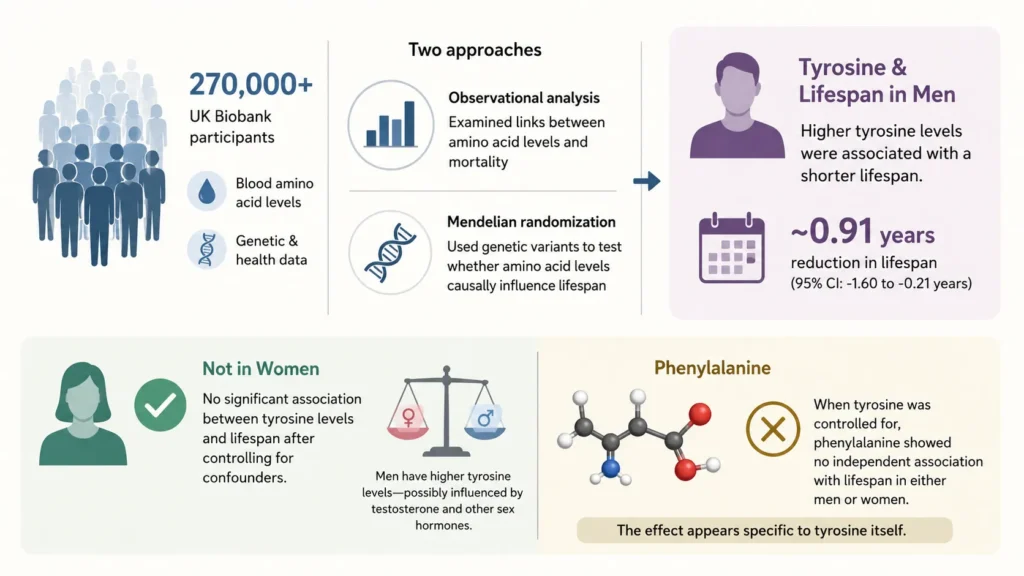
The research, led by Jie V. Zhao and colleagues from the University of Hong Kong and the University of Georgia, examined health and genetic data from more than 270,000 UK Biobank participants to test whether two amino acids — phenylalanine and tyrosine — influence lifespan.
The team used two approaches. First, they analysed observed associations between blood amino acid levels and mortality in the cohort. Second, and more importantly, they applied Mendelian randomization — a genetic method that uses inherited differences in gene variants to test whether the amino acid level itself may causally influence lifespan, rather than being simply correlated with it.
The primary finding: Higher levels of tyrosine were associated with a shorter lifespan in men. After controlling for phenylalanine (a closely related amino acid that covaries with tyrosine levels), the Mendelian randomization analysis found that genetically elevated tyrosine levels were associated with a reduction in lifespan of approximately 0.91 years (95% CI: -1.60 to -0.21 years) in men.
Not in women: No significant association was found in women after controlling for confounders. The researchers noted that men tend to have higher tyrosine levels than women overall, and hypothesised that this sex difference — possibly mediated by interactions with testosterone and other sex hormones — may contribute to the well-documented average lifespan difference between men and women.
Phenylalanine: When tyrosine was controlled for in the analysis, phenylalanine showed no independent association with lifespan in either men or women. The tyrosine effect appears specific to tyrosine itself, not to the broader phenylalanine-tyrosine metabolic pathway.
Critical Caveats: What This Study Does NOT Say
Before this finding is misread as a categorical indictment of tyrosine or high-protein diets, several essential scientific caveats must be understood — and I want to be unambiguous about them, because the media coverage has ranged from appropriately careful to misleadingly alarmist.
This study examined naturally occurring blood levels, not supplementation. The tyrosine levels assessed in this research reflect genetically determined baseline amino acid levels in blood — not the effects of taking tyrosine supplements in healthy adults with normal baseline levels. The Mendelian randomization approach estimates what happens when someone is genetically predisposed to have higher tyrosine throughout their life, from birth onward. This is a fundamentally different scenario from an adult taking a tyrosine supplement.
Correlation (even genetic) is not proof of causation. Mendelian randomization is one of the most powerful tools available for estimating causal effects in observational data — but it is not equivalent to a randomised controlled trial. Confounding through genetic pleiotropy (genes affecting multiple traits simultaneously) remains a limitation. The researchers themselves stated that “how tyrosine may be linked to lifespan remains unknown.”
The effect size is modest. A 0.91-year difference in lifespan is statistically significant but not catastrophically large. Compare this to the 47% mortality risk reduction associated with walking 7,000 steps daily, or the 44% cardiovascular risk reduction from 2 hours weekly of resistance training. Lifestyle interventions with well-established evidence vastly outweigh this amino acid signal in terms of health impact.
The researchers did not recommend avoiding tyrosine-rich foods. The study does not suggest reducing meat, fish, eggs, or dairy — all of which are tyrosine-rich. It hypothesises that people with elevated tyrosine levels might benefit from adjusting their diet, but explicitly notes “more research is needed before making recommendations like these.”
Why the Proposed Mechanisms Are Biologically Plausible
While causation has not been established, the research team proposed two mechanisms through which chronically elevated tyrosine might influence lifespan — and both are biologically coherent.
Mechanism 1: Insulin resistance. The study notes that higher tyrosine levels are associated with insulin resistance in prior research. Insulin resistance is one of the most consequential metabolic abnormalities of ageing — driving type 2 diabetes, cardiovascular disease, non-alcoholic fatty liver disease, and contributing to cancer risk and accelerated cellular ageing. If chronically elevated tyrosine promotes insulin resistance through mechanisms not yet fully characterised, this could explain an association with shorter lifespan through the compounded long-term effects of metabolic dysfunction.
Mechanism 2: Chronic catecholamine pathway activation. Tyrosine is the precursor to dopamine, norepinephrine, epinephrine, and thyroid hormones. These systems govern the body’s stress response. Chronically elevated tyrosine availability may contribute to sustained activation of the sympathetic nervous system and HPA axis — the physiological stress response systems — over time. Chronic stress system overactivation is associated with accelerated cellular ageing, telomere shortening, and increased inflammatory burden. Sex hormone interactions (testosterone amplifying catecholamine synthesis and activity) could explain why the effect was found in men but not women.
What This Means for Supplementation: My Clinical Perspective
After 12 years of advising clients on evidence-based supplementation, the tyrosine Aging-US study lands in a category I find clinically important: it does not warrant panic or immediate protocol changes, but it does warrant thoughtful reconsideration of the evidence base for high-dose tyrosine supplementation.
Here is where I stand on tyrosine supplementation in light of this research:
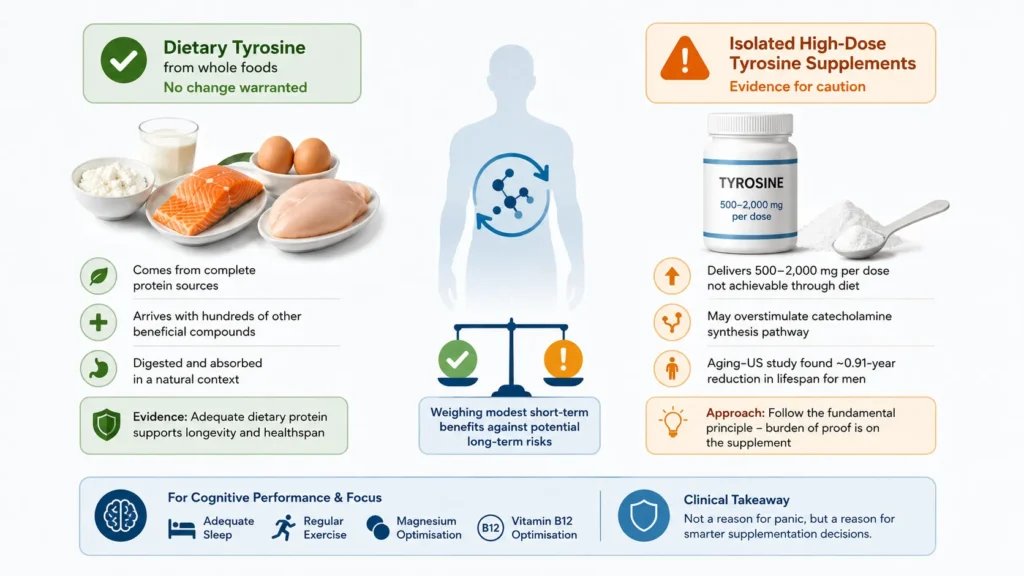
For dietary tyrosine — from protein-rich whole foods — no change is warranted. The research does not suggest that eating eggs, fish, dairy, or meat shortens lifespan. Dietary tyrosine comes embedded in complete protein sources alongside hundreds of other bioactive compounds, and arrives in the physiological context of digestion, absorption, and metabolic processing that differs fundamentally from isolated amino acid supplements. The extensive evidence that adequate dietary protein extends healthspan — covered in our July 2026 protein guidelines article — remains unaffected by this finding.
For isolated high-dose tyrosine supplements — the evidence for caution has strengthened. Most standalone tyrosine supplements deliver 500 to 2,000mg per dose. This is a concentration that dietary protein sources never deliver in isolation. The biological consequences of flooding the catecholamine synthesis pathway with a large isolated amino acid dose are different from the gradual, context-embedded delivery that food provides. Given the Aging-US finding, the appropriate response is to apply the fundamental supplementation principle: the burden of proof for safety and efficacy falls on the supplement, not on scepticism about it.
For clients taking tyrosine for cognitive performance or focus: The acute cognitive evidence — some improvements in working memory under stress or sleep deprivation — is real but modest. The potential long-term risk signal — a 0.91-year lifespan reduction in men — requires weighing against a modest acute performance benefit. Given the availability of evidence-based alternatives for cognitive performance (adequate sleep, exercise, magnesium, vitamin B12 optimisation), I am no longer recommending isolated tyrosine supplementation as a routine protocol.
For the complete picture of which supplements have robust evidence and which have significant uncertainty — including the emerging longevity supplement landscape — see our Best Longevity Supplements Evidence-Based Guide and our Science-Based Longevity Protocols guide.
The Broader Lesson: Questioning the Supplement-First Culture
The tyrosine Aging-US finding sits within a pattern of 2026 nutritional science that is consistently humbling for the supplement industry. Our coverage this year has already documented:
• Fish oil (omega-3) supplements failing to improve brain health in a two-year double-blind trial of 365 adults (our August 2026 fish oil article).
• Calcium and vitamin D supplements providing little meaningful fracture protection in a 154,000-person meta-analysis (our June 2026 calcium article).
• 39 common sweeteners — many marketed as safe alternatives — disrupting gut bacteria (our July 2026 sweeteners article).
The pattern is clear: isolated compounds extracted from food contexts, concentrated, and consumed as supplements frequently underperform and sometimes cause harm that was not anticipated from their isolated mechanisms. Whole foods, in their complex matrices, consistently outperform the isolated nutrients extracted from them.
This does not mean supplementation is never appropriate — our magnesium and B12 coverage this month documents situations where targeted supplementation corrects genuine deficiencies that diet alone cannot adequately address. But the default should always be food-first, with supplementation reserved for documented insufficiency or specific therapeutic goals with strong evidence bases. For the framework I use to make these decisions, see our Functional Nutrition guide.
The Takeaway
The Aging-US study of 270,000 UK Biobank participants, receiving wide coverage in June 2026, found that men with genetically higher tyrosine levels had lifespans nearly a year shorter than those with lower levels — potentially through mechanisms involving insulin resistance and chronic catecholamine pathway activation. The study does not prove that tyrosine supplements shorten lifespan, and significant caveats apply. But it adds a meaningful complication to the uncritical enthusiasm surrounding one of the supplement industry’s most widely used amino acid ingredients. In light of this research and the broader pattern of supplement overreach in 2026, the appropriate response is thoughtful evidence appraisal — continuing dietary protein from whole food sources while reconsidering isolated high-dose tyrosine supplementation for routine cognitive performance enhancement. For the evidence-based supplement decisions that do pass rigorous scrutiny, see our Best Longevity Supplements guide.
About the Author
Tanveer Ahmed Khan is a K11 School of Fitness Sciences-certified personal trainer and REPS India-registered dietitian-nutritionist with over 12 years of experience. Coaching: info@livenulife.com | Instagram: @fitwithtanveer | livenulife.com
Scientific References
1. Zhao, J.V., Sun, Y., Zhang, J., Ye, K. (2025/2026). The role of phenylalanine and tyrosine in longevity: a cohort and Mendelian randomization study. Aging-US, 17(10): 2500. DOI: 10.18632/aging.206326
2. ScienceDaily / Impact Journals. (June 15, 2026). This popular brain supplement was linked to shorter lifespans in men.
3. Newsweek. (June 16, 2026). Popular Supplement Ingredient Linked to Shorter Lifespans in Men.
4. MedicalDaily. (June 17, 2026). Tyrosine Is in Millions of Supplement Products. A 270,000-Person Study Links Higher Levels to Shorter Lifespan in Men.
5. University of Georgia Genetics Dept. (June 18, 2026). Popular Supplement Ingredient Linked to Shorter Lifespans in Men.