
By Tanveer Ahmed Khan | K11-Certified Trainer & Dietitian-Nutritionist | REPS India Registered | August 2026 | 12 min read
KEY TAKEAWAY: Research published in Gut (March 2026) and covered by ScienceDaily on August 21, 2026, found that a specific gut bacterium — Roseburia inulinivorans — is associated with 29% greater handgrip strength in older adults who carry it vs those who don’t. In mice, supplementing with this bacterium increased grip strength by ~30% and converted muscle fibres to the stronger fast-twitch type. This is the most compelling evidence yet for the gut-muscle axis — and its dietary implications are immediately actionable.
The Gut-Muscle Axis: Science’s Most Exciting New Frontier
When I began my career in fitness training 12 years ago, the gut microbiome was barely mentioned in exercise science. The prevailing model of muscle performance was simple: train the muscle, feed it protein, rest it, and repeat. The idea that the trillion microorganisms living in your colon might be directly influencing how strong your muscles are would have been dismissed as speculation.
By August 2026, it is no longer speculation. Research published in the high-impact journal Gut by researchers from the University of Almería, the University of Granada, and the Leiden University Medical Center — led by Borja Martinez-Tellez and Patrick Rensen — and covered by ScienceDaily on August 21, 2026, has identified a specific gut bacterium that is directly associated with muscle strength across both young and old humans, and that causally increases muscle strength when administered to mice.
Roseburia inulinivorans is a member of the Roseburia genus — a group of anaerobic, fibre-fermenting bacteria that produce butyrate (one of the most important short-chain fatty acids for gut and systemic health). What distinguishes R. inulinivorans from its Roseburia relatives is its specific and reproducible association with physical strength — an association that its close relatives R. faecis and R. hominis do not share.
📖 Also read: Gut Health Revolution: How Your Microbiome Controls Everything — The foundational guide to the gut microbiome — the essential companion to understanding how Roseburia inulinivorans communicates with skeletal muscle through the gut-muscle axis.
What the Research Found: The Human Data
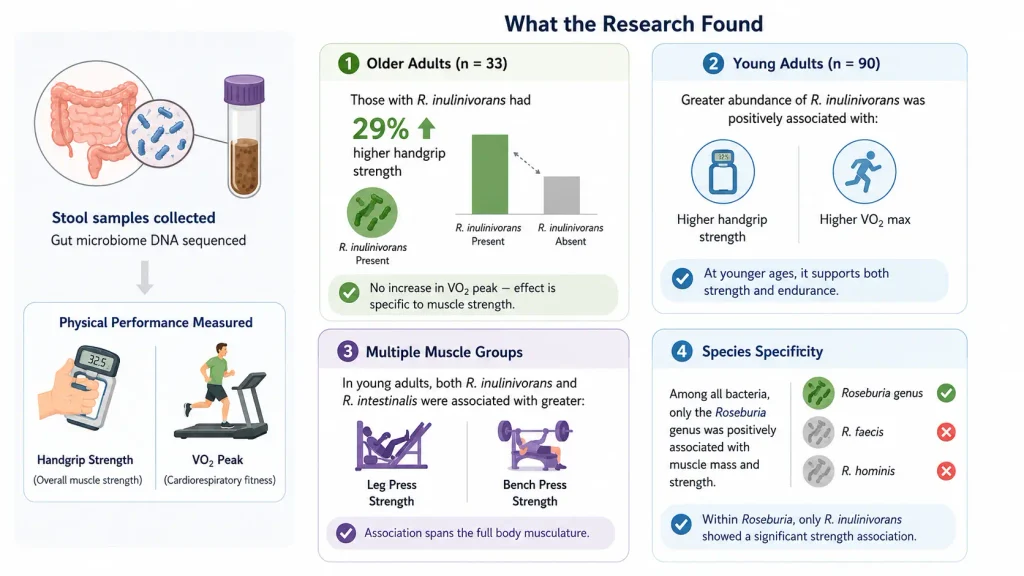
The researchers took stool samples from two human cohorts: 33 older adults and 90 young adults. They sequenced the gut microbiome DNA from each sample and cross-referenced the bacterial populations with two physical performance measures: handgrip strength (a validated measure of overall muscle strength and a powerful predictor of longevity) and VO₂ peak (maximum oxygen uptake, measuring cardiorespiratory fitness).
In older adults: Those with detectable Roseburia inulinivorans in their stool samples had 29% higher handgrip strength than those without the bacterium — a clinically meaningful difference. Critically, this strength difference occurred without a corresponding increase in peak oxygen uptake, indicating that R. inulinivorans was specifically associated with muscle strength independent of general cardiovascular fitness.
In young adults: Greater abundance of R. inulinivorans was positively associated with both handgrip strength AND VO₂ max, suggesting that at younger ages the bacterium may support both strength and endurance simultaneously — consistent with its role in muscle fibre type conversion.
Leg press and bench press strength: Both R. inulinivorans and R. intestinalis abundance in young adults was positively associated with leg press and bench press strength — multiple muscle groups, not just the grip used in handgrip testing. The association spans the full body musculature.
Species specificity: Among all bacteria found in the stool samples, the Roseburia genus was the only one positively associated with muscle mass and strength. And within Roseburia, R. faecis and R. hominis showed no significant associations — only R. inulinivorans carried the strength association. This specificity is one of the most compelling features of the research: it points to a precise biological mechanism, not a general healthy-gut effect.
The Mouse Model: Causation, Not Just Correlation
The human data is observational — it shows association, not causation. The critical advance in the Martinez-Tellez study is the mouse supplementation experiment, which directly tests whether R. inulinivorans causes strength improvement rather than simply being correlated with it.
Mice orally supplemented with R. inulinivorans gained approximately 30% more grip strength compared with unsupplemented controls. This is a remarkable effect size for a microbial intervention — comparable to what might be achieved with weeks of resistance training in mice. But the mechanism the researchers uncovered is perhaps even more interesting than the strength gain itself.
Muscle fibre type conversion. R. inulinivorans supplementation in mice caused a shift in muscle fibre composition toward fast-twitch (type II) fibres — the muscle fibre type specialised for high-intensity, high-force movements like sprinting, jumping, and heavy resistance exercise. Type II fibres are larger, stronger, and generate more force per unit of cross-section than slow-twitch (type I) fibres, which are optimised for endurance. This fibre type conversion explains why strength improved without a corresponding increase in VO₂ max — the bacterium specifically enhanced the force-generating capacity of muscle without dramatically changing endurance-related physiology.
Metabolic pathway activation. The researchers found increased activity in the purine and pentose phosphate pathways in muscle tissue of R. inulinivorans-treated mice. These metabolic pathways are essential for energy production (ATP synthesis), cellular repair, and nucleotide synthesis — the molecular building blocks of the DNA replication required for muscle fibre growth and maintenance. The bacterium appears to shift muscle cell metabolism toward more efficient anabolic pathways.
Amino acid depletion hypothesis. One proposed mechanism is that R. inulinivorans competes with muscle cells for amino acids — particularly branched-chain amino acids (leucine, isoleucine, valine) — in a way that stimulates muscles to upregulate their own amino acid synthesis and utilisation efficiency. This is similar to how mild exercise-induced stress stimulates muscle adaptation: the challenge produces a stronger response. The bacterium may be providing a metabolic stimulus that mimics some of exercise’s anabolic signals.
The Dietary Connection: How to Feed Roseburia Inulinivorans
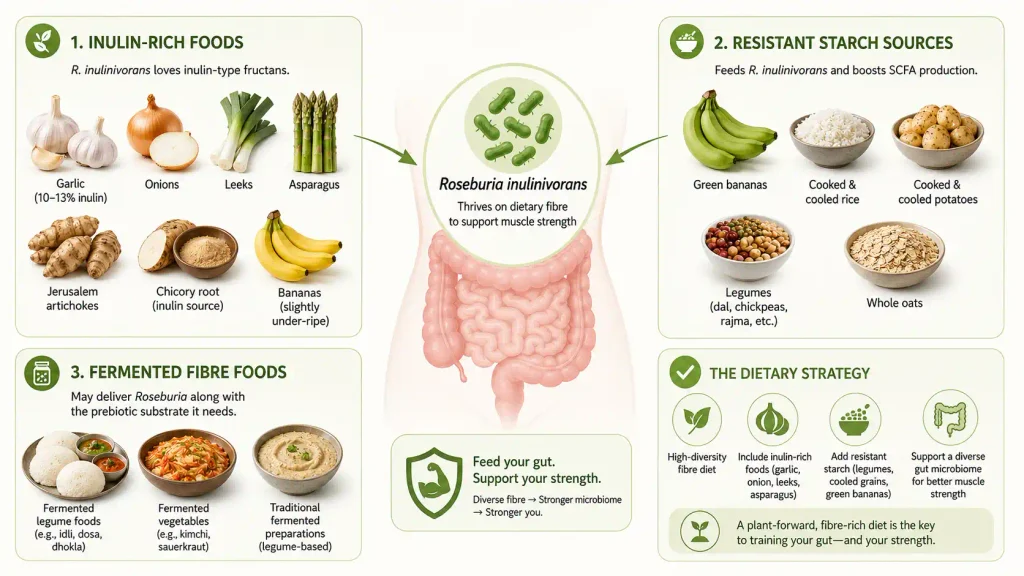
If R. inulinivorans is associated with muscle strength and its abundance is trainable through diet, the most important practical question is: what do you need to eat to support this bacterium in your gut?
Roseburia inulinivorans is a fibre-fermenting obligate anaerobe — it grows and thrives specifically on dietary fibre, particularly inulin-type fructans and resistant starch. Its name literally contains its dietary preference: inulinivorans means “inulin-consuming.”
• Inulin-rich foods: garlic (the richest dietary source at approximately 10–13% of dry weight as inulin), onions, leeks, asparagus, Jerusalem artichokes, chicory root (the commercial source of inulin supplements), and bananas (particularly slightly under-ripe bananas with higher resistant starch content).
• Resistant starch: green bananas, cooked-and-cooled rice and potatoes (the cooking-cooling process converts digestible starch to resistant starch), legumes (all dal varieties, chickpeas, rajma), whole oats.
• Fermented fibre foods: combinations of fibre-rich and fermented foods may deliver R. inulinivorans alongside the prebiotic substrate it needs to establish. While R. inulinivorans is not itself a commonly used probiotic strain, fermented whole-plant foods that have naturally occurring Roseburia populations include some traditionally fermented legume preparations.
The dietary strategy that most effectively supports Roseburia inulinivorans is the high-diversity fibre diet we detailed in our Fibermaxxing guide — specifically targeting inulin-type prebiotic fibres from garlic, onion, leeks, and asparagus alongside resistant starch from legumes and cooled whole grains. This is not a special or unusual diet — it is the plant-forward dietary pattern with prebiotic diversity that we have been covering throughout our 2026 series.
Why Roseburia Inulinivorans Declines With Age — And What to Do About It
The research documents something clinically important: Roseburia inulinivorans is less common in older people than in younger adults. This age-related decline in R. inulinivorans abundance follows the same pattern as sarcopenia — the progressive loss of muscle mass and strength that begins from approximately age 35 and accelerates after 60.
This parallel is not coincidental. The gut microbiome becomes less diverse with age — a process called “inflammaging” in the microbiome research literature. Roseburia species, which require high-fibre dietary environments to thrive, are among the first bacteria to decline in the typically lower-fibre, more processed diets that many older adults consume. The muscle weakness associated with ageing may be partially explained by the simultaneous decline in the gut bacteria that support muscle fibre health.
This finding connects directly to the magnesium research we covered in our August 2026 series: both magnesium and gut bacteria that support muscle strength decline with age through diet-mediated mechanisms that are substantially addressable through dietary intervention. The combination of magnesium supplementation (covered in our Magnesium Deficiency article) with a high-fibre, prebiotic-rich diet that supports R. inulinivorans may produce synergistic muscle-preserving effects that neither intervention alone achieves.
The Takeaway
The Roseburia inulinivorans research published in Gut 2026 and covered widely in August provides the clearest demonstration to date that the gut-muscle axis is a real, specific, and potentially trainable biological system. A gut bacterium that is specifically associated with 29% greater handgrip strength in older adults, that causally increases grip strength by approximately 30% in mice, that converts muscle fibres to the stronger fast-twitch type, and that declines with age through the same mechanism as sarcopenia — this is not a peripheral finding. It is a paradigm shift in how we understand muscle ageing and the role of dietary choices in preserving physical strength throughout the lifespan. The dietary strategy is clear and immediately implementable: increase inulin-rich prebiotic fibres (garlic, onion, leeks, asparagus) and resistant starch (legumes, cooled whole grains) to create the gut environment where R. inulinivorans can thrive. For the complete probiotic and prebiotic food framework, see our Top 15 Probiotic Foods guide and our Personalised Nutrition guide.
About the Author
Tanveer Ahmed Khan is a K11 School of Fitness Sciences-certified personal trainer and REPS India-registered dietitian-nutritionist with over 12 years of experience. Coaching: info@livenulife.com | Instagram: @fitwithtanveer | livenulife.com
Scientific References
1. Martinez-Tellez, B., Schönke, M., Kovynev, A., et al. (2026). Roseburia inulinivorans increases muscle strength. Gut. DOI: 10.1136/gutjnl-2025-336980
2. ScienceDaily / BMJ Group. (August 21, 2026). This gut microbe may help keep you strong as you age.
3. Technology Networks. (March 12, 2026). Muscle Strength Gains Linked to Roseburia Bacteria.
4. BMJ Group News. (March 11, 2026). Specific gut bacteria species (R inulinivorans) linked to muscle strength.
5. University of Granada News. (2026). Bacteria found in the human intestine capable of improving muscle strength.