By Tanveer Ahmed Khan | K11-Certified Trainer & Dietitian-Nutritionist | REPS India Registered | August 2026 | 12 min read
KEY TAKEAWAY: A comprehensive analysis published in The Conversation and covered by ScienceDaily on August 22, 2026, synthesises the current evidence that exercise is modest as a weight-loss tool but crucial for long-term weight maintenance — by preserving muscle, maintaining metabolic rate, improving fat oxidation, regulating appetite hormones, and controlling blood sugar. This reframes the entire exercise-diet relationship for sustainable weight management.
The Exercise Paradox Every Trainer Needs to Explain
After 12 years as a certified trainer, I have had the same conversation hundreds of times. A client joins a gym for weight loss. They train hard for six to twelve weeks. They lose some weight — less than expected. They grow frustrated. They conclude that exercise is ineffective. They quit.
This pattern is not a failure of willpower. It is a failure of expectation management based on a fundamental misunderstanding of what exercise actually does for body weight. A comprehensive analysis published in The Conversation on August 22, 2026, covered by ScienceDaily the same day, provides the most clear and complete synthesis of the current science that I have seen — and it completely reframes the role of exercise in weight management in a way that every client I work with needs to understand.
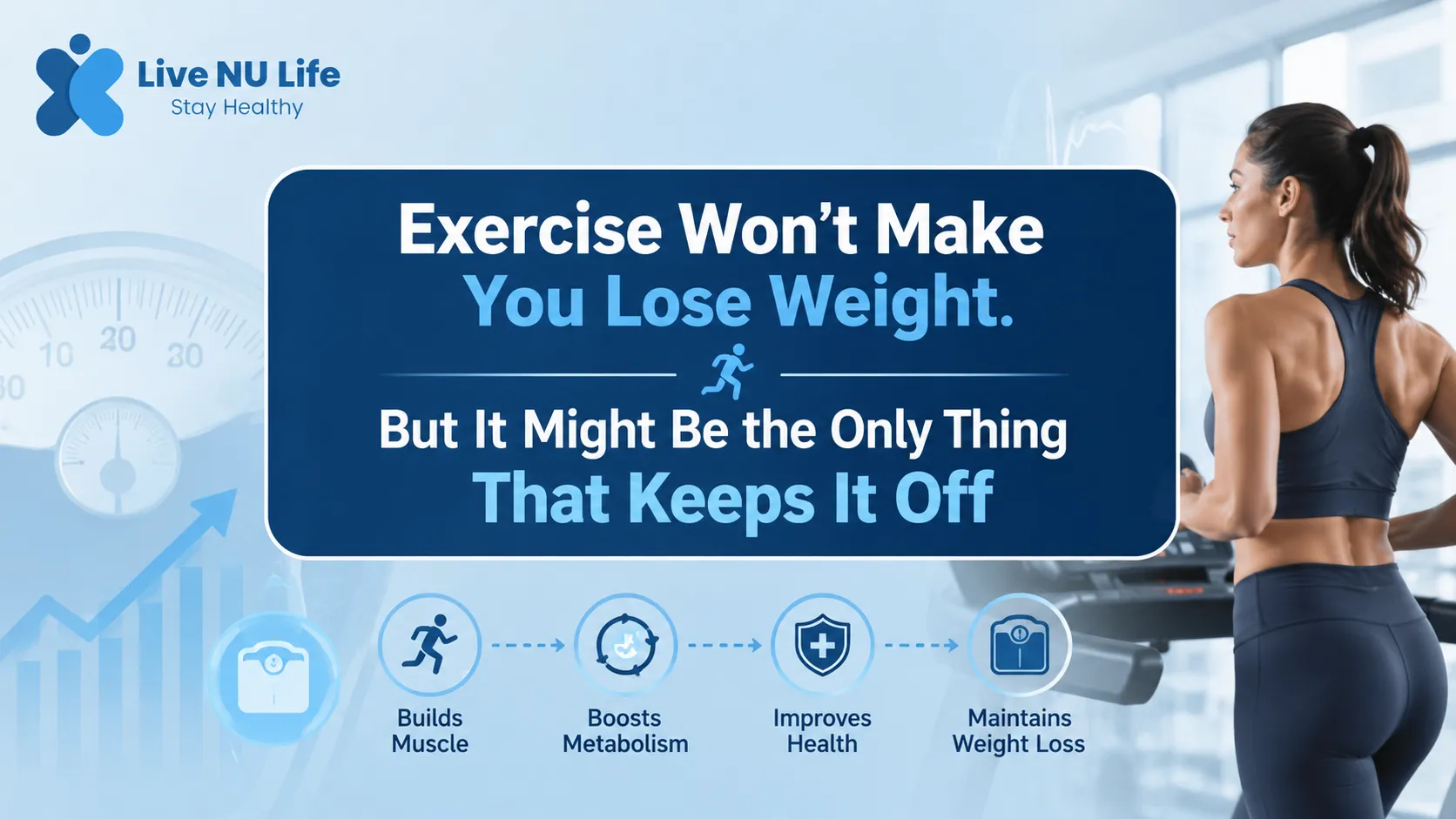
The core finding: exercise is a modest and unreliable tool for initial weight loss, but it appears to be one of the most important factors for preventing lost weight from returning. Not losing it — keeping it off.
📖 Also read: Once a Week Is Enough: The HKU Study That Redefines Exercise — August 2026 — The HKUMed Nature Communications study that found once-weekly HIIT produces equivalent fat loss to three sessions — the exercise frequency research that pairs directly with this weight maintenance analysis.
Why Exercise Disappoints for Weight Loss — The Biology
The reason exercise consistently underperforms for weight loss is not a mystery. The biology is well-characterised, and understanding it removes the self-blame that leads people to quit.
Compensation mechanisms. When people exercise more, their bodies tend to compensate in two ways: they eat more (unconsciously increasing calorie intake to partially replace expended calories) and they move less during the rest of the day (reducing non-exercise activity). Studies using doubly-labelled water — the gold standard for measuring actual total energy expenditure — consistently find that total daily calorie burn increases less than the calories directly expended during exercise sessions, because the body reduces its background activity.
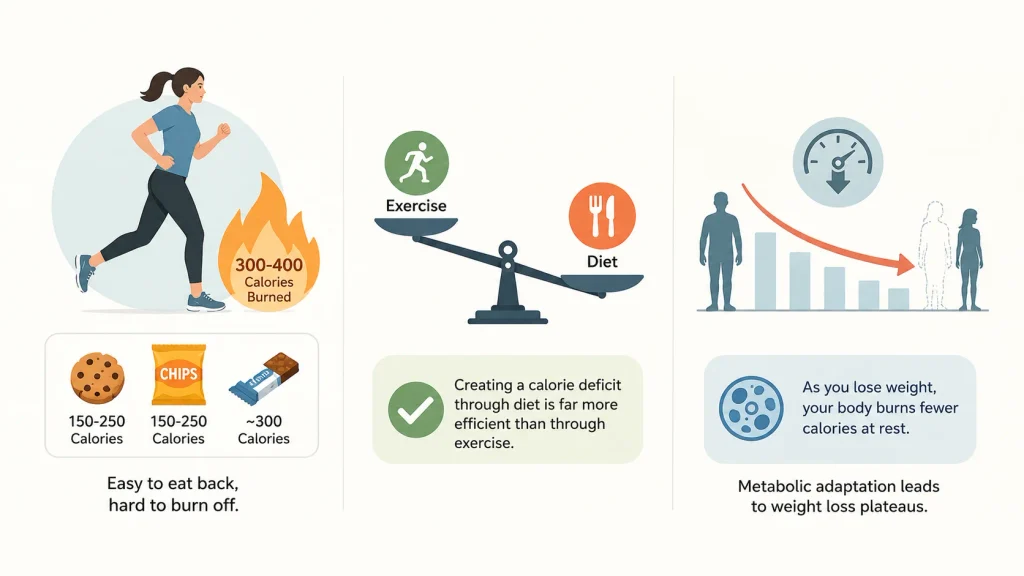
The calorie arithmetic problem. A typical 30-minute moderate-intensity run burns approximately 300 to 400 calories. A single coffee-shop biscuit or small packet of chips provides 150 to 250 calories. A post-workout protein bar marketed as healthy might add 300 calories. The calorie arithmetic of exercise-versus-diet in weight loss simply does not favour exercise as the primary driver. Creating a calorie deficit through diet is far more efficient than creating it through exercise for most people.
The metabolic adaptation problem. As people lose weight through any combination of diet and exercise, their resting metabolic rate declines — the body becomes more efficient and requires fewer calories. This is the primary driver of the weight-loss plateau that frustrates most dieters. Exercise alone does not adequately counteract this metabolic adaptation in the early stages of weight loss.
Why Exercise Is Indispensable for Weight Maintenance
Here is where the narrative completely reverses — and where exercise becomes not optional but essential.
Muscle preservation: the metabolic foundation. This is the most critical weight-maintenance mechanism. When people lose weight through diet alone, they lose significant amounts of lean muscle mass alongside fat — often 25 to 40% of total weight lost comes from muscle rather than fat. This muscle loss reduces resting metabolic rate, making weight regain far more likely because the body now requires fewer calories than before. Exercise — particularly resistance training — prevents this muscle loss during weight reduction and can even rebuild muscle during weight maintenance. Every kilogram of muscle preserved is approximately 13 additional calories burned daily at rest.
EPOC and fat oxidation. Exercise — especially resistance training and HIIT — produces excess post-exercise oxygen consumption (EPOC), an elevated metabolic rate that persists for hours after exercise completion. Over weeks and months, this sustained elevation in fat oxidation contributes meaningfully to the calorie-burning advantage that exercises people maintain over sedentary people of the same body weight.
Appetite regulation through leptin and GLP-1. Regular exercise improves the sensitivity of the hypothalamus to leptin — the satiety hormone produced by fat cells. People who exercise regularly show better leptin signalling, which means they feel more appropriately satisfied by meals and have better natural appetite regulation. Exercise also improves GLP-1 sensitivity — the same hormone system targeted by Ozempic. As we covered in our July 2026 GLP-1 Natural Stimulation article, regular physical activity is one of the most effective non-pharmaceutical means of improving GLP-1 system function.
Blood glucose regulation. Exercise — particularly resistance training and post-meal walking — dramatically improves insulin sensitivity and glucose disposal by skeletal muscle. This means less glucose is converted to fat and more is directed to energy use. The post-meal blood glucose spike that drives insulin-mediated fat storage is significantly blunted in people who exercise regularly, independent of any direct calorie-burning effect.
The gut microbiome dimension. Regular exercise is associated with increased microbial diversity in the gut, specifically higher populations of butyrate-producing bacteria that support metabolic health. As we cover in Article 3 of this volume — the Roseburia gut bacteria muscle research — the gut-muscle axis is bidirectional: gut bacteria influence muscle strength, and exercise influences gut bacteria composition. Exercise-associated microbiome changes contribute to the metabolic advantage maintained exercisers have over sedentary people during weight maintenance.
What Type of Exercise Matters Most for Weight Maintenance
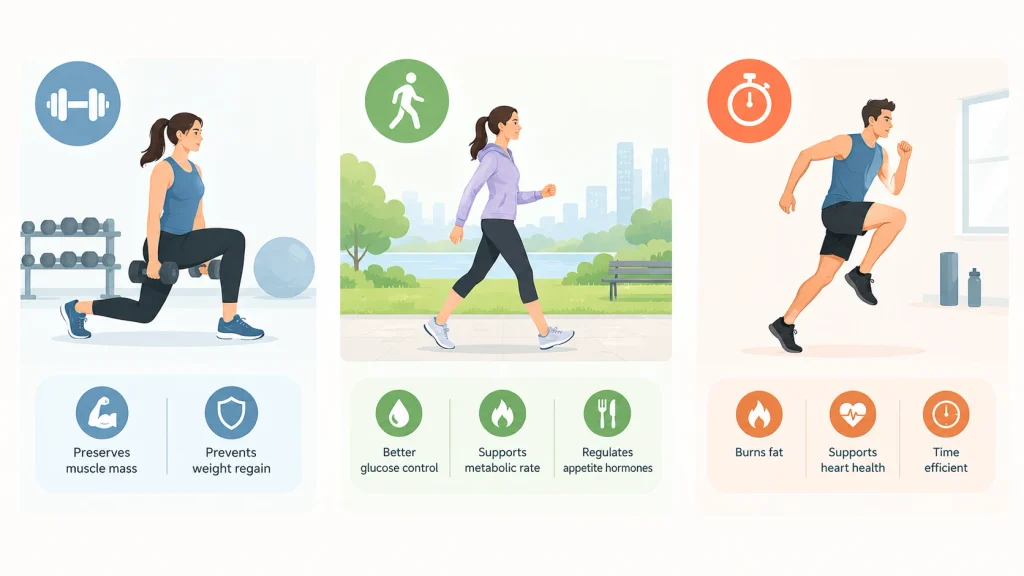
Resistance training: the non-negotiable. For weight maintenance specifically, resistance training is the highest-priority exercise modality because it directly addresses muscle preservation — the primary mechanism through which exercise prevents weight regain. Our August 2026 coverage of the Maturitas study (HIIT for Older Adults) found that HIIT specifically preserved muscle mass while losing fat — a crucial distinction from moderate exercise that causes fat and muscle loss simultaneously.
Walking and daily movement: the consistency play. The most sustainable form of weight maintenance exercise is the one people actually do. For many clients, that is walking — daily, habitual, integrated into their routines. Our August 2026 series on the Lancet 7,000 steps research confirmed that 7,000 steps per day is associated with 47% lower mortality risk. Daily walking as a habit produces the continuous glucose regulation, metabolic rate support, and appetite hormone benefits that intermittent gym sessions cannot maintain.
HIIT for time-efficient metabolic loading: For clients with limited time, HIIT once per week (as the HKUMed Nature Communications trial documented) provides meaningful fat loss and cardiovascular maintenance that supports weight maintenance without requiring daily gym visits.
The Exercise-Diet Integration: How I Structure It in Practice
After 12 years of weight management coaching, here is the framework that produces the best long-term outcomes for my clients:
• Phase 1 (Weight loss): diet carries 80% of the calorie deficit. Exercise focuses on resistance training to preserve muscle, with 20 to 30 minutes of resistance work three times per week minimum. Do not rely on exercise as the primary weight-loss mechanism — it will disappoint.
• Phase 2 (Weight maintenance): exercise becomes the primary metabolic regulator. Resistance training twice per week to maintain muscle mass and metabolic rate. Daily movement habit of 7,000+ steps. Once-weekly HIIT session for cardiovascular fitness and metabolic rate support.
• Nutrition supporting exercise: adequate protein (1.6–2.0g/kg) to support muscle preservation — as our July 2026 protein guidelines article documented, most people eating slightly above the new guidelines when exercising regularly. See our guide on the
best protein timing for exercise performance for the complete protocol.
For the complete exercise-nutrition integration framework, see our Functional Nutrition guide and our Health and Fitness guide.
The Takeaway
The August 22, 2026 ScienceDaily synthesis of exercise and weight management settles a debate that has confused millions of people: exercise is not a reliable weight-loss tool, but it is an indispensable weight-maintenance tool — through muscle preservation, metabolic rate maintenance, fat oxidation, GLP-1 sensitivity, blood glucose regulation, and gut microbiome support. The practical implication: stop expecting exercise to lose the weight for you, and start expecting it to keep off the weight you lose through dietary change. Combine resistance training for muscle, daily walking for metabolic consistency, and HIIT for time-efficient cardiovascular loading. For the complete weight management framework that integrates this exercise science with the energy density dietary approach we covered in our August 2026 JAMA vegan diet article, see our Science-Based Longevity Protocols guide.
About the Author
Tanveer Ahmed Khan is a K11 School of Fitness Sciences-certified personal trainer and REPS India-registered dietitian-nutritionist with over 12 years of experience. Coaching: info@livenulife.com | Instagram: @fitwithtanveer | livenulife.com
Scientific References
1. ScienceDaily / The Conversation. (August 22, 2026). Exercise may work better for keeping weight off than losing it.
2. Nature Reviews Endocrinology (2026). Strengthening the metabolic alliance: exercise as an essential partner of obesity pharmacotherapy.
3. McGowan, B.A. et al. (2025). A systematic review of pharmacological treatments for obesity in adults. Nature Medicine.
4. Prior research on EPOC and muscle mass in weight maintenance — American Journal of Clinical Nutrition (multiple studies).
5. Our August 2026 series: HKUMed once-weekly HIIT, Maturitas HIIT muscle preservation, Lancet 7,000 steps review — all directly cited exercise modalities for weight maintenance.