
KEY TAKEAWAY: A study from Emory University published in Sleep Medicine (August 23, 2026) found that older adults with mild cognitive impairment and sleep problems who took at least 5,000 IU of vitamin D daily scored more than 13% higher on cognitive tests than those taking none. The findings suggest vitamin D could be a modifiable factor during an early — potentially reversible — window of cognitive decline.
The Critical Window: Mild Cognitive Impairment
In 12 years of nutritional and lifestyle coaching, I have watched clients navigate one of the most frightening trajectories in modern medicine: the slow progression from “I forget things more often” to a diagnosis of mild cognitive impairment, and then the question of whether that journey continues toward dementia. What makes MCI so significant is precisely that it represents a window — a stage where cognitive decline is real and measurable, but where reversal or stabilisation is still possible.
A study from Emory University published in Sleep Medicine on August 23, 2026, led by Sirui Zhou, Paul Sudeshna, Lynn Marie Trotti, Donald Bliwise, and Victoria Pak, targets this exact window. The researchers enrolled 54 adults with both sleep disturbances and mild cognitive impairment — a population at heightened dementia risk — and examined whether vitamin D supplement intake was associated with better cognitive performance.
The finding: adults who took at least 5,000 IU of vitamin D daily scored more than 13% higher on a standardised cognitive test compared with those taking no vitamin D. In a preliminary study of 54 participants, this signal is meaningful — not definitive — but it points toward a mechanistic relationship that has strong biological plausibility and actionable clinical implications.
📖 Also read: Calcium and Vitamin D Supplements: The June 2026 Study That Changes Everything — The BMJ meta-analysis finding that standard calcium and vitamin D supplementation fails for bone protection — but this Emory cognitive study shows a different picture at higher doses for brain health.
Why Sleep Disturbance Amplifies Vitamin D Deficiency
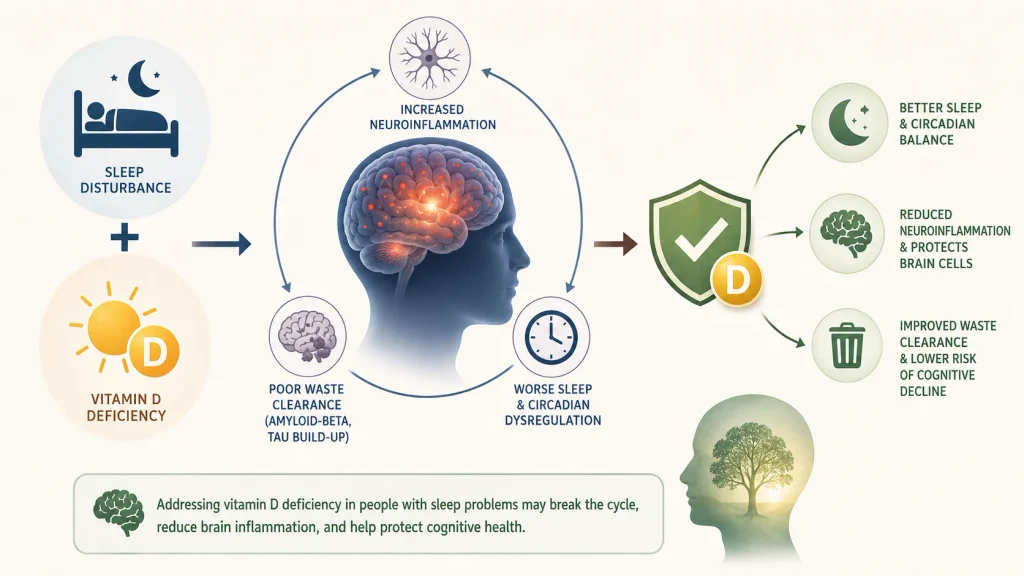
The Emory study’s specific population — adults with BOTH mild cognitive impairment AND sleep problems — is not arbitrary. The intersection of these two conditions creates a compounded vulnerability that vitamin D is positioned to address through multiple overlapping mechanisms.
Vitamin D and sleep architecture. Vitamin D receptors are present in brain regions responsible for sleep regulation including the suprachiasmatic nucleus (the brain’s primary circadian clock) and the brainstem regions governing sleep-wake cycling. Vitamin D participates in the synthesis of melatonin — the primary hormonal signal for sleep onset — through its effects on the enzyme AANAT (aralkylamine N-acetyltransferase). Low vitamin D is consistently associated with shorter sleep duration, poorer sleep quality, and higher rates of sleep disorders including sleep apnoea.
Sleep deprivation accelerates Alzheimer’s pathology. During sleep — particularly slow-wave sleep and REM — the glymphatic system (the brain’s waste-clearance mechanism) is most active, washing out metabolic waste products including amyloid-beta and tau proteins, the pathological proteins that accumulate in Alzheimer’s disease. Sleep disturbance reduces glymphatic clearance efficiency, allowing these proteins to accumulate. The combination of poor sleep and vitamin D deficiency may therefore produce a compounded acceleration of neurological decline.
Neuroinflammation: the shared mechanism. Vitamin D is a potent anti-inflammatory molecule in the central nervous system. It suppresses microglial activation — the brain’s resident immune cells — and reduces the production of pro-inflammatory cytokines that damage neurons when chronically elevated. Sleep deprivation independently drives neuroinflammation. Together, low vitamin D and poor sleep create a neuroinflammatory environment that accelerates cognitive decline through overlapping pathways. Vitamin D supplementation in this context may be addressing the shared inflammatory root cause of both conditions simultaneously.
The Dose That Mattered: 5,000 IU and Above
One of the most clinically significant aspects of the Emory finding is the dose threshold: 5,000 IU daily. This is substantially higher than the RDA for vitamin D established by most national health authorities, which range from 600 to 800 IU for most adults. Even the upper tolerable intake level in many countries is set at 4,000 IU.
The Emory researchers were not recommending that all adults take 5,000 IU. They were observing that, in their MCI-plus-sleep-disturbance population, meaningful cognitive benefit appeared at this dose level — and this has important implications for understanding what vitamin D is actually doing in the brain.
Why higher doses may be needed for neurological effects. Achieving the blood vitamin D concentrations associated with neurological protection requires higher supplemental doses than achieving the concentrations associated with basic bone health. The brain, like other tissues, depends on blood 25-hydroxyvitamin D (calcidiol) for conversion to the active form (calcitriol) at the tissue level. Research on vitamin D and cognitive function consistently shows dose-dependent relationships — suggesting that the tissues involved in cognition have higher vitamin D requirements than bone tissue.
The June 2026 BMJ calcium-vitamin D research context. In our June 2026 series, we covered the BMJ meta-analysis of 154,000 people finding that standard-dose calcium and vitamin D supplements provide little fracture protection. The Emory study represents a completely different question — not fracture prevention at standard doses, but cognitive effects at higher doses in a specific high-risk population. These findings are complementary, not contradictory: vitamin D appears to have brain effects at doses above what bone protection requires. See our full analysis in the Calcium and Vitamin D Supplements myth article.
Vitamin D and Brain Health: The Broader 2026 Mechanism
The August 23, 2026 Emory study sits within an accumulating body of 2026 evidence that vitamin D is far more than a bone mineral. In the brain specifically, vitamin D functions as a neurosteroid — a fat-soluble signalling molecule that enters neurons and directly regulates gene expression.
Neuroprotection through BDNF. Vitamin D stimulates the production of brain-derived neurotrophic factor (BDNF) — the brain’s most important growth and survival protein for neurons. BDNF supports neuroplasticity, promotes the survival of existing neurons, encourages the growth of new neurons (neurogenesis) in the hippocampus, and counteracts the neurodegeneration associated with Alzheimer’s disease. Low vitamin D status is associated with lower BDNF levels — a direct link between vitamin D deficiency and impaired neuronal maintenance.
Amyloid-beta clearance. Vitamin D has been shown to stimulate macrophage-mediated clearance of amyloid-beta — the protein that forms the plaques characteristic of Alzheimer’s disease. This mechanism, combined with vitamin D’s indirect support for the glymphatic clearance system through improved sleep quality, positions vitamin D as a potential multi-pathway modulator of Alzheimer’s pathology.
Serotonin synthesis support. Vitamin D activates the gene for tryptophan hydroxylase 2 — the enzyme responsible for synthesising serotonin in the brain. Serotonin not only regulates mood but also plays direct roles in cognitive function, including attention, memory consolidation, and executive function. This mechanism may partially explain the cognitive benefit observed in the Emory study.
Who Is Most Likely to Benefit — And Who Is at Risk
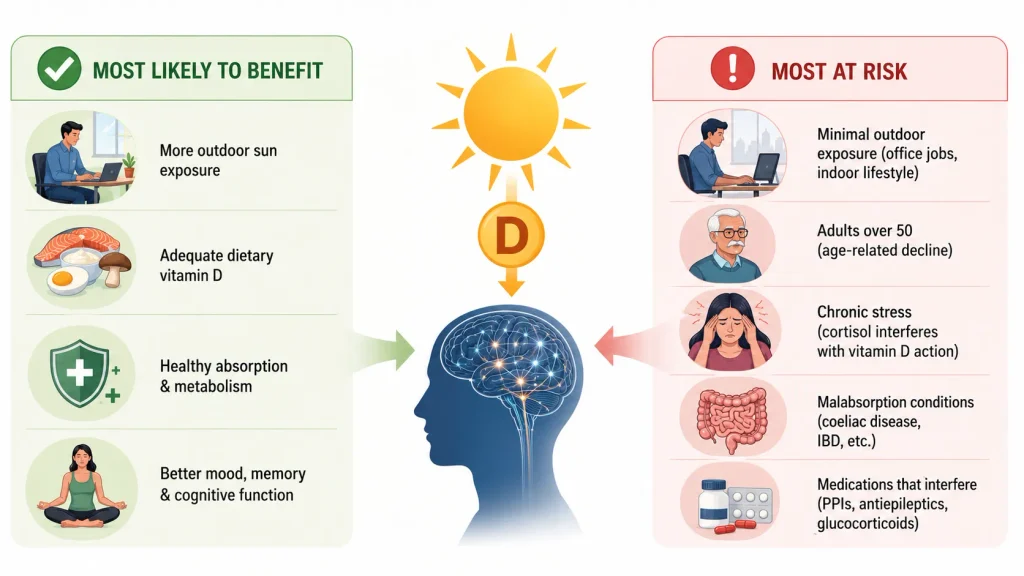
After 12 years of conducting detailed nutritional assessments of Indian clients, vitamin D deficiency is one of the most consistent findings I document — and the Indian context has specific features that make this research particularly urgent.
Despite India’s abundant sunshine, vitamin D deficiency affects an estimated 70 to 90% of the Indian population. The paradox is explained by several factors: most Indians with office jobs have minimal outdoor sun exposure during peak UV hours; traditional clothing covers significant skin surface area limiting synthesis; the skin pigmentation typical of South Asian populations requires longer sun exposure for equivalent vitamin D synthesis compared with lighter-skinned populations; and the vegetarian diet dominant in many Indian households contains very few dietary vitamin D sources.
Groups at highest risk for the cognitive consequences of deficiency: Urban professionals with minimal outdoor exposure; adults over 50 (cutaneous vitamin D synthesis declines with age); those with chronic stress (cortisol interferes with vitamin D receptor signalling — see our chronic stress guide); those with malabsorption conditions (coeliac disease, inflammatory bowel disease); and anyone on medications including proton pump inhibitors, antiepileptics, and glucocorticoids that interfere with vitamin D metabolism or receptor function.
The Sleep-Vitamin D Protocol I Apply in Practice
Step 1: Test before supplementing. Request a 25-hydroxyvitamin D (25-OHD) serum test. For general health, 40–60 ng/mL (100–150 nmol/L) is optimal. For neurological and cognitive applications — based on the Emory findings and prior research — targeting the higher end of this range (50–70 ng/mL) appears more relevant.
Step 2: Choose vitamin D3 with K2. Vitamin D3 (cholecalciferol) is the biologically active form and significantly more effective than D2 (ergocalciferol) at raising blood levels. Pair with vitamin K2 (MK-7 form, 100–200mcg daily) to ensure the calcium that vitamin D mobilises is directed to bone rather than soft tissues.
Step 3: Supplement strategically. For mild deficiency (20–30 ng/mL): 2,000–3,000 IU daily. For significant deficiency below 20 ng/mL: 4,000–5,000 IU daily under medical supervision. The Emory study’s cognitive benefit appeared at 5,000 IU in the MCI-sleep-disturbance population specifically.
Step 4: Optimise the sleep connection. The Emory study specifically targeted people with sleep disturbances. Vitamin D supplementation is most likely to support cognition when sleep quality is also addressed. See our Sleep Hygiene Hacks guide and our Natural Sleep Remedies guide for the complete sleep optimisation framework that amplifies vitamin D’s cognitive benefits.
Step 5: Support absorption through fat. Vitamin D is fat-soluble. It requires dietary fat for intestinal absorption. Take vitamin D supplements with the largest meal of the day — ideally one containing healthy fats like nuts, ghee, olive oil, or fatty fish.
For the complete framework of evidence-based supplementation that includes vitamin D alongside magnesium, B12, and the other micronutrients that 2026 research has identified as critical for brain and body health, see our Best Longevity Supplements Evidence-Based Guide.
The Takeaway
The Emory University Sleep Medicine 2026 study adds a significant piece to the vitamin D-brain health puzzle: in older adults with mild cognitive impairment and sleep disturbances — a population at high risk for Alzheimer’s progression — supplementing with 5,000 IU of vitamin D daily was associated with 13% better cognitive test scores. This is preliminary evidence from a small study, but it is mechanistically compelling and clinically actionable. Test vitamin D levels, supplement strategically to achieve optimal blood levels, pair D3 with K2, and address the sleep quality that both amplifies vitamin D’s brain benefits and independently protects against neurodegeneration. For the complete brain health nutritional framework, see our Vitamin C and Brain Health article and our Functional Nutrition guide.
About the Author
Tanveer Ahmed Khan is a K11 School of Fitness Sciences-certified personal trainer and nutrition coach with 12+ years of strength training experience. Coaching: info@livenulife.com | Instagram: @fitwithtanveer | livenulife.com
Scientific References
1. Zhou, S., Sudeshna, P., Trotti, L.M., Bliwise, D., Pak, V. (2026). Vitamin D supplement intake is associated with better cognition in persons with sleep disturbance and mild cognitive impairment. Sleep Medicine, 146: 108960. DOI: 10.1016/j.sleep.2026.108960
2. ScienceDaily / Emory University. (August 23, 2026). This common vitamin was linked to 13% better cognitive scores.
3. Knopf & Lamming (2026). Cell Press Blue protein restriction longevity review — vitamin D-cognitive interaction context.
4. Prior research: Annweiler, C. (2022). Vitamin D and cognitive performance in adults. Journal of Internal Medicine.
5. 2026 CDC National Nutrition Report — vitamin D deficiency prevalence data across demographic groups.