
KEY TAKEAWAY: A University of Oulu study of 2,264 adults published in the European Journal of Nutrition (July 16, 2026) and reported by ScienceDaily on August 19, 2026 found that higher habitual coffee intake correlates with less visceral fat, greater skeletal muscle mass, lower branched-chain amino acid levels associated with insulin resistance — and surprising sex-specific hormonal differences including higher testosterone in male coffee drinkers. Coffee is not simply a caffeine delivery vehicle. Here is the complete science.
The Finnish Paradox: Same BMI, Completely Different Bodies
Finland has the highest per-capita coffee consumption in the world. The average Finnish adult drinks approximately 5 cups per day — a cultural and metabolic immersion in coffee that makes Finland the ideal natural laboratory for studying what habitual, lifetime coffee consumption actually does to the human body at a population level.
A study published in the European Journal of Nutrition on July 16, 2026, and covered by ScienceDaily, Inc. Magazine, and Medical News Today on August 19, 2026, took advantage of this opportunity through the Northern Finland Birth Cohort 1966 — one of the most detailed long-term population health studies ever conducted. Researchers from the University of Oulu, led by Luca Verroest, Karl-Heinz Herzig, and colleagues, analysed the relationship between habitual coffee intake and body composition, metabolic markers, and sex hormones in 2,264 participants all aged 46.
The headline finding: two people of identical age, height, and weight — producing exactly the same body mass index — can carry fundamentally different bodies inside that identical number. And coffee consumption was systematically associated with carrying the better one.
This research arrives as an important companion to our recent coverage: our August 2026 coffee and liver health article — based on a 354,957-person Cedars-Sinai study — found that 3 to 5 cups daily was associated with 47% lower liver cancer risk and 42% lower liver-related mortality. The Finnish body composition study adds an entirely new dimension: coffee may also be actively reshaping metabolic body composition, not just protecting the liver.
📖 Also read: Your Daily Coffee Is Protecting Your Liver — August 2026 Cedars-Sinai Study — The 354,957-person UK Biobank study showing coffee dramatically reduces liver cancer, cirrhosis, and liver-related mortality — the liver health companion to this body composition research.
The Body Composition Findings: What the Data Showed
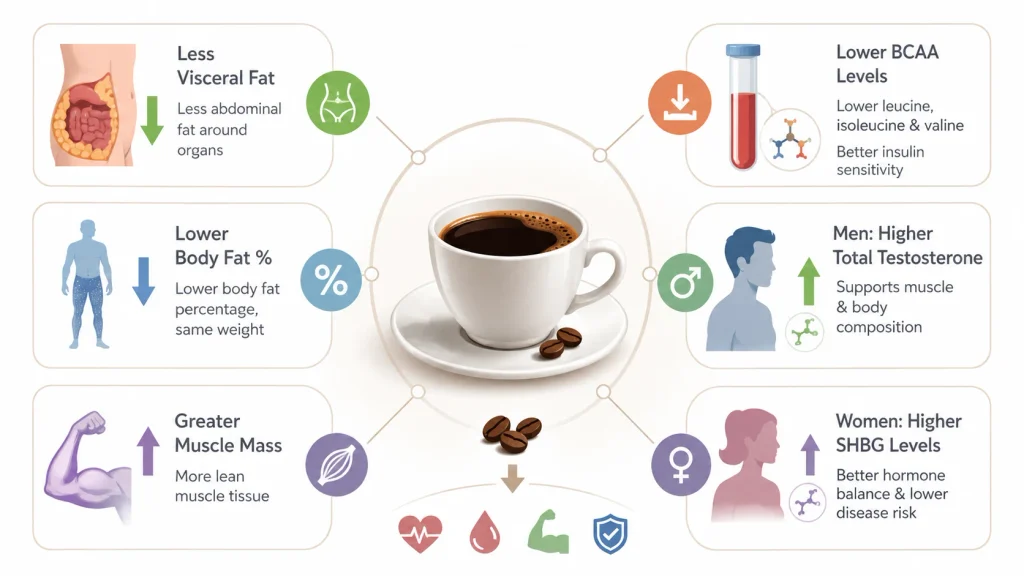
Less visceral fat in higher coffee drinkers. Participants who consumed the highest amounts of coffee — five or more cups daily — had measurably less visceral adipose tissue (abdominal fat surrounding internal organs) compared with low coffee consumers, even when total body weight and BMI were comparable. Visceral fat is the most metabolically dangerous fat depot in the body: it secretes pro-inflammatory cytokines, promotes insulin resistance, and is independently associated with cardiovascular disease, type 2 diabetes, and non-alcoholic fatty liver disease.
Lower total body fat percentage. Total body fat percentage was lower in higher coffee consumers across both men and women in the cohort, with the associations being more pronounced in men. This was a composition difference — not a weight difference. Higher coffee consumers did not weigh less on average; they carried less of their weight as fat and more as lean tissue.
Greater skeletal muscle mass. Higher coffee consumption was associated with greater skeletal muscle mass across the cohort. This finding was unexpected and has generated significant scientific interest, because skeletal muscle is not typically a tissue that nutritional research associates with coffee. The proposed mechanisms — discussed below — are speculative but biologically plausible.
Lower branched-chain amino acid (BCAA) levels. In both men and women, higher coffee intake was associated with lower circulating levels of branched-chain amino acids — particularly leucine, isoleucine, and valine. This is a striking metabolic finding because elevated BCAAs in the bloodstream are one of the most consistent biomarkers of insulin resistance and type 2 diabetes risk. People with insulin resistance characteristically have elevated circulating BCAAs because their muscle cells are not efficiently taking up these amino acids for protein synthesis. Coffee consumers’ lower BCAA levels suggest their muscles are more efficiently using amino acids — a marker of better insulin sensitivity and metabolic health.
Sex-specific hormonal patterns. The hormonal findings divided along sex lines. Male coffee consumers showed higher levels of total and bioavailable testosterone compared with men who drank little coffee — a finding with implications for body composition, since testosterone is the primary anabolic hormone driving muscle synthesis in men. However, male coffee drinkers also showed lower free testosterone (the biologically active fraction), suggesting that coffee may influence sex hormone-binding globulin levels and the way testosterone is distributed and available in the body. Female coffee consumers showed increased sex hormone-binding globulin (SHBG) — a protein that binds and regulates oestrogen and testosterone. Higher SHBG in women is generally associated with lower risk of polycystic ovary syndrome, type 2 diabetes, and breast cancer risk.
Why Does Coffee Do This? The Mechanisms
The Finnish study is observational — it can identify associations but cannot prove that coffee caused the body composition differences. However, multiple biological mechanisms have been proposed and partially validated, and they are worth understanding.
Chlorogenic acids and insulin sensitivity. Coffee’s primary bioactive compounds — chlorogenic acids — are polyphenolic antioxidants that inhibit the intestinal absorption of glucose and reduce hepatic glucose production. Improved insulin sensitivity means cells take up glucose and amino acids more efficiently, which supports better muscle glycogen storage and amino acid utilisation. Better amino acid utilisation means lower circulating BCAAs — exactly what the Finnish study found.
Caffeine and thermogenesis. Caffeine stimulates the sympathetic nervous system, increasing metabolic rate and fat oxidation for several hours after consumption. Regular caffeine exposure maintains a modest but consistent elevation in energy expenditure. In habitual coffee drinkers, this thermogenic effect may contribute to lower fat accumulation over time — though tolerance develops for many caffeine effects, and whether thermogenic effects persist in habitual consumers is debated.
Trigonelline and muscle protein synthesis. Trigonelline is a coffee alkaloid present in significant amounts in both caffeinated and decaffeinated coffee. It activates the NAD+ biosynthesis pathway — the same pathway targeted by NMN and NR supplements marketed for muscle maintenance and longevity. NAD+ is required for efficient mitochondrial energy production in muscle cells. Higher NAD+ availability supports mitochondrial biogenesis and muscle protein synthesis. This mechanism could explain the muscle mass association observed in the Finnish cohort — a genuinely novel and clinically interesting hypothesis.
Sex hormone modulation. Coffee contains compounds including quercetin and chlorogenic acids that influence the aromatase enzyme — the enzyme responsible for converting testosterone into oestrogen. Inhibition of aromatase could partially explain higher total testosterone in male coffee drinkers, since less testosterone is being converted. The SHBG increase in women may reflect coffee’s effects on liver protein synthesis, as SHBG is produced by the liver and its production is influenced by multiple dietary factors.
The India-Specific Context: Coffee Consumption in Indian Health Culture
India’s coffee culture is geographically concentrated but deep: South India — particularly Tamil Nadu, Karnataka, and Andhra Pradesh — has one of the oldest and most sophisticated coffee traditions in the world. South Indian filter coffee, prepared through metal strainers that retain higher concentrations of bioactive compounds including cafestol, kahweol, chlorogenic acids, and trigonelline, may deliver a more complete bioactive profile than paper-filtered Western-style coffee.
In our
In our August 2026 coffee liver health article, we noted that South Indian filter coffee retains higher concentrations of cafestol and kahweol — the diterpene compounds associated with phase II liver enzyme induction and hepatoprotection. The Finnish study adds that the full coffee bioactive complex — not just caffeine — may be reshaping metabolic body composition. This is another argument for traditional preparation methods over instant coffee, which loses significant portions of coffee’s bioactive compounds through the drying and processing required for its production.
For Indian coffee drinkers who are managing body composition, metabolic health, or hormonal balance, the Finnish data provides genuinely interesting science-based context for a traditional practice that many have been told to limit based on simplistic “caffeine is bad” advice.
The Caveats — What the Study Cannot Tell Us
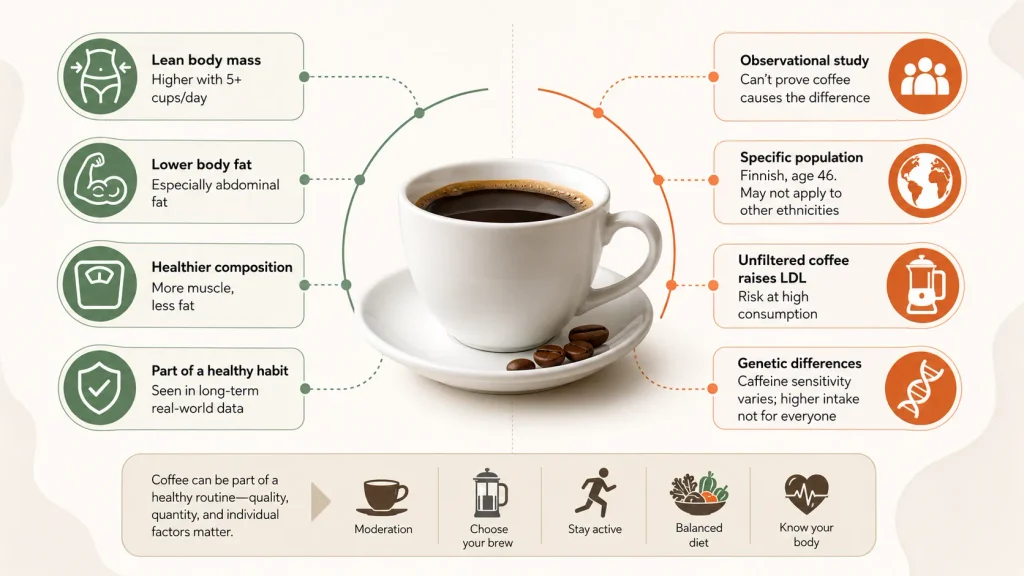
I want to be direct about the limitations of this research, because body composition claims generate enormous wellness industry interest and the caveats here are important.
• Observational design: the study cannot prove that coffee caused the body composition differences. People who habitually drink more coffee may differ systematically from non-drinkers in lifestyle, diet, activity level, or genetic factors that also influence body composition.
• The cohort is Finnish, aged 46, predominantly Northern European. Whether these findings replicate in Indian, South Asian, or other ethnic populations with different baseline metabolism, gut microbiome composition, and coffee preparation methods requires direct investigation.
• Unfiltered coffee (French press, moka pot, South Indian filter) raises LDL cholesterol at high consumption due to cafestol and kahweol — a cardiovascular risk consideration that must be balanced against other benefits.
• Five or more cups daily is the highest consumption group in the study. Individual caffeine sensitivity varies significantly — genetic variants in the CYP1A2 enzyme determine whether someone metabolises caffeine quickly or slowly, with slow metabolisers showing different and sometimes adverse cardiovascular responses to high caffeine intake.
The Practical Protocol: Applying the Finnish Research
Based on the Finnish data, the Cedars-Sinai liver research, and 12 years of clinical practice working with clients on metabolic health, here is how I now frame coffee recommendations:
For body composition goals: 3 to 5 cups of plain black coffee or traditional South Indian filter coffee daily, consumed earlier in the day (before 2pm to avoid sleep disruption), without added sugar, artificial sweeteners, or flavoured syrups. The research increasingly supports coffee as a positive metabolic food — not a treat to be minimised.
For men with testosterone or body composition concerns: The Finnish hormonal data is preliminary and observational. But the direction of the finding — higher total and bioavailable testosterone in regular male coffee drinkers — adds to the growing picture of coffee as a metabolically active food with hormonal dimensions, not merely a stimulant. Combine with adequate resistance training and our protein guidelines from July 2026 for the most complete body composition protocol.
For people with PCOS or women concerned about sex hormone balance: The SHBG increase observed in female coffee drinkers is consistent with known associations between higher SHBG and reduced PCOS risk and better metabolic health in women. This does not replace medical management — but it provides biological plausibility for coffee consumption being metabolically positive in this population context.
For the complete nutritional context that maximises coffee’s benefits while addressing the other pillars of metabolic health, see our Functional Nutrition guide and our GLP-1 Natural Stimulation article, which covers how coffee polyphenols support the gut-GLP-1 axis.
The Takeaway
The University of Oulu’s 2,264-person Finnish cohort study — published in the European Journal of Nutrition and widely covered on August 19, 2026 — adds a striking new dimension to coffee science: habitual coffee consumption is associated with lower visceral fat, greater skeletal muscle mass, better insulin sensitivity markers, and sex-specific hormonal differences that broadly favour metabolic health. The mechanisms — chlorogenic acid-mediated insulin sensitisation, trigonelline’s NAD+ pathway activation, and potential aromatase modulation — are biologically plausible and warrant further investigation. For the full coffee-health picture combining this body composition data with our August 2026 liver protection findings, see our Coffee and Liver Health article.
About the Author
Tanveer Ahmed Khan is a K11 School of Fitness Sciences-certified personal trainer and nutrition coach with 12+ years of strength training experience. Coaching: info@livenulife.com | Instagram: @fitwithtanveer | livenulife.com
Scientific References
1. Verroest, L., Jokelainen, J., Choudhary, S., et al. (2026). Associations of habitual coffee intake with testosterone and cardiometabolic markers: the Northern Finland Birth Cohort 1966 Study. European Journal of Nutrition. DOI: 10.1007/s00394-026-04038-z
2. ScienceDaily / University of Oulu. (August 19, 2026). Coffee drinkers have less fat, more muscle, and surprising hormone differences.
3. Medical News Today. (August 20, 2026). Coffee intake tied to leaner fat-to-muscle ratio and improved insulin sensitivity.
4. Inc. Magazine. (August 19, 2026). Think Coffee’s Main Benefit Is Energy? A Study of 2,264 People Linked the Drink to Less Fat and More Muscle.
5. MedicalDaily. (August 21, 2026). Drinking More Coffee Was Linked to Less Visceral Fat and More Muscle in a Surprisingly Detailed Health Study.