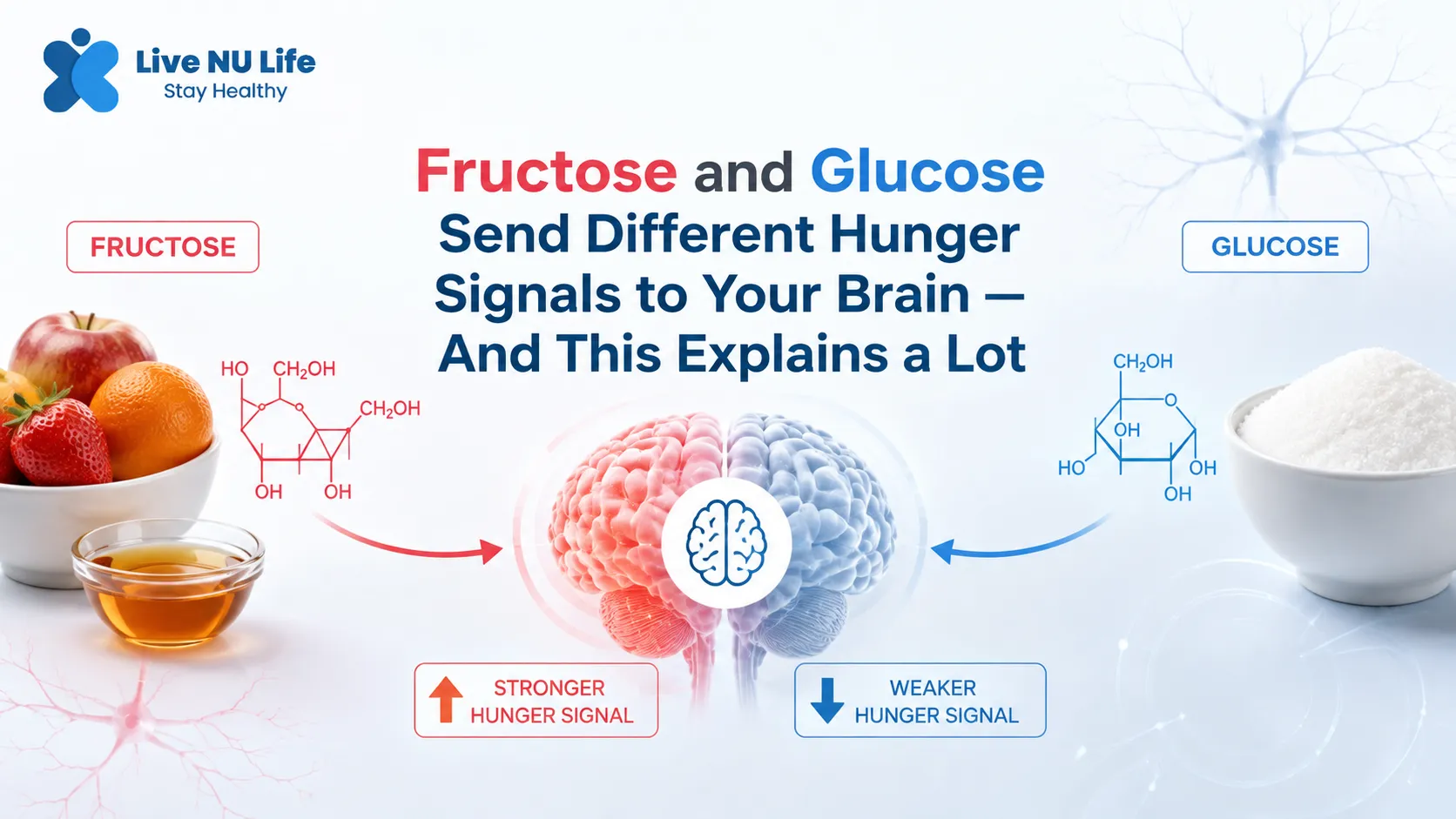
KEY TAKEAWAY: A study published in Neuron on June 10, 2026 by the Monell Chemical Senses Center (NIH-funded) found that fructose and glucose — both with identical calories — communicate with the brain through completely different gut-brain pathways. Glucose strongly suppresses hunger-promoting neurons. Fructose barely does. High-fructose corn syrup activates both reward and hunger pathways simultaneously. This is the neurological explanation for why fruit juice, soft drinks, and processed sweet foods make you hungrier rather than full — and what to do about it.
Same Calories, Completely Different Brain Signals
One of the most frustrating experiences my clients describe is this: they eat something sweet — a flavoured yoghurt, a piece of cake, a glass of juice — and feel just as hungry an hour later as before they ate. Sometimes hungrier. They blame themselves for lack of discipline. They assume they simply enjoy food too much.
The science says the problem is the type of sugar, not the person. A landmark study published in Neuron on June 10, 2026 by researchers at the Monell Chemical Senses Center — funded by the National Institutes of Health — has finally documented the precise neurological mechanism that explains why.
The team, led by Dr Amber Alhadeff, investigated how fructose and glucose — two sugars that appear identical on any nutrition label, both providing 4 calories per gram — communicate with the appetite-regulating regions of the brain. What they found was not a minor difference. Fructose and glucose activate completely separate gut-brain pathways, with dramatically different effects on the neurons that drive hunger.
The result: glucose suppresses hunger strongly. Fructose barely does. And high-fructose corn syrup — the combination of both sugars used in the majority of sweetened beverages and processed foods globally — simultaneously activates reward circuitry more powerfully than either sugar alone.
📖 Also read: Why Going Completely Sugar-Free May Backfire — June 2026 — The ENDO 2026 study showing complete sugar elimination disrupts gut bacteria — the other side of the sugar-brain story that pairs directly with this fructose research.
The Exact Mechanism: What Happens in the Brain
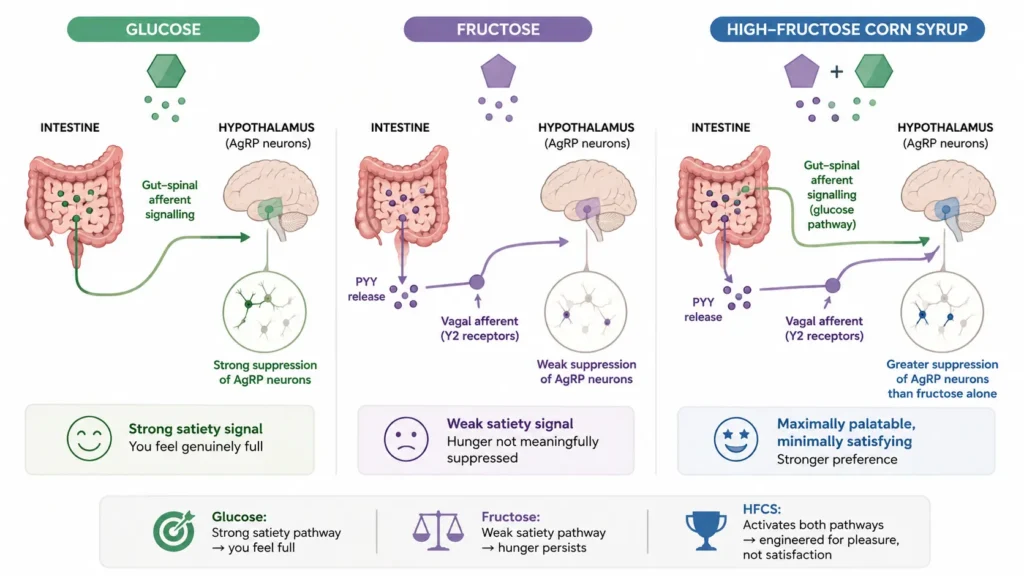
The Monell team focused on AgRP neurons — agouti-related protein neurons in the hypothalamus that are among the most powerful hunger-promoting cells in the brain. When AgRP neurons are active, you feel hungry. When they are suppressed, you feel satisfied. The brain’s response to eating is, in large part, a story about how well a food suppresses AgRP activity.
What glucose does: Glucose is sensed via gut-spinal afferent signalling — a direct neural pathway from the gut to the brain. When glucose is present in the intestine, this pathway sends a strong, rapid signal to the hypothalamus that suppresses AgRP neuron activity. The result: a clear, sustained satiety signal. You feel genuinely full.
What fructose does — and doesn’t do: Fructose is sensed through a completely separate pathway: it triggers the release of gut hormone PYY (peptide YY), which activates vagal afferent neurons through Y2 receptors, which then modestly inhibit AgRP neurons. This pathway is significantly weaker than glucose’s. Fructose produces a 45% increase in salivary nitrite (a different physiological effect) but sends a much weaker “I’m full” signal to the hypothalamus. The brain registers that something was consumed — but hunger is not meaningfully suppressed.
What high-fructose corn syrup does: HFCS contains a mixture of fructose and glucose. Because it contains both, it activates both pathways — the glucose pathway for modest satiety and the fructose pathway for food reward. But HFCS suppressed AgRP neuronal activity more than fructose alone, and animals showed stronger preference for HFCS than for either sugar individually. This is the neurological fingerprint of a substance engineered to be maximally palatable while minimally satisfying.
Why Fruit Is Different From Fruit Juice — The Key Distinction
Before my clients with fruit-heavy diets panic, I want to address this directly: this research does not mean fruit is harmful. Whole fruit and fructose-sweetened beverages are categorically different substances producing different physiological effects.
Whole fruit contains fructose, but it also contains fibre — soluble and insoluble — that dramatically slows the absorption of that fructose from the digestive tract. When fructose arrives slowly in the intestine, the liver has time to process it effectively. Blood fructose levels remain low and stable. The small amount of glucose in fruit activates the satiety pathway efficiently. And the fibre itself produces short-chain fatty acids in the colon that stimulate GLP-1 release — additional satiety signalling on top of the glucose pathway.
A glass of apple juice removes all of that. It concentrates the fructose from multiple apples, eliminates the fibre, and delivers it as a liquid that empties from the stomach in minutes. The liver is flooded with fructose faster than it can process it efficiently, and the gut-brain satiety pathway receives a weaker signal than it would from eating one whole apple.
This distinction is why our June 2026 Fibermaxxing guide emphasises that fibre is not just about bowel regularity — it fundamentally transforms how sugar is metabolised and how hunger hormones respond to food. And it is why our analysis of why going sugar-free backfires found that eliminating natural whole-food sugars (from fruit, dairy, and vegetables) disrupts gut bacteria while eliminating processed fructose sources is genuinely beneficial.
The High-Fructose Corn Syrup Problem in the Indian Diet
High-fructose corn syrup (HFCS) is commonly associated with American ultra-processed food, but its prevalence in the Indian market has been growing substantially. It appears in a wide range of commercially produced products — soft drinks, flavoured juices, ketchup, commercial biscuits, confectionery, packaged sauces and chutneys, and processed dairy desserts.
In my practice, I regularly conduct dietary assessments that reveal HFCS consumption in clients who believe they eat relatively clean Indian food. The issue is not necessarily that they are eating fast food — it is that the packaged condiments, beverages, and snacks they use daily contain HFCS in forms not obvious from casual label reading.
In India, HFCS is often listed under alternative names: glucose-fructose syrup, corn syrup solids, maize syrup, or isoglucose. Learning to identify these terms on food labels is a foundational skill I teach all my clients during their first dietary audit session.
The Neuron 2026 research confirms why this matters beyond just calorie counting: HFCS is specifically designed to maximise palatability while minimising satiety signalling. Every product that contains it is, by neurological design, less satisfying than its calorie content implies. Understanding this mechanism is essential for anyone struggling with appetite control, cravings, or the feeling of being hungry despite eating enough. For the complete framework on reading labels and reducing ultra-processed food exposure, see our Ultra-Processed Foods guide.
📖 Also read: 39 Sweeteners Tested — What They Do to Your Gut Bacteria — July 2026 — The Cambridge Molecular Systems Biology study showing that artificial sweetener alternatives to HFCS each carry their own gut microbiome risks — completing the sugar-substitute picture.
The Practical Implications: What This Research Means at Every Meal
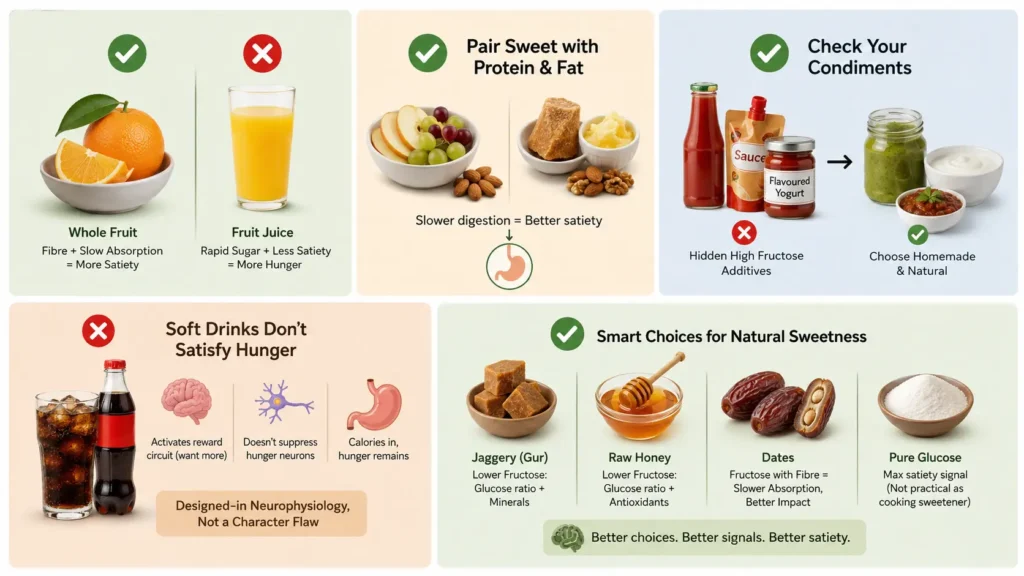
The June 2026 Neuron research has direct, actionable implications for appetite management, food choice, and the persistent hunger that sabotages dietary intentions. Here is how I apply this science in client practice:
Choose whole fruit over juice, always. One orange suppresses hunger through fibre, slow fructose absorption, and efficient glucose satiety signalling. A glass of orange juice (the equivalent of 3–4 oranges) delivers mostly fructose rapidly, minimal satiety signalling, and significant sugar load. This is not about calories — it is about the neurological satiety response.
Pair sweet foods with protein and fat. Protein and fat slow gastric emptying, giving the body more time to convert the glucose component of sweet foods into effective satiety signals, and blunting the rapid fructose absorption that overwhelms the liver. A piece of fruit with a handful of nuts, or a small amount of jaggery with ghee, produces a fundamentally different hormonal response than fruit or sweetener alone.
Audit your condiment labels. Ketchup, commercial chutneys, packaged sauces, and flavoured yoghurts are among the most common hidden sources of HFCS and high-fructose syrups in the Indian diet. These are the products where fructose load accumulates without conscious awareness. Switch to homemade chutneys, plain yoghurt, and freshly made sauces.
Understand why soft drinks never satisfy hunger. A 500ml cola contains approximately 55g of sugar, predominantly from HFCS. The Neuron 2026 research explains exactly why you can drink an entire bottle and feel equally hungry immediately after: fructose has triggered reward circuitry (creating the desire for more) while barely suppressing the AgRP neurons that drive hunger. The drink has delivered calories while leaving hunger biologically intact. This is not a character flaw. It is designed-in neurophysiology.
Be strategic about natural sweetener choices. When sweetness is desired, jaggery (gur) and raw honey contain smaller fructose-to-glucose ratios than refined HFCS, and arrive with trace minerals and antioxidants. Pure glucose (dextrose) would theoretically maximise the satiety signal — but is not a practical cooking sweetener. Dates provide fructose within fibre, which moderates the neurological impact significantly.
The Broader Significance: Rethinking How We Talk About Sugar
For decades, nutritional science has treated all sugars as essentially equivalent — differentiated only by their caloric density and glycaemic index. The June 2026 Neuron research fundamentally disrupts this framework. Fructose and glucose are not simply interchangeable carbohydrate sources. They are distinct signals in a complex gut-brain communication system, with dramatically different effects on appetite, satiety, and food preference.
This research connects directly to the Stanford BRP discovery we covered in our Natural Ozempic article — both reveal that appetite regulation is a sophisticated neurological system with specific molecular inputs, not simply a matter of calorie load. And it connects to the GLP-1 nutritional strategy we detailed in July 2026 — the fact that dietary fibre stimulates GLP-1 (appetite-regulating hormone) while fructose does not is a direct expression of the same gut-brain axis biology the Neuron study documents.
As a practitioner who has spent 12 years advising clients on food choices, this research validates an observation I have made consistently: clients who reduce their fructose load from processed sources — not fruit, not whole food sweeteners, but HFCS and concentrated fruit syrups in packaged products — consistently report reduced appetite, fewer cravings, and more sustainable dietary adherence. Not because they are eating fewer calories, but because they have restored their brain’s ability to register satiety accurately.
The Takeaway
The Monell Chemical Senses Center Neuron 2026 study reveals something that changes how we should think about sugar: fructose and glucose are the same calorie in a nutritional database and completely different molecules in your brain’s appetite-regulation system. Glucose suppresses hunger-promoting neurons powerfully and directly. Fructose barely does — and HFCS activates food reward pathways more strongly than either sugar alone. For the complete nutritional framework that helps manage hunger through food choice rather than willpower — including the role of protein, fibre, and fermented foods in satiety — see our Boost GLP-1 Naturally guide and our Functional Nutrition guide.
About the Author
Tanveer Ahmed Khan is a K11 School of Fitness Sciences-certified personal trainer and REPS India-registered dietitian-nutritionist with over 12 years of experience. Coaching: info@livenulife.com | Instagram: @fitwithtanveer | livenulife.com
Scientific References
1. McKnight, A.D., de Araujo, A., Hsu, F.Y., et al. (2026). Attenuated hypothalamic response to fructose via a dedicated gut-brain pathway. Neuron. DOI: 10.1016/j.neuron.2026.05.013
2. ScienceDaily / Monell Chemical Senses Center. (June 26, 2026). Researchers discover why fructose doesn’t satisfy hunger like glucose.
3. NIH Research Matters. (August 2026). Fructose and glucose trigger different brain responses.
4. MindBodyGreen. (June 25, 2026). This Sugar Sends A Much Weaker “I’m Full” Signal To Your Brain.
5. The Transmitter: Neuroscience News. (June 30, 2026). Fructose silences hunger-driving neurons less than glucose.