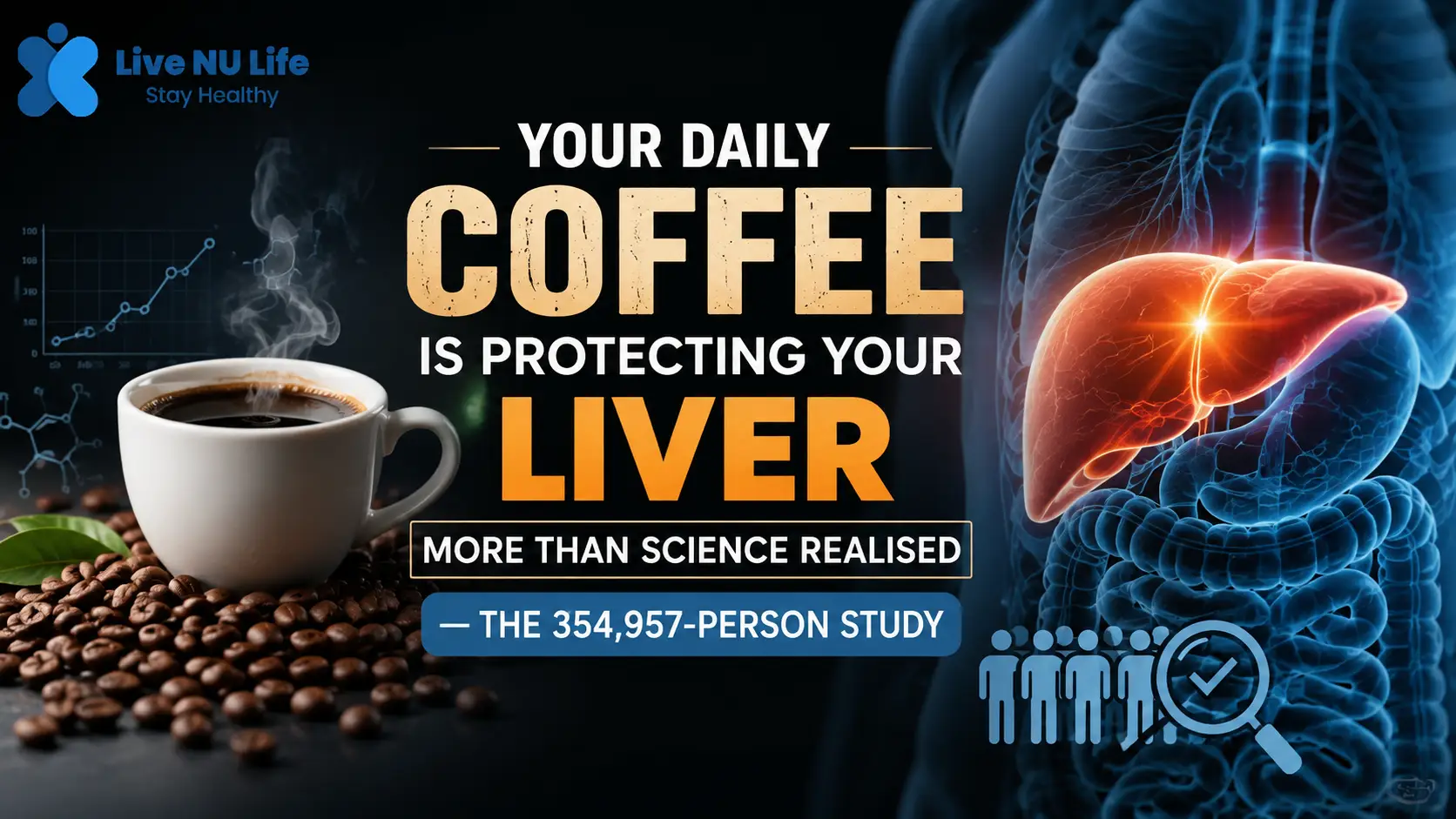
KEY TAKEAWAY: A Cedars-Sinai study of 354,957 adults, published in Clinical Gastroenterology and Hepatology (July 2026), found that coffee drinkers had up to 32% lower risk of cirrhosis, 47% lower risk of liver cancer, and 42% lower risk of liver-related death. Benefits began at just 1–2 cups daily. And decaf offered almost identical protection — proving caffeine is not the active ingredient. Here is the complete science, and what it means for your daily cup.
One of the Largest Liver Studies Ever Conducted — And What It Found
Every morning, approximately 2 billion cups of coffee are consumed globally. In India, while tea remains the dominant beverage, coffee consumption has been growing rapidly in urban centres — and for the 354,957 adults enrolled in the UK Biobank study, what they drank with their morning routine was quietly shaping the long-term health of one of their most critical organs.
A study published in Clinical Gastroenterology and Hepatology on July 1, 2026, led by investigators at Cedars-Sinai Health Sciences University — including Hyun-Seok Kim, Shelly C. Lu, Stephen Pandol, and Ju Dong Yang — represents one of the most comprehensive investigations into coffee and liver health ever conducted. The study analysed over a decade of health records from 354,957 UK Biobank participants who had no baseline cirrhosis or liver cancer, tracking new diagnoses of cirrhosis, hepatocellular carcinoma (the most common liver cancer), and liver-related deaths.
What separated this study from previous coffee-liver research was its depth. The investigators did not just cross-reference coffee intake with diagnosis records. They added two layers of biological evidence that had never been combined at this scale: liver MRI scans showing fat levels, iron, fibrosis, and inflammation directly in the liver tissue, and blood proteomics — analysis of thousands of proteins in the bloodstream — revealing the specific biological pathways through which coffee appears to protect the liver.
The results, when reported by ScienceDaily on July 25, 2026 and covered by CNN, Healthline, and Cedars-Sinai, made global health headlines. But most of the coverage focused on a single number. The full picture is considerably more interesting.
📖 Also read: Fatty Liver: Causes, Symptoms, Treatment & Diet Guide — The complete evidence-based guide to NAFLD — the liver condition that coffee’s protective mechanisms directly address.
The Numbers: Risk Reduction at Every Level of Coffee Consumption
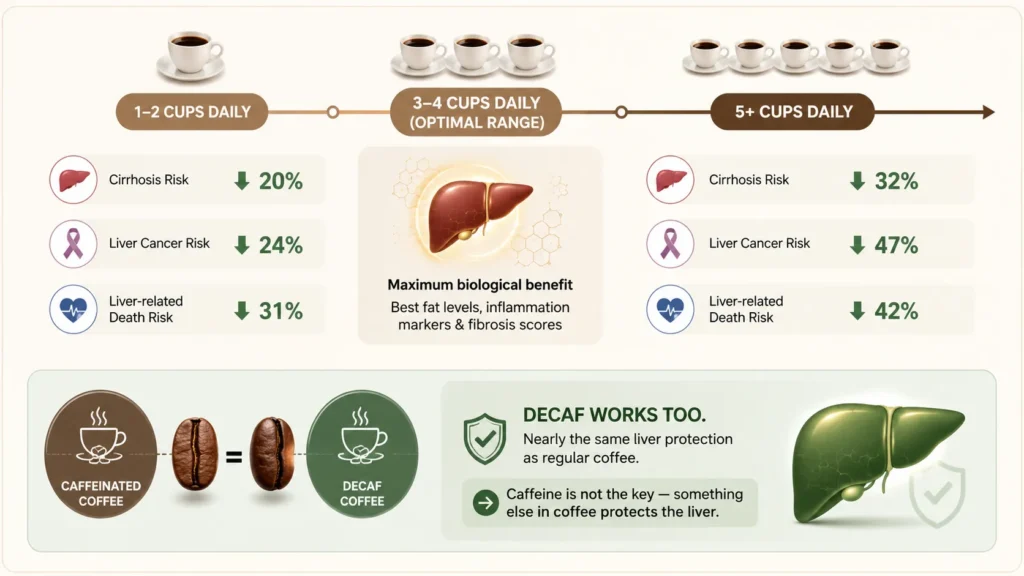
The Cedars-Sinai team found a dose-response relationship — the more coffee consumed, the greater the liver protection — with meaningful benefits appearing from the first cup. Here is the full dose-response picture:
1–2 cups daily: 20% lower risk of cirrhosis, 24% lower risk of liver cancer, and 31% lower odds of liver-related death compared with non-coffee drinkers.
3–4 cups daily (the optimal range): Progressive increases in protection across all three outcomes. This is the consumption level the study identified as the inflection point for maximum biological benefit — liver MRI scans and blood protein profiles of 3–4 cup drinkers showed the most favourable patterns across fat levels, inflammation markers, and fibrosis scores.
5+ cups daily: 32% lower risk of cirrhosis, 47% lower risk of liver cancer, and 42% lower risk of liver-related death compared to non-drinkers.
These are not marginal statistical associations. A 47% reduction in liver cancer risk, sustained across 354,957 people followed for over a decade, with biological imaging and proteomic evidence identifying the mechanisms, represents one of the strongest diet-cancer associations in modern nutritional epidemiology.
And then the finding that changes everything: decaf performed almost identically.
Participants who drank decaffeinated coffee showed nearly the same magnitude of liver protection as those drinking fully caffeinated coffee. This single finding demolishes the most intuitive explanation for coffee’s liver benefit. If caffeine were doing the work, removing it would remove the benefit. It does not. Something else — or more likely, multiple things — inside the coffee bean is protecting the liver.
What Is Actually in Coffee That Protects the Liver?
Coffee is not a simple beverage. A typical cup contains more than 1,000 distinct bioactive compounds, and the research on which of these are doing the hepatoprotective heavy lifting has been advancing rapidly through 2026.
Chlorogenic acids — the primary candidate. These are polyphenolic antioxidants present at high concentrations in both caffeinated and decaffeinated coffee. Chlorogenic acids are the reason the decaf finding is mechanistically plausible: they survive the decaffeination process, they are among the most potent antioxidants in the human diet, and they are directly absorbed in the gut and delivered to the liver via portal circulation.
Cafestol and kahweol — the diterpenes. These compounds, found in the natural oil of coffee beans, have been shown in laboratory studies to induce phase II detoxification enzymes in the liver — the enzymes responsible for neutralising carcinogens, alcohol metabolites, and inflammatory compounds before they cause cellular damage. They are present in unfiltered coffee (French press, stovetop moka pot, Turkish coffee) at higher concentrations than in paper-filtered drip coffee.
Trigonelline. This alkaloid — also present in both caffeinated and decaffeinated coffee — has demonstrated hepatoprotective properties in animal models, including reduction of liver fibrosis and lipid accumulation. Its contribution to the human liver benefits observed in the Cedars-Sinai study is an active area of research.
The antioxidant load: a broader mechanism. The Cedars-Sinai blood proteomics analysis found that coffee drinkers had higher levels of proteins tied to healthy liver function and lower levels of proteins linked to scarring, inflammation, and fat accumulation. This proteomic signature is consistent with a systemic reduction in oxidative stress — the central driver of liver disease progression across all major causes, including non-alcoholic fatty liver disease (NAFLD), viral hepatitis, and alcohol-associated liver disease.
Gut microbiome modulation. Emerging 2026 research has identified coffee’s prebiotic effects on the gut microbiome as an additional hepatoprotective mechanism. Coffee polyphenols — particularly chlorogenic acids — are fermented by gut bacteria into compounds that reduce gut permeability and the translocation of bacterial endotoxins (lipopolysaccharides) from the gut to the liver via the portal vein. This gut-liver axis protection is particularly relevant to NAFLD, where gut dysbiosis and endotoxin-driven liver inflammation are central to disease progression. For the complete gut-liver axis picture, see our Gut Health Revolution guide.
📖 Also read: The Ancient Beverage Science Is Proving More Powerful Than Imagined — June 2026 — Tea polyphenols share similar hepatoprotective antioxidant mechanisms with coffee — the two beverage giants of 2026 research.
Why This Matters So Much in 2026
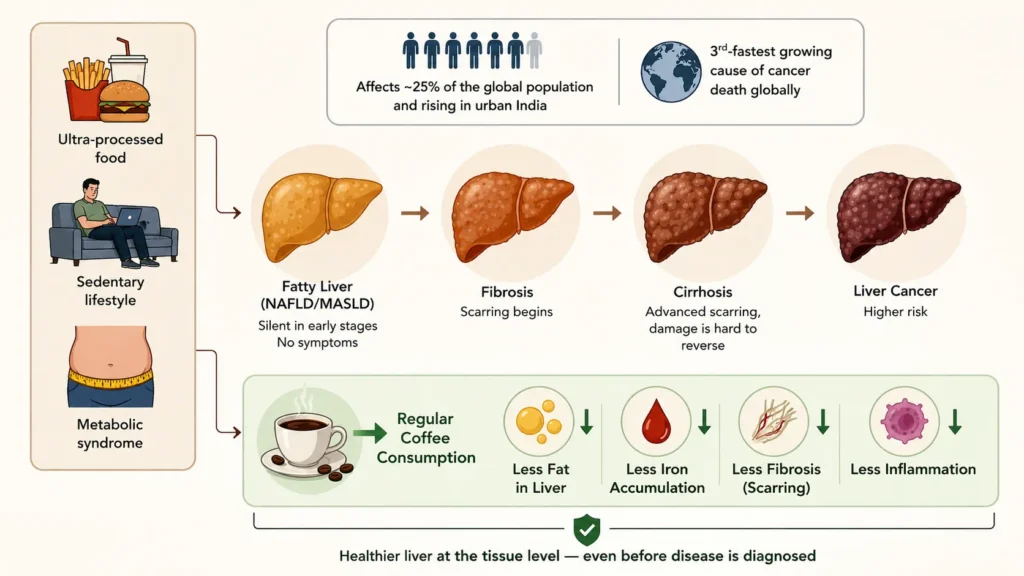
Liver disease is the third-fastest growing cause of cancer death globally. Non-alcoholic fatty liver disease (NAFLD) — now being renamed metabolic dysfunction-associated steatotic liver disease (MASLD) — affects an estimated 25% of the global population and is approaching epidemic levels in urban India, where ultra-processed food consumption, sedentary lifestyles, and metabolic syndrome are creating the conditions for widespread liver fat accumulation.
NAFLD is largely silent in its early stages. Most people with fatty liver disease have no symptoms until the condition has progressed to significant fibrosis or cirrhosis — by which point the damage is difficult or impossible to reverse. The Cedars-Sinai study found that even at the subclinical level — not yet diagnosed with cirrhosis or cancer — coffee drinkers showed objectively measurable differences in their liver MRI scans and blood protein profiles. Less fat. Less iron. Less fibrosis. Less inflammation. These are changes happening in the liver tissue itself, not just in disease registries.
In my 12 years of practice, I regularly see clients whose liver enzyme levels (ALT, AST) are mildly elevated, whose ultrasounds show early fatty changes, and who have not yet been given a formal NAFLD diagnosis. This is the population where the coffee finding is most immediately relevant. For the comprehensive dietary and lifestyle framework for addressing NAFLD, see our Fatty Liver Causes, Symptoms, Treatment & Diet guide.
The India-Specific Dimension: South Indian Filter Coffee
This is a point of genuine clinical and cultural relevance that I want to address for our Indian audience specifically.
South Indian filter coffee — prepared by passing hot water through finely ground, dark-roasted coffee and chicory, served with boiled milk — is one of the most common coffee preparations in southern India. It is a traditional beverage with a history stretching centuries, and the Cedars-Sinai study’s findings give it a scientific foundation that extends well beyond cultural preference.
Filter coffee made through a metal strainer — unlike paper-filtered drip coffee — retains higher concentrations of cafestol and kahweol, the diterpene compounds associated with liver enzyme induction and hepatoprotection. This means traditional South Indian filter coffee may, mechanistically, provide a more complete liver protection profile than paper-filtered Western-style drip coffee.
The chicory component adds another dimension. Chicory root contains inulin — a prebiotic fibre that feeds Bifidobacterium species in the gut microbiome — and hepatoprotective compounds including polyphenols and sesquiterpene lactones. The combination of coffee and chicory in traditional filter coffee is, from a liver health perspective, a scientifically rational preparation that modern nutritional research is beginning to validate.
Instant coffee — now dominant in many urban Indian households and offices — presents a different picture. Commercial instant coffee often contains fewer intact polyphenols (the drying and processing steps degrade chlorogenic acids), lower concentrations of diterpenes, and frequently includes artificial flavours, creamers, and added sugars that introduce the ultra-processed food harms that offset whatever coffee benefit remains.
The Sweetener and Sugar Warning the Study Includes
The Cedars-Sinai study included an important practical caveat: using sugars or sweeteners in coffee slightly reduced the protective effects. This finding connects directly to our July 2026 research on artificial sweeteners and gut bacteria — the Cambridge Molecular Systems Biology study that found common sweeteners suppress beneficial gut bacteria. The gut microbiome is the bridge between coffee’s prebiotic effects and its liver protection. Adding sweeteners to coffee disrupts the same microbial ecosystem through which coffee’s chlorogenic acids are fermented into hepatoprotective metabolites. The clinical recommendation is clear: consume coffee plain or with a small amount of whole, unprocessed milk. Black coffee is optimal for liver protection.
📖 Also read: Why Going Completely Sugar-Free May Backfire — June 2026 — Excessive sweeteners in coffee counteract its liver protection — the ENDO 2026 study on how sugar elimination strategy affects gut bacteria.
What the MRI and Proteomic Evidence Shows — The Biological Proof
This is the dimension of the July 2026 Cedars-Sinai study that elevates it above previous coffee-liver research, and it deserves careful explanation.
Previous studies established epidemiological associations: coffee drinkers get less liver disease. But they could not rule out healthy user bias — the possibility that coffee drinkers are simply healthier in other ways that account for the protection. The MRI and proteomic layers of the Cedars-Sinai analysis address this limitation directly.
Among participants who had liver MRI scans (a subset of the 354,957-person cohort), those who drank more coffee had objectively lower levels of liver fat (hepatic steatosis), lower liver iron (a marker of oxidative stress and cell damage), lower fibrosis scores (a measure of scarring), and lower levels of liver inflammation. These are structural, measurable differences in liver tissue — not just fewer diagnoses in a registry.
The proteomic analysis found that coffee drinkers had higher circulating levels of proteins associated with liver regeneration, healthy cell turnover, and bile acid metabolism, and lower levels of proteins associated with liver stellate cell activation — the cell type that drives fibrosis and scarring. This is the biological fingerprint of a liver under lower inflammatory and oxidative stress, and it matches exactly what coffee’s known mechanisms — antioxidant load, phase II enzyme induction, prebiotic effects — would predict.
The combination of clinical outcome data (fewer diagnoses), imaging data (healthier liver tissue structure), and proteomic data (healthier biological signalling patterns) across 354,957 people constitutes the most complete and compelling evidence yet that coffee’s liver protection is biological and causal, not merely correlational. This is the kind of multi-layered evidence base I look for before translating research into clinical recommendations — and it passes that bar. For the complete framework of evidence-based supplementation that complements dietary liver protection, see our Best Longevity Supplements guide.
What I Tell My Clients: The Practical Coffee Protocol
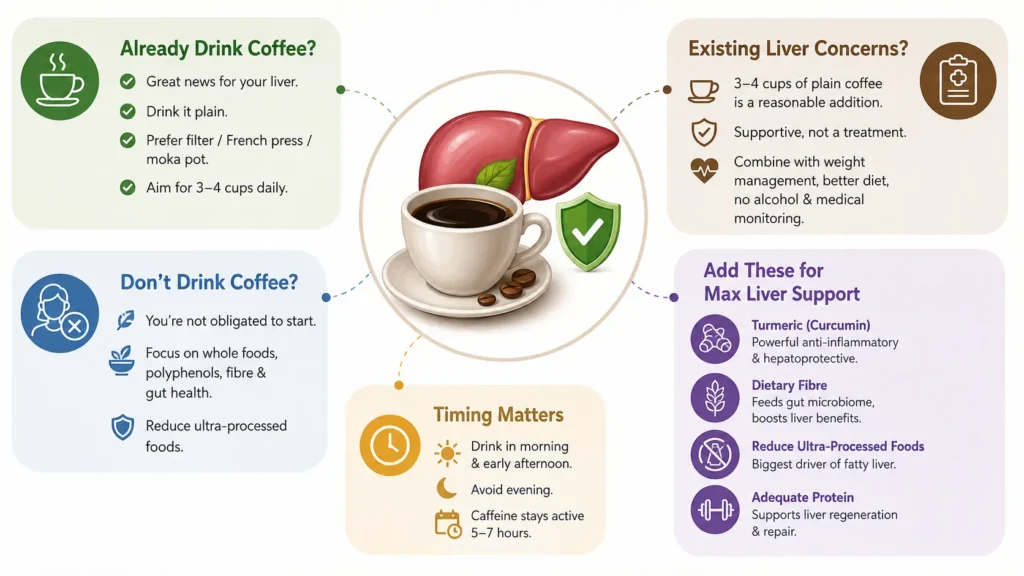
After 12 years of integrating nutritional research into clinical practice, here is how the July 2026 Cedars-Sinai study changes my conversations about coffee:
For clients who drink coffee: This is excellent news — your existing habit is likely providing measurable liver protection. Optimise it by drinking it plain (no added sugars, artificial sweeteners, or ultra-processed creamers), by using traditional preparation methods when possible (filter, French press, moka pot over instant), and by targeting 3 to 4 cups daily as the dose associated with the strongest biological benefit markers.
For clients who do not drink coffee and do not want to start: You are not obligated to start for liver health. The study is observational, not a randomised trial, and does not prove causation sufficiently to recommend coffee as a medical intervention. Focus instead on the dietary pattern modifications — whole-food polyphenol intake from other sources (tea, berries, vegetables), gut microbiome diversity through fibre and fermented foods, and ultra-processed food reduction — that address the same underlying mechanisms. See our Fibermaxxing and gut health guide and our Functional Nutrition guide.
For clients with existing liver concerns (elevated enzymes, early NAFLD, fatty liver on ultrasound): The July 2026 evidence suggests that 3 to 4 cups of plain coffee daily is a reasonable, evidence-supported dietary addition alongside the full NAFLD management protocol. Coffee is not a treatment for liver disease — it should be integrated within a comprehensive approach that includes weight management, dietary quality improvement, alcohol cessation, and medical monitoring. For the complete dietary protocol for fatty liver management, see our Fatty Liver Causes, Symptoms, Treatment & Diet guide.
Timing considerations. I advise clients to consume coffee within a time-restricted eating window aligned with their circadian rhythm — morning and early afternoon, not evening. Caffeine has a half-life of approximately 5 to 7 hours in most adults; coffee consumed at 4pm is still 50% active in the system at 9 to 11pm, disrupting the sleep quality that our August 2026 Columbia University study identified as directly linked to weight gain and metabolic health. For the full circadian nutrition picture, see our Circadian Rhythm Healing guide. For the sleep-weight gain connection specifically, see our August 2026 coverage of the Columbia sleep study.
What to add alongside coffee for maximal liver support. Coffee works best for liver health in the context of a broadly anti-inflammatory, polyphenol-rich dietary pattern. The following nutritional additions synergise with coffee’s hepatoprotective mechanisms:
• Turmeric (curcumin) — one of the most studied natural anti-inflammatory and hepatoprotective compounds. Combining coffee and turmeric in your diet delivers complementary polyphenol mechanisms. See our comprehensive Turmeric & Curcumin guide.
• Dietary fibre — particularly from legumes, whole grains, and vegetables — feeds the gut microbiome that mediates coffee’s prebiotic liver protection effects.
• Reduction of ultra-processed foods — the primary dietary driver of NAFLD. The June 2026 brain fog article and the entire 2026 UPF research landscape consistently show that UPF reduction is the highest-leverage dietary intervention for metabolic liver protection.
• Adequate protein — for liver regeneration and hepatic protein synthesis. The July 2026 dietary guidelines update we covered found that most adults are under-consuming protein, affecting every tissue including the liver.
The Caveats — Because Good Science Requires Them
The Cedars-Sinai study is observational — it follows people who chose their own coffee intake rather than randomly assigning them to drink specific amounts. This means causation cannot be fully established, though the biological imaging and proteomic layers substantially strengthen the causal argument.
The study population was UK Biobank participants — predominantly European, aged 40 to 69 at enrolment. Whether the findings generalise to South Asian populations, who have different metabolic risk profiles, different baseline gut microbiome compositions, and different dietary patterns, requires direct investigation in Asian cohorts.
High coffee consumption — above 5 to 6 cups daily — is associated in some populations with increased cardiovascular risk, anxiety, insomnia, and elevated homocysteine. The optimal liver-protection dose of 3 to 4 cups daily should be contextualised against individual cardiovascular risk, caffeine sensitivity, and sleep quality. For some individuals, 1 to 2 cups provides meaningful liver protection at a lower total caffeine load.
Finally, decaffeinated coffee — while showing equivalent liver protection in the study — often undergoes chemical decaffeination processes (using solvent extraction) that may leave trace residues. Swiss Water Process or CO2-decaffeinated coffee are cleaner alternatives for those who want the liver benefit without caffeine.
The Takeaway
The July 2026 Cedars-Sinai study of 354,957 adults — combining over a decade of clinical outcome data, liver MRI scans, and blood proteomics — delivers the most compelling evidence to date that coffee is one of the most powerful liver-protective dietary factors available. The dose-response relationship (more coffee, more protection), the biological imaging evidence (measurably healthier liver tissue), the proteomic evidence (healthier liver signalling pathways), and the decaf finding (caffeine is not the mechanism) together build a case that is close to definitive. If you drink 3 to 4 cups of plain, traditionally prepared coffee daily, the evidence suggests you are providing your liver with meaningful biochemical protection against cirrhosis, cancer, and liver-related mortality. That is a remarkable statement about one of the world’s oldest and most widely consumed beverages. For the complete lifestyle framework that supports liver health alongside daily coffee — including dietary patterns, gut microbiome optimisation, and evidence-based supplementation — see our Science-Based Longevity Protocols guide and our Functional Nutrition guide.
About the Author
Tanveer Ahmed Khan is a K11 School of Fitness Sciences-certified personal trainer and REPS India-registered dietitian-nutritionist with over 12 years of experience. Coaching: info@livenulife.com | Instagram: @fitwithtanveer | livenulife.com
Scientific References
1. Kim, H.S., Rezaee-Zavareh, M.S., Wang, Y., et al. (2026). Coffee Consumption and Improved Liver Outcomes: Clinical, Imaging, and Proteomic Evidence From the UK Biobank. Clinical Gastroenterology and Hepatology. DOI: 10.1016/j.cgh.2026.04.035
2. ScienceDaily / Cedars-Sinai Medical Center. (July 25, 2026). Coffee may help shield the liver from fat, scarring, and cancer. sciencedaily.com
3. Cedars-Sinai Newsroom. (July 1, 2026). Study: New biological clues behind coffee’s benefit to liver health. cedars-sinai.org
4. Healthline. (July 7, 2026). Coffee: 5 Cups a Day May Lower Your Liver Disease, Cancer Risk.
5. CNN Health. (July 1, 2026). Coffee may lower risk for liver disease, cancer.
6. SciTechDaily. (2026). Coffee May Protect the Liver in More Ways Than Scientists Realized.