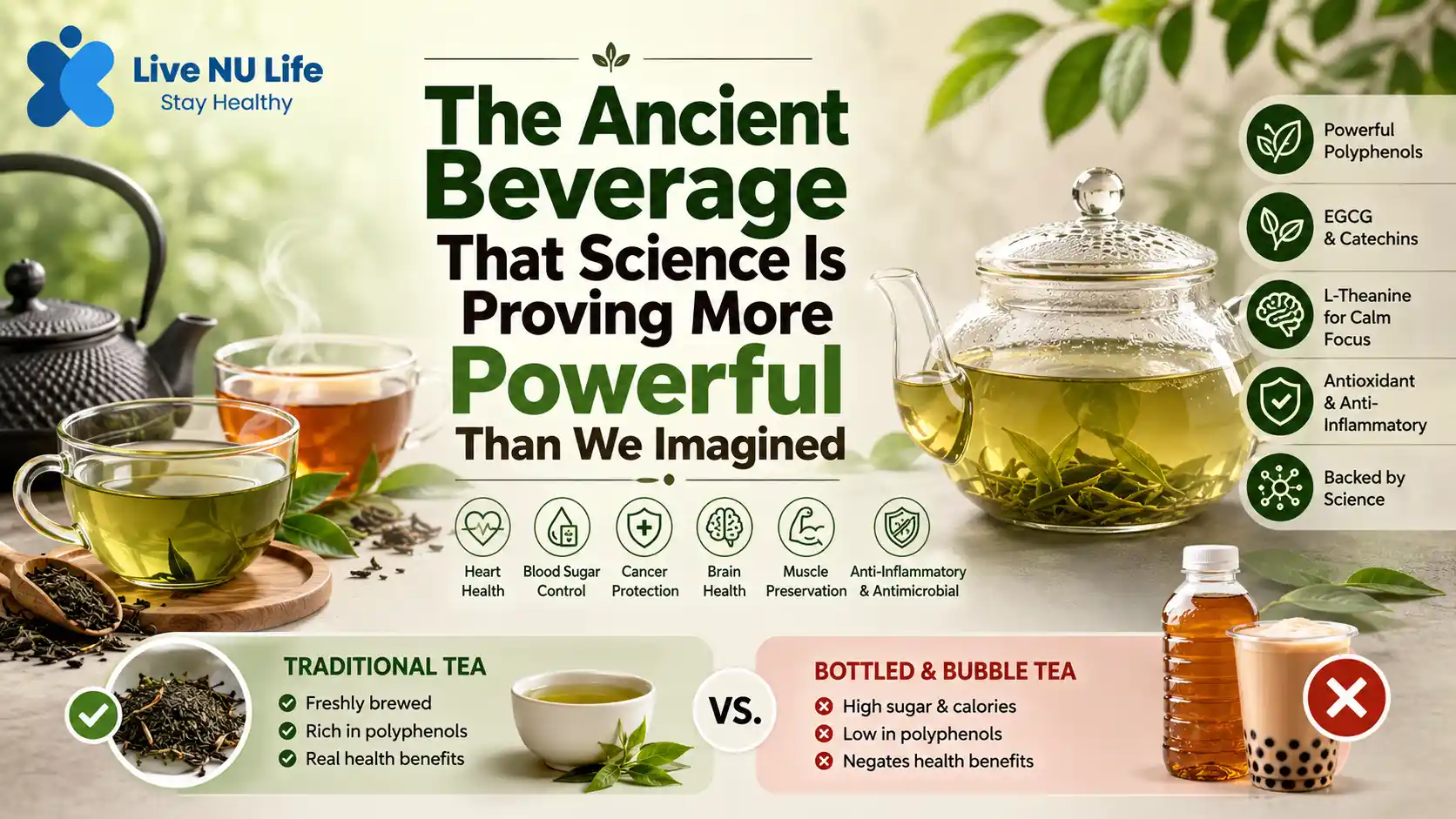
Key Takeaway: A major review published in Beverage Plant Research and covered by ScienceDaily on June 9, 2026, confirmed that regular, freshly brewed tea consumption protects against heart disease, diabetes, cancer, cognitive decline, and age-related muscle loss — but only when consumed in its traditional form. Bottled and bubble teas largely negate these benefits. Here is the complete guide to making tea work for your health.
Tea: From Ancient Ritual to 2026 Science
In my family, tea is not a beverage. It is the first sound of the morning — the kettle, the warmth, the quiet before the day begins. I grew up in a household where chai was the answer to fatigue, digestion issues, cold mornings, and social gatherings alike.
As I moved into fitness training and nutritional science, I came to appreciate that the instinct my family shared with billions of people across Asia and the world over millennia was grounded in something real — something that 2026’s research is now articulating with scientific precision.
A comprehensive review published in Beverage Plant Research by researchers from the Tea Research Institute of the Chinese Academy of Agricultural Sciences — led by Mingchuan Yang, Li Zhou, and colleagues — delivered one of the most thorough assessments of tea’s health effects to date. It was covered by ScienceDaily on June 9, 2026, and the findings confirm that tea is not merely a comforting tradition. It is a genuinely powerful health intervention — when consumed correctly.
Read More: Top Benefits of Fennel Tea for Better Digestion
What the June 2026 Research Found
The review examined evidence from both laboratory studies and human clinical research across multiple health outcomes. Its conclusions were wide-ranging and robust:
Cardiovascular disease protection. Regular, moderate intake of brewed tea — particularly green tea — is associated with measurable reductions in the risk of cardiovascular diseases including coronary heart disease and stroke. The mechanisms include improved endothelial function, reduced LDL oxidation, lower blood pressure, and anti-inflammatory effects.
Diabetes risk reduction. Tea consumption is associated with improved insulin sensitivity and lower risk of type 2 diabetes. Tea polyphenols — particularly EGCG (epigallocatechin gallate) in green tea — appear to improve glucose uptake and reduce post-meal blood sugar spikes.
Cancer protection signals. The review noted anti-cancer properties associated with tea catechins, particularly in relation to breast, colorectal, and prostate cancers. These are considered preliminary and require further clinical investigation, but the laboratory evidence is compelling.
Neuroprotection and cognitive health. Regular tea drinkers, particularly older adults, show lower rates of cognitive decline and fewer biomarkers linked to Alzheimer’s disease. A separate long-term study found that moderate consumption of caffeinated coffee or tea was linked to an 18% lower risk of dementia in a 43-year follow-up.
Read More: 30-Day Steps Challenge: Turn Walking into a Daily Win
Muscle preservation with age. This finding is one I find particularly compelling from a training perspective. Tea catechins appear to help slow age-related muscle loss — sarcopenia — which is one of the most significant drivers of functional decline, falls, fractures, and loss of independence in older adults.
Antimicrobial and anti-inflammatory activity. Tea polyphenols exhibit broad antimicrobial properties and consistently reduce markers of systemic inflammation across multiple human studies.
The review’s authors concluded: “Regular, moderate intake of brewed tea may help reduce the risk of cardiovascular diseases, diabetes, and cancer.”
But they added a crucial qualifier — one that most tea-related health reporting has ignored.
The Caveat That Changes Everything: How You Drink Tea Matters Enormously
The June 2026 review introduced a finding that should reshape how we think about tea in a market saturated with bottled tea products, bubble tea chains, and sweetened ready-to-drink beverages:
Bottled tea and bubble tea largely negate the health benefits of traditional brewed tea.
The mechanisms are straightforward and worth understanding in detail.
The processing problem with bottled tea
Commercial bottled teas undergo high-temperature pasteurisation, extended storage, and exposure to light — all of which degrade tea polyphenols, particularly the catechins responsible for tea’s primary health effects. A study in Food Chemistry found that commercially bottled teas contain as little as 3% of the polyphenol content of freshly brewed equivalents.
Additionally, most commercial bottled teas — even those marketed as “green tea” or “healthy” beverages — contain significant added sugar. A typical 500ml bottle of commercial iced tea contains 35 to 55 grams of added sugar — equivalent to 9 to 14 teaspoons. At this sugar loading, whatever residual polyphenol activity remains is overwhelmed by the metabolic harm of the sugar content.
The bubble tea problem
Bubble tea — the Taiwanese milk tea with tapioca pearls that has become a global phenomenon — represents an even more extreme disconnect from the health benefits of traditional tea.
A standard bubble tea contains 300 to 700 calories, 60 to 90 grams of sugar, and substantial amounts of saturated fat from the dairy or non-dairy creamers used. The flavourings and syrups that give bubble tea its characteristic sweetness typically contain no tea polyphenols whatsoever. The tapioca pearls are refined starch with no nutritional benefit.
In terms of health impact, bubble tea is not a tea product — it is a dessert beverage that happens to have the word “tea” in its name.
The June 2026 review’s recommendation for both bottled tea and bubble tea is unambiguous: moderate, with the understanding that these products do not deliver the health benefits of traditional brewed tea and may introduce harms — principally from sugar and calories — that counteract any benefit they might otherwise offer.
The Active Compounds: Why Tea Works
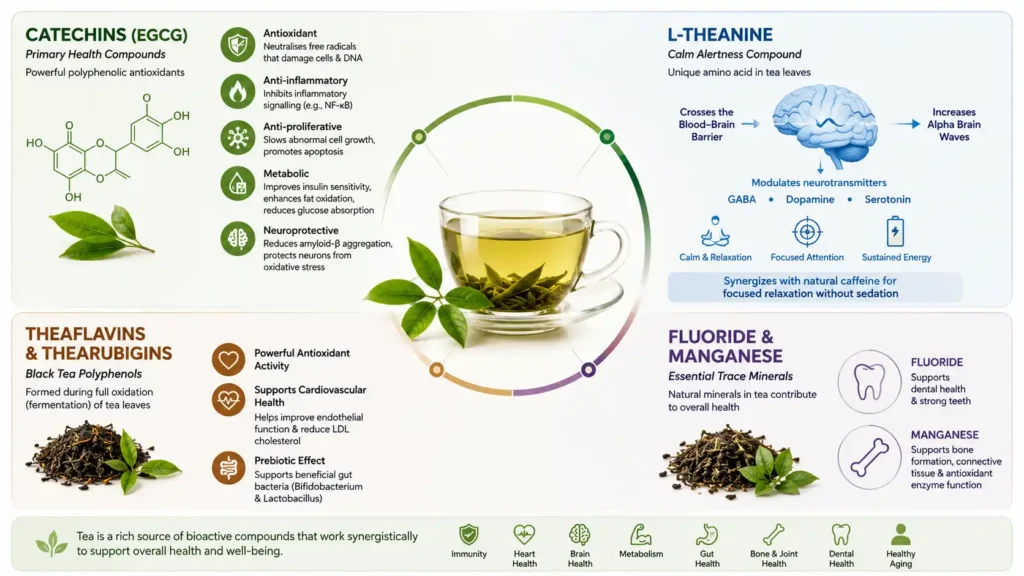
For those who want to understand the mechanism rather than just the outcome, here is a concise overview of tea’s biologically active components and how they produce their health effects.
Catechins — the primary health compounds
Green tea is particularly rich in catechins, a family of polyphenolic antioxidants. The most studied and most potent is EGCG (epigallocatechin gallate), which accounts for 50 to 80% of the catechin content in green tea. EGCG has demonstrated the following activities across laboratory and clinical research:
- Antioxidant: Neutralises reactive oxygen species that damage cells and DNA
- Anti-inflammatory: Inhibits pro-inflammatory signalling pathways including NF-kB
- Anti-proliferative: Slows the growth and promotes apoptosis (programmed death) of certain cancer cells in laboratory models
- Metabolic: Improves insulin sensitivity, enhances fat oxidation, reduces glucose absorption in the gut
- Neuroprotective: Reduces amyloid-beta aggregation in laboratory models of Alzheimer’s disease and protects neurons against oxidative stress
Black and oolong teas contain fewer catechins (because fermentation converts them into other polyphenols — theaflavins and thearubigins) but retain significant antioxidant and anti-inflammatory activity through these converted forms.
L-theanine — the calm alertness compound
L-theanine is an amino acid found almost exclusively in tea leaves. It is responsible for tea’s characteristic calm, sustained alertness — a different cognitive state from the jitteriness that coffee can produce in sensitive individuals.
L-theanine crosses the blood-brain barrier and increases alpha brain wave activity — the brain state associated with relaxed focus. It also modulates the neurotransmitters GABA, dopamine, and serotonin. When combined with the caffeine naturally present in tea, L-theanine produces a synergistic effect that cognitive researchers describe as “focused relaxation without sedation.”
For my clients who struggle with coffee-induced anxiety or afternoon energy crashes, switching to green or white tea delivers sustained, smooth cognitive energy without the cortisol spike that high-caffeine coffee can produce.
Theaflavins and thearubigins — black tea’s polyphenols
Black tea undergoes full oxidative fermentation, which converts catechins into theaflavins and thearubigins. These compounds are distinct from green tea catechins but retain significant antioxidant and cardiovascular protective activity. The clinical research on black tea cardiovascular benefits — particularly for LDL cholesterol reduction and endothelial function — is substantial and well-established.
Fluoride and manganese
A less-discussed benefit of tea: it is a meaningful source of fluoride (supporting dental health) and manganese (supporting bone formation, connective tissue health, and antioxidant enzyme function). For populations where dietary manganese is low, tea makes a genuine nutritional contribution beyond its polyphenol content.
The Different Teas: What Each Does Best
One of the most useful practical frameworks I share with clients is matching specific tea varieties to specific health goals, based on their distinct polyphenol profiles.
Green tea — the anti-inflammatory, metabolic powerhouse
Best for: blood sugar management, body composition, cognitive health, cancer risk reduction.
Green tea is minimally processed — leaves are steamed or pan-fired immediately after harvest to deactivate oxidation enzymes, preserving catechin content. EGCG levels are highest in gyokuro and matcha (shade-grown Japanese varieties), followed by sencha and most Chinese green teas.
In my coaching, I recommend one to three cups of brewed green tea daily for clients with metabolic health goals, weight management objectives, or cognitive performance priorities.
Preparation note: Brew at 70 to 80°C (not boiling), for 2 to 3 minutes. Boiling water degrades catechins and produces bitterness. Use loose-leaf or high-quality tea bags from transparent, reputable sources — commercial tea bags may contain tea dust with significantly lower polyphenol content.
Black tea — the cardiovascular protector
Best for: cardiovascular health, gut microbiome diversity, energy and focus.
Black tea’s theaflavins have been specifically studied for LDL cholesterol reduction and blood pressure management. A daily 2 to 3 cups of black tea has been associated with 7 to 11% reduction in LDL cholesterol in some trials — a clinically meaningful effect.
Additionally, black tea theaflavins are prebiotic — they selectively stimulate the growth of beneficial Bifidobacterium and Lactobacillus species. In the context of the gut health focus that defines 2026’s nutritional science, this makes black tea an underappreciated prebiotic food source.
Oolong tea — the fat oxidation tea
Best for: body composition, metabolic rate, digestive comfort.
Partially fermented, oolong sits between green and black tea in polyphenol profile. It contains a unique mixture of catechins and theaflavins and has been specifically studied for its effects on fat oxidation — the rate at which the body burns fat as fuel.
Several studies have found that habitual oolong consumption increases fat oxidation by 10 to 15% compared to water, making it a useful adjunct for clients working on body composition goals alongside structured resistance training.
White tea — the delicate antioxidant
Best for: skin health, anti-ageing, sensitive individuals who find green tea bitter.
White tea is the least processed of all tea varieties — simply sun-dried with no heating step. It retains the highest catechin content of any tea type, but in a gentler form. The flavour is delicate and naturally sweet.
White tea has been specifically studied for its anti-fibrotic properties — inhibiting the enzymes that break down collagen and elastin in the skin. For clients interested in skin health and anti-ageing nutrition, white tea is an underused tool.
Read More: Science-Based Longevity Protocols for Optimal Aging
How Much Tea Is Optimal?
The research consistently points to an optimal range of three to five cups per day of traditional, freshly brewed tea for maximal health benefit. Below three cups, the dose-dependent benefits are diminished. Above five to seven cups, there are potential concerns around excessive caffeine intake and, in some populations, excessive fluoride.
The June 2026 review’s specific language was “regular, moderate intake” — consistent with the three-to-five cups daily finding from population studies.
One important nuance for South Asian populations: traditional chai — made with milk, sugar, and often ginger, cardamom, and other spices — has a different polyphenol profile and health impact than plain brewed tea. The milk proteins (particularly casein) bind to tea polyphenols and reduce their bioavailability. Adding milk to tea reduces catechin absorption by approximately 50%.
This does not mean chai is unhealthy — the spices in traditional masala chai have their own documented health benefits, and the ritual of chai has psychological and social wellbeing value that is not captured by polyphenol measurements. But for clients specifically using tea as a therapeutic health intervention, I recommend brewing plain green or black tea without milk as their primary daily intake, and enjoying traditional chai as an additional pleasure rather than counting it toward their therapeutic dose.
The Tea Protocol I Follow and Recommend
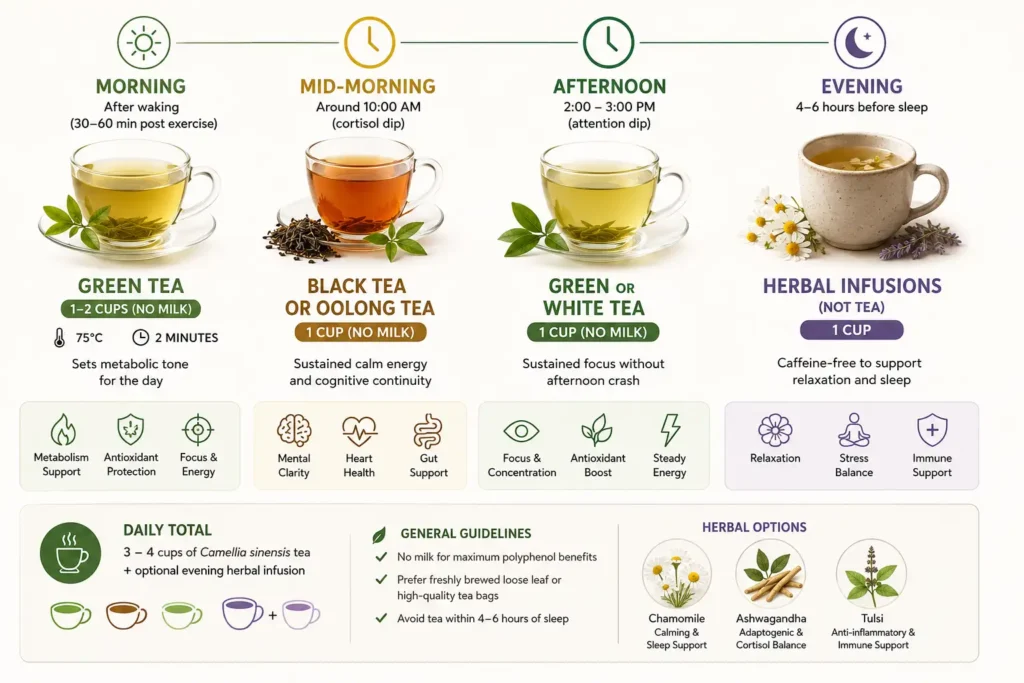
Based on the research and 12 years of observing what works in practice, here is the daily tea framework I use personally and recommend to clients:
Morning — Green tea, 1 to 2 cups (no milk) Brewed at 75°C for 2 minutes. Consumed 30 to 60 minutes after waking, after any morning exercise is complete (to avoid interfering with post-exercise nutrition absorption). Sets metabolic tone for the day.
Mid-morning — Black tea or oolong, 1 cup (no milk) At approximately 10am, when cortisol begins its natural mid-morning dip. Provides theaflavins, sustained L-theanine calm, and mild caffeine for cognitive continuity.
Afternoon — Green or white tea, 1 cup (no milk) The 2 to 3pm window, when attention typically dips. Green tea’s L-theanine and EGCG combination supports sustained focus without the cortisol spike that afternoon coffee can produce in sensitive individuals. Avoids sleep disruption for most people when consumed before 3pm.
Evening — Herbal infusions (not classified as tea) True tea — from the Camellia sinensis plant — contains caffeine and is better avoided within 4 to 6 hours of sleep for most individuals. Evening herbal options: chamomile (mild anxiolytic, sleep-supporting), ashwagandha tea (adaptogenic, cortisol-modulating), tulsi (anti-inflammatory, mild immune support).
Total daily intake: three to four cups of Camellia sinensis tea, plus optional evening herbal infusion.
Read More: Top 15 Probiotic Foods for Digestive Health
The Takeaway: Ancient Wisdom, Modern Science
What the June 2026 Beverage Plant Research review confirms is something that billions of people across Asia have known experientially for thousands of years: regular tea consumption, in its traditional freshly brewed form, is associated with meaningfully better health outcomes across a remarkable range of conditions.
The research identifies protection against cardiovascular disease, diabetes, cognitive decline, cancer, muscle loss, and inflammation — from a beverage that costs pennies per cup, requires no prescription, produces no meaningful side effects within normal consumption ranges, and has been safely consumed by humanity for millennia.
The critical qualifier — that bottled and bubble teas do not deliver these benefits — is not a minor footnote. It is one of the most important practical points in the June 2026 research, particularly for younger populations whose “tea” consumption is primarily through commercial ready-to-drink products.
Brew your own. Use whole leaves or quality bags. Consume without milk if your goal is polyphenol absorption. Drink three to five cups daily. Adjust temperature and steeping time for the variety you choose.
In over 12 years of nutritional practice, tea is one of the simplest, cheapest, and most consistently powerful health habits I recommend. The June 2026 research confirms it belongs in every serious health protocol — not as an afterthought, but as a cornerstone.
Scientific References
- Yang, M., Zhou, L., Kan, Z., Fu, Z., Zhang, X., & Yang, C.S. (2025/2026). Beneficial health effects and possible health concerns of tea consumption: a review. Beverage Plant Research, 5(1). https://doi.org/10.48130/bpr-0025-0036
- ScienceDaily / Maximum Academic Press. (June 9, 2026). Tea can improve your health and longevity, but the way you drink it matters. https://www.sciencedaily.com/releases/2026/06/260609025534.htm
- ScienceDaily. (June 9, 2026). Tea Can Improve Your Health and Longevity, but How You Drink It Matters. https://www.sciencedaily.com/releases/2026/01/260127112132.htm
- ScienceDaily. (March 18, 2026). Your Daily Coffee May Be Protecting Your Brain, 43-Year Study Finds. https://www.sciencedaily.com
- Chen, H., Gao, M., Huang, L. et al. (2025). Tea consumption may improve psychological resilience among older adults with chronic diseases: a prospective cohort study. Frontiers in Psychiatry. https://doi.org/10.3389/fpsyt.2025.1594067