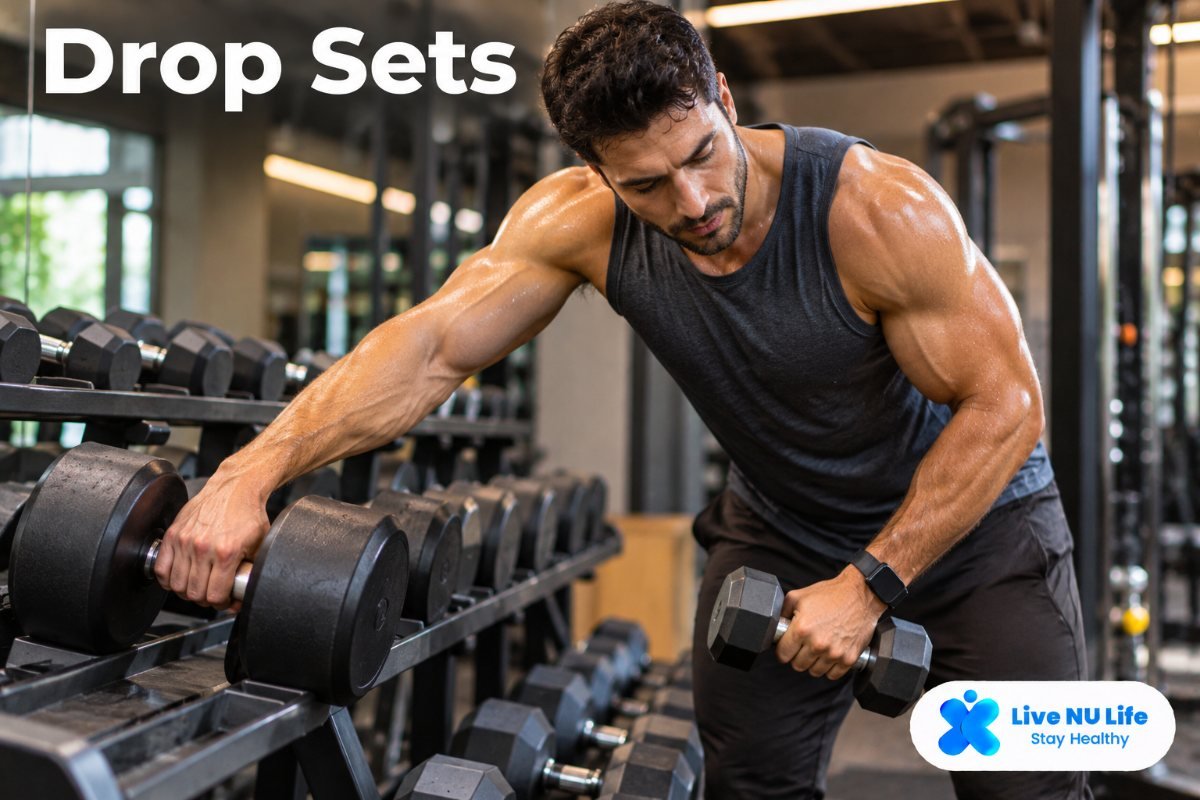
A drop set is when you do a set close to failure, immediately reduce the weight by about 20–30%, and keep going with little or no rest. You can repeat the drop once or twice. A 2023 meta-analysis found drop sets build about the same amount of muscle as normal sets, and some protocols took half to a third of the time (Sødal et al., 2023).
So drop sets are a time-saver for muscle growth, not a magic upgrade. Here is how to use them well.
What is a drop set?
A normal set ends when you can’t do another good rep. In a drop set, that is where you drop the weight and continue. A typical drop set looks like this:
- Main set: 8–12 reps with a weight you can just about finish.
- Drop 1: immediately reduce the weight by 20–30% and do as many good reps as you can.
- Drop 2 (optional): reduce again by 20–30% and go once more.
The short rests between drops (only as long as it takes to change the weight) keep your muscles under tension and lead to a lot of fatigue in a short time.
Do drop sets build more muscle?
Not more, but about the same in less time.
The 2023 systematic review and meta-analysis in Sports Medicine – Open pooled studies comparing drop sets with traditional sets (Sødal et al., 2023):
- Studies: 6 studies met the criteria (5 in the pooled analysis), with 142 mostly young adults
- Result: both drop sets and traditional sets increased muscle size, and the difference between them was not significant
- Time: some drop set protocols took half to a third of the training time
The included studies were small and short, and mostly in young men. Treat drop sets as an efficient option, not a superior one.
Benefits of drop sets
- Time-efficient. Get similar muscle-building stimulus in fewer minutes.
- More total reps per exercise without long rests.
- Useful at home or with limited weights. Drop sets let you reach a hard effort when you don’t have heavy enough dumbbells.
- Good for isolation exercises where heavy single sets are awkward, such as lateral raises or curls.
How to do a drop set: 5 rules
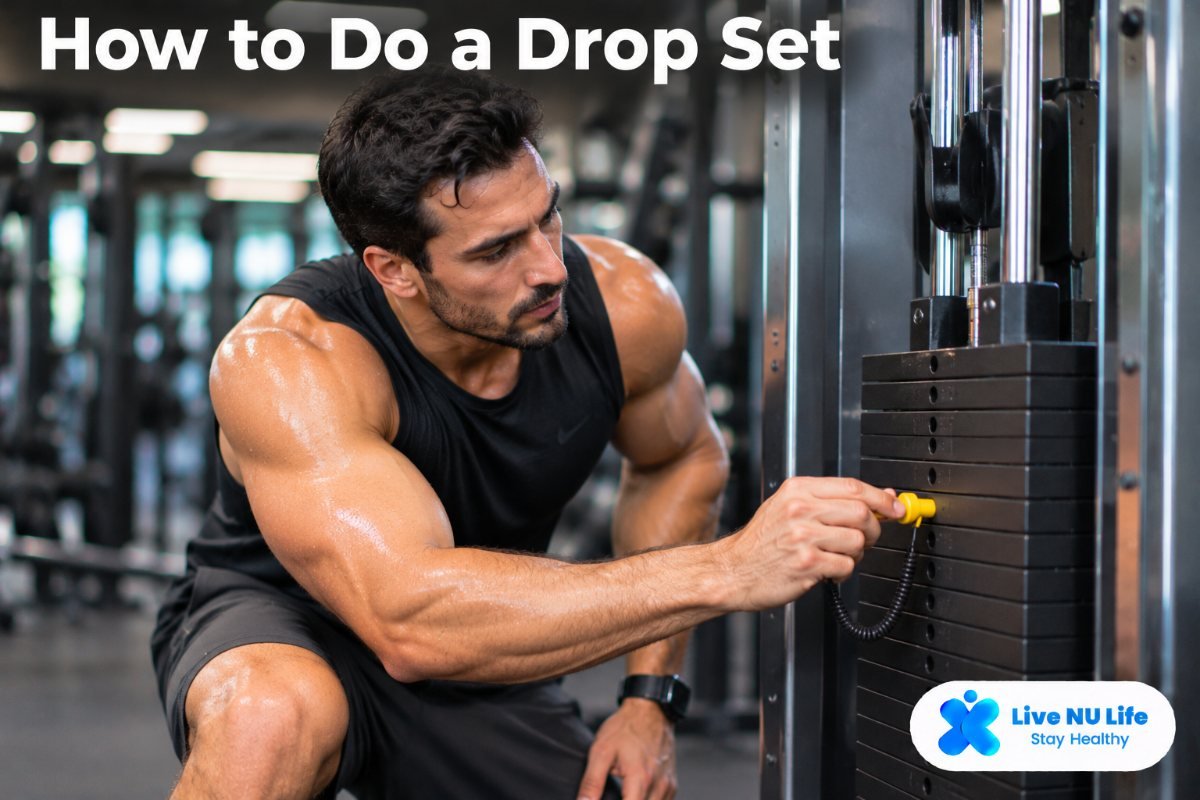
- Pick the right exercise. Machines, cables and dumbbells work best because the weight is quick to change. Avoid heavy barbell squats and deadlifts, where technique breaks down when you are exhausted.
- Set up the drops before you start. Line up your dumbbells or note the machine pin positions so the change takes seconds.
- Drop 20–30% each time. Smaller drops give fewer extra reps; much bigger drops make the set too easy.
- Stop at technical failure. End each drop when your form starts to break, not when you are swinging the weight.
- Use them sparingly. One drop set on the last set of one or two exercises per session is plenty.
Drop set examples
| Exercise | Main set | Drop 1 | Drop 2 |
|---|---|---|---|
| Dumbbell lateral raise | 10 kg × 12 | 7.5 kg × as many as possible | 5 kg × as many as possible |
| Cable triceps pushdown | 30 kg × 10 | 22.5 kg × as many as possible | 15 kg × as many as possible |
| Leg extension (machine) | 50 kg × 12 | 35 kg × as many as possible | – |
| Dumbbell curl | 12.5 kg × 10 | 10 kg × as many as possible | 7.5 kg × as many as possible |
| Push-up (body weight) | Feet on bench, to near failure | Regular push-up | Knees on floor |
Weights are only examples. Choose loads that match your strength.
Types of drop sets
- Standard drop set: reduce the weight, same exercise.
- Mechanical drop set: keep the weight, switch to an easier version of the movement. Example: incline push-ups, then regular push-ups, then kneeling push-ups. Or a lateral raise with straight arms, then bent arms.
- Double or triple drop set: two or three weight reductions in a row. Very fatiguing; save for experienced lifters.
- Reverse drop set: start light and add weight. Less common and more of a warm-up style approach.
Drop set vs superset
| Drop set | Superset | |
|---|---|---|
| What changes | The weight (or exercise difficulty) | The exercise |
| Muscles | Same muscle, worked to deeper fatigue | Usually two different muscles (e.g. biceps and triceps) |
| Main benefit | More effort for one muscle in less time | Saves time by pairing exercises with no rest |
Who should be careful with drop sets
- Beginners: in your first few months, you will grow well from normal sets. Learn good technique first.
- Strength athletes before competition: drop sets add fatigue that can hurt performance on heavy lifts.
- Anyone with high blood pressure or heart conditions: very hard sets close to failure cause big, brief blood pressure spikes. Talk to your doctor before training to failure.
- If you are recovering from an injury, avoid training the injured area to failure.
How often to use drop sets
For most lifters, drop sets on one or two exercises per session, two to three times a week, is enough. Because they are so fatiguing, they can make the rest of your workout worse if you do them early. Put them at the end of a session.
For recovery between hard sessions, read our guide to recovery tools and how much protein you need in the 2026 protein guidelines. If you are new to lifting, start with our strength training plan for women over 40, which works for any beginner. Creatine can also help you do more reps in hard sets: see creatine loading phase.
Frequently asked questions
How many drops should a drop set have?
One or two is enough for most people. More drops add fatigue with little extra benefit.
How much rest between drops?
As little as possible: just long enough to change the weight, usually under 10 seconds.
Are drop sets good for building strength?
They are better for muscle size and endurance than for maximal strength. For strength, heavy sets with longer rests work better.
Can I do drop sets every workout?
You can use them on one or two exercises in many sessions, but avoid doing them on every exercise. Too much training to failure slows recovery.
Are drop sets good for fat loss?
They burn a few more calories per minute than standard sets, but fat loss depends mainly on your overall diet and activity.
Sources
- Sødal LK, Kristiansen E, Larsen S, van den Tillaar R. Effects of drop sets on skeletal muscle hypertrophy: a systematic review and meta-analysis. Sports Med Open. 2023;9(1).
Check with your doctor before high-intensity training if you have high blood pressure, heart disease or an injury. See our medical disclaimer.