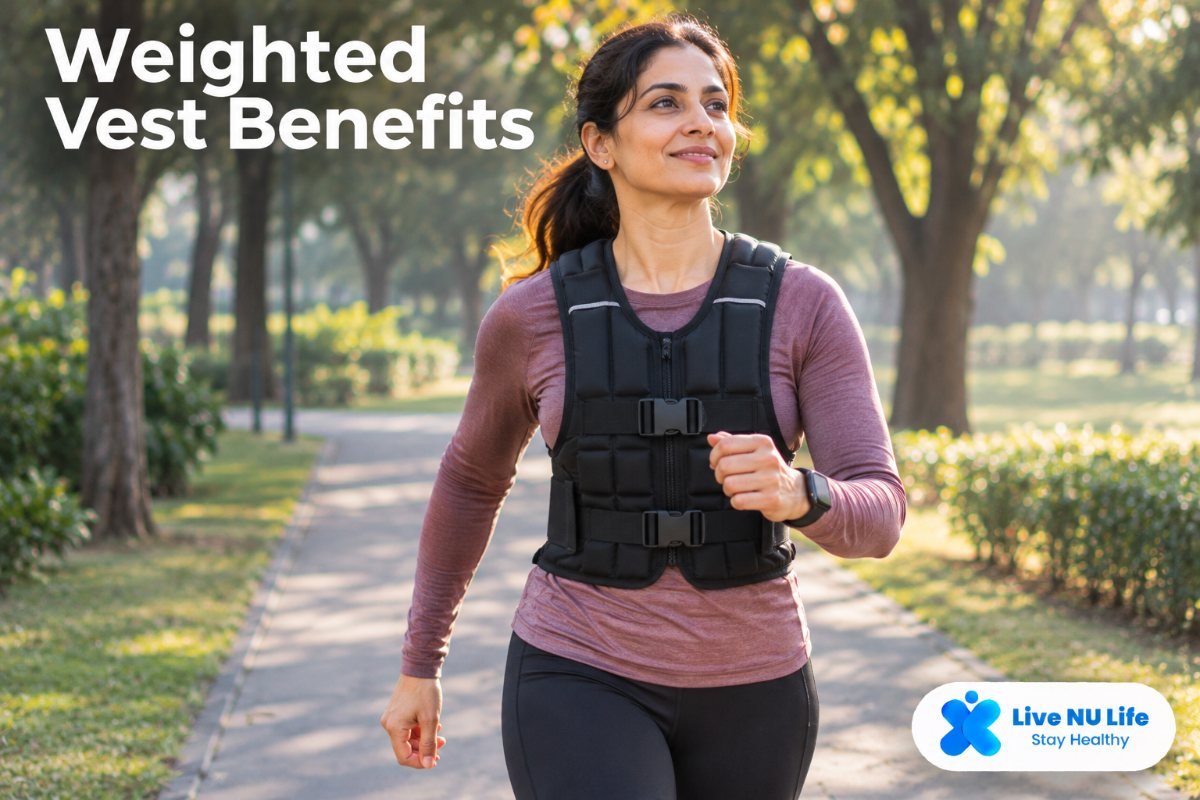
A weighted vest makes everyday walking a bit harder, so you burn slightly more calories and your heart, legs and bones work a little more. In one study, a vest weighing about 15% of body weight raised calories burned during flat, slow walking by about 12%. The bone benefits are less certain than social media suggests: a 2025 trial found a vest did not stop hip bone loss during weight loss.
So a weighted vest is a useful tool, not a shortcut. Here is what the evidence actually shows, how heavy to go, and how to start safely.
What a weighted vest does
A weighted vest adds load close to your center of gravity, so your posture and gait stay fairly natural. That is safer than carrying hand or ankle weights, which pull on your shoulders and knees.
The extra load means:
- More work for your heart and lungs at the same walking speed
- More load on your legs and hips with each step
- More calories burned for the same distance
Weighted vest benefits: what the research shows
Slightly more calories burned
For the American Council on Exercise, researchers had 13 untrained women walk on a treadmill at 2.5 mph with no vest, a vest at 10% of body weight, or a vest at 15% (ACE):
| Walking condition | Vest | Extra calories vs no vest |
|---|---|---|
| Flat (0% incline) | 10% of body weight | No significant increase |
| Flat (0% incline) | 15% of body weight | About 12% more |
| 5–10% incline | 10% of body weight | About 13% more |
| 5–10% incline | 15% of body weight | No extra benefit over 10% |
What that means in practice: if a 30-minute walk burns 150 kcal, a vest might add about 18–20 kcal. Helpful over months, but small. Walking a bit longer, or adding an incline, raises calorie burn just as well.
Bone health: promising idea, mixed evidence
The idea is simple. Bones respond to load, so carrying extra weight should help keep them strong. The best test so far is the INVEST trial, published in JAMA Network Open in 2025 (Beavers et al., 2025):
- Who: 150 adults aged 60–85 with obesity, mostly women
- What: 12 months of weight loss alone, weight loss plus a weighted vest worn about 7 hours a day (adding back the weight they lost, up to 10% of starting weight), or weight loss plus supervised strength training three times a week
- Result: hip bone density fell by a similar amount in all three groups. The authors concluded that neither the vest nor resistance training prevented weight-loss-related bone loss at the hip.
So a vest is not a proven way to protect bones on its own. Heavy, progressive strength training has stronger evidence for bone in postmenopausal women. We cover it in strength training for women over 40.
Builds walking fitness
Adding load to a familiar walk raises the effort without running, which suits people whose joints don’t like impact. It is a simple way to progress if easy walks no longer feel like a workout. For heart-rate guidance, see zone 2 cardio, and note that a vest will push you into a higher zone at the same pace.
Makes body-weight exercises harder
Squats, lunges, step-ups, push-ups and pull-ups get harder with a vest, which helps when you train at home with no other equipment.
How heavy should a weighted vest be?
| Starting point | Vest weight |
|---|---|
| New to vests | About 5% of body weight |
| Comfortable after 2–4 weeks | 8–10% of body weight |
| Experienced, healthy joints | Up to 15% of body weight |
For a 70 kg person, that is roughly 3.5 kg to start, 6–7 kg after a few weeks, and 10 kg at most. The ACE research found that on an incline, going from 10% to 15% added no extra calorie burn, so heavier is not always better.
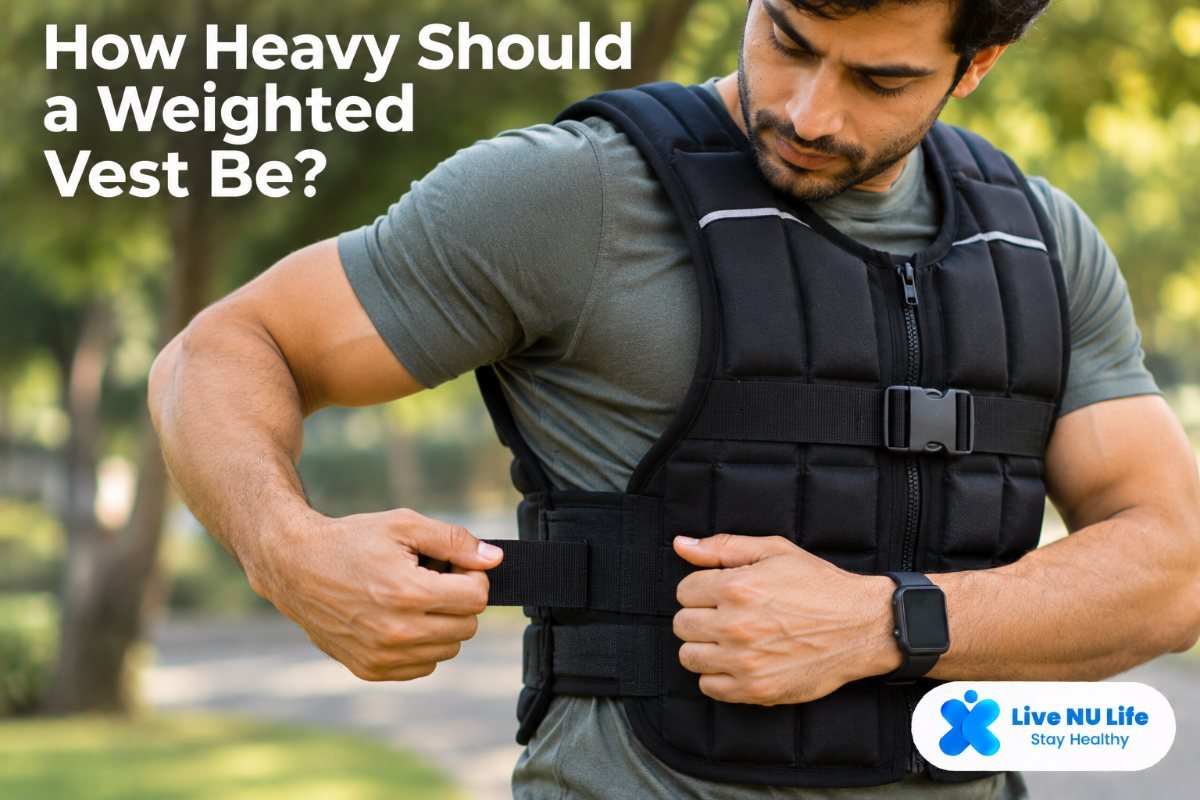
Fit matters. The vest should sit snug and high on your torso and not bounce. Adjustable vests with small weight inserts let you build up gradually.
A 6-week weighted vest walking plan
| Week | Vest weight | Sessions | Duration |
|---|---|---|---|
| 1–2 | About 5% of body weight | 3 per week | 20–30 min, flat |
| 3–4 | 5–8% | 3–4 per week | 30–40 min, add gentle hills |
| 5–6 | 8–10% | 3–4 per week | 30–45 min, include 5–10 min of incline |
Keep your normal, unweighted walks on other days. Use a pace where you can still talk in sentences.
Who should avoid a weighted vest or ask a doctor first
- Knee or hip arthritis: extra load can flare symptoms.
- Back problems, including disc issues or recent back pain
- Severe osteoporosis or a past spinal fracture
- Heart or lung disease, including COPD
- Pregnancy
- High body weight: if you are carrying a lot of extra weight, your joints already handle a heavy load. Start with plain walking.
Stop if you feel sharp joint pain, chest pain, dizziness or unusual breathlessness.
Common mistakes
- Starting too heavy. It is the fastest way to sore knees and an aching back.
- Running in a vest from day one. Running multiplies the impact. Build up with walking first.
- Wearing it all day as a “hack”. Long daily wear adds strain without proven extra benefit for most people.
- Expecting fat loss from the vest alone. Food intake and total activity matter far more.
For more ways to build a walking habit, read 7,000 vs 10,000 steps a day, our 30-day steps challenge, and exercise for weight loss and maintenance.
Frequently asked questions
Is walking with a weighted vest good for you?
For most healthy adults, yes, if you start light and build up. It adds a little effort and calorie burn to walks.
Can a weighted vest help you lose weight?
It adds a small number of calories per walk. Weight loss still depends mainly on your diet and how much you move overall.
How long should I wear a weighted vest?
Start with 20–30 minutes during walks, three times a week. Build up gradually rather than wearing it for hours.
Are weighted vests good for women over 50?
They can add useful load to walks, but a 2025 trial found they did not prevent hip bone loss during weight loss. Combine walking with strength training for bones.
Is a weighted vest better than ankle weights?
Generally, yes. A vest keeps the load near your center of gravity. Ankle weights change your walking mechanics and can strain the knees and hips.
Sources
- Beavers KM, et al. Weighted vest use or resistance exercise to offset weight loss–associated bone loss in older adults: a randomized clinical trial. JAMA Netw Open. 2025;8(6):e2516772. doi:10.1001/jamanetworkopen.2025.16772
- Kravitz L, McCormick JJ. American Council on Exercise weighted vest study (treadmill walking at 10% and 15% of body mass).
Check with your doctor before using a weighted vest if you have joint, back, heart or lung problems, or osteoporosis. See our medical disclaimer.