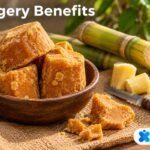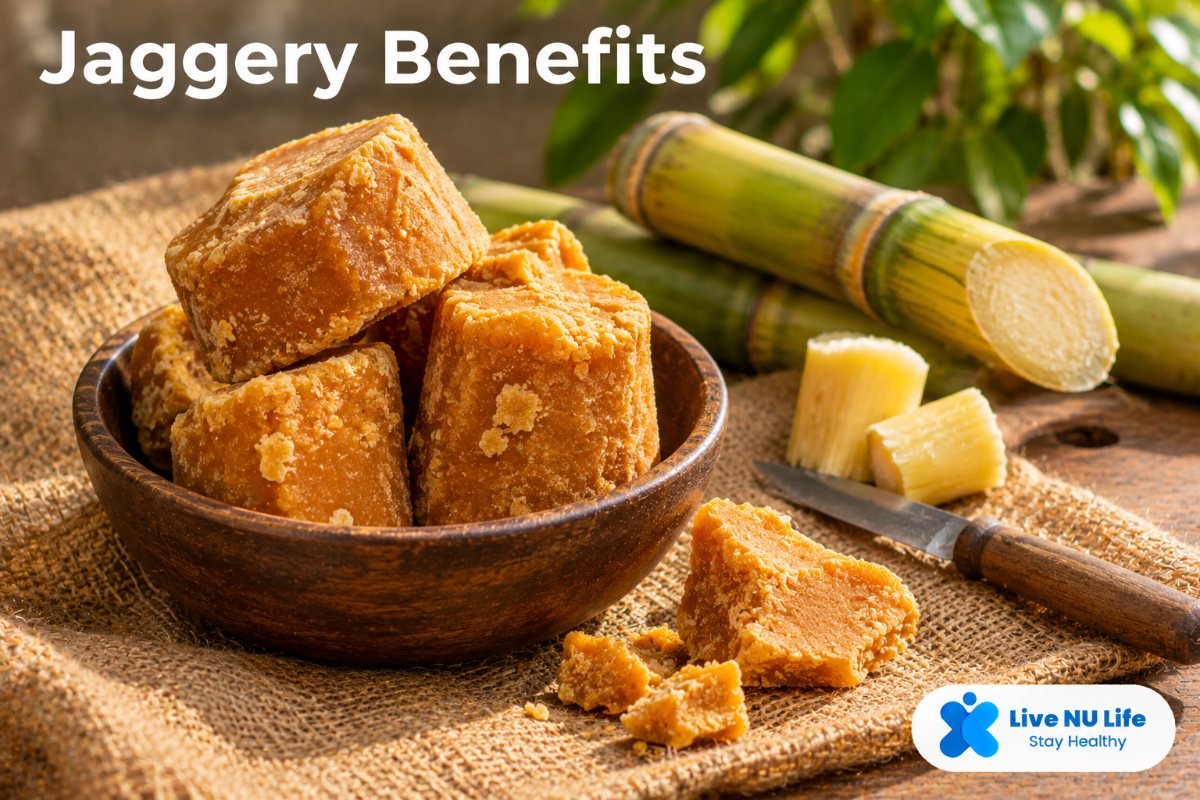
Jaggery (gur) is slightly more nutritious than white sugar because it keeps some of the minerals from sugarcane juice, especially iron. But it is still mostly sugar. Solid jaggery is about 65–85% sucrose and has nearly as many calories as white sugar. Swapping white sugar for jaggery is a small step up. Eating more jaggery because it is “healthy” is not.
That is the honest answer most “10 benefits of jaggery” lists skip. Here is what gur actually contains, where its reputation comes from, and how to enjoy it sensibly this winter.
Jaggery nutrition per 100 g
| Per 100 g | Solid jaggery (gur) | White sugar |
|---|---|---|
| Energy | 383 kcal | 398 kcal |
| Sucrose | 65–85 g | 99.5 g |
| Glucose and fructose | 9–15 g | – |
| Protein | 0.4 g | – |
| Iron | 11.4 mg | trace |
| Calcium | 8 mg | trace |
Source: composition table by Said and Pradhan (2013), as reproduced in a 2023 review of non-centrifugal cane sugar (Venkatesh et al., 2023). Values vary with the cane, the region and how the jaggery is made.
What that means for a normal serving
Most people eat jaggery a piece at a time, not 100 g. A 10 g piece (about two teaspoons of powder) gives roughly:
- 38 kcal
- 7–10 g of sugars
- about 1.1 mg of iron
ICMR-NIN sets the daily iron requirement at 29 mg for adult women and 19 mg for men (ICMR-NIN, 2020). So a 10 g piece covers about 4% of a woman’s daily iron. You would need to eat a lot of jaggery, and a lot of sugar with it, for the iron to make a real difference.
About calcium: some websites claim jaggery is a good calcium source. The composition data above lists only about 8 mg per 100 g, which is tiny. Til (sesame) in a til-gud laddoo brings far more calcium than the gud does.
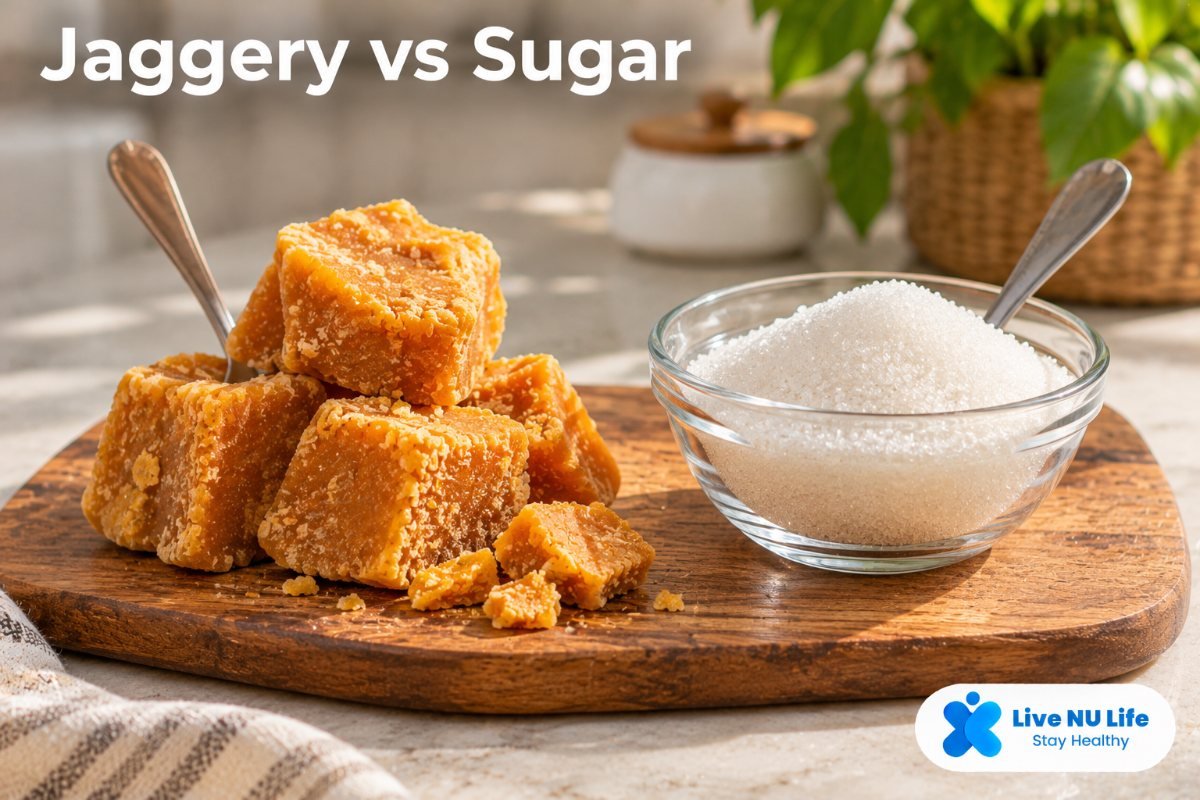
Jaggery vs sugar
| Jaggery | White sugar | |
|---|---|---|
| How it is made | Sugarcane juice boiled down, molasses kept | Juice refined and crystallised, molasses removed |
| Calories | About 383 kcal per 100 g | About 398 kcal per 100 g |
| Minerals | Small amounts of iron and other minerals | Almost none |
| Plant compounds | Some phenolic antioxidants | Almost none |
| Effect on blood sugar | Raises blood sugar, like sugar | Raises blood sugar |
| Taste | Caramel, molasses-like | Plain sweet |
Verdict: jaggery wins on minerals, but the difference is small per serving. Both count as added sugar.
Is jaggery good for diabetes?
No. For blood sugar purposes, treat jaggery the same as sugar.
There is no reliable published glycemic index (GI) value for jaggery that we could verify. Figures quoted online vary a lot and rarely cite a study. Since jaggery is mostly sucrose, the same sugar as white sugar, it raises blood glucose in a similar way. If you have diabetes or prediabetes, count jaggery, gur chai, chikki and laddoos as sweets, and ask your doctor or dietitian how much fits your plan.
Jaggery benefits: what is real and what is tradition
Small amounts of minerals
Jaggery does contain iron and other minerals that refined sugar lacks. This is the one benefit that holds up, though the amounts per serving are small.
Antioxidants
Jaggery contains phenolic compounds with antioxidant activity in lab studies. There is no good evidence yet that the amounts in a normal serving improve health in people.
Digestion after meals
Eating a small piece of gur after a meal is a long Indian tradition, and many people say it helps digestion. There are no good human trials testing it. If it works for you, enjoy a small piece.
“Warming” food in winter
In Ayurveda and Indian food tradition, gur is considered warming and is eaten more in winter, often with til, ghee, peanuts or dry ginger. This is a traditional belief rather than a measured effect, but it explains why winter is jaggery season. See our guide on how to balance vata dosha naturally.
Claims without evidence
“Detoxes the liver”, “cures anaemia”, “purifies the blood”, “treats asthma” and “helps weight loss” are common claims with no solid clinical evidence behind them. Jaggery does not help weight loss: it adds calories just like sugar.
How much jaggery is OK per day?
Jaggery counts as a free sugar. The World Health Organization advises keeping free sugars below 10% of daily calories, and ideally below 5%. On a 2,000 kcal diet, 5% is about 25 g of sugar a day from all sources, including tea, sweets, biscuits and drinks.
So a small piece of jaggery a day (5–10 g) fits easily for most healthy people, as long as it replaces sugar rather than adding to it.
Types of jaggery
- Sugarcane jaggery: the most common, sold as blocks, cubes or powder.
- Palm jaggery (karupatti, panam vellam): made from palm sap, popular in Tamil Nadu and Kerala. It has a different flavour and is still mainly sugar.
- Date palm jaggery (nolen gur, khejur gur): a Bengal winter speciality, sold as liquid (jhola gur) or solid (patali gur).
- Liquid jaggery: a syrup form, used in sweets and drinks.
- Jaggery powder: convenient for tea and baking. Check the label for added sugar.
How to spot adulterated jaggery
Researchers have reported several adulterants in Indian jaggery, including sodium hydrosulphite (“hydros”) used to lighten the colour, washing soda, chalk powder and an unpermitted yellow dye, metanil yellow (Venkatesh et al., 2023). To lower your risk:
- Be wary of very bright yellow or pale golden jaggery. Natural gur is usually golden brown to dark brown.
- Do the water test. Dissolve a piece in warm water. Chalk or other powders often settle at the bottom.
- Buy from brands with an FSSAI licence number on the pack, or from a trusted local maker.
- Choose “chemical-free” or organic jaggery if you can, but still check the colour and texture.
Healthy ways to use jaggery
- Sweeten tea or coffee with a little jaggery powder instead of sugar, and gradually use less.
- Make til-gud laddoos with whole sesame for a winter treat. Our sesame seeds benefits guide explains why whole til matters.
- Add a small piece to dal, sambar or kadhi for balance, as in Gujarati and Maharashtrian cooking.
- Pair it with protein and fat, such as peanuts in chikki, rather than eating it alone. Watch the portion: chikki is high in calories.
If you are trying to cut sugar, read why going sugar-free can backfire before you overhaul your diet.
Frequently asked questions
Is jaggery better than sugar?
Slightly, because it contains small amounts of iron and other minerals. It has almost the same calories and effect on blood sugar, so it is not a health food.
Can jaggery help with weight loss?
No. Jaggery has about 38 kcal per 10 g. Replacing sugar with jaggery does not reduce calories meaningfully.
Is jaggery good for anaemia?
A 10 g piece gives about 1.1 mg of iron, a small share of daily needs. It cannot treat anaemia. If you have low haemoglobin, see a doctor for testing and treatment.
Can I eat jaggery every day?
Yes, in small amounts that replace other sugar. Keep total added sugar low.
Is jaggery safe in pregnancy?
In normal food amounts, yes. If you have gestational diabetes, count it as sugar and follow your doctor’s advice.
Sources
- Venkatesh T, et al. Current production strategies and sustainable approaches towards the resurgence of non-centrifugal cane sugar production: a review. Royal Society of Chemistry, 2023. (Composition table after Said PP, Pradhan RC, 2013.)
- ICMR-National Institute of Nutrition. Nutrient Requirements for Indians: RDA and EAR. 2020.
- World Health Organization. Guideline: Sugars intake for adults and children. 2015.
This article is for general information and is not medical advice. If you have diabetes, ask your doctor how much sugar, including jaggery, fits your plan. See our medical disclaimer.