By Tanveer Ahmed Khan | K11-Certified Trainer & Dietitian-Nutritionist | REPS India Registered | livenulife.com | 14 min read
THE CORE INSIGHT: Cognitive neuroscientists design experiments, collect and analyse brain imaging and behavioural data, develop theories of how neural circuits produce cognition, write and publish research, teach at universities, and increasingly apply their findings to clinical, educational, and technological challenges. Their work spans laboratory research, clinical application, policy, and industry — making it one of the most versatile science careers of the 21st century.
The Core Activity: The Scientific Research Cycle
At its foundation, what a cognitive neuroscientist does is science — the iterative process of designing questions, collecting evidence, and building understanding from that evidence. But the specific activities of a cognitive neuroscientist’s day are more varied, technically demanding, and contextually rich than the generic description of “doing science” suggests.
In academic research settings — which employ the majority of cognitive neuroscientists — the work is organised around what scientists call the research cycle: the progression from question through hypothesis, experimental design, data collection, analysis, interpretation, and publication. Each stage has its own distinctive demands and requires specific skills.
Stage 1: Generating Research Questions
The first and in many ways most creative activity of a cognitive neuroscientist is deciding what to study. Good research questions in cognitive neuroscience have several characteristics: they are scientifically tractable (answerable with available methods), theoretically significant (their answers would advance understanding of how the brain works), not already answered by existing research, and often — though not always — practically relevant to human health or welfare.
Research questions in cognitive neuroscience arise from multiple sources. They may emerge from gaps or contradictions in the existing literature — a study finding that brain region X is active during memory task Y, combined with a conflicting study finding it is not, raises the question of what experimental conditions determine X’s involvement. They may arise from clinical observation — a neurologist noticing that patients with damage to a particular brain region show an unexpected combination of preserved and impaired abilities raises the question of what that region actually does. They may arise from technological opportunity — the development of a new neuroimaging method that can detect previously invisible neural processes creates the opportunity to ask questions that were previously unanswerable.
Generating good research questions requires deep knowledge of the existing literature, theoretical sophistication, methodological awareness, and a combination of creativity and scientific rigour that is genuinely difficult to develop. This is why postgraduate training in cognitive neuroscience typically takes 4 to 6 years — much of that time is devoted to developing the critical reading, theoretical, and experimental skills required to ask questions that will actually advance the field.
📖 Also read: Mindfulness for Stress Relief: Complete Beginner’s Guide — Cognitive neuroscientists have produced the research showing that mindfulness practice structurally changes the brain — thickening the prefrontal cortex and hippocampus, reducing amygdala reactivity. Here is the practical application.
Stage 2: Designing the Experiment
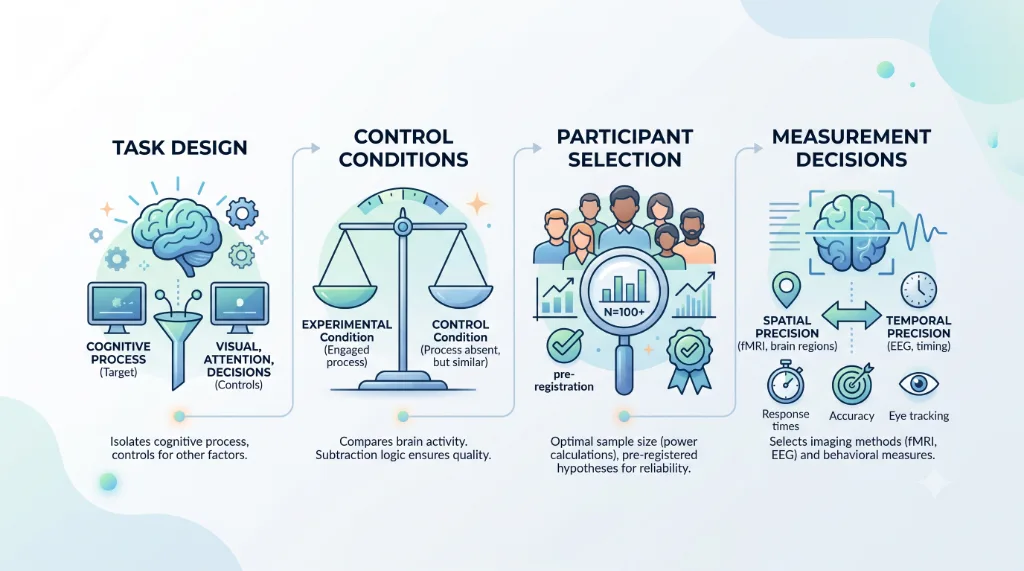
Experimental design in cognitive neuroscience is a sophisticated craft. The researcher must simultaneously address several intersecting challenges:
Task design: What will participants do while their brains are being imaged or recorded? The task must isolate the cognitive process of interest while controlling for everything else. If you want to study the neural basis of memory encoding, you need participants to actively try to memorise information — but you also need to control for the visual processing, attention, and decision-making that inevitably accompany memory encoding. Experimental cognitive neuroscientists spend enormous creative energy designing tasks that are elegant — doing exactly what is needed with minimum confound.
Control conditions: Almost all cognitive neuroscience experiments use a subtraction logic — comparing brain activity during an experimental condition (where the cognitive process of interest is engaged) with a control condition (that is as similar as possible except that the process of interest is absent). The quality of the control condition determines the quality of the experiment. A poorly designed control condition can make any brain region appear to be involved in any function.
Participant selection: Who will participate, and how many participants are needed to detect a real effect reliably? Power calculations — statistical estimates of the minimum sample size needed to detect an effect of expected magnitude — are a standard part of experimental design. Cognitive neuroscience has been criticised for historically using small samples (often 15 to 30 participants), which produce unreliable results. The field has moved strongly toward larger samples and pre-registration of hypotheses in recent years.
Measurement decisions: Which imaging method or combination of methods is most appropriate for the question? Is spatial precision (where in the brain) or temporal precision (when events occur) more important? Can both be achieved through multi-modal imaging combining fMRI and EEG? What other behavioural measures — response times, accuracy, eye tracking, physiological measures — should be collected alongside brain imaging?
Stage 3: Collecting Data
Data collection in cognitive neuroscience is technically demanding and highly standardised. Depending on the method, this might involve:
Running fMRI sessions: Participants lie in a scanner (a tube surrounded by powerful magnets and radiofrequency coils) for typically 1 to 2 hours while performing experimental tasks presented on a screen visible via a mirror system. The researcher monitors task performance and scanner data quality from a control room. fMRI requires maintaining scanner calibration, minimising participant movement (which degrades image quality), ensuring the task programme runs correctly, and managing participant comfort and compliance. Each scanning session generates gigabytes of raw data.
Running EEG sessions: Participants sit with an EEG cap fitted on their head — a flexible cap containing 32 to 256 small electrodes — while performing tasks on a computer screen. The researcher applies conductive gel to each electrode to maintain good electrical contact, monitors signal quality across all channels, and ensures the task is properly synchronised with the brain recording. EEG is more accessible and less claustrophobic than fMRI but requires careful attention to signal quality and artefact sources (muscle movement, eye blinks, electromagnetic interference).
Running behavioural experiments: Not all cognitive neuroscience involves brain imaging. Computational cognitive neuroscientists may collect only behavioural data (reaction times, choices, error patterns) and fit mathematical models to those data to infer the computational processes underlying behaviour. Patient studies may involve standardised neuropsychological assessments. Many studies combine imaging with detailed behavioural measurement.
Stage 4: Analysing the Data
Data analysis is one of the most time-intensive and technically demanding aspects of cognitive neuroscience research. The analysis of fMRI data in particular involves a complex pipeline of processing steps, each of which can significantly affect the conclusions drawn from the data:
Preprocessing: Raw fMRI data contains numerous artefacts — participant head movement between scans, physiological noise from heartbeat and respiration, scanner drift — that must be removed or modelled before the neural signal of interest can be analysed. Preprocessing pipelines typically include motion correction, slice timing correction, spatial smoothing, and registration of each participant’s brain scans to a standard anatomical template so that data can be averaged across participants.
General linear modelling: The preprocessed data is then fitted with a statistical model — typically a general linear model (GLM) — that estimates the relationship between the experimental task conditions and the brain’s BOLD signal at each voxel (a three-dimensional pixel) in the brain. This produces statistical maps showing which brain regions respond more strongly during the experimental condition than the control condition.
Multiple comparisons correction: A typical fMRI dataset has approximately 100,000 to 200,000 voxels. If each voxel is tested independently at a 5% significance threshold, thousands of voxels will appear significant by chance alone — a massive multiple comparisons problem. Cognitive neuroscientists use various correction methods to control for this false positive inflation, including family-wise error correction, false discovery rate correction, and permutation testing.
Machine learning and multivariate analysis: Beyond the conventional “where in the brain” question, modern cognitive neuroscience increasingly uses multivariate pattern analysis (MVPA) and machine learning to decode what information is represented in brain activity patterns — asking not just “which brain regions are active during memory?” but “can we decode from brain activity which specific memory a person is recalling?” These methods extract far more information from brain imaging data than conventional univariate approaches.
For researchers using EEG or MEG, the analysis pipeline is different but equally complex — involving spectral analysis of neural oscillations, event-related potential (ERP) component analysis, time-frequency analysis, and source localisation methods that estimate where in the brain the scalp-recorded signals originate.
Stage 5: Interpreting Results and Writing
Generating statistical results is only the beginning of the cognitive neuroscientist’s interpretive work. The results must be placed in the context of existing theories and prior findings, their implications assessed, and their limitations honestly acknowledged. What do the results tell us about how the brain works? Do they support or challenge existing theoretical frameworks? What alternative interpretations might account for the data? What follow-up experiments would be most informative?
This interpretive work culminates in writing the scientific paper — the primary vehicle through which cognitive neuroscientists communicate their findings to the broader community. A typical cognitive neuroscience paper includes an introduction reviewing the relevant literature and justifying the experimental approach, a methods section describing the experimental design and analysis pipeline in enough detail for other researchers to replicate the study, a results section presenting the statistical findings without interpretation, and a discussion section interpreting the results, addressing their limitations, and placing them in theoretical context.
Writing and revising scientific papers is one of the most time-consuming activities in academic cognitive neuroscience. Papers are submitted to scientific journals, reviewed by two or three expert peer reviewers, revised in response to reviewer comments, resubmitted, and often go through multiple rounds of revision before being accepted for publication. The time from submission to publication can range from a few months to several years for complex or controversial findings.
Teaching and Mentoring: The Educational Dimension
Most cognitive neuroscientists work in academic institutions — universities and research centres — and teaching is a central part of their role. At the undergraduate level, they teach courses in cognitive psychology, neuroscience, cognitive neuroscience, research methods, and statistics. At the postgraduate level, they supervise PhD students and postdoctoral researchers, mentoring the next generation of cognitive neuroscientists through the process of designing, conducting, and publishing their own original research.
Mentoring PhD students and postdoctoral fellows is one of the most significant and influential things an academic cognitive neuroscientist does. The relationship between a doctoral student and their supervisor shapes not just the student’s research training but often their entire intellectual development and scientific identity. The most effective scientific mentors combine deep scientific knowledge and methodological expertise with the interpersonal skills to support, challenge, and inspire early-career researchers.
Grant Writing: The Funding of Discovery
Scientific research is expensive. A single fMRI scanning session costs hundreds of dollars in scanner time alone, plus participant payments, researcher salaries, data storage, and analytical software. Running a cognitive neuroscience laboratory requires a continuous stream of funding from research councils, foundations, or government agencies.
Writing grant applications — detailed proposals describing planned research programmes, justifying their scientific significance, explaining methodological approaches, and providing detailed budgets — is a major activity for established cognitive neuroscientists. Securing funding is increasingly competitive: success rates for major grant applications are typically 15 to 25% even from strong research groups, meaning most grants are rejected. Successful grant writing requires the same combination of scientific vision, methodological rigour, and communication skill as successful research, and it consumes a substantial fraction of a senior academic cognitive neuroscientist’s working time.
Clinical Cognitive Neuroscience: Translating Research Into Treatment
Not all cognitive neuroscientists work primarily in laboratory research settings. A growing and important category of cognitive neuroscientists works at the interface between research and clinical practice — translating laboratory findings into diagnostic tools, therapeutic interventions, and clinical understanding of neurological and psychiatric disorders.
Research on neurodegenerative diseases: Cognitive neuroscientists study the progression of Alzheimer’s disease, Parkinson’s disease, frontotemporal dementia, and other neurodegenerative conditions — tracking how cognitive function changes as the disease progresses, identifying biomarkers that predict decline before clinical symptoms appear, and testing potential interventions to slow cognitive deterioration.
Brain stimulation therapeutics: Cognitive neuroscientists work with psychiatrists and neurologists to develop and evaluate brain stimulation treatments — transcranial magnetic stimulation (TMS) and transcranial direct current stimulation (tDCS) for depression, anxiety, PTSD, and cognitive rehabilitation after stroke. This applied research requires both deep cognitive neuroscience expertise and engagement with clinical research methodology.
Neurofeedback: Some cognitive neuroscientists develop and study neurofeedback protocols — training participants to voluntarily regulate their own brain activity patterns, detected in real time by EEG or fMRI, as a non-pharmacological approach to treating conditions including ADHD, chronic pain, and anxiety disorders.
Cognitive rehabilitation: Research on how the brain reorganises after injury — neuroplasticity after stroke, traumatic brain injury, or neurosurgery — informs the design of rehabilitation programmes that exploit the brain’s remaining plasticity to restore lost function or develop compensatory strategies.
The insights about brain plasticity, sleep, exercise, and nutritional support for neural function that cognitive neuroscience research generates directly inform the lifestyle approaches we advocate at Live NU Life. For the nutritional strategies that support brain health, see our Functional Nutrition guide and our Magnesium Deficiency article.
Industry and Technology: Cognitive Neuroscience Beyond Academia
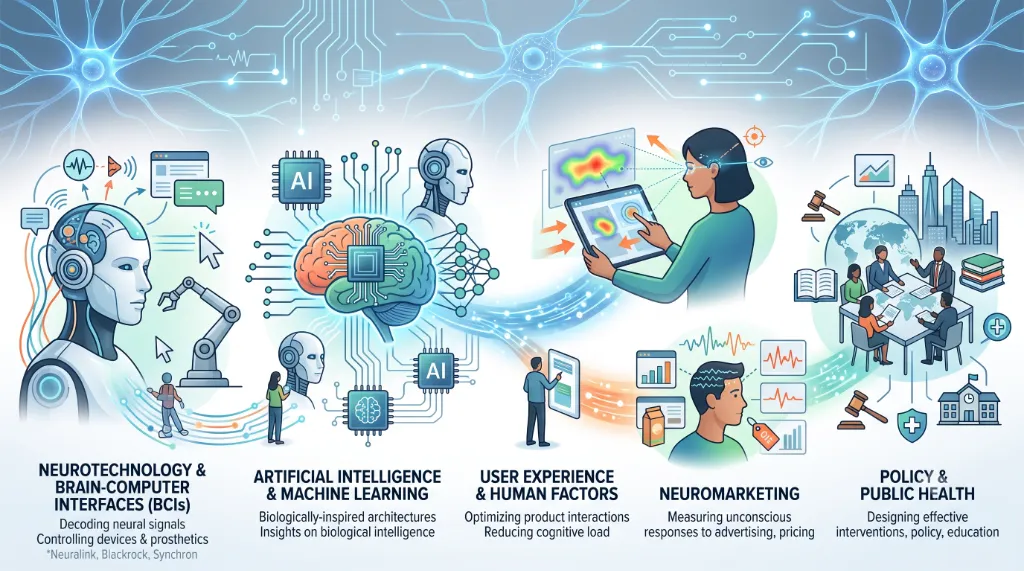
A growing proportion of cognitive neuroscientists work outside traditional academic and clinical settings, applying their expertise in technology companies, start-ups, consulting firms, and government agencies.
Neurotechnology and brain-computer interfaces: Companies developing brain-computer interfaces (BCIs) — devices that translate neural activity directly into control signals for computers, prosthetic limbs, or communication devices — employ cognitive neuroscientists to understand what neural signals encode relevant information, how to decode that information from recordings, and how to design user-friendly systems that work reliably in real-world conditions. Neuralink, Blackrock Neurotech, Synchron, and many smaller companies are hiring cognitive neuroscientists for exactly this work.
AI and machine learning: The connections between cognitive neuroscience and artificial intelligence run deep. Many of the architectural principles underlying modern deep learning — convolutional networks inspired by visual cortex, recurrent networks drawing on working memory theory, reinforcement learning modelled on dopaminergic prediction error — were directly inspired by cognitive neuroscience. AI companies employ cognitive neuroscientists to provide insights about biological intelligence that can inspire more capable and efficient artificial systems.
User experience and human factors: Technology companies studying how users interact with products — how attention is captured and held, how interfaces should be designed to minimise cognitive load, how decision-making unfolds in consumer contexts — hire cognitive neuroscientists to apply their knowledge of human cognition and attention to product design.
Neuromarketing: A controversial but commercially active application of cognitive neuroscience tools — particularly EEG and eye tracking — to measure consumers’ unconscious neural and physiological responses to advertising, product design, pricing, and retail environments. This field uses the methods of cognitive neuroscience for commercial rather than scientific purposes.
Policy and public health: Some cognitive neuroscientists work in government agencies, think tanks, or non-governmental organisations, applying their understanding of human decision-making, risk perception, and behaviour change to the design of public health interventions, economic policy, legal frameworks, and educational systems.
A Typical Week in the Life of an Academic Cognitive Neuroscientist
To make this concrete, here is a realistic picture of how an academic cognitive neuroscientist at a research university might spend a typical working week:
Monday: Lab meeting in the morning — a group discussion with PhD students and postdocs reviewing recent papers in the field and discussing ongoing projects. Afternoon: working with a PhD student on revisions to a manuscript that received reviewer comments from a journal. Evening: reviewing grant application text for a submission due next month.
Tuesday: Teaching a 2-hour undergraduate lecture on memory systems. Afternoon: meeting with a collaborating neuropsychologist about designing a study testing a new theory of working memory in patients with frontal lobe damage.
Wednesday: Running three fMRI participants in scanner sessions — 2 hours each including participant preparation, scanning, and data quality check. This is a dedicated scanning day, physically demanding and logistically intensive.
Thursday: Writing — revising the introduction to a new manuscript, incorporating recent papers that have been published since the first draft. Separately, reviewing the analysis code written by a postdoctoral researcher to ensure the statistical approach is appropriate for the research question.
Friday: Supervising a PhD student’s progress meeting — reviewing their timeline, discussing their pilot data, helping them refine their next experimental design. Then: attending a departmental seminar where a visiting cognitive neuroscientist presents their work. Email throughout the day — responding to collaborators, reviewing paper submissions for journals, communicating with grant administrators.
Weekends, while nominally free, often involve reading papers (which is difficult to find time for during the week), writing grant sections or manuscript drafts, and thinking through experimental design problems that benefit from mental space away from the daily workload.
The Skills a Cognitive Neuroscientist Develops
The range of activities described above requires a remarkably broad skill set:
• Scientific literacy: the ability to read, critically evaluate, and synthesise a vast primary research literature.
• Experimental design: the creativity and methodological sophistication to design experiments that cleanly answer theoretically significant questions.
• Technical expertise: deep proficiency with the specific tools of their sub-field — operating and programming MRI scanners, writing EEG analysis code, programming experimental tasks.
• Statistical and computational skills: knowledge of the statistical methods used in their field, increasingly including machine learning and programming in languages like Python, MATLAB, or R.
• Writing: the ability to communicate complex scientific ideas clearly, precisely, and persuasively — in papers, grants, reviews, and public communication.
• Teaching and mentoring: the ability to explain difficult concepts clearly and to support the development of junior researchers.
• Project management: the ability to run multiple projects simultaneously, manage budgets, coordinate collaborators, and meet deadlines.
• Communication: the ability to present research findings to diverse audiences — from specialist scientists to clinicians, policymakers, journalists, and the public.
The Takeaway: A Career of Profound Questions and Practical Impact
What does a cognitive neuroscientist do? They ask profound questions about how the physical brain produces the mental life that is the entirety of human experience. They design ingenious experiments to answer those questions. They develop and use extraordinary technologies to peer inside the living human brain. They analyse complex data with sophisticated statistical and computational methods. They write and teach and mentor. They apply their findings to clinical treatment, educational practice, technological innovation, and public policy. It is a demanding, technically sophisticated, intellectually rewarding career at the intersection of biology, psychology, computation, and medicine — and its importance to human wellbeing will only grow as the brain becomes an increasingly central focus of medicine, technology, and our collective self-understanding. For the lifestyle and nutritional practices that support the brain health this science illuminates, see our What Actually Happens in Your Brain When You Learn Something New and our Wellbeing Mastery guide.