By Tanveer Ahmed Khan | K11-Certified Trainer & Dietitian-Nutritionist | REPS India Registered | livenulife.com | 13 min read
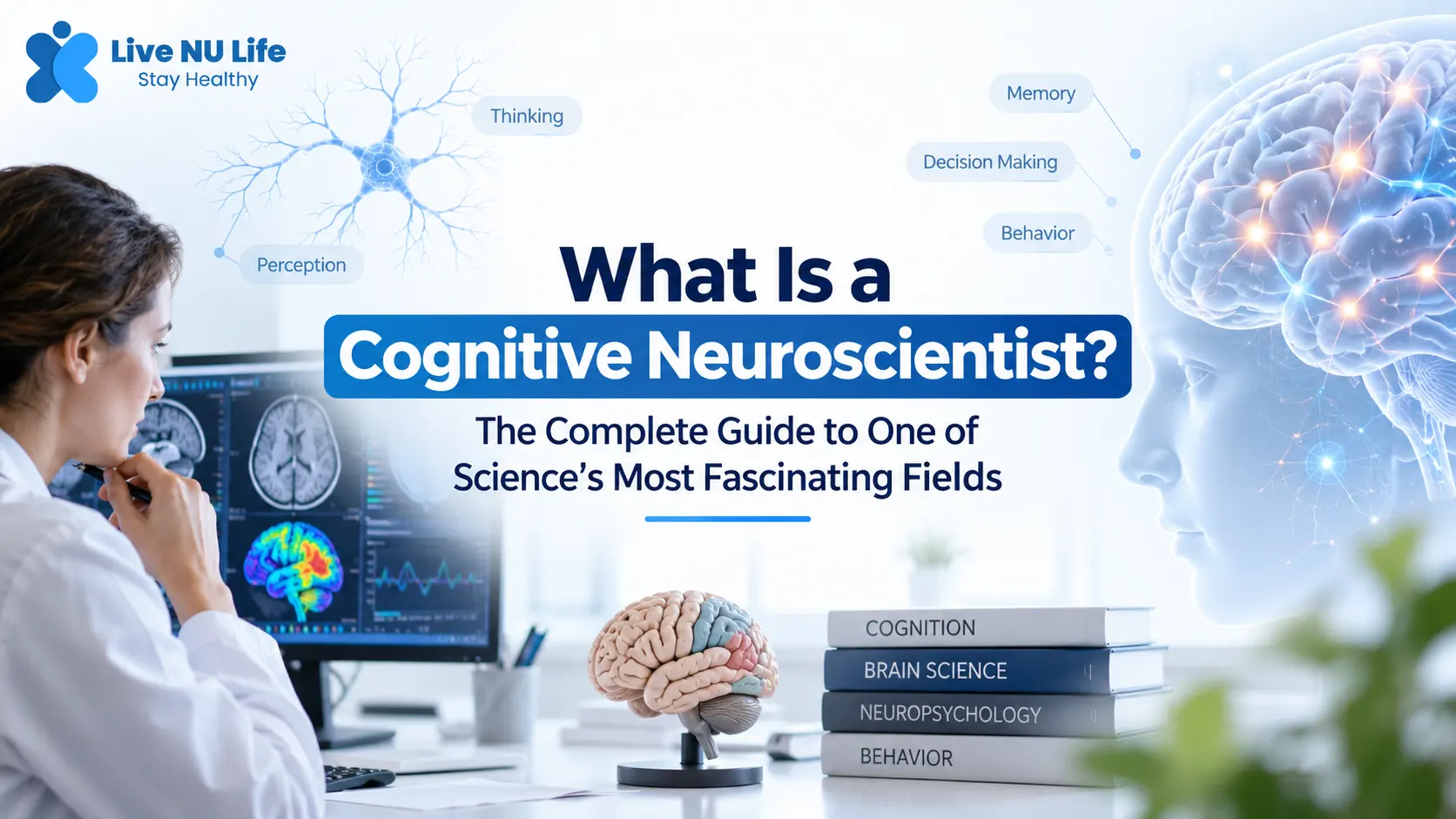
THE CORE INSIGHT: A cognitive neuroscientist is a scientist who studies the biological mechanisms of the human mind — mapping how neural circuits in the brain give rise to perception, attention, memory, language, emotion, and consciousness. Their work sits at the intersection of psychology and neuroscience, and the discoveries they make are reshaping medicine, education, technology, and our understanding of what it means to be human.
Where Psychology Meets Neuroscience
There is one of the most profound questions in all of science, and it sits at the heart of what cognitive neuroscientists do: how does a physical organ — 1.4 kilograms of interconnected neurons, blood vessels, and support cells — produce the entire landscape of human experience? How do electrical-chemical signals moving across synapses give rise to memory, language, emotion, creativity, decision-making, and consciousness itself?
Cognitive neuroscience is the scientific discipline dedicated to answering this question. It combines the conceptual frameworks of cognitive psychology — the study of mental processes like perception, attention, memory, and reasoning — with the methods of neuroscience — the biological study of the brain and nervous system at every level from molecule to whole-brain circuit. The scientists who work in this field are cognitive neuroscientists.
The field itself is relatively young. While philosophers have debated the relationship between mind and brain for millennia, and psychologists have studied mental processes since the late 19th century, cognitive neuroscience as a formal scientific discipline emerged primarily in the late 1970s and 1980s, when new neuroimaging technologies — particularly positron emission tomography (PET) and later functional magnetic resonance imaging (fMRI) — made it possible for the first time to observe the living human brain in action while people performed cognitive tasks.
The term “cognitive neuroscience” was coined in the late 1970s by psychologist Michael Gazzaniga and neuroscientist George Miller — reportedly in a New York City taxi during a late-night conversation about how to bridge the gap between psychology and brain biology. That conversation inaugurated a field that now employs thousands of researchers worldwide and has produced some of the most transformative scientific insights of the past 50 years.
📖 Also read: What Actually Happens in Your Brain When You Learn Something New — Our deep dive into the neuroscience of learning — LTP, neuroplasticity, hippocampal function, and the lifestyle factors that optimise brain change. The perfect companion to understanding what cognitive neuroscientists study.
The Two Parent Disciplines: What Cognitive Neuroscience Inherits
To understand what a cognitive neuroscientist is, it helps to understand the two disciplines they bring together.
Cognitive psychology emerged from the “cognitive revolution” of the 1950s and 1960s — a scientific reaction against behaviourism, which had dominated psychology by studying only observable behaviour and dismissing any discussion of internal mental states as unscientific. Cognitive psychologists argued that the mind’s internal operations — perception, attention, memory, language, problem-solving, decision-making — were legitimate objects of scientific study. They developed experimental methods for measuring these processes precisely: reaction time studies, memory recall tasks, perceptual threshold measurements, and computational models of mental processes. But cognitive psychology had a fundamental limitation: it studied the mind as if the brain were a black box, inferring internal processes from behaviour without being able to look directly at the biological mechanisms involved.
Neuroscience investigated the brain and nervous system at the biological level — studying neurons, synapses, neural circuits, neurotransmitters, and the structural organisation of the brain. Early neuroscience relied heavily on animal studies, post-mortem brain examination, and the study of patients with brain lesions — identifying which brain regions were necessary for which functions by observing what was lost when those regions were damaged. But neuroscience had its own limitation: it could describe the biological machinery without always being able to connect it to the specific cognitive functions that machinery supported.
Cognitive neuroscience synthesises these two traditions. It uses the experimental precision of cognitive psychology to design tasks that isolate specific mental processes, and the methods of neuroscience to observe what is happening in the brain while those processes occur. The result is a science that can answer both the “what” of mental processes (what are the computational steps involved in recognising a face, or forming a new memory?) and the “how” and “where” in the brain those processes are implemented biologically.
The Core Questions of Cognitive Neuroscience
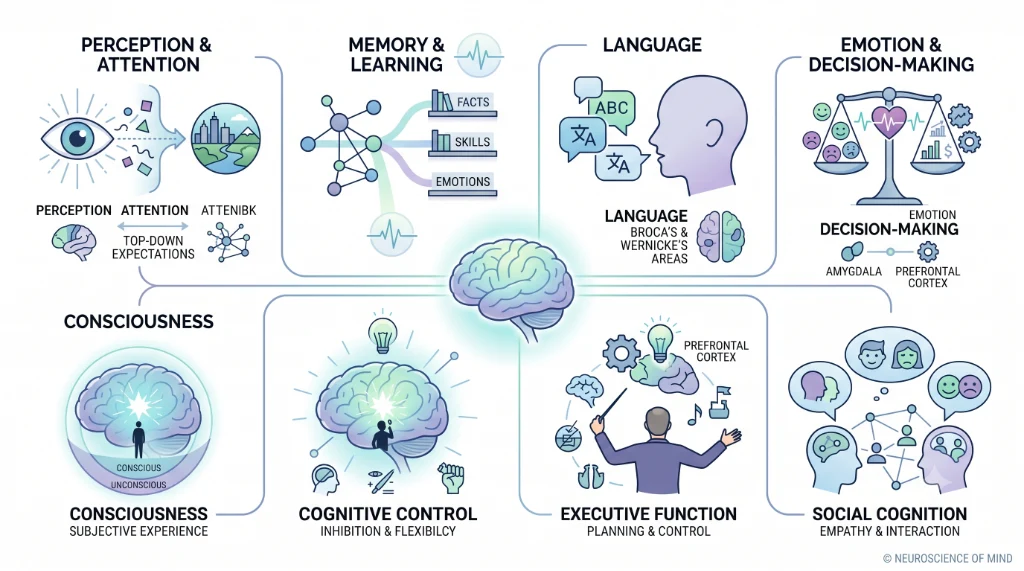
Cognitive neuroscientists investigate a remarkably broad range of questions about how the brain produces the mind. The field is organised around several major domains:
Perception and attention: How does the brain construct a coherent experience of the world from the chaotic torrent of sensory information it receives? How does attention select what to process and what to ignore? How do top-down expectations (what we know and believe) shape what we actually perceive? These questions are studied by tracking neural activity in sensory cortex and frontoparietal attention networks while participants perform perceptual tasks under varying attentional demands.
Memory and learning: How are new memories formed, consolidated, and retrieved? What makes some experiences remembered for a lifetime while others fade within minutes? What is the difference between the memory systems for facts (declarative memory), skills (procedural memory), and emotionally significant events (emotional memory)? How does the brain prevent old memories from interfering with new ones? These questions have been transformed by neuroimaging studies showing the distinct brain regions involved in different memory types, and by the molecular neuroscience of long-term potentiation that we covered in our companion article on the neuroscience of learning.
Language: How does the brain process spoken and written language — recognising words, parsing grammatical structure, extracting meaning, formulating responses? Why are the left and right hemispheres different in their contributions to language? How does the brain manage multiple languages in bilingual and multilingual speakers? Language is one of the most distinctively human cognitive capacities, and its neural basis has been studied since the 19th-century discovery that damage to two specific left-hemisphere regions (Broca’s area and Wernicke’s area) produces distinct language impairments.
Emotion and decision-making: How does the brain generate emotional responses? How do emotions interact with cognition — facilitating some decisions while impairing others? How do the prefrontal cortex and amygdala interact to regulate emotional responses? What goes wrong in the neural circuits of emotion in depression, anxiety, PTSD, and other psychiatric conditions? These questions sit at the intersection of cognitive neuroscience, psychiatry, and behavioural economics.
Consciousness: Perhaps the most profound question in all of science: how does the brain produce subjective experience — the sense of being a self, of being aware, of there being “something it is like” to see red or feel pain? The neuroscience of consciousness is one of the most philosophically contentious and scientifically challenging areas of cognitive neuroscience, with major ongoing debates about the neural correlates of consciousness, what distinguishes conscious from unconscious processing, and whether consciousness can ever be fully explained in purely physical terms.
Executive function and cognitive control: How does the prefrontal cortex orchestrate complex goal-directed behaviour — planning, working memory, cognitive flexibility, impulse inhibition, and decision-making? How does cognitive control develop across childhood and adolescence? How does it decline in ageing and neurological disease? These questions have enormous implications for education, clinical neuropsychology, and the understanding of disorders like ADHD.
Social cognition: How does the brain process information about other minds — recognising emotions in faces, inferring others’ intentions, empathising, cooperating, and competing? What is the neural basis of theory of mind — the capacity to understand that other people have beliefs, desires, and knowledge states different from one’s own? How is social cognition disrupted in autism spectrum disorder?
The Major Tools of Cognitive Neuroscience
Cognitive neuroscientists are distinguished not just by the questions they ask but by the extraordinary array of tools they use to answer those questions. The technological development of these tools has driven much of the field’s progress.
Functional MRI (fMRI): The dominant brain imaging method of modern cognitive neuroscience. fMRI measures changes in blood oxygenation throughout the brain — the BOLD (blood oxygen level-dependent) signal — as a proxy for neural activity. When neurons in a brain region are more active, blood flow to that region increases, changing the magnetic properties of the blood in ways detectable by the MRI scanner. fMRI has excellent spatial resolution (can localise activity to within a few millimetres), though its temporal resolution is limited (it reflects neural activity over seconds, not milliseconds, because it tracks blood flow rather than electrical activity directly). fMRI has produced thousands of studies mapping which brain regions are involved in which cognitive tasks.
Electroencephalography (EEG): EEG records the electrical activity of the brain through electrodes placed on the scalp. Because it directly measures neural electrical activity (rather than blood flow), it has millisecond temporal resolution — capturing the precise timing of neural events as they unfold. The trade-off is poor spatial resolution; EEG cannot localise activity to specific brain regions with precision. EEG is ideal for studying the rapid dynamics of cognitive processing — the sequential stages of attention, perception, and memory retrieval that unfold over tens to hundreds of milliseconds.
Magnetoencephalography (MEG): MEG measures the tiny magnetic fields generated by electrical currents in neurons, providing both excellent temporal resolution (like EEG) and better spatial resolution than EEG. It is a powerful tool for studying the timing and spatial organisation of cognitive processes, though MEG machines are expensive and rare.
Transcranial Magnetic Stimulation (TMS): TMS uses a powerful magnetic coil held near the scalp to briefly disrupt neural activity in specific brain regions. By temporarily “switching off” a brain region and observing the effects on cognitive performance, researchers can establish causal relationships between brain regions and cognitive functions — not just correlations. TMS can also be used therapeutically: repetitive TMS (rTMS) is an approved treatment for depression, and its applications in cognitive enhancement and rehabilitation are actively researched.
Lesion studies: The oldest method in cognitive neuroscience, and still one of the most informative: studying patients who have suffered brain damage from stroke, tumour, trauma, or neurological disease, and examining what cognitive functions are disrupted when specific brain regions are lost. The most famous lesion cases in cognitive neuroscience history — including H.M. (who lost the ability to form new memories after surgical removal of his hippocampus), Phineas Gage (whose personality was dramatically altered by a metal rod through his prefrontal cortex), and Paul Broca’s patients (who lost the ability to speak fluently after damage to the left frontal lobe) — drove foundational insights about brain organisation that shaped the entire field.
Single-unit electrophysiology: Recording the electrical activity of individual neurons through microelectrodes inserted into brain tissue — primarily in animal studies and, in humans, in patients undergoing neurosurgery. This technique provides the finest-grained resolution of neural coding: what patterns of firing in individual neurons represent specific stimuli, memories, decisions, or movements.
Genetics and genomics: Cognitive neuroscientists increasingly use genetic approaches — studying how genetic variants affect brain structure, neural function, and cognitive abilities; how gene expression in neurons changes in response to experience; and how genetic disorders affect cognitive development. Genome-wide association studies (GWAS) have identified hundreds of genetic variants associated with cognitive traits like intelligence, memory, and psychiatric conditions.
The Relationship Between Cognitive Neuroscience and Related Fields
Cognitive neuroscience does not stand alone — it is part of an interconnected web of scientific disciplines, each contributing different methods and frameworks for understanding the brain and mind.
Neuropsychology is the clinical application of brain-behaviour relationships — assessing and treating cognitive impairments in patients with neurological or psychiatric conditions. A neuropsychologist uses standardised cognitive tests to map a patient’s specific deficits and preserved abilities, providing diagnostic information and guiding rehabilitation. Many neuropsychologists draw on the theoretical frameworks developed by cognitive neuroscience researchers.
Computational neuroscience develops mathematical and computational models of how neural circuits perform cognitive operations — how populations of neurons encode information, how learning algorithms implemented in neural networks solve problems, and how dynamical systems of neurons produce complex behaviour. The increasingly productive dialogue between computational neuroscience and machine learning has driven advances in both fields.
Developmental cognitive neuroscience studies how the brain and mind develop from infancy through adolescence and into adulthood — how cognitive capacities emerge, when different brain systems mature, and what happens when development goes wrong. This sub-field has transformed our understanding of critical periods in brain development and has important implications for education and child mental health.
Social neuroscience extends cognitive neuroscience’s methods to social behaviour — studying the neural basis of social perception, empathy, cooperation, and social decision-making, and investigating how social relationships affect brain structure and function.
Affective neuroscience focuses specifically on the neuroscience of emotion — how emotions are generated, represented, and regulated in the brain, and how emotional dysfunction underlies psychiatric disorders.
Cognitive Neuroscience in India: A Growing Field
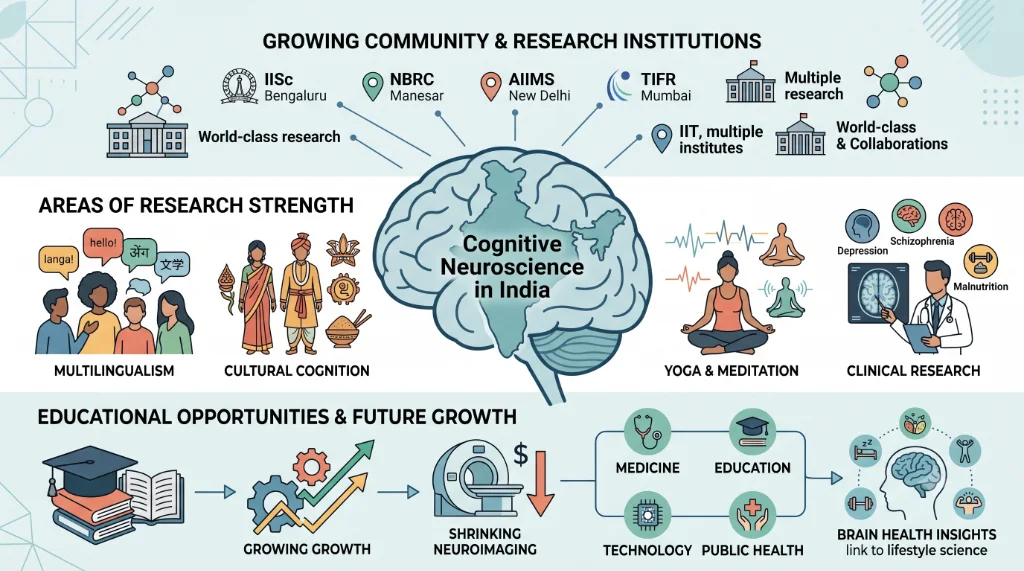
India has a growing and increasingly internationally prominent community of cognitive neuroscientists. Institutions including the National Brain Research Centre (NBRC) in Manesar, the Indian Institute of Science (IISc) in Bengaluru, AIIMS in New Delhi, the Tata Institute of Fundamental Research (TIFR) in Mumbai, and multiple IITs are conducting world-class research in cognitive neuroscience and related fields.
Areas of particular strength in Indian cognitive neuroscience research include: studies of multilingualism and how the brain processes multiple languages (a particularly relevant question in India’s extraordinarily linguistically diverse context); investigations of how cultural background shapes cognition and perception; research on the neural basis of yoga and meditation practices that originated in Indian traditions; and clinical cognitive neuroscience research on conditions with high prevalence in India including depression, schizophrenia, and the cognitive effects of malnutrition.
For students and professionals interested in this field, India now offers postgraduate programmes in neuroscience and cognitive science at multiple institutions. The field is growing rapidly as the cost of neuroimaging equipment decreases and as the scientific community increasingly recognises the central importance of understanding the brain for medicine, education, technology, and public health.
The brain health insights from cognitive neuroscience — including the relationships between sleep, nutrition, exercise, stress, and cognitive function — are directly relevant to the nutritional and lifestyle science we cover on Live NU Life. For the nutritional framework that supports brain health, see our Functional Nutrition guide and our Vitamin C and Brain Health article.
Why Cognitive Neuroscience Matters to Everyone
Cognitive neuroscience is not just an academic enterprise. Its discoveries have profound and direct implications for how we live, learn, work, maintain our health, and understand ourselves.
For education: Cognitive neuroscience research on memory consolidation, the spacing effect, active recall, and the role of sleep in learning has begun to reshape educational practice. Understanding how the brain acquires and retains knowledge allows educators to design curricula and study strategies that work with the brain’s biology rather than against it.
For medicine: Cognitive neuroscience is transforming the understanding and treatment of neurological and psychiatric disorders — Alzheimer’s disease, Parkinson’s disease, depression, anxiety disorders, ADHD, schizophrenia, autism spectrum disorder, PTSD, and traumatic brain injury. The field is identifying biomarkers that allow earlier diagnosis, new therapeutic targets, and brain stimulation techniques that can treat conditions that have not responded to conventional pharmacology.
For technology: The insights of cognitive neuroscience have inspired much of the architecture of modern artificial intelligence — convolutional neural networks were inspired by the visual cortex; recurrent neural networks draw on theories of working memory; reinforcement learning algorithms are modelled on dopaminergic reward prediction error signals. Brain-computer interfaces, now reaching clinical use for paralysis and communication disorders, depend directly on cognitive neuroscience research.
For personal wellbeing: Understanding how stress impairs hippocampal function, how sleep consolidates learning, how exercise generates BDNF and supports neurogenesis, and how nutrition provides the building blocks for neurotransmitter synthesis and neural membrane integrity — all of this cognitive neuroscience knowledge empowers individuals to make evidence-based lifestyle decisions that protect and enhance their brain health across the lifespan. This connection between cognitive neuroscience and lifestyle optimisation is the foundation of much of what we do at Live NU Life.
The Takeaway: A Science at the Centre of Human Self-Understanding
A cognitive neuroscientist is a scientist who has dedicated their career to one of the most challenging and consequential questions in all of human inquiry: how does the physical brain produce the mental life that is the entirety of our experience? Through the tools of neuroimaging, electrophysiology, genetics, computational modelling, and carefully designed behavioural experiments, cognitive neuroscientists are progressively mapping the biological architecture of perception, memory, language, emotion, and consciousness.
The field matters because the brain is not merely a seat of intellectual performance — it is the organ through which we experience everything. Protecting and supporting brain health through evidence-based nutrition, sleep, exercise, and stress management is among the most important investments anyone can make in their quality of life. For the complete brain health optimisation framework, see our Wellbeing Mastery guide and our Science-Based Longevity Protocols.