By Tanveer Ahmed Khan | K11-Certified Trainer & Dietitian-Nutritionist | REPS India Registered | August 2026 | 12 min read
KEY TAKEAWAY: Two studies published in PNAS (July 27, 2026) and ScienceDaily (August 14, 2026) from Princeton University revealed that when gut bacteria run low on fibre, they begin consuming proteins from the mucus lining protecting the gut wall — producing harmful phenol metabolites in the process. The research also identified a new class of dietary compounds called Prifs (proteins-imitating-fiber) that work alongside fibre to protect the gut lining. This completely reframes what “adequate fibre” means for intestinal health.
The Architecture of Your Gut’s First Line of Defence
Your gut wall is not simply a tube. It is a sophisticated biological barrier — one of the most complex interfaces between your body and the external environment, because the contents of your digestive tract are, in a very real sense, outside your body. Everything that passes through requires active management: absorption of beneficial nutrients, exclusion of pathogens and toxins, and a carefully maintained interface with the trillions of microorganisms living in your gut.
The primary physical barrier of this interface is the mucus layer — a thick, gel-like coating produced by specialised goblet cells in the intestinal epithelium. The mucus layer is not passive. It is a dynamic, constantly renewed biological gel composed primarily of glycoproteins (proteins with sugar chains attached) that forms two distinct layers: an inner layer largely sterile of bacteria and directly attached to the epithelium, and an outer layer inhabited by commensal bacteria that harvest nutrients from the mucus sugars as part of a complex ecology.
This architecture — mucus layer, commensal bacteria, intestinal epithelium — functions as an integrated system. When it works, pathogens cannot reach the epithelial cells, inflammation is controlled, and the gut communicates appropriately with the immune system. When it breaks down, the consequences include inflammatory bowel disease, increased intestinal permeability (“leaky gut”), systemic inflammation, and accelerated progression of multiple chronic diseases.
Research published in PNAS on July 27, 2026, and covered by ScienceDaily on August 14, 2026, from the Rabinowitz laboratory at Princeton University, has now revealed a specific and alarming mechanism by which this architecture breaks down — driven by insufficient dietary fibre.
📖 Also read: Fibermaxxing in 2026: What the Trend Gets Right and Wrong — Our June 2026 guide to fibre diversity and optimal intake — now updated with the Princeton PNAS finding that quantity of fibre matters critically for preventing gut bacteria from consuming the mucus lining.
The Mechanism: What Happens When Fibre Runs Out
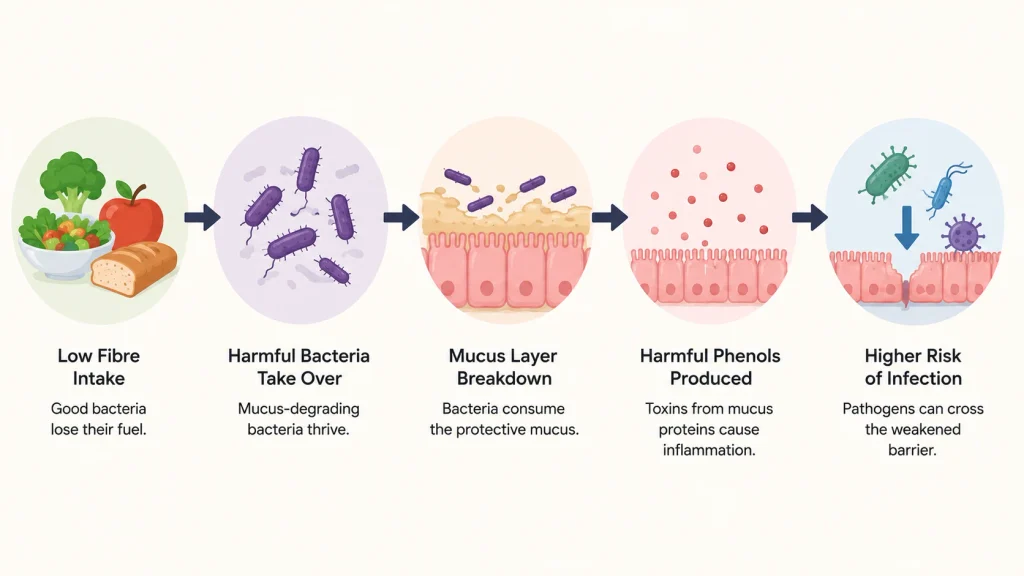
Gut bacteria — including many beneficial species — primarily ferment dietary fibre for energy. The short-chain fatty acids they produce from this fermentation (butyrate, propionate, acetate) are the fuel that powers colonocytes (gut lining cells), signals to the immune system, and maintains the structural integrity of the mucus layer.
When dietary fibre is scarce, bacteria need alternative energy sources. The Princeton research identified the specific alternative they choose — and it is alarming: they begin consuming the glycoprotein components of the mucus layer itself.
The mucus-degrading bacteria. The Princeton team found that four specific bacterial strains flourished most under low-fibre conditions — and these four strains were the only ones producing enzymes capable of breaking down the glycoproteins in the mucus layer. In a fibre-deprived gut, these bacteria rapidly expand their populations, outcompete fibre-fermenting species, and begin enzymatically digesting the mucus that protects the gut wall.
The phenol consequence. As bacteria metabolise the protein components of gut mucus, they produce harmful phenol metabolites — specifically from the amino acid tyrosine in the mucus glycoproteins. These phenols are associated with intestinal inflammation, impaired barrier function, and increased pathogen susceptibility. The Princeton study showed that phenol production rises dramatically when gut bacteria are consuming the mucus lining rather than dietary fibre. It also found that fibre availability actively suppressed this mucus degradation and reduced phenol production.
The vulnerability to infection. An eroded mucus layer allows pathogenic bacteria direct access to the intestinal epithelium — the cells that would otherwise be protected. The Princeton research team confirmed that fibre-deprived mice with thinned mucus layers showed dramatically increased vulnerability to bacterial pathogens that would normally be excluded by an intact mucus barrier.
The Prif Discovery: A New Class of Gut-Protective Nutrients
The second major finding from the Princeton research is one of the most important nutrition science discoveries of August 2026: the identification of Prifs — Proteins-imitating-fiber — as a distinct and previously under-recognised category of dietary compounds that protect gut health alongside traditional fibre.
Prifs are indigestible plant proteins — proteins that the body cannot break down in the small intestine and that therefore reach the colon intact, where they function similarly to fibre as bacterial substrates. Unlike the proteins in meat, eggs, or dairy — which are efficiently digested and absorbed in the small intestine — Prifs survive the journey to the colon and are fermented by bacteria there, providing alternative energy that suppresses mucus degradation even when fibre is insufficient.
What contains Prifs? The Princeton research found Prifs in whole plant foods — legumes, whole grains, vegetables, and nuts all contain these resistant plant proteins alongside their fibre content. Critically, Prifs are largely absent from ultra-processed foods, which use isolated protein ingredients (whey, soy protein isolate, pea protein concentrate) that are highly digestible in the small intestine and therefore do not reach the colon as Prif-type compounds.
Why Prifs explain why whole foods outperform supplements. The research provides a mechanistic explanation for something nutritional science has consistently observed: whole plant foods produce better gut health outcomes than equivalent amounts of isolated fibre supplements. A psyllium husk supplement provides fibre but no Prifs. A cup of lentils provides both fibre AND indigestible plant proteins that function as Prifs. The combination protects the mucus layer through two complementary mechanisms.
The food labelling implication. “Food packaging may eventually list Prif right below fiber,” said Joshua Rabinowitz, lead researcher. This prediction, if realised, would be as significant a nutritional labelling change as the addition of dietary fibre to food labels in the 1970s and 1980s. The concept of Prif as an essential gut-health nutrient category — alongside but distinct from fibre — represents a genuine advance in nutritional science.
Why Ultra-Processed Food Creates the Fibre-Prif Deficit
The Princeton research explains, at the molecular level, exactly why the ultra-processed food dietary pattern produces the gut health consequences we have been documenting throughout our 2026 series.
Ultra-processed foods are by design efficient calorie delivery systems. They are engineered for human digestibility — maximising absorption in the small intestine and leaving as little residue as possible for colonic fermentation. This means they systematically strip both fibre and Prifs from the food matrix:
• Refined grains (white flour, white rice) have their bran and germ removed — the parts that contain fibre and the indigestible proteins that function as Prifs.
• Isolated protein ingredients (whey, soy isolate, pea protein concentrate) are produced by removing the fibre and much of the structural protein complex from the original plant food, leaving highly digestible protein that does not reach the colon.
• Commercial biscuits, packaged snacks, and instant noodles contain little to no intact dietary fibre or Prifs — their gut-bacterial substrate content is essentially zero.
When the gut bacteria receive insufficient fibre and Prifs from an ultra-processed food diet, they do what the Princeton research documents: they start consuming the gut lining. This is the molecular mechanism underlying the gut dysbiosis, increased intestinal permeability, and systemic inflammation that our entire 2026 series has documented as consequences of ultra-processed food consumption. See our June 2026 UPF brain health article for the cognitive consequences of this same dietary pattern, and our July 2026 sweeteners gut bacteria article for the additional damage that artificial sweeteners add to this picture.
My Clinical Protocol: Foods That Protect the Mucus Layer
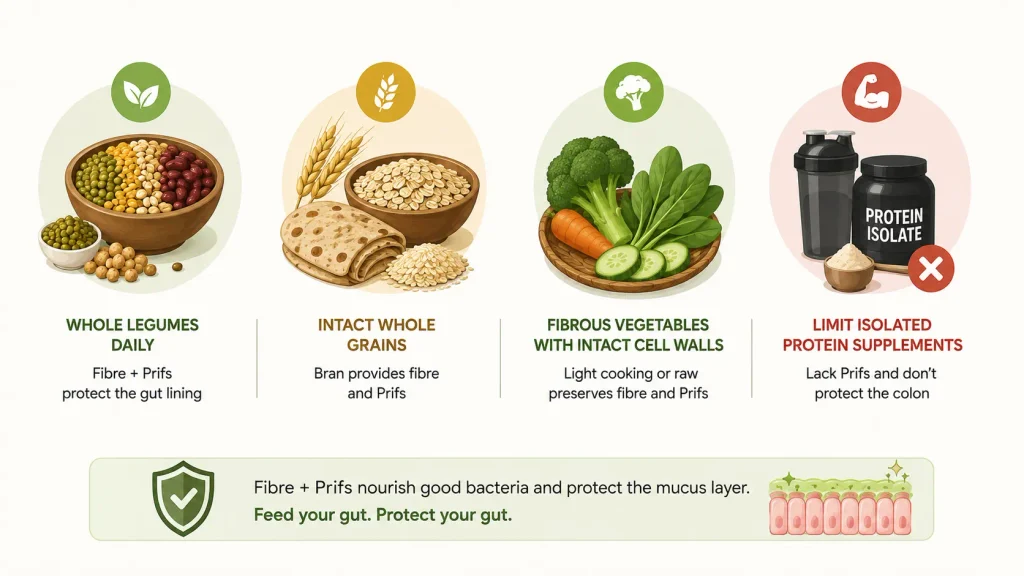
Based on the Princeton PNAS research and the broader evidence base, here is how I advise clients to build the dietary pattern that protects the mucus layer through both fibre and Prif delivery:
Whole legumes daily: Dal, rajma, chana, mung, urad — all provide both dietary fibre and indigestible plant proteins that function as Prifs. The whole legume matrix, prepared from dried or raw legumes rather than isolated protein powders, is one of the most important gut-protective foods available in Indian cuisine.
Intact whole grains (not refined): Brown rice, whole wheat roti, oats, ragi, jowar, bajra — the bran layer of whole grains contains both fibre and the indigestible structural proteins that function as Prifs. Refining removes both simultaneously.
Fibrous vegetables with intact cell walls: Cooking methods that preserve vegetable structure (light steaming, raw consumption, minimal processing) preserve both fibre and Prif content better than boiling to mush or commercial processing.
Reduce isolated protein supplements when gut health is the priority: Whey protein concentrate, soy protein isolate, and similar products deliver efficiently digestible protein that does not protect the colon. For gut health specifically, whole-food protein sources that arrive with their Prif content intact are superior.
For the complete dietary strategy that supports gut microbiome diversity while protecting the mucus layer, see our Gut Health Revolution guide and our Microbiome Dysbiosis guide.
The Takeaway
The Princeton PNAS research published July/August 2026 delivers a mechanistically precise and viscerally compelling message: when your gut bacteria do not receive enough fibre and Prifs from whole plant foods, they begin consuming the mucus layer that protects your gut wall — producing harmful phenol metabolites and creating vulnerability to infection and inflammation. Dietary fibre is not simply about bowel regularity. It is maintaining the physical integrity of your gut’s first line of defence. And Prifs — the newly identified class of indigestible plant proteins — are equally essential partners that fibre alone cannot replace. Eat whole plants: whole legumes, whole grains, fibrous vegetables. Reduce ultra-processed foods that strip both fibre and Prifs from the food matrix. Your gut lining depends on it. For the complete fibre and gut microbiome optimisation framework, see our Fibermaxxing guide and our Top 15 Probiotic Foods guide.
About the Author
Tanveer Ahmed Khan is a K11 School of Fitness Sciences-certified personal trainer and REPS India-registered dietitian-nutritionist with over 12 years of experience. Coaching: info@livenulife.com | Instagram: @fitwithtanveer | livenulife.com
Scientific References
1. AbuSalim, J.E., MacArthur, M.M., Gupta, M., et al. (2026). Digestion-resistant proteins support the healthy metabolite profiles associated with plant-based diets. Proceedings of the National Academy of Sciences. DOI: 10.1073/pnas.2605226123
2. ScienceDaily / Princeton University. (August 14, 2026). When gut microbes run low on fiber, they may start eating you.
3. SciTechDaily. (2026). When Gut Bacteria Run Out of Fiber, They May Start Eating You.
4. Mitchell, C.J., Hunter, J., et al. (2026). Nature Metabolism study on phenol and indole metabolites and fiber dependency.
5. UNILAD Health. (August 16, 2026). Scientists warn your gut bacteria could literally start eating you if you don’t get enough fibre.