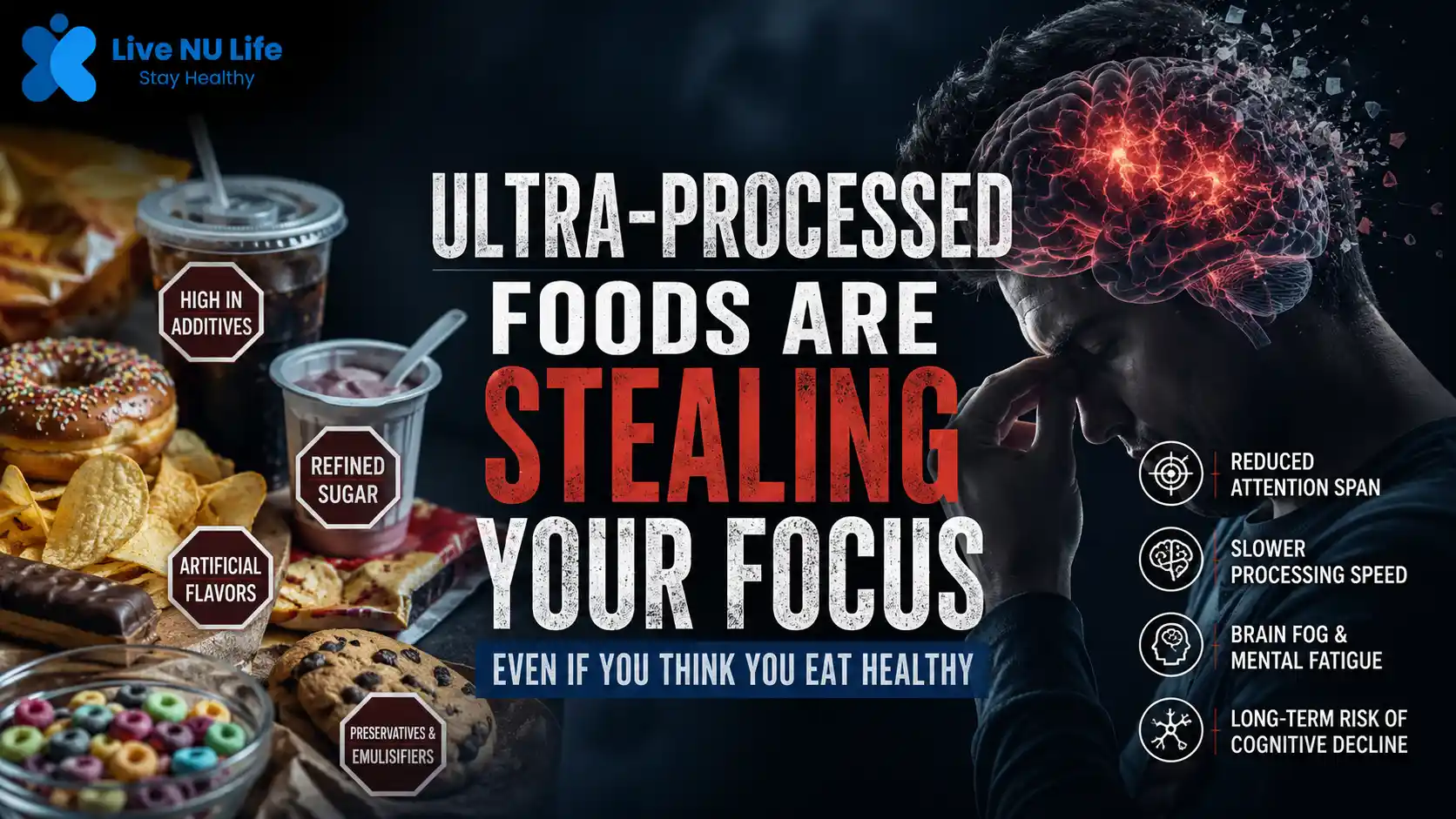
By Tanveer Ahmed Khan | Certified Trainer & Dietitian-Nutritionist (K11 School of Fitness Sciences, REPS India) | June 2026
There is a question I get asked constantly in my coaching practice: “Tanveer, I eat salads, I take my supplements, I exercise regularly — so why do I still feel foggy and unfocused by afternoon?”
After more than 12 years of working with busy professionals and entrepreneurs, I have watched this pattern repeat itself hundreds of times. The person eats reasonably well. They are not living on fast food. But somewhere in their day — a packet of biscuits here, a flavoured protein bar there, a can of diet soda — ultra-processed foods are quietly working against everything else they are doing right.
New research published in June 2026 has now given this observation a firm scientific foundation, and the findings are impossible to ignore.
What a Major New Study Found — Published June 2026
A study published in Alzheimer’s & Dementia: Diagnosis, Assessment & Disease Monitoring — a journal of the Alzheimer’s Association — examined the diets and cognitive health of more than 2,100 Australian adults aged 40 to 70 who were free of dementia at the time of the study.
Led by nutritional biochemist Dr Barbara Cardoso from Monash University, the research team found something both striking and sobering:
For every 10% increase in the proportion of ultra-processed food in a participant’s daily diet, there was a measurable and distinct drop in attention span and processing speed — and this association held even among people whose overall diet was otherwise healthy.
In the words of Dr Cardoso herself: “For every 10 per cent increase in ultra-processed food a person consumed, we saw a distinct and measurable drop in a person’s ability to focus.”
The study, which received wide coverage from ScienceDaily on 9 June 2026, found that participants consumed approximately 41% of their daily calories from ultra-processed foods — nearly identical to Australia’s national average of 42%. Given that similar figures exist across India’s urban population and most of the developed world, this research speaks directly to millions of people who believe their diet is “good enough.”
What the research is actually saying
The study could not establish direct causation — it is observational, and rightly so. But it revealed something more alarming than simple correlation: the harm from ultra-processed foods appears to be driven by the industrial processing itself, not merely by the displacement of nutritious foods in the diet. Even people eating plenty of vegetables, fruits, and whole foods alongside ultra-processed items showed measurable cognitive decline.
A separate systematic review published in BMJ Nutrition, Prevention & Health in 2026 analysed 14 studies and found that 78.5% of them reported significant associations between higher ultra-processed food consumption and poorer cognitive outcomes — including deficits in memory, executive function, and global cognition.
And research published in Frontiers in Nutrition (June 2, 2026) found that ultra-processed food consumption was directly associated with mild cognitive impairment (MCI) status in elderly patients — with processed meat showing the strongest association of all subcategories.
What Are Ultra-Processed Foods, Exactly?
I want to pause here, because there is real confusion about this term in popular conversation.
Ultra-processed foods (UPFs) are not simply foods that have been cooked or modified. The NOVA classification system — the internationally recognised framework used by researchers — defines ultra-processed foods as industrial formulations that contain ingredients rarely or never used in home kitchens: hydrolysed proteins, maltodextrin, high-fructose corn syrup, artificial colours, emulsifiers, flavour enhancers, and other additives designed to maximise palatability and shelf life.
In practical terms, this covers a vast range of products that most people consider entirely normal:
- Packaged biscuits, crackers, and cookies
- Most breakfast cereals (even “whole grain” varieties)
- Flavoured yoghurts with fruit preparations
- Processed meats: hot dogs, packaged deli meats, sausages
- Carbonated soft drinks and most fruit juices
- Flavoured protein bars and many meal replacement shakes
- Instant noodles and ready-to-heat meals
- Most commercial bread (particularly sliced white and brown bread)
- Energy drinks and flavoured plant milks
Notice something? Several of these items appear on “healthy eating” lists. A flavoured Greek yoghurt. A commercial protein bar. A “multigrain” cracker. The marketing is sophisticated, but the underlying industrial processing tells a different story.
Why Does Processing Harm the Brain?
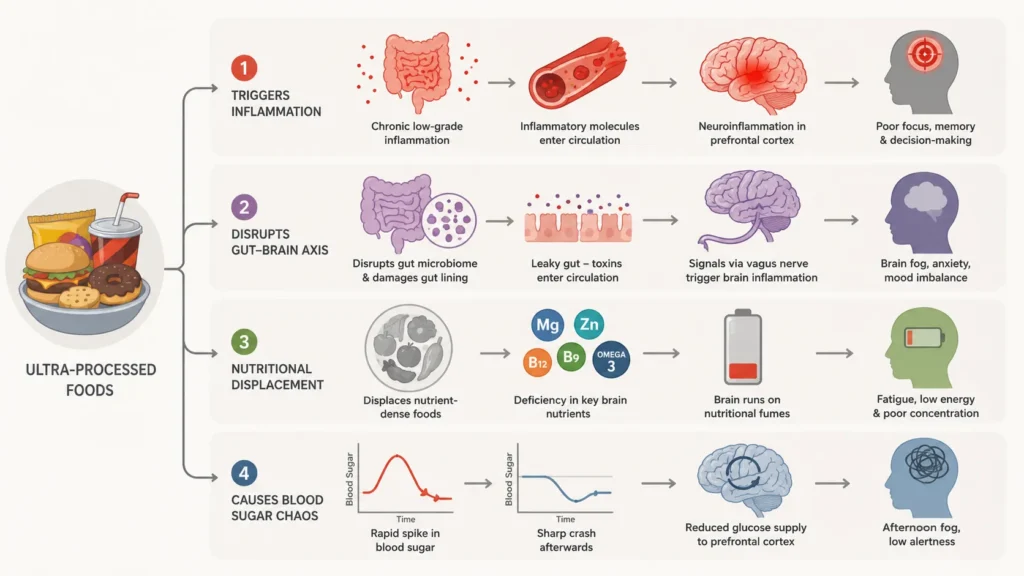
In my years working with clients, this is the question that generates the most interesting conversations, because the answer goes several layers deeper than most people expect.
1. Inflammation is the central mechanism
Ultra-processed foods are extraordinarily good at triggering chronic, low-grade systemic inflammation. This is not the acute inflammation your body uses to heal a wound — it is a persistent background state of immune activation that slowly damages tissues over time.
The brain is particularly vulnerable to this process. Neuroinflammation impairs the function of neurons in the prefrontal cortex — the region responsible for sustained attention, working memory, impulse control, and executive function. The 2026 Monash study specifically found that higher ultra-processed food intake was associated with increases in known dementia risk factors including obesity and elevated blood pressure, both of which have inflammation as a core driver.
Read More: Top Benefits of Fennel Tea for Better Digestion
2. The gut-brain axis is being disrupted
This is the mechanism I find most compelling — and the one most relevant to the fibermaxxing conversation happening simultaneously in nutritional science right now.
Your gut microbiome communicates directly with your brain via the vagus nerve, producing neurotransmitters including approximately 90% of your body’s serotonin and significant amounts of GABA, dopamine precursors, and short-chain fatty acids that maintain the integrity of the blood-brain barrier.
Ultra-processed foods decimate the diversity of your gut microbiome. The additives, emulsifiers, and artificial sweeteners used in UPF production — polysorbate-80, carrageenan, sucralose — have been shown in multiple studies to disrupt microbial communities and increase intestinal permeability (often called “leaky gut”). When the gut lining is compromised, inflammatory molecules gain access to systemic circulation and, eventually, the brain.
3. Nutritional displacement without satiety correction
Here is something I see constantly in practice: people who eat ultra-processed foods tend to underestimate their calories while simultaneously being less satisfied. UPFs are engineered to bypass natural satiety signals — they are hyperpalatable by design. This leads to a pattern where clients consume adequate or even excess calories, yet are genuinely deficient in the micronutrients the brain needs most: magnesium, zinc, B vitamins (particularly B12 and folate), and omega-3 fatty acids.
I recently worked with a software engineer in Hyderabad who was logging 2,400 calories daily and could not understand why he felt exhausted and unfocused. When we mapped his actual food intake carefully, approximately 60% of his calories came from ultra-processed sources. Despite eating enough quantity, his brain was running on nutritional fumes.
4. Blood sugar chaos and the afternoon fog
Ultra-processed foods — even those marketed as “low sugar” — create rapid glycaemic spikes followed by sharp crashes. The prefrontal cortex is extraordinarily sensitive to glucose fluctuations. That 2–4 pm window of brain fog that so many busy professionals describe to me? In the vast majority of cases, it maps directly onto a lunch or mid-morning snack that was ultra-processed.
The Attention Crisis Nobody Is Connecting to Food
Here is the clinical insight from the 2026 Monash research that I want to emphasise to every client and reader:
Attention deficits often precede more obvious memory changes by years. This means that the brain fog you experience now — the difficulty staying in a meeting, the re-reading of paragraphs, the mid-afternoon mental slowdown — is not just inconvenient. It may be an early biological warning signal.
As ScienceDaily reported: “Because attention serves as the foundation for so many aspects of thinking, declines in focus may represent an important early warning sign of broader cognitive changes.”
From a performance coaching perspective, this matters enormously. The professionals I work with are not concerned primarily with dementia — they are concerned with delivering their best thinking today, in the next board meeting, on the next client call. Ultra-processed foods are taxing that capacity right now, in real time.
What I Tell My Clients: The Practical Protocol
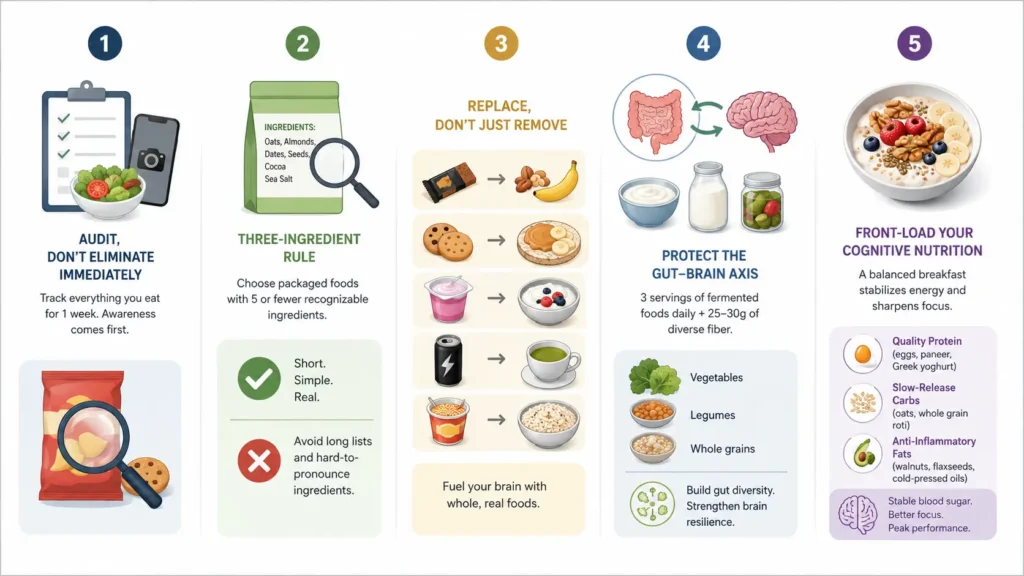
After 12 years of helping busy professionals build sustainable nutritional habits — without fad diets, gym requirements, or unrealistic restriction — here is what I have found actually works.
Step 1: Audit, don’t eliminate immediately
Sudden elimination of ultra-processed foods often triggers a rebound. Instead, spend one week photographing or writing down everything you eat. Most clients are genuinely surprised when they count the UPF instances in an otherwise “healthy” day.
Step 2: Apply the three-ingredient rule for packaged foods
When choosing packaged products, look for items with five or fewer recognisable ingredients. If an ingredient requires a chemistry degree to pronounce, it does not belong in your body. This is not a perfect system, but it is a practical one that works in real-world shopping conditions.
Step 3: Replace, don’t just remove
The brain needs fuel. When I reduce UPFs for a client, I simultaneously increase whole-food alternatives that deliver the same convenience and palatability:
- Replace flavoured protein bars with a handful of mixed nuts and a banana
- Replace packaged biscuits with rice cakes topped with nut butter and sliced banana
- Replace sweetened yoghurt with full-fat plain yoghurt and fresh berries
- Replace energy drinks with matcha green tea or black coffee with a teaspoon of coconut oil for sustained energy
- Replace instant noodles with a pre-cooked batch of whole grain rice or oats that takes 2 minutes to reheat
Step 4: Protect the gut-brain axis with diversity
Since the mechanism of UPF brain harm runs through the gut microbiome, rebuilding microbial diversity is a direct countermeasure. I recommend three fermented food servings per day (plain yoghurt, kefir, idli/dosa batter that has genuinely fermented, or pickled vegetables without vinegar) alongside at least 25–30 grams of diverse fibre from vegetables, legumes, and whole grains.
Step 5: Front-load your cognitive nutrition
The brain needs its most critical nutrients available when cognitive demand is highest — the morning hours. I structure my clients’ breakfast around three non-negotiables: quality protein (eggs, paneer, Greek yoghurt), slow-release carbohydrate (oats, whole grain roti), and an anti-inflammatory fat source (walnuts, flaxseeds, or a tablespoon of cold-pressed oils). This combination stabilises blood glucose through the most important mental performance window of the day.
A Note on the 2026 Research Landscape
It is important to be honest about what the current research does and does not establish. The 2026 Monash study is observational — it cannot prove that ultra-processed foods cause cognitive decline, only that a strong statistical association exists. Randomised controlled trials examining long-term cognitive outcomes from dietary changes take years to conduct.
However, the convergence of evidence is now substantial. Multiple independent research teams in 2026, using different populations and methodologies, are arriving at the same conclusion: ultra-processed food intake is associated with measurable, clinically meaningful declines in cognitive function.
Given that the intervention — reducing UPF consumption — carries zero downside risk and delivers multiple documented benefits to metabolic health, cardiovascular health, and gut microbiome diversity, the evidence threshold for changing behaviour has already been crossed.
The Bottom Line
You do not have to live on ultra-processed food to suffer its effects. As the June 2026 research makes clear, even moderate inclusion of these products in an otherwise healthy diet is sufficient to measurably erode your capacity to focus, process information, and think clearly.
In my practice, I have seen this play out in exactly the pattern the research describes. The professionals who feel most cognitively sharp are not the ones following the most extreme diets — they are the ones who have systematically reduced industrial processing from their daily eating, replaced it with whole and minimally processed alternatives, and protected the gut-brain axis through consistent fibre diversity and fermented foods.
Your attention is one of your most valuable professional and personal assets. What you ate for breakfast, lunch, and that mid-morning snack is directly influencing the quality of that attention right now.
Choose accordingly.
Scientific References
- Cardoso, B.R. et al. (2026). Ultra-processed food intake, cognitive function, and dementia risk: A cross-sectional study of middle-aged and older Australian adults. Alzheimer’s & Dementia: Diagnosis, Assessment & Disease Monitoring, 18(2). https://doi.org/10.1002/dad2.70335
- Bauermeister, S. et al. (2026). Ultra-processed food exposure and cognitive outcomes: a systematic review of observational studies. BMJ Nutrition, Prevention & Health. https://doi.org/10.1136/bmjnph-2025-001325
- Grasso M. et al. (2026). Consumption of ultra-processed foods is associated with cognitive status in elderly patients. Frontiers in Nutrition, 13:1839722. https://doi.org/10.3389/fnut.2026.1839722
- Rodríguez-Serrano, L.M. et al. (2026). Ultraprocessed Food Intake, Cognition, and Executive Function in Adults: A Systematic Review. Nutrients, 18(9), 1361. https://doi.org/10.3390/nu18091361
- ScienceDaily. (9 June 2026). Ultra-processed foods may be stealing your focus even if you eat healthy. Monash University. www.sciencedaily.com/releases/2026/06/260608040017.htm