By Tanveer Ahmed Khan | K11-Certified Trainer & Dietitian-Nutritionist | REPS India Registered | August 2026 | 12 min read
KEY TAKEAWAY: A University of Toronto study published in The Journal of Nutrition (August 9, 2026) found that adults consuming three daily servings of full-fat dairy for 12 weeks showed no meaningful increases in weight, body fat, LDL cholesterol, or insulin resistance — and experienced improved blood pressure and higher intakes of calcium, protein, and vitamin D. The “dairy matrix hypothesis” may explain why full-fat dairy behaves differently from other sources of saturated fat. Here is what this means for you.
The Advice That Has Been Wrong for 50 Years
Since the 1970s, dietary guidelines in most countries have said the same thing about dairy: choose low-fat or fat-free. The reasoning was simple: full-fat dairy contains saturated fat, saturated fat raises LDL cholesterol, high LDL cholesterol causes heart disease. Ergo, choose skim milk over whole milk. Choose low-fat yoghurt over full-fat. Choose reduced-fat cheese over the real thing.
This logic was never as straightforward as the guidelines implied — and over the past decade, the research has been methodically dismantling it. A study published in The Journal of Nutrition on August 9, 2026, led by University of Toronto professor Harvey Anderson at the Temerty Faculty of Medicine, now provides one of the most direct and well-controlled demonstrations that three daily servings of full-fat dairy do not adversely affect body weight, body composition, or blood lipids — and may actively improve some health markers.
This is not a fringe study. Harvey Anderson is one of Canada’s most respected nutritional scientists. The Journal of Nutrition is the flagship publication of the American Society for Nutrition. And the findings align with a growing body of evidence that the relationship between dairy fat and health is far more complex — and far more favourable — than the low-fat dietary guidelines assumed.
📖 Also read: Why Going Completely Sugar-Free May Backfire — June 2026 — The ENDO 2026 finding that extreme dietary restriction creates unintended metabolic consequences — the same principle of evidence-led nuance that the full-fat dairy research embodies.
The Study Design: What They Did
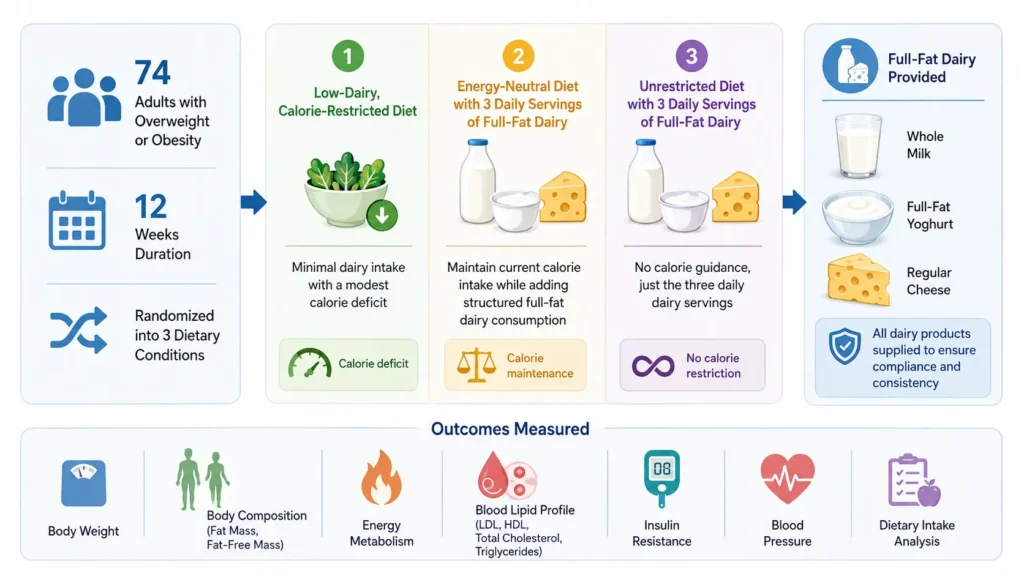
The Toronto study enrolled 74 adults with overweight or obesity and randomly assigned them to one of three dietary conditions for 12 weeks:
• Low-dairy, calorie-restricted diet: minimal dairy intake combined with a modest calorie deficit.
• Energy-neutral diet with three daily servings of full-fat dairy: maintaining current calorie intake while adding structured full-fat dairy consumption.
• Unrestricted diet with three daily servings of full-fat dairy: no calorie guidance, just the three daily dairy servings.
The dairy products supplied to the full-fat groups included whole milk, full-fat yoghurt, and regular cheese — the kind of dairy products that dietary guidelines have been discouraging for five decades. Participants in the dairy groups were supplied with all their dairy products to ensure compliance and consistency.
The outcome measurements were comprehensive: body weight, body composition (fat mass, fat-free mass), energy metabolism, blood lipid profile (LDL, HDL, total cholesterol, triglycerides), insulin resistance, blood pressure, and dietary intake analysis.
What the Results Showed — And Why They Matter
Body weight and body composition: no meaningful change. There were no statistically or clinically meaningful differences in weight gain or body fat between the low-dairy group and either full-fat dairy group after 12 weeks. People eating three servings of full-fat dairy daily — adding significant additional saturated fat to their diet — did not gain weight or body fat at meaningfully higher rates than those who barely ate any dairy.
Blood cholesterol: no adverse effect. “Those that had three servings of dairy didn’t have adverse levels of blood cholesterol or lipids or evidence of insulin resistance,” said Professor Anderson. LDL cholesterol — the primary concern cited by low-fat dairy guidelines — did not increase meaningfully in the full-fat dairy groups compared with the low-dairy group. This is the central finding that challenges five decades of dietary guidance.
Blood pressure improvement. Participants who consumed three dairy servings daily experienced improvements in blood pressure compared with the low-dairy group. This finding is consistent with prior research showing that the calcium, potassium, and dairy peptides in full-fat dairy products are vasodilatory — they actively help relax blood vessel walls and reduce arterial resistance. The blood pressure benefit of dairy is not eliminated by its fat content.
Improved nutritional profile. Participants eating full-fat dairy consumed significantly more calcium, protein, and vitamin D — three nutrients for which North American and Indian populations are consistently below recommended intake. This nutritional density advantage is one of the key reasons why the “replace full-fat dairy with something else” strategy often backfires: people do not consistently replace removed dairy with equivalent nutritional substitutes.
The Dairy Matrix Hypothesis: Why Full-Fat Dairy Behaves Differently
The most scientifically significant contribution of the Toronto 2026 study is not the numerical findings — it is the explanatory framework the researchers advance to account for those findings: the dairy matrix hypothesis.
The dairy matrix hypothesis proposes that the health effects of a food cannot be predicted simply by adding up the effects of its individual nutrients. The physical and chemical structure of the food — how its components are organised, bound together, and presented to the digestive system — fundamentally shapes how those nutrients are absorbed, metabolised, and utilised.
In whole-fat dairy products, the fat does not exist as free fatty acids or isolated triglycerides. It is encapsulated within a protective phospholipid membrane called the milk fat globule membrane (MFGM). This structure significantly alters how dairy fat is digested and absorbed. Specifically:
• MFGM delays fatty acid absorption and reduces the rate at which dietary fat enters the bloodstream — moderating the post-meal triglyceride spike that is one of the mechanisms by which saturated fat drives cardiovascular risk.
• MFGM contains bioactive phospholipids, sphingolipids, and specific fatty acids (including conjugated linoleic acid and odd-chain fatty acids like pentadecanoic acid) that have independent cardiovascular and metabolic benefits.
• Dairy proteins — casein and whey — interact with fats during digestion, forming complexes that further alter fat absorption and stimulate satiety hormones more strongly than fat-free dairy alternatives.
• The fermentation process in cheese and yoghurt produces short-chain fatty acids and other bioactive compounds that further modify the metabolic effects of dairy fat.
The dairy matrix hypothesis explains why epidemiological research on dairy intake consistently finds neutral or favourable cardiovascular associations — despite the saturated fat content that simplistic nutritional reductionism predicts should be harmful. The fat in full-fat dairy is not metabolically equivalent to the same amount of saturated fat from other sources precisely because of the structural context in which it exists.
The Funding Question — Addressed Directly
Multiple media reports on the Toronto study noted that it was industry-backed — partially funded by dairy industry interests. This is a legitimate transparency concern and I want to address it directly, because my clients ask me about this and I believe in scientific literacy.
Industry funding of nutrition research is common and does not automatically invalidate findings. What it does is increase the importance of examining methodology critically. The Toronto study used a rigorous randomised controlled design with objective outcome measurements including body composition by DXA scan and blood work — not self-reported dietary data or surrogate endpoints that are easy to manipulate. The statistical analyses were standard and the results were published in a peer-reviewed journal. These methodological features provide reasonable confidence in the findings.
More importantly, the Toronto study’s results are consistent with a much broader body of research not funded by dairy interests — including multiple independent meta-analyses and systematic reviews of randomised controlled trials that have found dairy fat consumption does not increase cardiovascular risk at typical intake levels. The dairy matrix hypothesis is being advanced by independent researchers across multiple countries. Industry funding adds a reason for scrutiny, not automatic dismissal.
What This Means for the Indian Context
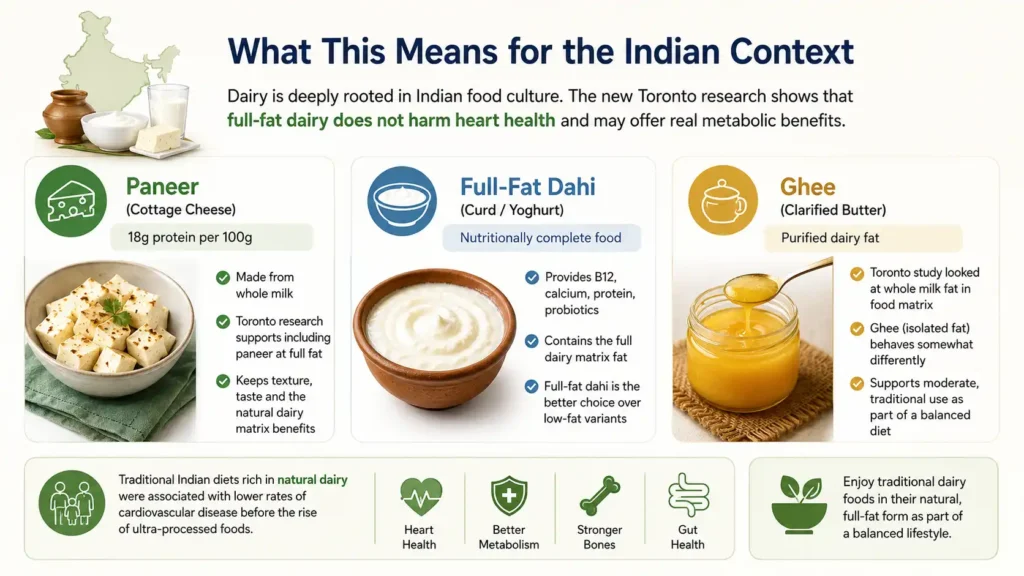
For Indian readers, this research is particularly relevant — because dairy is deeply embedded in Indian food culture, and the low-fat dairy advice has been applied in Indian clinical practice without strong justification.
Traditional Indian dairy consumption is extraordinarily varied and often at high fat content: whole milk chai, full-fat dahi (yoghurt), paneer made from whole milk, ghee (clarified butter), lassi made from full-fat curd. These have been consumed by Indian populations for millennia, and the populations that consumed them traditionally (before ultra-processed food displacement) showed dramatically lower rates of the cardiovascular disease that now afflicts urban India.
Paneer (cottage cheese): 18g protein per 100g, made from whole milk. The Toronto research supports including paneer at full fat rather than switching to low-fat versions, which sacrifice texture, palatability, and the dairy matrix structural benefits.
Full-fat dahi (curd/yoghurt): One of the most nutritionally complete foods in the Indian diet, providing B12, calcium, protein, probiotics, and full dairy matrix fat. The Toronto findings support using full-fat dahi as the default rather than low-fat variants that add artificial thickeners and sweeteners to compensate for removed fat.
Ghee: Clarified butter — purified dairy fat. The Toronto study specifically examined whole milk fat in the food matrix context; ghee, as an isolated fat, behaves somewhat differently and is a distinct question. The research supports moderate traditional ghee use as part of a balanced diet but does not directly validate unlimited consumption.
For the nutritional framework that integrates full-fat dairy into a comprehensive dietary approach, see our Functional Nutrition guide and our 6 Top Foods to Improve Heart Health.
The Critical Nuance: Three Servings vs. Unlimited
Before this research is read as permission to eat unlimited full-fat dairy, several important nuances must be stated clearly.
The study tested three servings daily — not unlimited consumption. Three servings is approximately: one cup of whole milk, one 175g serving of full-fat yoghurt, and 30–45g of cheese. This is a moderate, structured intake — not a green light for an all-dairy diet.
The study was 12 weeks long. Whether these outcomes hold over years and decades — particularly for cardiovascular endpoints — requires longer-term studies. The dairy matrix hypothesis provides biological plausibility for sustained neutral or positive effects, but 12-week trials cannot establish this.
The participants had overweight or obesity. People with different metabolic profiles — including those with confirmed familial hypercholesterolaemia (genetic high cholesterol), severe coronary artery disease, or specific genetic variants affecting saturated fat metabolism — may respond differently.
My Clinical Recommendation After 12 Years of Practice
The Toronto 2026 study, combined with the broader evidence base, has moved my clinical position on full-fat dairy firmly: for the vast majority of healthy adults and for clients with overweight or obesity who do not have familial hypercholesterolaemia, there is no evidence-based reason to avoid full-fat dairy in favour of low-fat alternatives. The nutritional density, satiety benefits, dairy matrix structural advantages, and probiotic benefits of full-fat dairy products — particularly fermented ones — make them a genuinely valuable component of a balanced diet.
Choose full-fat plain yoghurt over low-fat flavoured alternatives (which typically contain more sugar than ice cream). Use whole milk in cooking and chai. Include paneer regularly for protein. Use ghee in traditional preparations. The evidence does not support the last 50 years of low-fat dairy advice — and the dairy matrix hypothesis provides a biologically coherent explanation for why. For the fermented dairy dimension and its gut microbiome benefits, see our Top 15 Probiotic Foods guide and our Gut Health Revolution guide.
The Takeaway
The University of Toronto Journal of Nutrition 2026 study of 74 adults over 12 weeks has provided direct, well-controlled evidence that three daily servings of full-fat dairy produce no meaningful adverse effects on body weight, body fat, LDL cholesterol, or insulin resistance — and actively improve blood pressure and nutritional intake. The dairy matrix hypothesis offers a biologically credible explanation: dairy fat exists in a structural context that fundamentally alters its metabolic behaviour compared with saturated fat from other sources. After a careful review of this research and 12 years of clinical practice, my recommendation is to stop defaulting to low-fat dairy and instead choose full-fat fermented dairy as the primary dairy format. For the science-based longevity framework that integrates this research alongside the broader nutritional evidence from 2026, see our Science-Based Longevity Protocols guide.
About the Author
Tanveer Ahmed Khan is a K11 School of Fitness Sciences-certified personal trainer and REPS India-registered dietitian-nutritionist with over 12 years of experience. Coaching: info@livenulife.com | Instagram: @fitwithtanveer | livenulife.com
Scientific References
1. Anderson, G.H., Zhou, C.Z.C., Vien, S., et al. (2026). The Effect of Three Daily Servings of Full-Fat Dairy for 12 Weeks on Body Weight, Body Composition, Energy Metabolism, Blood Lipids, and Dietary Intake of Adults with Overweight and Obesity. The Journal of Nutrition, 156(4), 101373. DOI: 10.1016/j.tjnut.2026.101373
2. ScienceDaily / University of Toronto. (August 9, 2026). For decades, we were told to choose low-fat dairy. New research says otherwise.
3. Newsweek. (August 9, 2026). For Years, We Were Told To Choose Low-Fat Dairy: New Research Disagrees.
4. Temerty Faculty of Medicine, University of Toronto. (June 17, 2026). Full-fat dairy shows benefits without raising body fat or cholesterol, study finds.
5. MedicalXpress. (July 6, 2026). Full-fat dairy shows benefits without raising body fat or cholesterol, study finds.