KEY TAKEAWAY: A natural experiment exploiting the abrupt end of Britain’s wartime sugar rationing in 1953 — published in PNAS and widely covered August 26, 2026 — followed 64,761 UK Biobank participants for decades. Those whose first 1,000 days fell under sugar rationing had 36–69% lower incidence of liver, rectal, lung, prostate, and breast cancers as adults. They also aged biologically slower and consumed less sugar 50 years later. Early sugar exposure causally programmes lifelong cancer risk.
The Rarest Kind of Evidence in Nutritional Science
Randomised controlled trials assigning children to different lifetime dietary patterns are almost always impossible. But in September 1953, the United Kingdom ended its wartime sugar rationing — a policy in force since 1940, limiting sugar to approximately 180 kilocalories per day per person. The next day, sugar consumption surged to approximately 300 kilocalories per day.
This created a natural experiment: people born before September 1953 spent their first 1,000 days — from conception to the second birthday — under sugar restriction. Those born after spent those days in freely available sugar. A study led by Weilong Zhang and colleagues, published in PNAS and covered by ScienceDaily on August 26, 2026, analysed 64,761 UK Biobank participants followed for decades. The findings are among the most significant in nutritional epidemiology of 2026.
📖 Also read: Why Going Completely Sugar-Free May Backfire — June 2026 — The ENDO 2026 finding that total sugar elimination disrupts gut bacteria — the important nuance when translating this cancer-risk research into practical dietary advice.
The Cancer Findings: 36–69% Risk Reduction
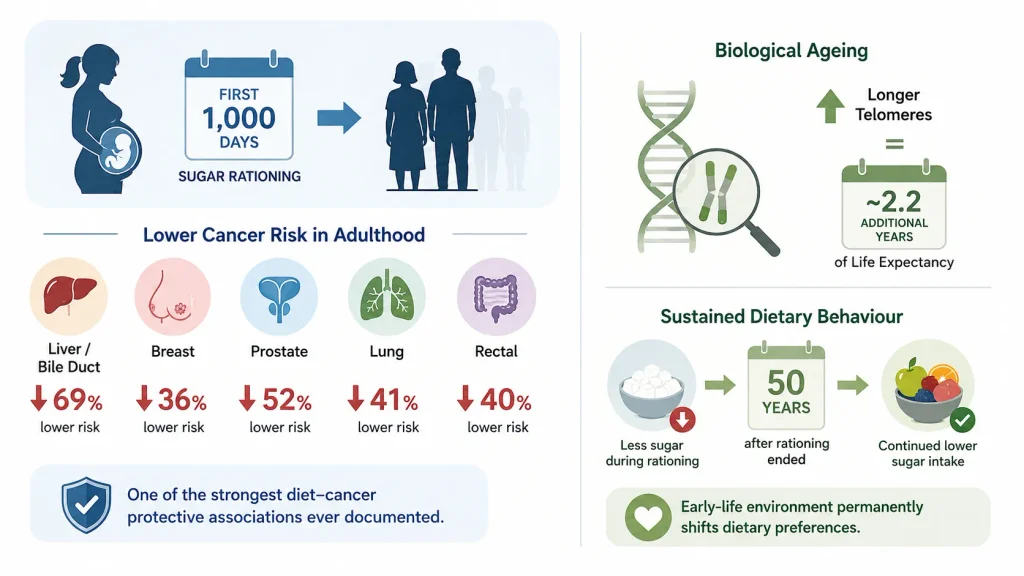
Adults whose first 1,000 days fell under sugar rationing showed significantly lower cancer incidence across five specific types:
• Liver/intrahepatic bile duct cancer: Hazard ratio 0.31 — approximately 69% LOWER likelihood. One of the strongest diet-cancer protective associations ever documented.
• Breast cancer: HR 0.64 — approximately 36% lower risk.
• Prostate cancer: HR 0.48 — approximately 52% lower risk.
• Lung cancer: HR 0.59 — approximately 41% lower risk.
• Rectal cancer: HR 0.60 — approximately 40% lower risk.
Biological ageing: Rationed adults showed measurably longer telomeres — the researchers estimated this corresponded to approximately 2.2 additional years of life expectancy.
Sustained dietary behaviour: Rationed adults consumed less sugar 50 years after rationing ended — their early-life environment permanently shifted dietary preferences toward lower sugar intake.
Why the First 1,000 Days Are Different
Metabolic programming. During the first 1,000 days, major metabolic organs establish their fundamental architecture and functional set points. Excess sugar exposure programmes insulin secretion patterns, adipose tissue distribution, and inflammatory tone in ways that persist for decades.
Taste preference programming. Palatability preferences for sweetness are established in early childhood. Children exposed to high-sugar foods during weaning develop a permanently elevated preference for sweetness.
Gut microbiome establishment. The gut microbiome undergoes its most formative development in the first 2–3 years. As we covered in our July 2026 toddler food research article, 81% of commercial toddler foods are ultra-processed and sugar-heavy — disrupting the microbiome during its critical developmental window.
Epigenetic programming. Early nutritional exposures produce lasting epigenetic modifications — changes to DNA methylation and histone modification that alter gene expression without changing the underlying DNA sequence.
How Excess Early Sugar Raises Adult Cancer Risk
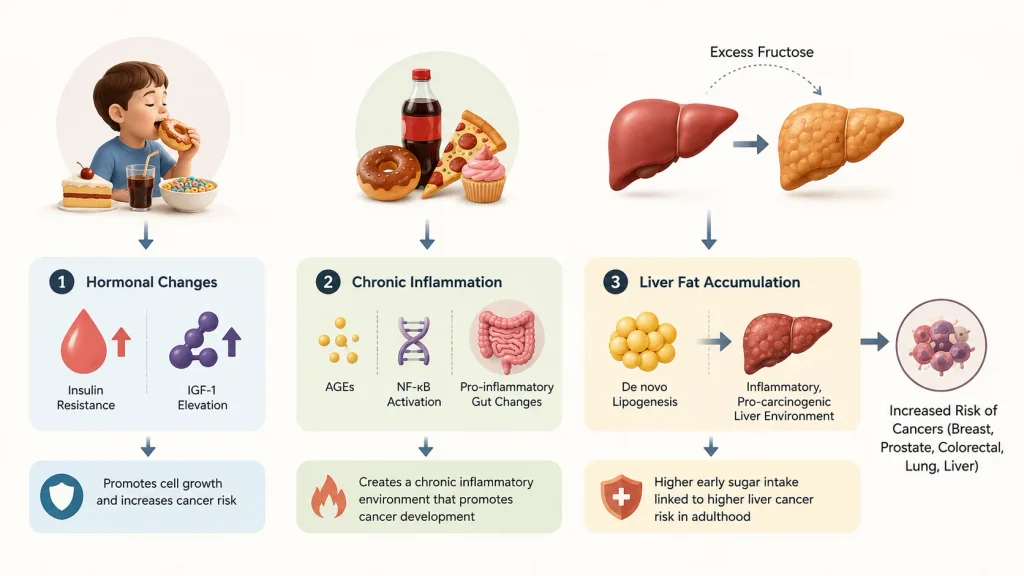
Insulin resistance and IGF-1 elevation. Excess sugar — particularly fructose — promotes insulin resistance and chronically elevates IGF-1, a potent cellular growth signal. Elevated IGF-1 is independently associated with increased risk of breast, prostate, colorectal, and lung cancers.
Chronic inflammation. High sugar diets promote chronic low-grade inflammation through AGEs, NF-κB activation, and the pro-inflammatory gut microbiome composition that ultra-processed, high-sugar diets create.
Hepatic fat accumulation. Fructose metabolism produces hepatic fat through de novo lipogenesis. This creates an inflammatory, pro-carcinogenic hepatic environment. The 69% lower liver cancer risk in rationed adults is consistent with more favourable hepatic metabolic patterns from reduced early fructose exposure. See our Fatty Liver guide.
The India Connection
Traditional Indian weaning practices — ragi porridge, moong dal khichdi, mashed banana — are naturally low in added sugar. But these are being displaced by commercial weaning foods that are 81% ultra-processed and 49% failing WHO standards. The PNAS finding is an argument for protecting the first 1,000 days from excess sugar.
For the complete early-life nutrition framework, see our toddler food research article and our Healthy Habits for New Moms guide.
Practical Guidance for Parents
• First 6 months: exclusive breastfeeding — zero added sugar.
• 6–12 months: single-ingredient whole-food purees. No added sugar. No commercial fruit juices.
• 12–24 months: family foods adapted to soft textures. No sweetened beverages. Whole fruit only, never juice.
The Takeaway
The PNAS natural experiment — 64,761 adults, 70-year follow-up — provides causal evidence that restricting sugar during the first 1,000 days is associated with 36–69% lower adult cancer incidence across five cancer types, measurably slower biological ageing, and permanently reduced sugar consumption 50 years later. The first 1,000 days shape the metabolic biology that persists for the next 70 years. See our Functional Nutrition guide.
About the Author
Tanveer Ahmed Khan is a K11 School of Fitness Sciences-certified personal trainer and nutrition coach with 12+ years of strength training experience. Coaching: info@livenulife.com | Instagram: @fitwithtanveer | livenulife.com
Scientific References
1. Zhang, W., et al. (2026). Early-life sugar restriction causally reduces adult cancer incidence and slows biological aging. PNAS, 123(32). DOI: 10.1073/pnas.2610287123
2. ScienceDaily. (August 26, 2026). Britain’s postwar sugar rationing created a rare natural experiment.
3. Scripps News. (August 2026). Study links lower early-life sugar intake to reduced cancer risk.
4. The Hill. (August 2026). Sugar rationing in infancy tied to lower cancer risk, study finds.
5. AJCN (2026). Sugar rationing during the first 1000 days and early onset cancer: a natural experiment.