KEY TAKEAWAY: A study tracking more than 340,000 adults for over a decade, reported by ScienceDaily on August 9, 2026, found that heavy drinking increased the risk of death regardless of beverage type — overturning claims that wine’s polyphenols provide special cardiovascular protection beyond alcohol itself. Light-to-moderate drinking showed no significant cardiovascular advantage over abstinence when confounders were properly controlled. Here is the complete evidence — and what it means for your choices.
The “Red Wine Is Good for You” Claim — Where It Came From
The idea that red wine specifically protects cardiovascular health has dominated popular nutrition for 30 years. It was rooted in a concept called the “French Paradox” — the observation in the 1990s that French people had relatively low rates of cardiovascular disease despite eating a diet rich in saturated fat, and that this might be explained by their relatively high red wine consumption.
The proposed mechanism was resveratrol — a polyphenol compound present in red grape skins that showed impressive anti-oxidant, anti-inflammatory, and cardiovascular-protective properties in laboratory research. Red wine became one of the most studied dietary compounds in nutritional science. Thousands of papers were published. The Mediterranean diet, which includes moderate wine consumption, became celebrated as the gold standard dietary pattern for cardiovascular health.
A study of more than 340,000 adults tracked for over a decade — reported by ScienceDaily on August 9, 2026 — has now provided the most comprehensive real-world test of whether wine’s special status in alcohol research is justified. The findings dismantle it.
📖 Also read: The Ancient Beverage Science Is Proving More Powerful Than Imagined — June 2026 — If not wine, what beverage does the evidence actually support for cardiovascular and longevity benefits? Our June 2026 research on tea — backed by 354,957 participants — makes the case for freshly brewed tea.
What the 340,000-Person Study Found
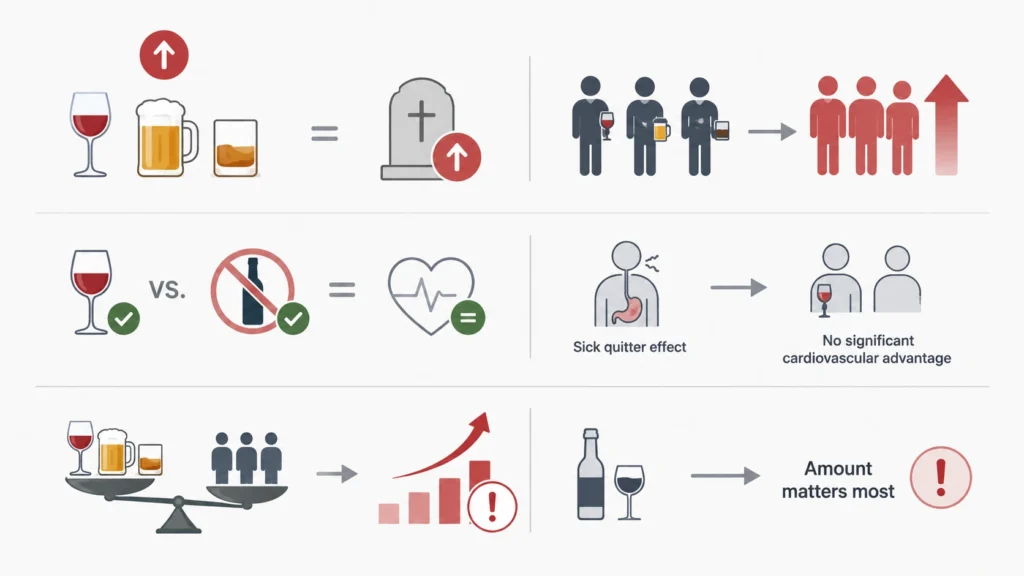
Heavy drinking increases mortality risk equally across all beverage types. When participants who drank heavily were analysed by beverage type — wine, beer, or spirits — the elevated mortality risk was comparable regardless of what they drank. The protective framing of red wine specifically did not manifest as a meaningful survival advantage among heavy wine drinkers compared with heavy beer or spirit drinkers. Alcohol’s harms are driven by ethanol — the alcohol molecule itself — not counteracted by whatever polyphenols accompany it in a specific beverage.
Light-to-moderate drinking showed no significant cardiovascular advantage over abstinence when confounders were controlled. This is the most contested finding in alcohol-health research, and the 340,000-person dataset provides the statistical power to address it properly. When researchers controlled for the “sick quitter” effect — the well-documented phenomenon where abstainers often include former drinkers who quit for health reasons, making abstainers appear unhealthier than moderate drinkers — the apparent cardiovascular advantage of light-to-moderate drinking disappears or becomes negligible.
The type of beverage mattered less than the amount consumed. Whether wine’s polyphenols, beer’s B vitamins, or spirits’ lack of accompanying compounds theoretically modify the health effects of alcohol, the overriding variable in this dataset was consumption volume. More alcohol meant more risk, regardless of the glass it arrived in.
The Resveratrol Problem
One of the most significant pieces of background information for understanding the August 2026 findings is the resveratrol story — and it is a cautionary tale about the gap between laboratory evidence and clinical reality.
Resveratrol showed extraordinary promise in laboratory and animal research: it activated sirtuins (proteins linked to longevity), reduced inflammation, improved mitochondrial function, and produced cardiovascular benefits in cell cultures and mice. The supplement industry sold hundreds of millions of dollars of resveratrol products.
Then human trials ran. The results were consistently disappointing. Human trials of resveratrol supplements failed to reproduce the benefits seen in laboratory models. The concentrations used in animal research were orders of magnitude higher than what could be achieved through dietary intake or supplementation. And a key clinical trial was retracted after concerns about data manipulation by one of the leading resveratrol researchers.
The red wine story was built substantially on the resveratrol hypothesis. When resveratrol failed as a pharmacological intervention in humans, it should have weakened the case for wine’s special protective status. The August 2026 mortality data confirms what that pharmacological failure suggested: wine is not metabolically special relative to other alcohol beverages, and its apparent cardiovascular benefits in some observational studies were confounded, not caused.
The Specific Harms of Heavy Alcohol Consumption
With the “wine is special” claim dismantled, it is useful to summarise what the evidence clearly establishes about alcohol and health — because the picture is not simply “alcohol is bad.”
Heavy alcohol consumption clearly increases risk across multiple domains: liver disease (alcoholic hepatitis, cirrhosis, and alcohol-associated liver cancer); cardiovascular disease at higher doses (atrial fibrillation, cardiomyopathy, hypertension); gastrointestinal cancers including mouth, throat, oesophagus, colorectal cancer; breast cancer risk in women; neurological damage including alcohol-associated brain damage and peripheral neuropathy; sleep architecture disruption; and progressive nutritional deficiencies (particularly thiamine/vitamin B1, folate, and zinc).
For the specific fatty liver risk — one of the most common and underdiagnosed alcohol-associated conditions in India — see our Fatty Liver Causes, Symptoms, Treatment & Diet guide and our Fatty Liver Symptoms Warning Signs guide.
Light consumption’s relationship with health is genuinely complex. Some observational data does show apparent cardiovascular benefit from light alcohol consumption. The methodological debate — how well confounders like the sick-quitter effect are controlled — remains active in the research community. The most rigorous analyses, including Mendelian randomization studies (which use genetic variants to better isolate causal effects of alcohol), generally find that the apparent benefit from light drinking disappears or reverses when better causal methods are applied. The August 2026 large-scale mortality data is consistent with this emerging consensus.
The Indian Context: Why This Research Is Particularly Relevant
Alcohol consumption in India sits at a complex intersection of public health, cultural practice, and economic reality. India has one of the highest rates of binge drinking among alcohol consumers globally — meaning that much of India’s alcohol consumption occurs in heavy episodic patterns rather than the light-to-moderate daily pattern that some earlier research associated with potential benefit.
Alcohol-related liver disease is a major contributor to the liver disease burden in India — particularly in urban populations where access and affordability have increased substantially over the past two decades. The 2026 mortality data is unambiguous about this category: heavy episodic drinking increases mortality risk, and the type of beverage does not provide meaningful protection.
The specific risk in Indian drinkers: The combination of heavy alcohol use, already high rates of fatty liver from dietary patterns, and the prevalence of metabolic syndrome in urban India creates compounding liver damage risk. The August 2026 study’s finding that heavy drinking increases death risk across all beverage types applies directly to this population context.
For the complete approach to liver health — including dietary strategies that protect against alcohol-associated liver damage and support recovery for those reducing alcohol intake — see our Fatty Liver Causes, Symptoms, Treatment & Diet guide.
What to Drink Instead: The Evidence-Based Beverage Hierarchy in 2026
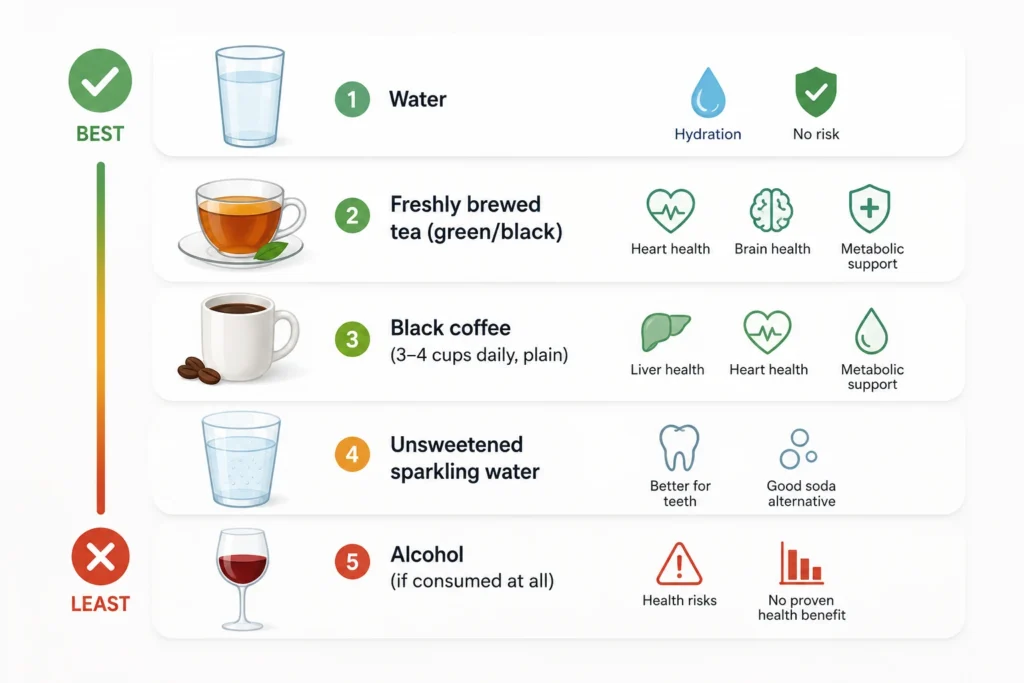
With the wine-is-special hypothesis dismantled, the question of what to drink for health becomes cleaner. The 2026 research landscape has provided the most comprehensive beverage health data available. Our August 2026 Vol II article on sparkling water vs soda and NUTRITION 2026 and our June 2026 research on freshly brewed tea and longevity provide the foundation. The hierarchy, based on the available 2026 evidence:
• Plain water: the physiological baseline. No health risk, essential hydration, zero caloric contribution.
• Freshly brewed tea (green or black, unsweetened): the best-evidenced beverage for systemic health. The Cedars-Sinai 354,957-person study found coffee and tea drinkers had dramatically lower liver disease risk. The 2026 tea research confirmed cardiovascular, cognitive, and metabolic benefits. Tea polyphenols — unlike wine polyphenols — produce their benefits at achievable dietary concentrations without the accompanying pharmacological alcohol load.
• Black coffee (3–4 cups daily, plain): the liver research we covered documents 47% lower liver cancer risk and 42% lower liver-related mortality. Coffee polyphenols have independent cardiovascular and metabolic benefits without alcohol.
• Unsweetened plain sparkling water: lower dental risk than soda, adequate as a soda substitute (NUTRITION 2026 data).
• Alcohol — if consumed at all: the evidence supports minimal amounts, with no clear evidence that any level of consumption is health-positive when better methods are used to remove confounders. The “red wine is special” justification is no longer scientifically defensible based on the August 2026 data.
For the complete nutritional approach to protecting liver health and cardiovascular function through diet — including the foods and beverages that actively reverse NAFLD and support vascular health — see our 6 Top Foods to Improve Heart Health and our Functional Nutrition guide.
The Takeaway
The August 2026 study of 340,000 adults tracked for over a decade settles the wine-type debate: heavy drinking increases mortality risk equally across beverage types, overturning the claim that wine’s polyphenols provide special cardiovascular protection. Light-to-moderate drinking shows no significant survival advantage over abstinence once the sick-quitter confound is properly addressed. The type of alcohol matters far less than the amount consumed. For the beverages that do provide documented health benefits without alcohol’s pharmacological harms — freshly brewed tea and coffee in particular — see our June 2026 tea research article and the coffee-liver findings from our August 2026 coverage. For protecting the liver from both alcohol and dietary fat accumulation, see our Fatty Liver comprehensive guide.
About the Author
Tanveer Ahmed Khan is a K11 School of Fitness Sciences-certified personal trainer and nutrition coach with 12+ years of strength training experience. Coaching: info@livenulife.com | Instagram: @fitwithtanveer | livenulife.com
Scientific References
1. ScienceDaily. (August 9, 2026). Wine, Beer, or Spirits? Massive Study Finds a Surprising Health Divide. Study tracking 340,000+ adults over a decade examining beverage type and mortality risk.
2. Ronksley, P.E., et al. (2011). Association of alcohol consumption with selected cardiovascular disease outcomes: systematic review and meta-analysis. BMJ, 342: d671. (Key prior meta-analysis for context.)
3. Mendelian randomization studies on alcohol and cardiovascular risk: Holmes, M.V., et al. (2014). Association between alcohol and cardiovascular disease: Mendelian randomisation analysis. BMJ, 349: g4164.
4. ScienceDaily / Cedars-Sinai. (July 25, 2026). Coffee and tea consumption linked to lower liver disease, cancer, and death risk. (354,957-person UK Biobank study.)
5. Topiwala, A., et al. (2017). Moderate alcohol consumption as risk factor for adverse brain outcomes and cognitive decline. BMJ, 357: j2353. (Prior evidence on light-to-moderate drinking and brain health.)