By Tanveer Ahmed Khan | K11-Certified Trainer & Dietitian-Nutritionist | REPS India Registered | August 2026 | 12 min read
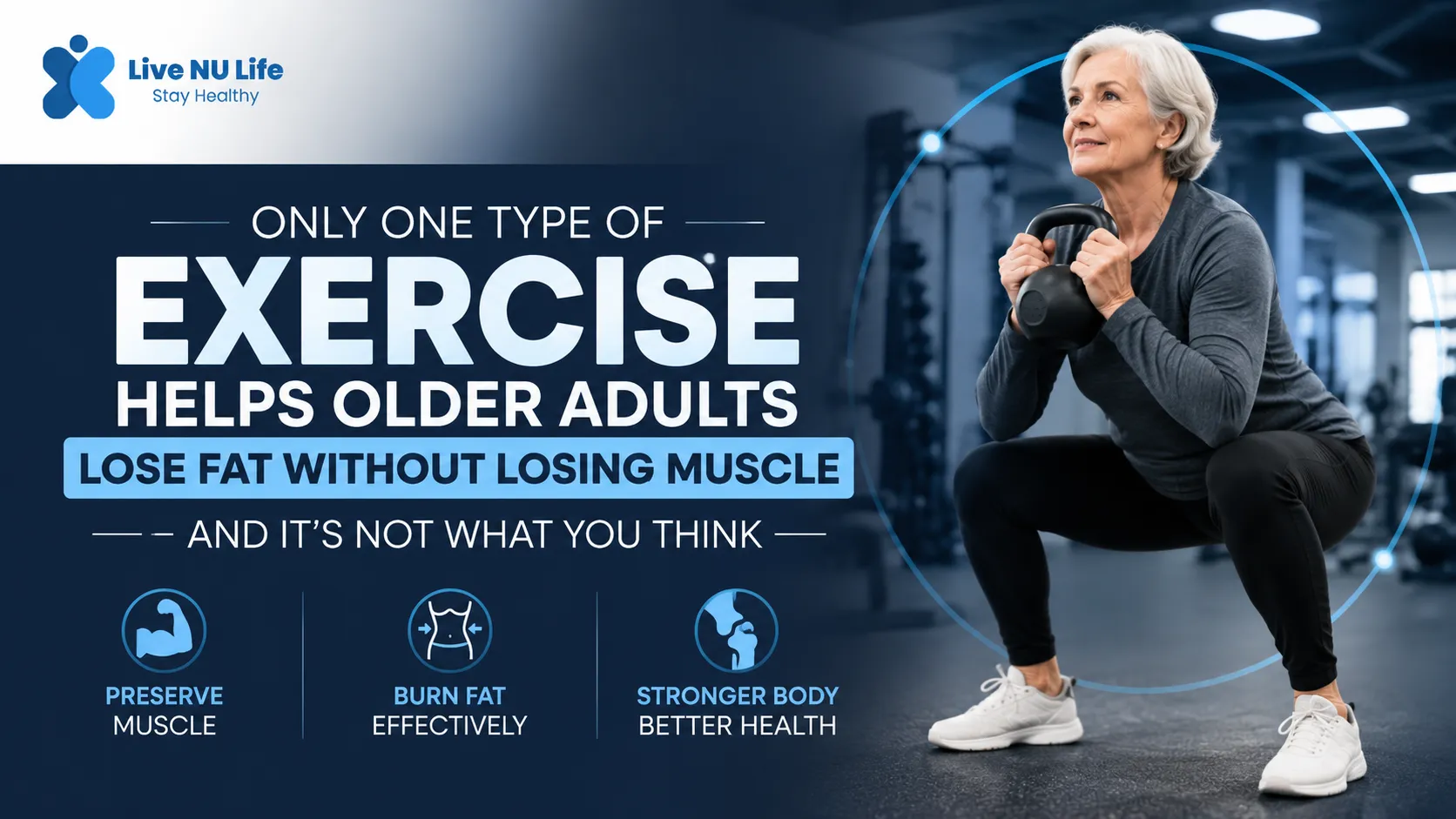
KEY TAKEAWAY: A six-month randomised study of 120+ adults in their 70s, published in Maturitas and covered by ScienceDaily (June 28, 2026), found that only high-intensity interval training (HIIT) reduced body fat while preserving lean muscle mass. Moderate and low-intensity exercise also reduced fat but caused small muscle losses. Here is what HIIT for older adults actually looks like — and why the intensity is scalable for anyone.
The Exercise Finding That Redefines “Senior Fitness”
When I tell clients over 60 that they should be doing high-intensity interval training, the response is almost always the same: a look of alarm, followed by concerns about joints, heart risk, and the assumption that HIIT is for young athletes in gym commercials. Let me address that response directly before we examine the research, because both the assumption and the alarm are wrong.
HIIT — high-intensity interval training — is not a fixed exercise programme. It is a training principle: periods of elevated effort followed by periods of recovery. The “high intensity” that is appropriate for a healthy 72-year-old is completely different from what that phrase means in a 25-year-old athlete’s programme. Heart rate targets, work intervals, exercise selection, and recovery periods are all calibrated to the individual.
With that context established, the research: a six-month randomised study of more than 120 healthy adults with an average age of 72 years, led by Dr Grace Rose and colleagues at the University of the Sunshine Coast (UniSC) in Australia, published in Maturitas and reported by ScienceDaily on June 28, 2026.
The study compared three exercise intensities: high (HIIT), moderate, and low. All three produced some fat loss. But only one produced fat loss without muscle loss.
📖 Also read: Why Every Woman Needs to Lift Weights — June 2026 JACC Study — The cardiovascular and body composition evidence for resistance training in women — complements the HIIT muscle preservation finding directly.
Exactly What the Study Found
The 120 participants were healthy older adults assigned to one of the three exercise intensity groups for six months, exercising three times per week. Researchers measured fat mass, fat-free mass (muscle, bone, water), body fat percentage, and overall body composition at baseline, three months, and six months.
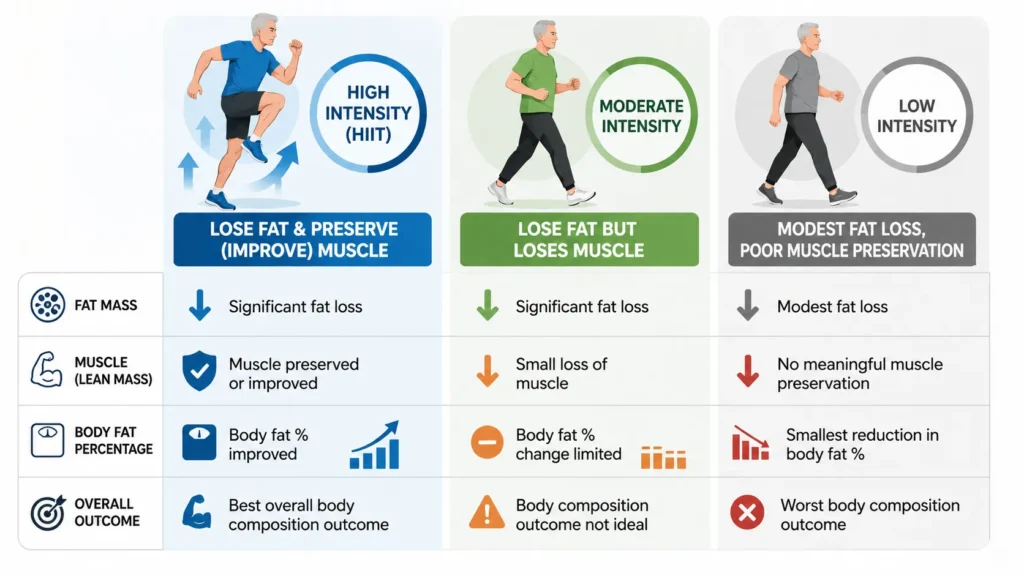
High-intensity group (HIIT): Reduced body fat AND preserved or improved lean muscle mass. The only group with a net improvement in body fat percentage (p = 0.017) and the only group showing greater lean mass than the moderate-intensity group at six months (p = 0.042). This is the gold standard outcome in body composition terms: simultaneous fat loss and muscle preservation — the combination that protects against sarcopenia, metabolic decline, and functional loss in ageing.
Moderate-intensity group: Reduced fat mass similarly to the high-intensity group initially, but also caused small reductions in fat-free mass — muscle loss — at both the three-month and six-month marks (p = 0.005 and p = 0.050 respectively). A moderate-intensity programme that causes you to lose muscle while losing fat is, for older adults, potentially making the most consequential physiological problem of ageing worse, not better.
Low-intensity group: Produced modest fat loss but the worst body composition outcomes — including the smallest reduction in body fat percentage and no meaningful muscle preservation benefit.
“We found that high, medium, and low intensity exercises all led to modest fat loss but only HIIT retained lean muscle,” said lead author Dr Grace Rose. “HIIT likely works better because it puts more stress on the muscles, giving the body a stronger signal to keep muscle tissue rather than lose it.”
Why Muscle Loss in Older Adults Is the Real Emergency
To understand why the HIIT finding matters so much, you need to understand why muscle preservation in older adults is among the most critical health outcomes in medicine.
Sarcopenia — age-related muscle loss — is not an aesthetic concern. It is one of the most consequential physiological changes of ageing, with cascading consequences that touch virtually every domain of health:
• Falls and fractures: Muscle weakness is the primary modifiable risk factor for falls in adults over 65. Falls are the leading cause of injury death in this age group. Preserving muscle strength preserves functional independence and, literally, saves lives.
• Metabolic rate and weight management: Every kilogram of muscle tissue burns approximately 13 additional calories per day at rest. Adults who lose muscle mass with age experience progressive metabolic rate decline — the biological basis of the “middle-age metabolism slowdown” that most people attribute to ageing itself but that is substantially driven by progressive muscle loss.
• Glucose disposal and diabetes risk: Skeletal muscle is the primary site of glucose uptake from the bloodstream. Reduced muscle mass means reduced glucose disposal capacity — a direct contributor to insulin resistance and type 2 diabetes progression in older adults.
• Immune function: Muscle is the body’s primary reservoir of glutamine — the amino acid used preferentially by immune cells during infection and illness. Sarcopenic older adults have impaired immune responses to infection, vaccination, and surgical stress.
• Cognitive function: Muscle-derived myokines — particularly BDNF (brain-derived neurotrophic factor), irisin, and IL-6 — are produced during muscle contraction and directly support neuroplasticity, neurogenesis, and cognitive function. Sarcopenia is independently associated with accelerated cognitive decline.
For the specific nutritional strategy that supports both muscle preservation and cardiovascular health — the protein-exercise pairing — see our July 2026 protein guidelines article which found that current protein recommendations remain too low for most active adults and those over 55.
📖 Also read: The Protein Guidelines Are Wrong — July 2026 Research Says So — The protein intake that makes HIIT’s muscle-preserving signal most effective — combining the right exercise intensity with adequate dietary protein for muscle synthesis.
What HIIT Actually Looks Like at 70 — My Clinical Framework
This is where the research stops and the practice begins. After 12 years as a certified trainer, I want to translate what “high-intensity interval training” means in a clinical context for older adults — because the term is routinely misunderstood.
Defining “high intensity” appropriately. The study used intervals where breathing is heavy and conversation is difficult — not maximal effort sprinting. In practice, I use the “talk test” with older clients: high intensity means you can say only 3 to 4 words comfortably between breaths. For most adults in their 60s and 70s, this corresponds to a brisk uphill walk, a moderately paced swim, a stationary cycling bout at increased resistance, or low-impact aerobic exercise at elevated heart rate. It does not require running, jumping, or high-impact movements.
The interval structure. For older adults beginning HIIT, I use a conservative starting structure: 30 seconds of elevated effort followed by 90 seconds of easy recovery, repeated 6 to 8 times, for a total of 12 to 16 minutes of interval work. This is a 1:3 work-to-rest ratio — more conservative than typical HIIT protocols — that builds aerobic capacity and muscle signalling without overloading recovery systems.
Exercise selection for joint safety. High-impact exercises — box jumps, running, jumping jacks — are not required for HIIT and are often inappropriate for older adults with knee, hip, or ankle concerns. I design HIIT programmes for clients over 60 using low-impact modalities: stationary cycling, swimming, seated rowing, water aerobics, elliptical, or even brisk stair walking. These produce equivalent cardiovascular and muscular stress without joint impact loading.
Progression protocol. Week 1 to 2: 4 intervals of 20 seconds high effort / 2 minutes recovery. Week 3 to 4: 6 intervals of 30 seconds / 90 seconds recovery. Week 5 to 6: 8 intervals of 30 seconds / 60 seconds recovery. Month 3+: 10 intervals of 45 seconds / 60 seconds recovery. Progress is individual — the goal is sustained elevated effort, not a specific protocol.
Nutritional support for HIIT in older adults. HIIT creates a larger acute muscle protein synthesis demand than moderate exercise. This makes adequate protein intake non-negotiable — I target 1.6 to 2.0g per kilogram of body weight daily for clients over 60 doing HIIT, with an emphasis on leucine-rich sources (eggs, dairy, fish, legumes) in the meal within 90 minutes of training. Combined with the magnesium optimisation protocol from Article 2 and adequate sleep from Article 1, this triad — HIIT + protein + sleep — is the most evidence-supported body composition and longevity intervention stack I have found in 12 years of practice.
The Safety Question — Addressing It Directly
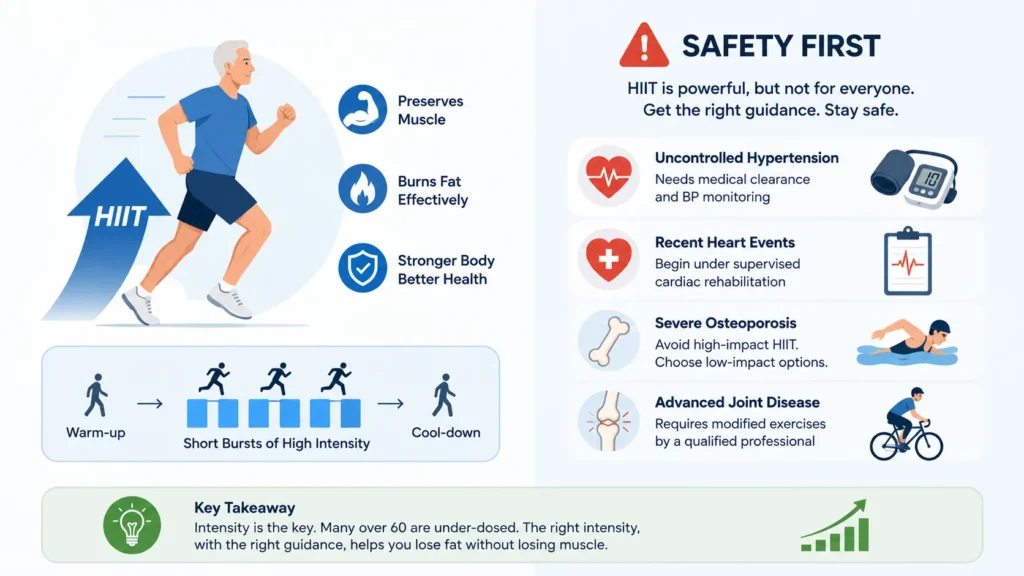
The study focused on healthy older adults. HIIT is not appropriate without modification — or at all — for everyone over 60. Specific conditions require medical clearance and modified protocols:
• Uncontrolled hypertension: High-intensity exercise can produce acute blood pressure spikes. Clearance from a cardiologist and blood pressure monitoring during sessions are essential before beginning HIIT.
• Recent cardiovascular events: Anyone who has had a heart attack, cardiac surgery, or stroke within the past 12 months should begin any new exercise programme under supervised cardiac rehabilitation.
• Severe osteoporosis: High-impact HIIT is contraindicated. Low-impact alternatives — swimming, cycling — achieve the same muscle-preservation stimulus without skeletal stress.
• Advanced joint disease: Modifications to exercise selection are required. A certified exercise physiologist (not just a general fitness trainer) should design the programme.
The message is not that everyone over 60 should immediately begin sprinting intervals. It is that exercise intensity is a dose-response variable, and that many older adults are systematically under-dosed — doing only low-intensity walking when their bodies would benefit from a progressive increase in effort that their heart and muscles are capable of tolerating.
The Takeaway
The UniSC Maturitas study settles a question that matters profoundly for ageing populations: among common exercise modalities, only HIIT produces the combination of fat loss and muscle preservation that older adults need most. Moderate and low-intensity exercise produce some fat loss but at the cost of small but meaningful muscle reductions — exactly the wrong trade-off in a population already experiencing progressive sarcopenia. HIIT is scalable, low-impact options exist, and the evidence is clear. For the nutritional support that makes HIIT’s muscle-preserving signal most effective, see our protein guidelines article. For the complete recovery framework that ensures HIIT adaptations are consolidated, see our Recovery Tools guide.
About the Author
Tanveer Ahmed Khan is a K11 School of Fitness Sciences-certified personal trainer and REPS India-registered dietitian-nutritionist with over 12 years of experience helping busy professionals achieve elite, sustainable health. Coaching: info@livenulife.com | Instagram: @fitwithtanveer | livenulife.com
Scientific References
1. Rose, G., Hume, E., Blackmore, D., et al. (2025/2026). Exercise intensity influences body composition: a 6-month comparison of high-intensity interval, moderate- and low-intensity training among healthy older adults. Maturitas. doi: 10.1016/j.maturitas.2025.108172
2. ScienceDaily / University of the Sunshine Coast. (June 28, 2026). Only one workout helped older adults lose fat without losing muscle.
3. Medical News Today. (February 2, 2026). Older adults may benefit most from HIIT exercise, study suggests.
4. SciTechDaily. (January 24, 2026). This Type of Exercise Is Most Effective at Reducing Body Fat in Older Adults.
5. Medical Daily. (2026). A Six-Month Study Found Only One Type of Exercise Helps Older Adults Lose Fat Without Losing Muscle.