
By Tanveer Ahmed Khan | K11-Certified Trainer & Dietitian-Nutritionist | REPS India Registered | July 2026 | 12 min read
KEY TAKEAWAY: Stanford Medicine researchers used artificial intelligence to discover BRP — a naturally occurring 12-amino-acid peptide the human body already produces — that suppresses appetite and reduces body weight like semaglutide (Ozempic) but without nausea, constipation, or muscle loss in animal studies. Reported by ScienceDaily on July 24, 2026. Here is what BRP is, how it works, and — more importantly — how to support the same biological pathways through nutrition and lifestyle right now.
A Discovery That Rewrites How We Think About Appetite
The obesity medication landscape of 2026 is being defined by GLP-1 agonist drugs — semaglutide (Ozempic, Wegovy) and tirzepatide (Mounjaro, Zepbound). These medications work by mimicking GLP-1, a gut hormone that regulates appetite, blood sugar, gastric emptying, and energy balance. Their effectiveness is genuine and documented. Their side effects — nausea in approximately 44% of users, constipation, slowed digestion, and meaningful muscle loss — are equally documented.
On July 24, 2026, ScienceDaily reported on a Stanford Medicine discovery that has been generating significant attention in the research community: a naturally occurring peptide called BRP (BRINP2-related peptide), identified using artificial intelligence, that appears to suppress appetite and drive fat loss through a different biological pathway from Ozempic — with no nausea, no food aversion, and no significant muscle loss in animal studies.
The discovery was published in Nature (March 2026) and has been reported extensively since. The July 2026 coverage represents the most comprehensive public explanation of what BRP is, how it works, and what it means for the future of weight management medicine.
📖 Also read: Your Diet Can Trigger Your Own GLP-1 Hormones — BRP works through a pathway related to GLP-1. Our comprehensive guide shows how food already activates the same metabolic system — without any drug.
What Is BRP and How Did AI Find It?
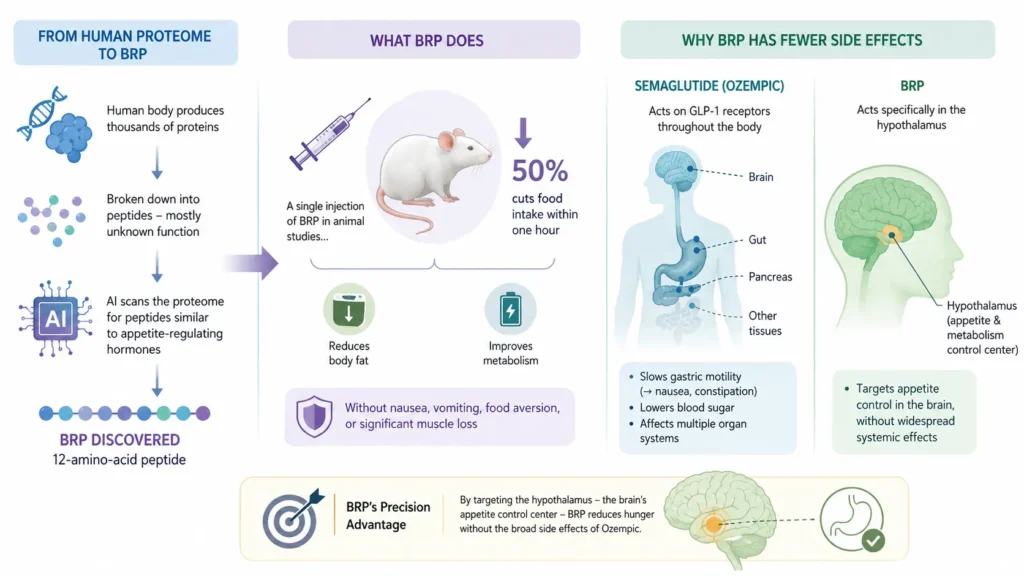
The human body produces thousands of proteins. Many of these proteins are broken down into smaller fragments called peptides, whose biological functions remain largely unknown — a vast unexplored territory of endogenous molecules that the body makes but that science has not yet characterised.
The Stanford team, led by assistant professor of pathology Katrin Svensson, PhD, used an artificial intelligence system to scan the proteome — the complete set of proteins produced by the human body — looking for peptides with structural properties similar to known appetite-regulating hormones. BRP emerged from this AI-driven analysis as a candidate worth investigating.
BRP is a 12-amino-acid peptide — extraordinarily small by biological standards. In animal studies, a single injection of BRP cut food intake by up to 50% within one hour. Over the testing period, it produced body fat reduction and metabolic improvement without the nausea, vomiting, food aversion, or substantial muscle loss that commonly accompany semaglutide treatment.
Why doesn’t BRP cause Ozempic’s side effects? The answer lies in anatomical specificity. Semaglutide’s GLP-1 receptors are found throughout the body — in the brain, gut, pancreas, and other tissues. This broad distribution is why Ozempic slows gastric motility (causing constipation and nausea), lowers blood sugar (useful in diabetes but a risk in non-diabetics), and affects multiple organ systems simultaneously. BRP, in contrast, appears to act specifically in the hypothalamus — the small brain region that controls appetite, metabolism, and energy use. By targeting a more precise neural location, BRP influences hunger without the widespread systemic effects that drive Ozempic’s side effect profile.
Critical Caveats: What BRP Is Not
Before going further, I want to be direct about what this discovery is and is not — because the media coverage of BRP has ranged from careful to breathless, and the breathless version is misleading.
BRP has not been tested in humans. It has not been reviewed or approved by any regulatory body. It is not available in any pharmacy, clinic, supplement store, or online marketplace. Anyone claiming to sell “natural BRP” or “BRP supplements” is selling you something that bears no relationship to the molecule that Stanford researchers discovered.
Clinical trials in humans have not yet begun. Svensson has co-founded a company with plans to begin human trials in the near future, but the path from animal study to approved medication typically takes seven to twelve years and involves multiple phases of safety and efficacy testing.
What BRP represents is a proof of concept — evidence that the body’s own molecular toolkit includes appetite-regulating peptides that we have not yet characterised, and that these molecules may represent a route to more targeted, less side-effect-burdened weight management medicine in the future. That is genuinely exciting. It is not a solution available today.
Why This Discovery Matters: The Deeper Implication
The BRP discovery carries a significance beyond the specific molecule — and this is the dimension I want to explore in depth, because it directly affects what you should be doing for your health right now.
The fact that the human body naturally produces a molecule with Ozempic-like appetite-suppressing properties is not a surprise to metabolic researchers. It is a confirmation of something that has been building in the scientific literature for years: the body’s own regulatory systems — when properly supported through nutrition, lifestyle, and gut microbiome health — produce the metabolic signals that pharmaceutical drugs are trying to replicate artificially.
As I detailed in our article Your Diet Can Trigger Your Own GLP-1 Hormones, high-fibre diets, specific protein sources, fermented foods, omega-3 fatty acids, and strategic meal timing all stimulate natural GLP-1 production — the same hormone that Ozempic mimics. BRP is now revealing that GLP-1 is not even the only such appetite-regulating molecule the body produces naturally. There are others, and we are only beginning to find them.
The implication is both humbling and empowering: the pharmaceutical industry is discovering that the body has already solved the problem it is trying to solve. The medications are catching up to biology. And the nutritional practices that support that biology are available to you today.
📖 Also read: The USC Longevity Diet That Outperformed Keto — July 2026 — The same USC Cell Metabolism study found the longevity diet naturally increased GLP-1 and FGF21 — the metabolic hormones Stanford’s BRP research is now illuminating from a different angle.
The Muscle Loss Problem With Current Ozempic — And Why BRP Solves It
One of the most clinically significant issues with GLP-1 agonist medications in 2026 is muscle loss. Multiple studies now confirm that patients on semaglutide or tirzepatide lose substantial lean body mass alongside fat — in some analyses, 25 to 40% of total weight lost comes from muscle rather than fat.
This is not a minor side effect. Muscle mass is the primary determinant of long-term metabolic health, functional independence, fracture risk, immune function, and mortality in older adults. Losing muscle while losing weight with Ozempic may be trading one metabolic problem for a deeper one — particularly for patients who are already sarcopenic or who are over 55.
BRP’s apparent absence of muscle loss in animal studies is therefore one of its most significant potential advantages. The mechanism is not yet fully understood, but it likely relates to BRP’s specificity for the hypothalamic appetite centre rather than the systemic GLP-1 receptor pathway that affects peripheral tissues including muscle. For the evidence on why muscle preservation is the central challenge of healthy ageing — and how resistance training addresses it — see our protein needs article and our June 2026 research on strength training cutting women’s heart attack risk by 44%.
What You Can Do Right Now: Activating Your Own Metabolic Signals
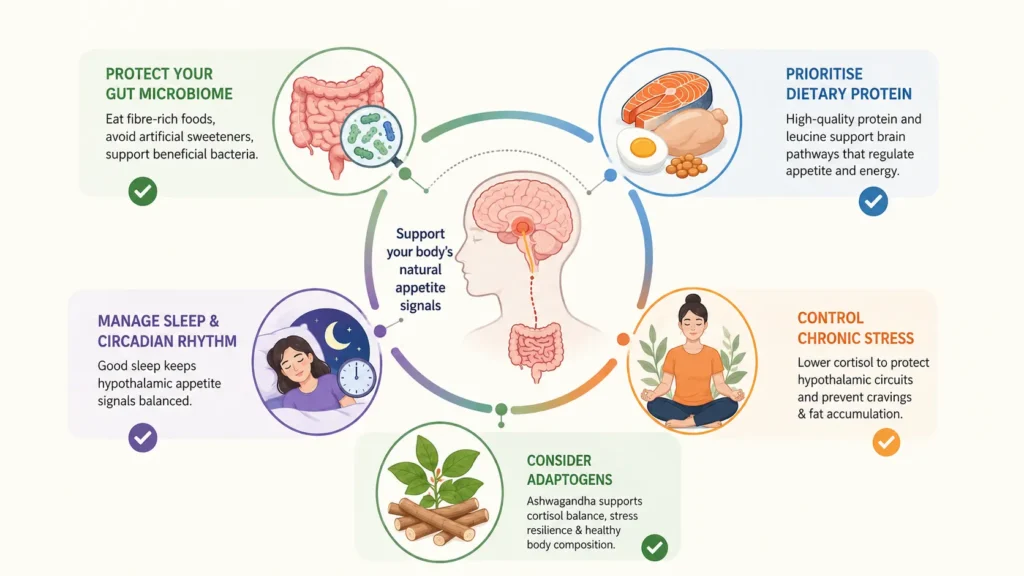
BRP is not available to you today. But the biological principle it represents — that your body produces natural appetite-regulating signals that can be supported or undermined by lifestyle choices — is immediately actionable.
Protect your gut microbiome. The gut-brain peptide communication axis that BRP research illuminates runs through the microbiome. Gut bacteria produce metabolites that signal to the hypothalamus, modulate GLP-1 production, and influence appetite hormones. A diverse, fibre-rich microbiome is the nutritional foundation of these systems. As we reported in our July 2026 coverage of the 39 sweetener gut bacteria study, artificial sweeteners — particularly sucralose and saccharin — actively suppress the beneficial bacteria that support this axis.
Prioritise dietary protein. Leucine — the primary amino acid in high-quality protein sources — directly stimulates hypothalamic signalling pathways that regulate appetite and energy balance. The July 2026 Journal of Nutrition research on protein guidelines being too low is directly relevant here: adequate protein intake supports the same neurological pathways that BRP is acting on.
Manage sleep and circadian rhythm. Hypothalamic function — the exact target of BRP — is severely disrupted by sleep deprivation. Just one night of poor sleep measurably alters hypothalamic appetite signalling, increasing hunger hormones and reducing satiety hormones. Protecting sleep quality is not just a lifestyle recommendation — it is directly relevant to the same metabolic pathways BRP research is exploring. See our Sleep Hygiene Hacks guide and our Circadian Rhythm Healing guide.
Control chronic stress. Chronic stress-induced cortisol elevation directly dysregulates hypothalamic appetite circuits — the same region BRP targets. Chronically elevated cortisol promotes visceral fat accumulation, insulin resistance, and elevated appetite for calorie-dense foods. Our guide on why chronic stress is hard to detect in early stages explores the nutritional and lifestyle interventions that protect hypothalamic function from stress-driven disruption.
Consider adaptogenic support. Ashwagandha (withania somnifera) has demonstrated in multiple human trials that it reduces cortisol, improves hypothalamic-pituitary-adrenal axis regulation, and supports body composition — mechanisms that directly complement the appetite-regulatory pathways BRP research is illuminating. Our comprehensive Ashwagandha Benefits guide covers the clinical evidence in detail.
The Future: What BRP Means for Medicine
Katrin Svensson’s co-founded company plans to begin human clinical trials of BRP in the near future. If those trials confirm the animal study findings — no nausea, no muscle loss, targeted hypothalamic appetite suppression — BRP would represent a genuinely new class of weight management medication that addresses the most significant limitation of current GLP-1 agonists.
The AI methodology used to find BRP is, if anything, the bigger story. The same AI-driven proteome search that identified BRP can be applied to find other unknown appetite-regulating peptides. We are likely at the beginning of a discovery period in endogenous metabolic peptides that will produce multiple new candidates over the next decade.
For the broader context of where 2026 anti-obesity research is heading — including the GLP-1 food-first approach and the longevity diet’s natural GLP-1 elevation — see our Boost GLP-1 Naturally article and our USC Longevity Diet coverage. For the supplementation landscape that supports metabolic health while pharmaceutical development continues, see our Best Longevity Supplements Evidence-Based Guide.
The Takeaway
The Stanford BRP discovery — an AI-identified natural peptide that mimics Ozempic without its side effects in animal models — is one of the most significant metabolic research findings of July 2026. It is not a solution available today, and it will not be a clinical reality for years. But it confirms a principle that nutritional science has been building toward: the body’s own regulatory systems, when properly supported, produce the metabolic signals that medicine is trying to replicate pharmaceutically. The most actionable response to the BRP discovery is not to wait for the drug. It is to support the biological infrastructure that BRP research reveals: a healthy gut microbiome, adequate protein, strong sleep quality, controlled chronic stress, and the dietary patterns — fibre-rich, plant-forward, whole-food-based — that keep the body’s own appetite-regulatory machinery functioning at its best.
About the Author
Tanveer Ahmed Khan is a K11 School of Fitness Sciences-certified personal trainer and REPS India-registered dietitian-nutritionist with over 12 years of experience helping busy professionals achieve elite, sustainable health. Coaching: info@livenulife.com | Instagram: @fitwithtanveer | livenulife.com
Scientific References
1. Svensson, K. et al. (2026). BRP: a naturally occurring 12-amino-acid peptide with appetite-suppressing and weight-reducing properties. Nature. doi: 10.1038/s41586-025-08683-y
2. ScienceDaily / Stanford Medicine. (July 24, 2026). AI helps Stanford scientists discover “natural Ozempic” without the usual side effects. sciencedaily.com
3. Psychology Today. (July 2026). A “Natural Ozempic” Discovered by AI? psychologytoday.com
4. AOL / Stanford Medicine. (2026). Stanford Scientists Confirm a Natural Peptide Your Body Already Makes Can Suppress Appetite Like GLP-1s.