
By Tanveer Ahmed Khan | K11-Certified Trainer & Dietitian-Nutritionist | REPS India Registered | August 2026 | 11 min read
KEY TAKEAWAY: A study led by Professor Andrew Agbaje at the University of Eastern Finland — published in The Journal of Nutrition and covered by ScienceDaily on July 31, 2026 — found that the “adiposity rebound,” a 42-year-old theory claiming children’s rising BMI at age 6 signals obesity risk, is not a fat rebound at all. It is healthy muscle growth. BMI has been misidentifying normal childhood development as an obesity warning sign for four decades, causing unnecessary parental anxiety and dietary interventions. Here is what actually protects children from obesity.
The Theory That Has Shaped Paediatric Nutrition for Four Decades
In 1984, French researcher Marie-Françoise Rolland-Cachera published a paper describing a pattern in children’s body mass index that she termed the “adiposity rebound.” The observation: children’s BMI rises rapidly in the first year of life, then falls to its lowest point around age four, then begins climbing again from approximately age six — at which point the pattern “rebounds” toward higher BMI values that persist into adolescence.
Rolland-Cachera’s paper proposed that children who experienced this rebound earlier — before age 5.5 — were at significantly higher risk of obesity in later life. This became one of the most widely cited paediatric obesity concepts in medical history. Doctors, paediatricians, and nutritionists around the world adopted the adiposity rebound as a meaningful clinical warning sign. Parents were counselled to intervene — modify diet, increase physical activity — if their child’s BMI began rising at an early age.
A study published in The Journal of Nutrition in March 2026 and reported by ScienceDaily on July 31, 2026, led by Professor Andrew Agbaje, a physician and associate professor of clinical epidemiology and child health at the University of Eastern Finland, has now challenged this 42-year foundation with a methodologically simple but profoundly disruptive analysis.
📖 Also read: 4 in 5 Toddler Foods Are Ultra-Processed — July 2026 NUTRITION 2026 — The research that shows what is actually in the foods most parents feed their children — directly complementary to understanding how to support genuine childhood nutrition.
The Methodological Problem: BMI Cannot Distinguish Muscle from Fat
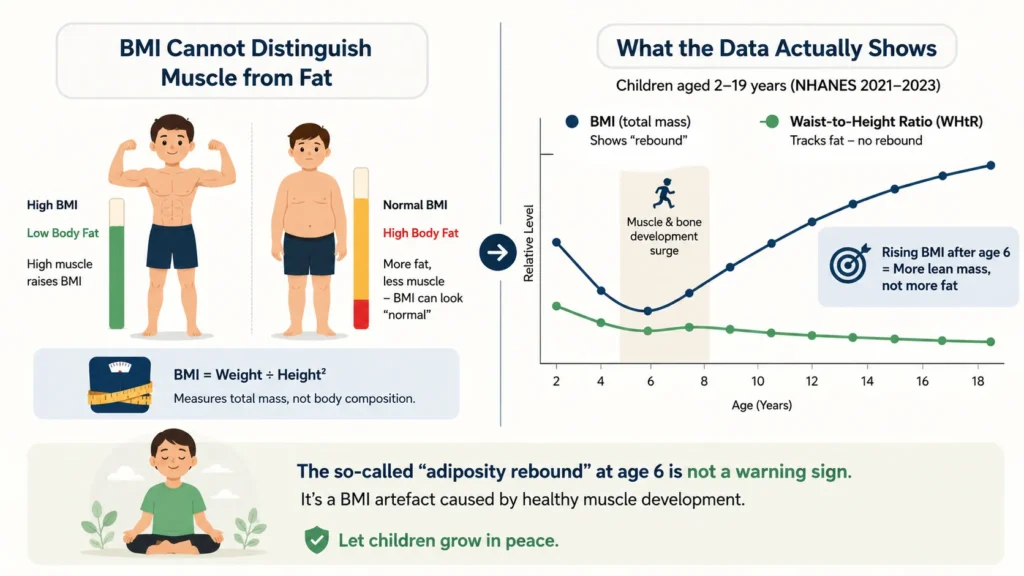
The central issue Professor Agbaje identified is a fundamental limitation of BMI — one that has been documented in the scientific literature for decades but has not previously been applied to question the adiposity rebound theory.
BMI (body mass index) is calculated from height and weight. It measures total body mass relative to height — but it cannot distinguish between fat mass and lean mass (muscle, bone, organs, and water). A person with extensive muscle development will have a high BMI alongside very low body fat. A person with little muscle but significant fat may have a “normal” BMI. BMI conflates these entirely different body composition profiles.
In growing children, this limitation is particularly consequential. Children aged 4 to 7 years are in a phase of substantial musculoskeletal development — they are building the muscle and bone base that will support their growth through adolescence. This phase produces real increases in lean body mass, which necessarily increases BMI because the child is heavier (due to muscle and bone) relative to height.
Agbaje’s analysis: Using data from the US National Health and Nutrition Examination Survey (NHANES) 2021–2023, covering 2,410 children aged 2 to 19 years, Agbaje compared BMI trajectories against waist-to-height ratio (WHtR) — a measurement specifically sensitive to fat mass accumulation rather than lean mass.
The result was decisive: BMI followed the classic adiposity rebound pattern — declining from age 2 to a nadir around age 4 to 5, then rising from age 6. But WHtR — the measure that actually tracks fat — showed no rebound. It continued decreasing throughout childhood. Children’s fat mass was not rebounding at age 6. It was continuing to decline. What was rising was lean mass.
“Let’s allow children to grow in peace,” said Agbaje, summarising the clinical implication of his findings. The adiposity rebound is not an early obesity warning sign. It is a BMI artefact produced by healthy muscle development. The paediatric interventions it has triggered for four decades have been responding to a measurement error, not a genuine biological risk signal.
Why This Matters — The Clinical Consequences
The implications of this finding extend far beyond academic debate. In my 12 years of practice, I have worked with parents who were told their child’s rising BMI at age 6 or 7 was an early obesity warning sign, and who responded with dietary restriction, intense monitoring of what their child ate, and worry that their child was on a path to overweight.
For children growing normally, these interventions are not just unnecessary — they can be harmful:
• Dietary restriction in children who do not need it can create unhealthy relationships with food, anxiety around eating, and disordered eating patterns that persist into adulthood.
• Parental anxiety about a child’s weight is transmitted to the child, who internalises messages about their body being problematic at an age when body image is being established.
• Medical and paediatric resources have been directed toward modifying a normal growth phase rather than addressing the genuine dietary and activity patterns that actually drive childhood obesity.
Agbaje notes that three separate Cochrane systematic reviews and meta-analyses covering hundreds of dietary and physical activity randomised controlled trials among 2 to 4 year olds, 5 to 11 year olds, and 12 to 18 year olds found that interventions had “little to no effect in reducing childhood and adolescent obesity.” This is consistent with his finding that the theoretical framework driving many of those interventions — the adiposity rebound — was targeting a measurement artefact rather than actual fat accumulation.
What Actually Predicts Childhood Obesity Risk
If BMI rebound at age 6 is not the meaningful warning sign it has been treated as, what should parents, paediatricians, and nutritionists actually be monitoring?
Waist-to-height ratio (WHtR). Agbaje’s research identifies WHtR as the more appropriate measure of adiposity in growing children. A WHtR above 0.5 (waist circumference greater than half of height) is associated with cardiometabolic risk across age groups. This can be measured easily at home: wrap a tape measure around the narrowest part of the waist, measure height, divide waist by height. This measurement reflects actual fat distribution, particularly abdominal fat, which is the metabolically significant fat type.
Diet quality — specifically ultra-processed food exposure. As we covered in our July 2026 report on toddler foods, 81% of baby and toddler foods in grocery stores are ultra-processed, and 49% fail WHO nutrient standards. The dietary pattern that actually drives childhood obesity is not rising BMI at age 6 — it is high ultra-processed food exposure from infancy establishing hyperpalatable taste preferences, gut microbiome disruption, and metabolic programming that promotes fat accumulation in later childhood.
Physical activity patterns. Muscle growth — which is what the BMI “rebound” appears to reflect — requires adequate physical activity to be maintained. Children who are physically active develop more lean mass; children who are sedentary accumulate more fat relative to lean mass. Monitoring and supporting physical activity habits from early childhood is more meaningful than monitoring BMI.
Family dietary environment. The food patterns established at home during ages 2 to 7 — what is routinely served, what is kept in the house, what is used as treats or rewards — are among the most powerful predictors of lifetime dietary patterns. These environmental factors are far more actionable than reacting to BMI trajectories that reflect normal development.
For specific guidance on building the nutritional foundation during the early childhood and toddler years — aligned with the July 2026 NUTRITION 2026 research on ultra-processed toddler foods — see our Healthy Habits for New Moms guide, which covers the critical first three months and the nutritional principles for the critical early years.
My Practitioner Perspective: The Measurement Problem in Nutrition
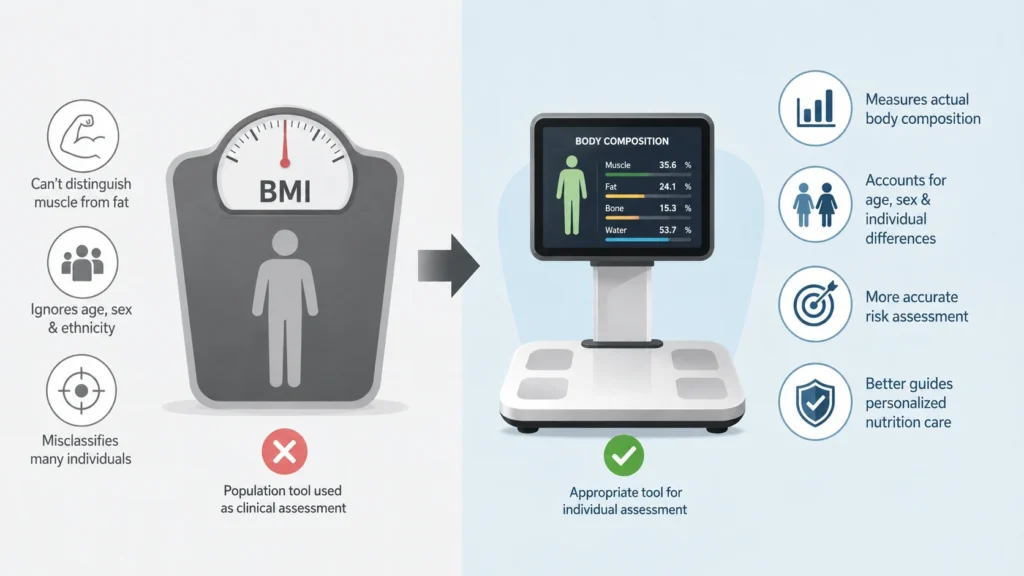
The adiposity rebound research belongs to a broader pattern in nutritional science that I find personally and professionally significant: the consequences of using the wrong measurement tool and then building four decades of clinical practice on the resulting data.
BMI was designed in the 1830s by Adolphe Quetelet as a population-level statistical tool, not a clinical assessment instrument for individual patients. It has known limitations — it does not distinguish muscle from fat, it does not account for age, sex, or ethnicity differences in body composition, and it misclassifies a substantial proportion of both individuals with high fat mass and low fat mass. Yet it became the primary clinical tool for assessing body composition in children, adults, and elderly patients across medicine.
The 2026 Agbaje finding is not the first time measurement tool limitations have led nutritional science and clinical practice astray. Our series on fish oil supplements failing brain health trials in August 2026 and the calcium and vitamin D supplement myth from June 2026 share a similar structure: decades of practice based on an incomplete understanding, corrected by more rigorous measurement or study design. The pattern suggests that where we have uncertainty in nutritional science, we should be especially cautious about translating population-level statistics into individual clinical interventions.
What to Tell Parents Who Are Worried About Their Child’s Weight
Based on the July 2026 Agbaje findings and the broader evidence base, here is how I advise parents who come to me with concerns about their child’s rising BMI:
• A rising BMI between ages 4 and 10 in a child who is physically active and eating a reasonably whole-food diet is most likely reflecting muscle and bone development, not fat accumulation. This is normal. Measure waist-to-height ratio as a more meaningful indicator.
• Ensure the home food environment is built around minimally processed whole foods: dal, roti, rice, vegetables, curd, fruit, eggs, and fish or chicken. Limit ultra-processed products, sweetened beverages, and commercial packaged snacks — not because of calorie content, but because of their effects on gut microbiome, taste preference, and metabolic programming.
• Prioritise physical activity — outdoor play, swimming, sport, dancing — that builds muscle and supports the healthy lean mass development that the Agbaje research shows is what is actually happening in children aged 4 to 10.
• Do not put children on calorie-restricted diets based on rising BMI alone. The psychological consequences of early dietary restriction, in a child who is growing normally, are real and lasting. If you have genuine concerns, seek assessment from a paediatric dietitian who uses waist-to-height ratio and body composition analysis, not BMI alone.
The Takeaway
The University of Eastern Finland July 2026 research overturns a 42-year clinical framework that has caused unnecessary parental anxiety and misguided dietary interventions in growing children. The adiposity rebound is a BMI measurement artefact, not a genuine fat rebound. What rises in children’s BMI around age 6 is lean mass — healthy muscle and bone growth. The actual drivers of childhood obesity are ultra-processed food exposure, sedentary lifestyle, and early-life metabolic programming through diet quality — not the timing of a BMI trajectory that reflects normal development. For the complete framework on childhood nutrition and the foods that actually matter, see our coverage of ultra-processed toddler food research and our Functional Nutrition guide.
About the Author
Tanveer Ahmed Khan is a K11 School of Fitness Sciences-certified personal trainer and REPS India-registered dietitian-nutritionist with over 12 years of experience. Coaching: info@livenulife.com | Instagram: @fitwithtanveer | livenulife.com
Scientific References
1. Agbaje, A.O. (2026). Adiposity Rebound or Fat-Free Mass Anabolism in Children—Challenging a 42-Year-Old BMI Puzzle with Waist-to-Height Ratio: The ASNF-NNF 2025 Inaugural Flemming Quaade Award for Innovation in Childhood Obesity Lecture. The Journal of Nutrition. DOI: 10.1016/j.tjnut.2026.101437
2. ScienceDaily / University of Eastern Finland. (July 31, 2026). A 42-year-old childhood obesity theory may be wrong.
3. SciTechDaily. (2026). Scientists Say a 40-Year-Old Childhood Obesity Warning May Be Completely Wrong.
4. Medscape. (April 22, 2026). Childhood Adiposity Rebound Challenged as BMI Fallacy.
5. EurekAlert / University of Eastern Finland. (April 16, 2026). Study challenges decades-old puzzle about childhood body fat.