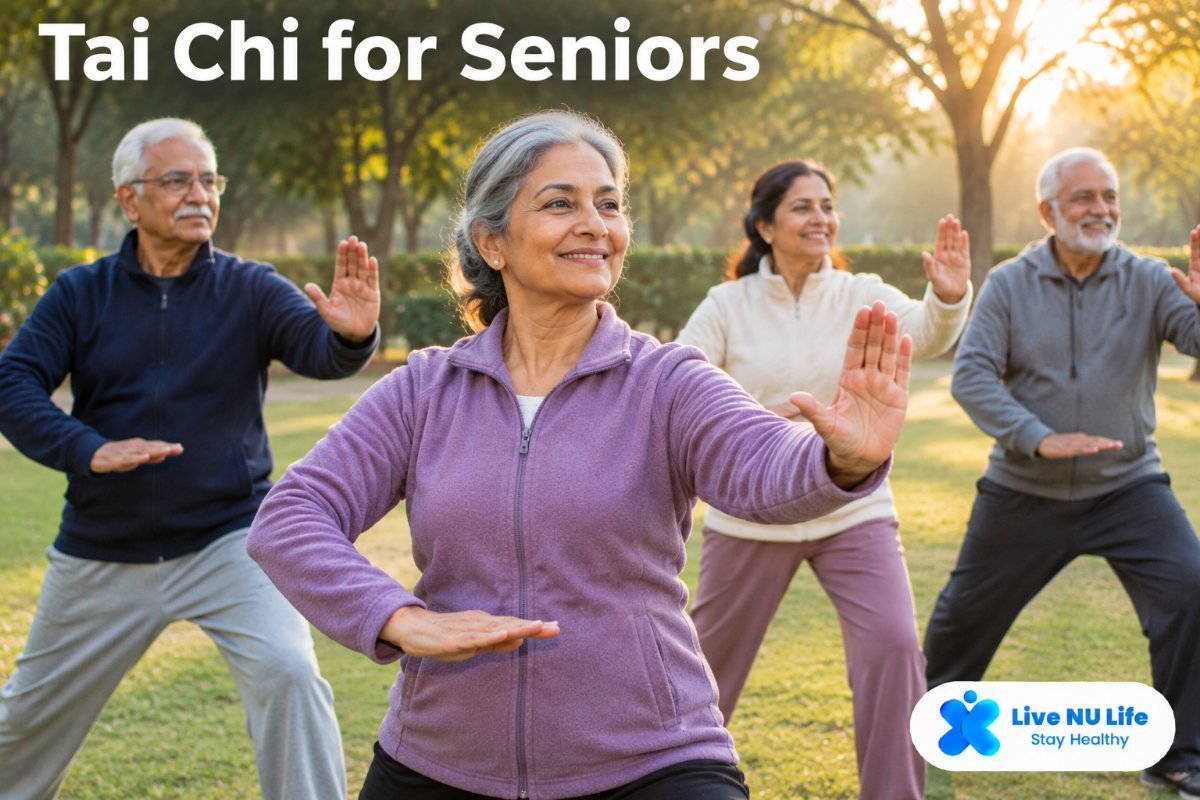
Tai chi is a slow, flowing exercise that improves balance and leg strength, and it is one of the best-studied ways for older adults to reduce falls. In a 2018 trial of 670 adults aged 70 and over at high risk of falling, a tai chi program cut falls by 58% compared with stretching (Li et al., 2018). Two one-hour sessions a week is the dose most programs use.
Below are 8 beginner moves you can try at home, with a chair option for each, plus how to practise safely.
Benefits of tai chi for seniors
Fewer falls
- Li et al., 2018 (JAMA Internal Medicine): 670 adults aged 70+ who had fallen or had poor mobility did one of three programs, two 60-minute sessions a week for 24 weeks. Tai chi (Tai Ji Quan: Moving for Better Balance) reduced falls by 58% vs stretching and 31% vs a mixed exercise program of aerobic, strength, balance and flexibility work.
- Cochrane review, 2019: across 7 trials with 2,655 people, tai chi reduced the rate of falls by about 19% (Sherrington et al., 2019). The evidence was rated low certainty, so results vary between programs.
Better balance and leg strength
Tai chi trains you to shift weight slowly from one leg to the other and to stand steadily on one foot. Those are the exact skills that keep you upright when you trip or turn quickly.
Gentle on joints
Movements are slow, low-impact and done with soft knees. Many people with arthritis can practise tai chi when other exercise hurts.
Calm focus
Slow breathing and steady attention make tai chi a moving form of relaxation. Many people find it easier to stick with than a gym routine.
Before you start
- Check with your doctor if you have had recent falls, dizziness, a joint replacement, heart problems or osteoporosis.
- Use a sturdy chair or kitchen counter for support in every standing move.
- Wear flat, closed shoes or practise barefoot on a non-slip floor.
- Keep knees soft and never bend them past a comfortable range.
- Breathe slowly through your nose. Never hold your breath.
8 tai chi moves for seniors
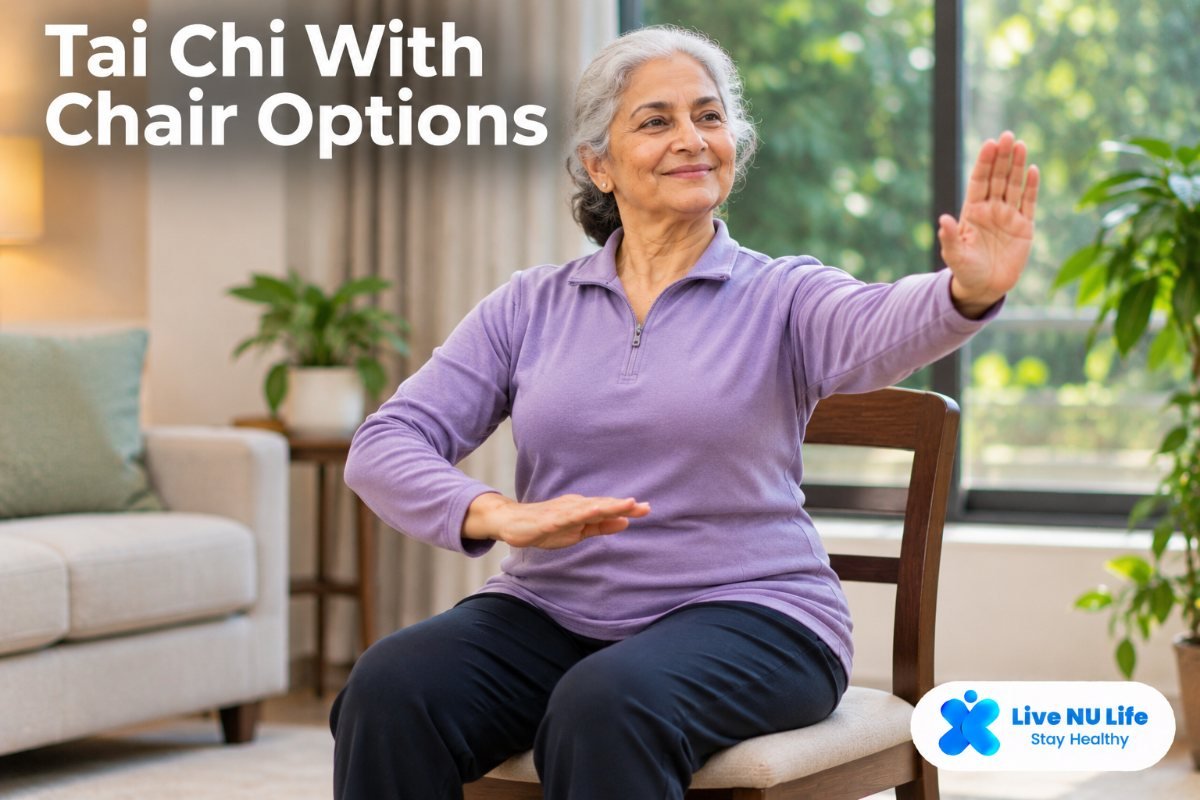
Do each move slowly, 4–8 times. The whole routine takes about 10–15 minutes.
1. Commencement (raising the arms)
Stand with feet hip-width apart and knees soft. Breathe in as you slowly float both arms up in front of you to shoulder height, palms down. Breathe out as you lower them and bend your knees slightly. Chair option: sit tall at the front of the chair and do the arm movement only.
2. Weight shifting side to side
Feet wider than hips. Slowly shift your weight onto your right leg until your left foot feels light, then shift to the left. Keep your hips level. Chair option: seated, lean your weight gently from one hip to the other.
3. Parting the wild horse’s mane
Step forward with your left foot, heel first. As you shift your weight onto it, sweep your left arm up and forward to chest height while your right hand presses down by your hip. Step back to center and repeat on the other side. Chair option: seated, do the arm sweep while turning your upper body slightly toward the leading arm.
4. White crane spreads its wings
Stand with most of your weight on your back leg and the front toes lightly touching the floor. Raise one hand above your head, palm out, while the other hand lowers by your hip. Switch sides. Chair option: seated, one arm rises while the other lowers, then switch.
5. Brush knee and push
Step forward. As you shift onto the front leg, your lower hand brushes past the front knee while the other hand pushes forward at chest height, palm out. Return and switch sides. Chair option: seated, brush one hand past your knee while the other pushes forward.
6. Wave hands like clouds
With soft knees, slowly turn your waist from side to side. Your hands float in front of you, one at face height and one at waist height, switching as you turn. Keep your feet planted. Chair option: the same turning and hand movement while seated.
7. Golden rooster stands on one leg
Hold the chair back. Shift your weight onto your left leg and slowly lift your right knee a few centimetres. Hold for 3–5 breaths, then lower. Switch sides. Lift the knee higher only as your balance improves. Chair option: seated, lift one knee at a time and hold.
8. Closing form
Bring your feet together, raise your arms slowly to chest height, then lower your palms down in front of your body as you breathe out. Stand still for a few breaths. Chair option: the same, seated.
These moves come from traditional tai chi forms, simplified for beginners. They are not a substitute for a class with a trained instructor.
How often should seniors do tai chi?
| Goal | Suggested amount |
|---|---|
| Fall prevention | Two 1-hour classes a week for at least 6 months, as in the major trials |
| General balance and mobility | 10–15 minutes at home most days, plus a weekly class if possible |
| Staying active overall | Add walking and strength training two days a week |
The US National Council on Aging lists Tai Ji Quan: Moving for Better Balance as an evidence-based fall-prevention program, delivered as two 1-hour sessions a week for 24 weeks (NCOA).
Tai chi or yoga for seniors?
Both help. Tai chi focuses on standing balance and slow weight shifts, which is why it has strong fall-prevention evidence. Yoga emphasises flexibility and held postures. If falls are your main worry, tai chi is the better first choice.
Finding a class
Look for a class labelled for older adults or for balance, run by an instructor trained in a recognised program. Community centres, senior centres, hospitals and some gyms run them. Online videos are a good way to practise between classes, but a live instructor can check your posture.
Related practices
Tai chi is part of a wider family of Chinese movement practices. Read our guide to Baduanjin, another gentle routine. For other ways to stay strong as you age, see the best exercise for older adults to lose fat and keep muscle and 10 daily habits to extend your healthspan.
Frequently asked questions
Is tai chi good for seniors with bad knees?
Often, yes. Keep your knees only slightly bent and make steps shorter. Stop any move that causes sharp pain.
Can you do tai chi sitting down?
Yes. Chair tai chi uses the same arm movements and upper-body turns. It is a good start for people with limited balance or mobility.
How long does it take to see results?
Balance trials usually run for 3–6 months. Many people feel steadier within a few weeks of regular practice.
What is the easiest tai chi form for beginners?
Short routines built from a few repeated moves, like the ones above, are easiest. Fall-prevention programs often use an 8-form routine.
Is tai chi enough exercise on its own?
It is excellent for balance, but you also need some walking or other aerobic activity, and strength training for muscle and bone.
Sources
- Li F, et al. Effectiveness of a therapeutic Tai Ji Quan intervention vs a multimodal exercise intervention to prevent falls among older adults at high risk of falling: a randomized clinical trial. JAMA Intern Med. 2018. doi:10.1001/jamainternmed.2018.3915
- Sherrington C, et al. Exercise for preventing falls in older people living in the community. Cochrane Database Syst Rev. 2019;CD012424.
- National Council on Aging. Evidence-based program: Tai Ji Quan: Moving for Better Balance.
Check with your doctor before starting a new exercise program if you have balance problems, recent falls or a heart condition. See our medical disclaimer.