
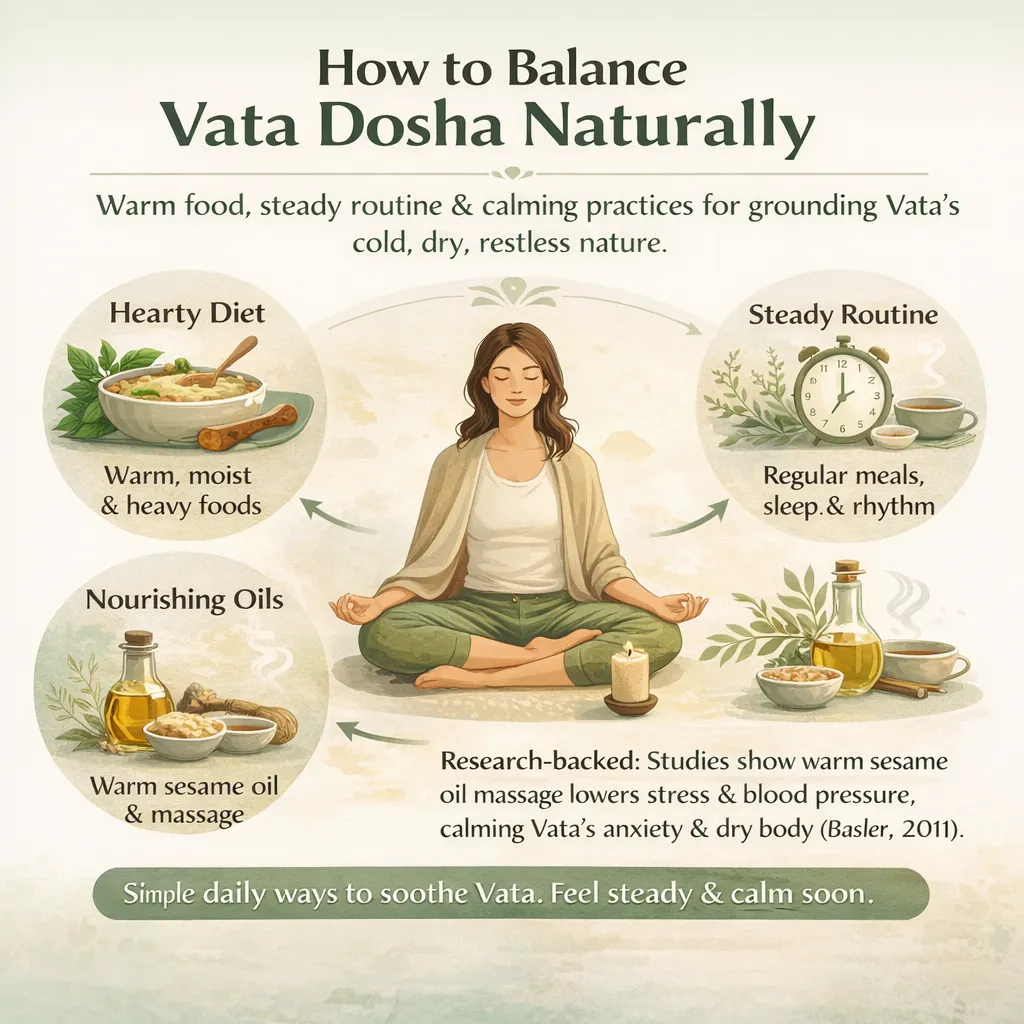
Vata is cold, dry, light and moving fast. Balance it with warmth and moisture, heavy food and steady routine, and calm. A natural way to balance vata dosha comes from good food, daily rhythm, and care for nerves and body warmth. No quick pills. This helps people with dry skin, anxiety, constipation or always restless.
Now this article shows simple ways. Diet first. Then routine. Body care is like oil. And my mind is calm.
Research backs this. One pilot study on Ayurvedic abhyanga massage by Basler in Journal of Alternative and Complementary Medicine, 2011, found it lowers stress, heart rate and blood pressure. Abhyanga uses warm sesame oil. It calms vata nerves. Another study on heat and massage by Kim in Yonsei Medical Journal, 2011, shows that it relaxes the autonomic nervous system. Good for vata imbalance.
Do these every day. Feel steady soon.
Table of Contents
ToggleWhat Does It Actually Mean When Vata Is Imbalanced?
Vata controls all movement in the body and mind. It is air and space. When too much, excess movement happens. Digestion becomes irregular. Nerves get jumpy. The mind races too fast. Dryness comes from a lack of moisture. Irregularity from no steady flow. Depletion from over-movement uses up energy. Symptoms show because Vata pushes too hard. Like wind blowing everything around. Natural Vata people always have some dryness or a quick mind. But temporary aggravation hits anyone from stress, cold weather, or the wrong food. It comes and goes.
Signs of high vata:
- Constipation or gas, bowels not regular
- Dry skin, dry hair, cracked heels
- Anxiety, worry, racing thoughts
- Feeling cold in the hands and feet
- Fatigue, low energy after a busy day
This imbalance is functional. Body out of tune. Not a fixed disease.
A 2019 exploratory study in the Journal of Ayurveda and Integrative Medicine examined how Ayurvedic diagnostic categories relate to Western measures of psychological states, supporting the link between mind-body balance and dosha assessment. Researchers found Vata imbalance linked to more anxiety, more rumination, less mindfulness, and lower quality of life.
The Core Principle of Vata Balance (This Guides Everything Else)
In Ayurveda, vata has qualities like cold, dry, light, rough, and irregular. Balance it with opposites. Use warmth for cold. Moist for dry. Routine for irregular. Heavy and grounding for light. This principle works for everything in vata balancing. Like increases. Opposites calm it down. Apply this logic always.
A 2019 exploratory study by Hanks et al. in the Journal of Ayurveda and Integrative Medicine found vata imbalance linked to higher anxiety and lower quality of life. Balancing with opposites helped reduce these issues.
Vata Quality | Balancing Approach |
Cold | Warmth |
Dry | Moist |
Light | Heavy |
Rough | Smooth |
Irregular | Routine |
Now, use this in food choices and daily habits. It guides the next parts. Simple. Effective.
How to Eat to Calm Vata (Not Just What to Eat)
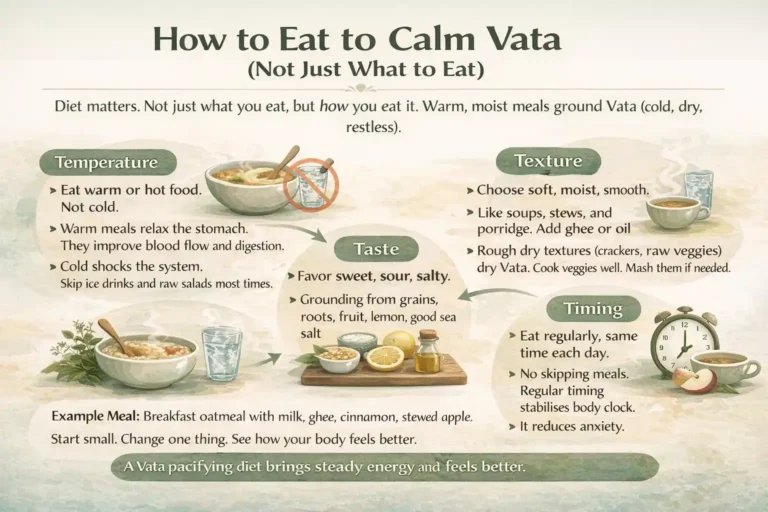
Vata gets upset easily. It brings a dry feeling, worry, gas, and bad sleep. A vata pacifying diet helps a lot. But not only pick certain foods. Pay attention to how you eat them. Warm, moist, cooked meals ground the body. They have steady digestion and calm nerves. Cold raw stuff makes things worse.
Researchers explored whether vagus nerve activity could indicate Vata dosha levels, suggesting a possible physiological marker for this Ayurvedic concept. They link vata functions to the vagus nerve. Vagus calms the nervous system and helps digestion. Warm cooked foods support better vagal tone. They ease stress on the gut and mind.
Do this:
● Temperature
Eat warm or hot food. Not cold. Warm meals relax the stomach. They improve blood flow and digestion. Cold shocks the system. Skip ice drinks and raw salads most times.
● Texture
Choose soft, moist, smooth. Like soups, stews, and porridge. Add ghee or oil. Rough dry textures, like crackers or raw veggies, increase vata dryness. Cook vegetables well. Mash them if needed.
● Taste
Favour sweet, sour, salty. These ground and nourish. Sweet from grains, roots, fruits – not too much sugar. Sour from lemon, yoghurt. Salty from good sea salt. These tastes soothe nerves. Cut bitter, pungent, astringent.
● Timing
Eat regularly. Three meals at the same time each day. No skip. Regular timing stabilises the body clock. It reduces anxiety.
Example meal: Breakfast oatmeal. Cook oats in milk. Add ghee, cinnamon, stewed apple, pinch of salt. Warm and moist. Sweet, sour, salty mix. Easy digestion. Calms vata quickly.
Start small. Change one thing. See how your body feels better. A Vata pacifying diet brings steady energy and peace.
Foods and Drinks That Quiet Vata vs. Those That Disturb It
Vata gets upset easily with cold, dry, light things. You feel anxious, bloated, or sleepy. Choose warm, moist, heavy foods instead. They ground you. Cook meals fresh. Add ghee or oil. Drink warm.
A 2025 study by Tianying Wu at San Diego State University found that cold foods and drinks in summer are linked to more anxiety, insomnia, and gut fullness in Asian people. Hot drinks in winter cut depression and help sleep in others. Warm foods activate relaxation in the nervous system. Cold ones raise stress.
Focus on patterns. Avoid too many cold, dry leftovers. Eat fresh and warm most times.
Support Vata | Aggravate Vata |
Warm cooked grains like oats, rice | Raw salads, cold cereals |
Soups with root veggies, ghee | Dry crackers, popcorn |
Warm milk with spices | Iced drinks, caffeine |
Ripe sweet fruits, steamed | Bitter greens, raw apples |
Nuts soaked, warm herbal tea | Leftover cold food, beans, raw |
Listen to your body. Some tolerate a little aggravating food fine. Eat in moderation always. Your tolerance changes day to day.
Daily Routine as Medicine for Vata
Vata gets upset easily with change. Irregular sleep, skipped meals, too much travel. These drain your nervous system fast. You feel anxious, tired, scattered. Routine fixes this. It grounds vata. Keeps energy steady.
Science backs this, too. In “Circadian rhythm disruption and mental health” by Walker et al., published in Translational Psychiatry in 2020, irregular rhythms are linked to mood problems and nervous system imbalance. Regular schedule protects.
Build your daily routine with these anchor habits.
- Eat meals at fixed times every day. Breakfast, lunch, dinner. No skipping. Warm foods help.
- Sleep early. Bed by 10 pm. Wake at the same time. Aim 7-8 hours.
- Start mornings warm. Drink warm water. Light oil massage. Gentle walk in the sun.
Do these daily.
Consistency matters more than perfection. Miss one day? Start again next. Your body heals with a steady rhythm. Vata stays calm. You feel strong. Try it now.
Abhyanga and Body-Based Practices That Ground Vata
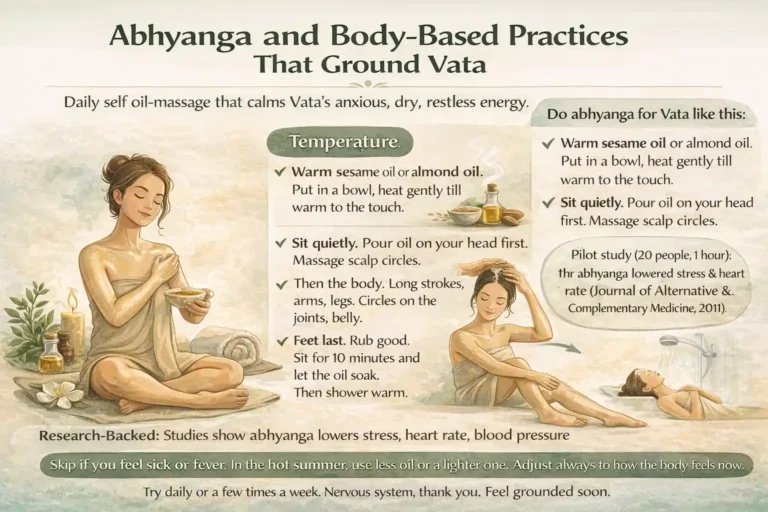
Vata gets high easily in cold months or on busy days. You feel anxious, have dry skin, and a restless mind. Abhyanga is an oil massage for yourself. It feeds the nervous system like real food. Not just luxury. Warm oil goes to the skin and calms everything down. For vata calming practices, this is the top one.
Pilot study investigating the effects of Ayurvedic Abhyanga massage on subjective stress experience by Basler AJ in Journal of Alternative and Complementary Medicine, 2011. Twenty people got a one-hour abhyanga. Stress feelings dropped significantly. Heart rate is lower, too.
Do abhyanga for vata like this.
- Warm sesame oil or almond oil. Put in a bowl, heat gently till warm to the touch.
- Sit quietly. Pour oil on your head first. Massage scalp circles.
- Then the body. Long strokes, arms, legs. Circles on the joints of the belly.
- Feet last. Rub good. Sit for 10 minutes and let the oil soak. Then shower warm.
Skip if you feel sick or fever. In the hot summer, use less oil or a lighter one. Adjust always to how the body feels now.
Try daily or a few times a week. Nervous system, thank you. Feel grounded soon.
Movement and Yoga That Balance Vata Without Depleting Energy
Vata gets worse with too much stimulation. Fast moves, loud noise, quick changes. All that stirs air and space inside you. Then you feel anxious, tired fast, and sleep badly. Choose slow, rhythmic, grounding movement instead. Hold poses longer. Breathe deep. This calms vata. Keeps energy steady.
Research backs this. In a 2013 study by Streeter et al. in the Journal of Alternative and Complementary Medicine, gentle yoga reduced stress and anxiety by raising GABA levels in the brain. Good for vata types who often have worry and restlessness.
Do these:
- Walk slowly in nature. Feel feet on the ground. 20-30 minutes daily.
- Practice slow yoga. Like hatha or restorative. Focus on forward bends, child’s pose, and legs up the wall.
- Swim gently. Water supports the body. No big effort.
Avoid vigorous exercise when vata is aggravated. No running, hot yoga, fast, heavy cardio. That depletes energy more. Makes dry, light feelings worse.
Calming the Mind and Nervous System (Where Vata Shows First)
Vata controls movement in the body and mind. When Vata gets high, the mind feels restless first. Thoughts race. Worry comes easily. The body feels light and cold. Anxiety starts here. Calm Vata with breath, warmth, repetition, and safety cues. These send calm signals to the nervous system. Deep, slow breathing tones the vagus nerve. Routines give safety. Warm things ground you.
Do these practices daily for vata anxiety relief. Calm vata naturally.
- Breathe deep and slow. Inhale belly full. Exhale longer. Do 5-10 minutes. Magnon, Dutheil, and Vallet’s study in Scientific Reports, 2021, showed that one session reduces anxiety in young and older adults.
- Practice Yoga Nidra. Lie down. Follow guided relaxation. Body scans and breath awareness. Moszeik’s study in Current Psychology, 2020, found that short Yoga Nidra lowers stress fast.
- Drink warm herbal teas. Chamomile or tulsi. Hold a hot cup. Sip slowly. Warmth calms Vata. Ritual gives safety cues.
Now, one simple evening ritual. Dim lights. Sit or lie comfortably. Have warm milk mixed with nutmeg, or drink chamomile tea. Then do 10 minutes of deep breathing. Follow with 20 minutes of Yoga Nidra audio. End with hands on belly. Feel warm and safe. Repeat every night. My mind settles. Sleep comes better.
Simple Home Remedies That Support Vata Balance Safely
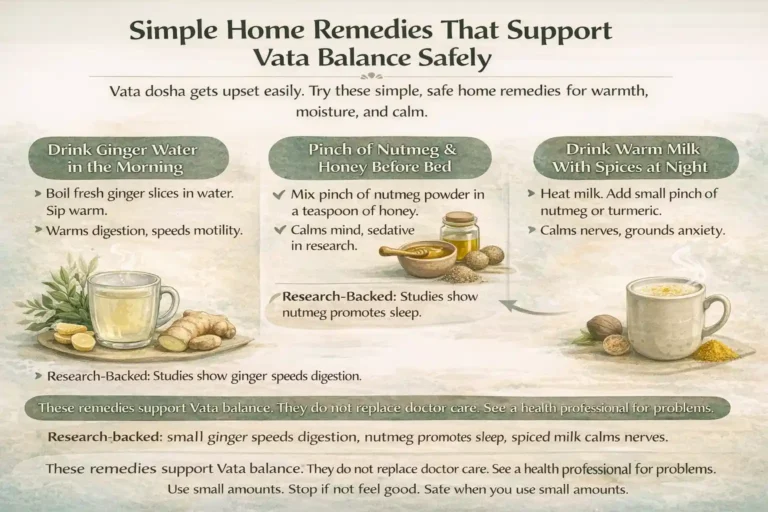
Vata dosha gets out of balance easily. It brings dry skin, worry, bad sleep, and gas. You need warmth, moisture, and calm. Try these vata dosha home remedies. They are simple foods. Safe when you use small amounts.
- Drink ginger water in the morning. Boil fresh ginger slices in water. Sip warm. It warms the body and helps digestion move better. Ginger speeds gastric emptying, like in studies on ginger for motility.
- Take a pinch of nutmeg with honey before bed. Mix a small pinch of nutmeg powder in a teaspoon of honey. Eat slow. It calms the mind and helps sleep come easily. Nutmeg shows sedative effects in animal tests, from Grover et al. Research reported in 2002 in Experimental and Clinical Pharmacology examined relevant methods and findings for this topic.
- Drink warm milk with spices at night. Heat milk. Add a pinch of nutmeg or turmeric. Stir and drink. It grounds vata, eases worry, and brings rest. Warm spiced milk supports a calm nervous system, tied to vata balance in Ayurveda.
These natural vata remedies help support balance. Research backs parts, like ginger for digestion and nutmeg for calm.
These remedies support vata balance. They do not replace doctor care. See a health professional for problems. Use small amounts. Stop if not feel good.
How Long Does It Take to Balance Vata (What to Expect Realistically)
Balancing vata dosha takes time. Your nervous system calms down slowly. Not overnight. But stay consistent with warm foods, oil massage, and regular sleep. And you feel changes.
- First 1-2 weeks: Better sleep starts. Less dry skin. Digestion feels smoother. Small shifts come quickly if you follow a routine every day.
- 4-8 weeks: Anxiety drops. Energy stays steady. Joints are less stiff. Noticeable calm in mind and body.
- 3-6 months: Deeper balance. The nervous system is stronger. Symptoms like worry or restlessness go away more fully.
A 2024 case study in the AYUSHDHARA journal by Kirti Gaikwad and Meera K. Bhojani showed full emotional stability after 90 days of Ayurvedic treatment for vata-related anxiety.
Keep going. Consistency wins. You got this. Feel grounded soon.
When to Seek Personal Ayurvedic Guidance
General tips on this blog help many people balance vata. Like warm oils. Regular meals. Gentle yoga. These work for mild imbalance. But Ayurveda looks at each person differently. Your body type. Your current dosha state. Lifestyle. So general advice has limits. For deeper issues, you need personal guidance from qualified practitioners. Get an Ayurvedic consultation for Vata problems that last long.
Research backs this. Personalised treatment works better for chronic vata issues. For example, in Hirschsprung disease with severe constipation (pakvasayagata vata), a child got relief only after tailored basti and swedana. Singh SK and Rajoria K reported this case in Journal of Ayurveda and Integrative Medicine, 2018.
Seek personal ayurvedic consultation for vata when:
- Chronic constipation. Hard stools most days. For weeks or months.
- Severe anxiety. Worry that stops sleep. Or daily life.
- Ongoing pain. Like joint pain. Back pain. That does not go away with simple home remedies.
Do this now. Find an experienced Ayurvedic doctor. They check your prakriti and vikriti. Then give the right diet, herbs, and therapies for you. This brings real balance. Safe and deep healing.
Note: Prakriti = natural constitution, and Vikriti = current state of imbalance.
🌿 Support Resilience, Emotional Balance & Immunity
Build daily strength and clarity with Wellbeing Mastery: Science-Based Strategies.
Strengthen mental resilience and emotional balance through Emotional Health.
Enhance natural immunity with Best Ayurvedic Herbs for Immune System Boost.
References
Basler, A. J. (2011). Pilot study investigating the effects of Ayurvedic Abhyanga massage on subjective stress experience. Journal of Alternative and Complementary Medicine, 17(5), 435–440.
Kim, H. G., Cheon, E. J., Bai, D. S., Lee, Y. H., & Koo, B. H. (2011). The effects of heat and massage application on the autonomic nervous system. Yonsei Medical Journal, 52(6), 982–989.
Mills, P. J., Schneider, R. H., Dillbeck, M. C., Travis, F., Jones, R. T., Hill, D., & Walton, K. G. (2019). Relationships among classifications of ayurvedic medicine diagnostics for imbalances and Western measures of psychological states: An exploratory study. Journal of Ayurveda and Integrative Medicine, 10(4), 250–255.
Sumantran, V. N. (2019). Can the vagus nerve serve as a biomarker for vata dosha activity? Journal of Ayurveda and Integrative Medicine, 10(4), 286–291.
Walker, W. H., Walton, J. C., DeVries, A. C., & Nelson, R. J. (2020). Disrupted circadian rhythms and mental health. Translational Psychiatry, 10, 28.
Streeter, C. C., Jensen, J. E., Perlmutter, R. M., Cabral, H. J., Tian, H., Terhune, D. B., Ciraulo, D. A., & Renshaw, P. F. (2007). Yoga Asana sessions increase brain GABA levels: A pilot study. Journal of Alternative and Complementary Medicine, 13(4), 419–426.
Magnon, V., Dutheil, F., & Vallet, G. T. (2021). Benefits from one session of deep and slow breathing on vagal tone and anxiety in young and older adults. Scientific Reports, 11, 19267.
Moszeik, E. N., von Oertzen, T., & Renner, K.-H. (2020). Effectiveness of a short Yoga Nidra meditation on stress, sleep, and well-being in a large sample: Results from an online intervention. Current Psychology, 39, 2913–2924.
Singh, S. K., & Rajoria, K. (2018). Pakvasayagata vata (Hirschsprung disease): A case study. Journal of Ayurveda and Integrative Medicine, 9(3), 215–219.