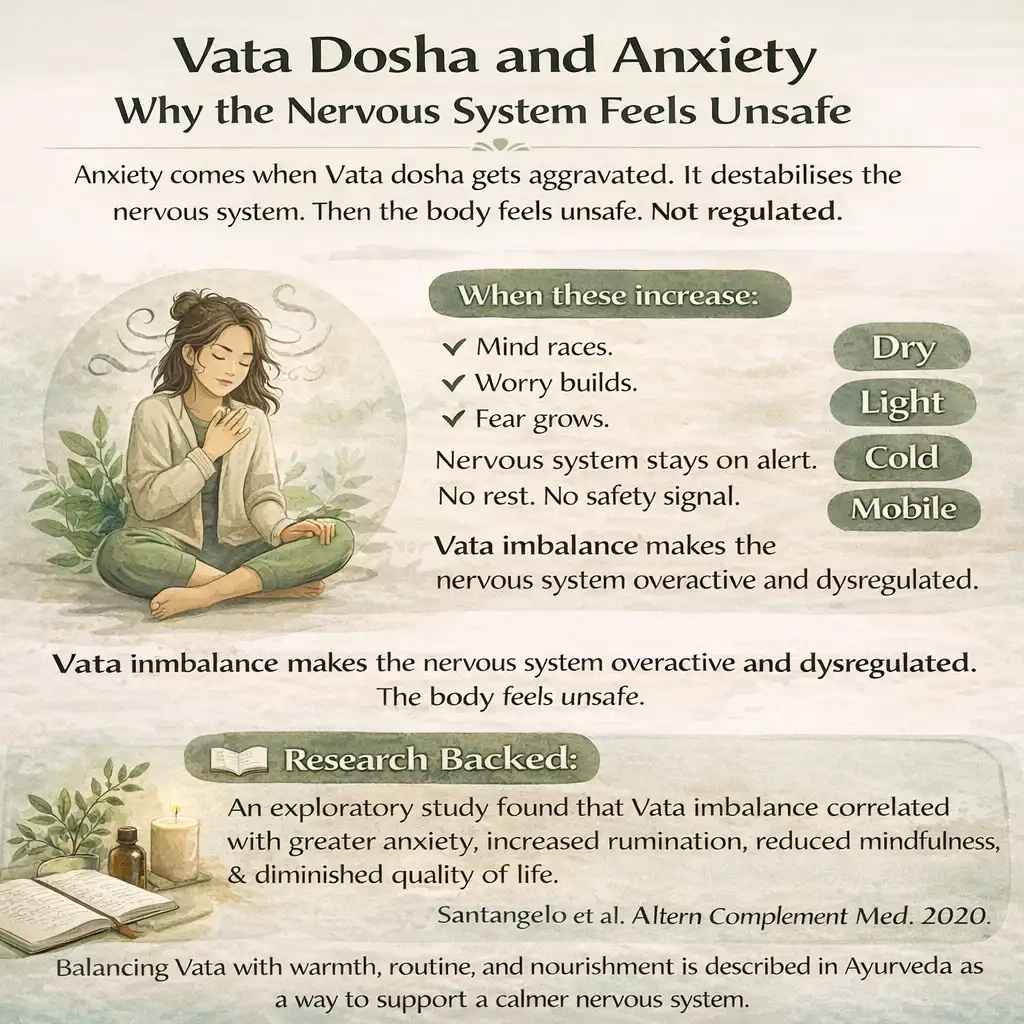
Anxiety comes when Vata dosha gets aggravated. It destabilises the nervous system. Then the body feels unsafe. Not regulated.
In Ayurveda, Vata controls movement. And flow in the nervous system. Vata has qualities like dry, light, cold, and mobile. When these increase, the mind races. Worry builds. Fear grows. The nervous system stays on alert. No rest. No safety signal.
Vata imbalance makes the nervous system overactive. It feels unsafe because regulation is lost.
Research backs this. In this exploratory study, “Relationships among classifications of ayurvedic medicine diagnostics for imbalances and western measures of psychological states,” individuals with elevated Vata imbalance scores reported greater anxiety, increased rumination, reduced mindfulness, and diminished quality of life.
Some small Ayurvedic clinical reports suggest that Vata aggravation is common in patients with anxiety disorders, but large, high‑quality studies are still lacking.
Balancing Vata with warmth, routine, and nourishment is described in Ayurveda as a way to support a calmer nervous system.
How Vata Governs the Nervous System and Stress Response?
In Ayurveda, Vata dosha controls all movement in the body and mind. It handles breath. Circulation. Neural signals. Even thoughts. When Vata stays balanced, the nervous system works smoothly. Stress response stays calm. But excess Vata makes things erratic. Fast heart. Racing mind. Anxiety comes. Not from weakness. Too much movement disturbs regulation.
Research-backed models support this link. A discussion paper by Sumantran and Nair, ‘Can the vagus nerve serve as a biomarker for vata dosha activity?’, proposes functional parallels between Vata, the vagus nerve, and the autonomic nervous system.
Travis and Wallace present a neural model suggesting that Vata‑type individuals may show greater variability in arousal and limbic sensitivity, which could predispose them to stronger stress reactions. This remains a hypothesis that needs more empirical testing.
Vata’s Role in Neural Signalling and Sensory Processing
Vata moves signals between nerves. Processes senses quickly. Keeps the brain alert. Breathe steady. Circulation even.
Why Excess Movement Creates Instability
Too much Vata speeds everything. Signals fire erratically. Breathe shallow. Heart races. My mind jumps. Anxiety rises. Not an emotional fault. Just Vata is out of control.
Functions Vata governs:
- Breath and respiration
- Blood circulation
- Neural impulses and communication
- Sensory input and processing
- Waste elimination
- Thought movement and cognition
Balance Vata. The calm nervous system follows.
Why Does an Aggravated Vata Make the Nervous System Feel Unsafe?
Vata imbalance hits the nervous system hard. It turns normal alertness into constant unsafety. The body stays on guard. No real danger needed. Just the qualities of Vata do this. Light, dry, mobile, cold. These make you feel ungrounded and hypervigilant. Threats seem to be everywhere. Fear rises fast. This is not just in your head. It is physiological. The nervous system reacts as if danger is always near.
A 2019 exploratory study titled “Relationships among classifications of ayurvedic medicine diagnostics for imbalances and western measures of psychological states” by Mills et al. found that vitiated Vata was linked to more anxiety and rumination. Less mindfulness, too. People with Vata imbalance feel more vulnerable to panic and fear.
Heightened Sensory Sensitivity
Vata’s mobile and light qualities speed up everything. Sounds feel louder. Lights brighter. Small changes bother you a lot. The body overreacts. Like a smoke alarm that goes off too easily. You jump at nothing. This keeps the fear response on.
Loss of Internal Stability and Grounding
Dry and cold Vata pulls away moisture and warmth. You lose that calm base inside. No anchor. Mind races. The body feels floaty or shaky. Then the unsafety grows. No rest. Always scanning for threats.
See these signs of vata imbalance symptoms and anxiety nervous system ayurveda:
- Constant worry or racing thoughts. My mind won’t settle.
- Feeling ungrounded, like feet not on earth. Or spacey.
- Quick fear response. Heart races fast at small triggers.
Balancing Vata and grounding the body can, for many people, reduce feelings of hypervigilance and unsafety.
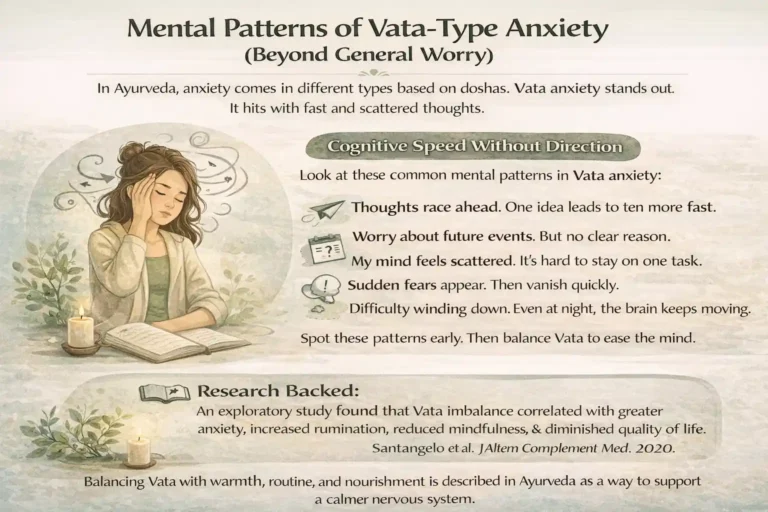
Mental Patterns of Vata-Type Anxiety (Beyond General Worry)
In Ayurveda, anxiety comes in different types based on doshas. Vata anxiety stands out. It is not just an everyday worry. It hits with a mind that races fast but goes nowhere. Thoughts jump quickly. Fear comes suddenly, even without real cause. The person feels restless inside. It’s hard to calm down or focus for long. Like wind blowing scattered. This vata mind imbalance makes settling tough. For example, you plan many things but finish none. Or anticipate problems that never happen. Now, research backs this link.
One exploratory study by Mills et al in the Journal of Ayurveda and Integrative Medicine, 2019, looked at ayurvedic imbalances and psychological states. They found that people with more Vata imbalance had higher anxiety and more rumination. Also, less mindfulness and lower quality of life.
Cognitive Speed Without Direction
Look at these common mental patterns in vata anxiety.
- Thoughts race ahead. One idea leads to ten more fast.
- Worry about future events. But no clear reason.
- My mind feels scattered. It’s hard to stay on one task.
- Sudden fears appear. Then vanish quickly.
- Difficulty winding down. Even at night, the brain keeps moving.
Spot these patterns early. Then balance vata to ease the mind.
Physical Signals That the Nervous System Is Dysregulated by Vata
In Ayurveda, when Vata goes high, your nervous system gets shaky fast. You feel anxious not only in your mind. The body screams, too. These physical symptoms of vata anxiety keep feeding the worry. It becomes a loop you must break with your body first.
Body-Based Feedback Loops
The body and nervous system talk all the time. Dry mouth, cold hands, twitching muscles – these are vata nervous imbalance signs. They make the brain think danger is here. Anxiety grows bigger. Fix body signals. Anxiety drops quickly.
| Vata Signal | Nervous System Effect |
| Can’t sleep or light sleep | The brain stays in fight‑or‑flight, as described in both Ayurvedic texts and modern sleep–stress research. |
| Tremors or shaky hands | linked in classical Ayurveda (Charaka Samhita, Chikitsa Sthana 28) to aggravated Vata and heightened sympathetic arousal.” |
| Dry skin, dry mouth | Dry skin, dry mouth – signs of sympathetic dominance and reduced ‘rest and digest’ tone. |
| Gas, bloating, irregular poop | Triggers stress hormones via gut-brain axis (Dr Vasant Lad, Textbook of Ayurveda Vol. 3, 2012) |
| Short, fast breath or air hunger | Short, fast breath or air hunger – known in modern physiology to reinforce hyperventilation and anxiety loops; slow breathing and pranayama can help counter this. |
See the loop? The body feels unsafe because of vata. The brain gets a message: more danger. You feel more anxious. Touch the body first. Warm oil. Slow breath. Heavy food. Loop breaks. Calm returns. Do it today.
What Triggers Vata-Driven Anxiety in Daily Life?
Vata dosha governs movement in the body and mind. When it gets out of balance, anxiety comes easily. Nervous thoughts race. Worry builds fast. The body feels restless. This happens from daily habits and surroundings that increase Vata qualities like dry, light, cold, and mobile.
Research backs this link. In “Relationships among classifications of ayurvedic medicine diagnostics for imbalances and western measures of psychological states: An exploratory study” by Paul J Mills et al., 2019, people with more Vata imbalance showed higher anxiety levels and more rumination.
These causes of vata imbalance stir nervous instability. Know them. Spot them in your day.
Lifestyle Patterns That Increase Nervous Instability
- Irregular routines, like changing meal times or sleep hours daily
- Too much screen time or noisy places that overstimulate the senses
- Exposure to cold winds or dry air without protection
- Poor sleep, like staying up late or waking often at night
These vata aggravating factors, such as anxiety, build up slowly. Then anxiety feels stronger. Watch for them.
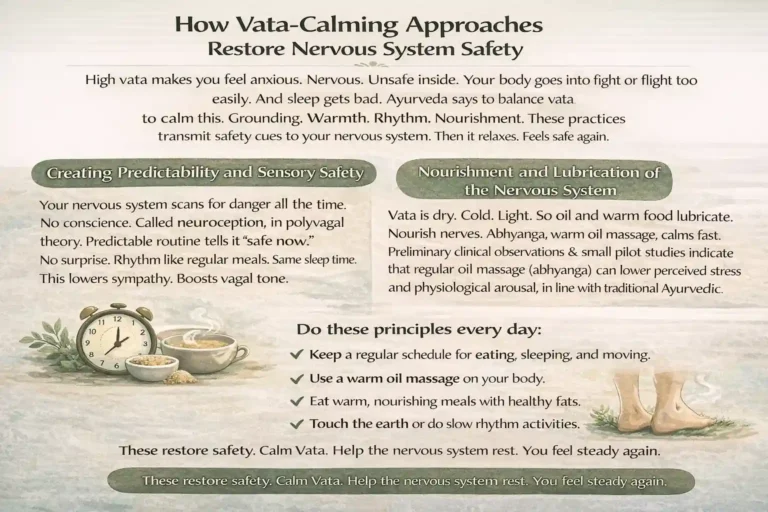
How Vata-Calming Approaches Restore Nervous System Safety
High vata makes you feel anxious. Nervous. Unsafe inside. Your body goes into fight or flight too easily. And sleep gets bad. Ayurveda says to balance vata to calm this. Grounding. Warmth. Rhythm. Nourishment. These practices transmit safety cues to your nervous system. Then it relaxes. Feels safe again.
Research links vata dosha to the vagus nerve. In “Can the vagus nerve serve as a biomarker for vata dosha activity?” by V.N. Sumantran and P.P. Nair, 2019, Journal of Ayurveda and Integrative Medicine. They show normal vata, and vagus both keep homeostasis. And higher functions like a calm mind. Polyvagal theory by Stephen Porges (2009) says cues of safety turn on the parasympathetic. Turn off defence.
Creating Predictability and Sensory Safety
Your nervous system scans for danger all the time. No conscience. Called neuroception. In polyvagal theory. Predictable routine tells it “safe now”. No surprise. Rhythm like regular meals. Same sleep time. This lowers sympathy. Boosts vagal tone.
Grounding too. Feet on earth. Or steady poses. Small studies on grounding (earthing) suggest it can shift heart rate variability toward greater parasympathetic activity and reduced stress, but this research is still preliminary.
Nourishment and Lubrication of the Nervous System
Vata is dry. Cold. Light. So oil and warm food lubricate. Nourish nerves. Abhyanga, warm oil massage, calms fast. Preliminary clinical observations and small pilot studies indicate that regular oil massage (abhyanga) can lower perceived stress and physiological arousal, in line with traditional Ayurvedic claims.
Warmth from oil or food signals safety. Rhythmic strokes activate the vagus. Nourishment like oily foods or ghee feeds tissues. Stops dry nerves from firing too much. Then anxiety drops.
Do these principles every day.
- Keep a regular schedule for eating, sleeping, and moving.
- Use a warm oil massage on your body.
- Eat warm, nourishing meals with healthy fats.
- Touch the earth or do slow rhythm activities.
These restore safety. Calm vata. Help the nervous system rest. You feel steady again.
Diet and Sensory Inputs That Stabilise Vata-Related Anxiety
Vata anxiety comes from too much lightness, dryness, and cold in the body and mind. It makes you worry a lot, feel restless, and sleep badly. Choose warmth, moisture, and grounding tastes. These calm the nerves fast. Eat sweet, sour, and salty foods more. Cook them warm and oily. Then the mind settles down.
A 2014 systematic review of human trials found that ashwagandha extract produced greater reductions in anxiety and stress scores than placebo in several small studies, although overall evidence quality was limited.
Now focus on food and senses. Warm meals ground you. Soft music or a gentle touch helps too. Avoid loud noise or dry air. So your vata stays balanced.
What to Favour vs What to Reduce
Favour these for calm:
- Warm cooked foods like soups, oats, stewed fruits
- Moist and oily items – ghee, avocado, nuts, soaked
- Sweet tastes – rice, milk, dates; sour like lemon; salty in moderation
- Grounding senses – warm oil massage, soft blankets, calm smells like lavender
Reduce these to stop agitation:
- Cold dry foods – raw salads, crackers, popcorn
- Bitter, pungent, astringent tastes – caffeine, chilli, beans, too much
- Light meals or skipping food
- Stimulating inputs – windy places, loud screens lateat night, dry cold air
Start small. Add one warm meal a day. Then see how anxiety drops. Eat regularly. The body likes routine for vata peace.
Breath, Routine, and Body Practices That Signal Safety
Your nervous system needs signals of safety. It calms when you give it slow breath, daily routine, gentle oiling, and soft movement. These practices tell the body: no danger now. And this happens at a real physiological level. The parasympathetic side turns on. Vagal tone gets stronger. Stress hormones drop.
Breath as a Regulator of Vata Movement
In Ayurveda, vata brings movement and worry. Too much vata means anxiety. Pranayama for vata anxiety uses slow breathing. It balances that fast energy.
Slow breathing boosts parasympathetic activity. It raises heart rate variability and vagal tone. For example, Assessment of the Effects of Pranayama/Alternate Nostril Breathing on the Parasympathetic Nervous System in Young Adults by Gopal et al., 2013, showed a clear increase in parasympathetic markers.
Then, Physiology of long pranayamic breathing by Brown and Gerbarg, 2005, found that slow pranayama shifts the system to calm through the vagus nerve.
Routine as Nervous System Anchoring
The Ayurveda routine nervous system loves dinacharya. Same times for wake, eat, sleep. It anchors the day. No chaos for vata.
Lack of routine brings stress. Fixed habits calm it. Pilot study investigating the effects of Ayurvedic Abhyanga massage on subjective stress experience by Basler, 2011, linked oil massage in routine to a big drop in stress and heart rate.
Daily rhythm supports autonomic balance. Consistency signals safety to the brain.
These ways communicate safety deep inside. The body relaxes. The mind follows. Try them. Feel the change.
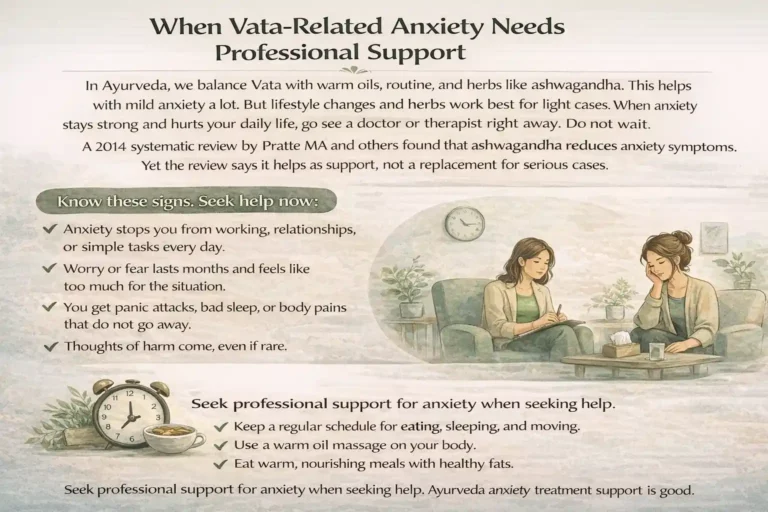
When Vata-Related Anxiety Needs Professional Support
In Ayurveda, we balance Vata with warm oils, routine, and herbs like ashwagandha. This helps with mild anxiety a lot. But lifestyle changes and herbs work best for light cases. When anxiety stays strong and hurts your daily life, go see a doctor or therapist right away. Do not wait. A 2014 systematic review by Pratte MA and others found that ashwagandha reduces anxiety symptoms. Yet the review says it helps as support, not a replacement for serious cases.
Know these signs. Seek help now:
- Anxiety stops you from working, relationships, or simple tasks every day.
- Worry or fear lasts months and feels like too much for the situation.
- You get panic attacks, bad sleep, or body pains that do not go away.
- Thoughts of harm come, even if rare.
Seek professional support for anxiety when seeking help. Ayurveda anxiety treatment support is good, but combined with expert care for safety.
Core Insight — Why Balancing Vata Restores a Sense of Safety
Anxiety comes when Vata gets too high. The body feels unsteady. Like wind blowing everything around. Then the nervous system stays on alert. It sees danger even when there is none. You feel unsafe inside.
Do not try to push calm into the mind. That fights it more. Instead, bring Vata back to balance. Give warmth. Give routine. Give grounding. Then the nervous system relaxes. It knows no threat now. Safety returns on its own.
One study shows this clearly. In “Relationships among classifications of ayurvedic medicine diagnostics for imbalances and western measures of psychological states: These findings support a link between Vata imbalance and anxiety‑related states, but they do not prove that correcting Vata alone will cure anxiety.
Now, calm the body first. Eat warm foods. Sleep at the same time every night. Oil the skin. Walk slowly on earth. These pull Vata down. The nervous system feels safe again.
So, start today. Balance Vata. Watch anxiety ease. Feel grounded. Feel protected inside.
🌿 Nurture Emotional Balance & Ayurvedic Wellness
Strengthen mental resilience and emotional stability with Emotional Health.
Support immunity naturally using Best Ayurvedic Herbs for Immune System Boost.
Restore mind–body harmony by learning How to Balance Vata Dosha Naturally.
References
Mills, P. J., Peterson, C. T., Pung, M. A., Patel, S., Weiss, L., Wilson, K. L., Vijayendra, R., & Peterson, S. N. (2019). Relationships among classifications of ayurvedic medicine diagnostics for imbalances and Western measures of psychological states: An exploratory study. Journal of Ayurveda and Integrative Medicine, 10(3), 185–190.
Sumantran, V. N., & Nair, P. P. (2019). Can the vagus nerve serve as a biomarker for vata dosha activity? Journal of Ayurveda and Integrative Medicine, 10(3), 188–193.
Travis, F., & Wallace, R. K. (2016). Dosha brain-types: A neural model of individual differences. Journal of Ayurveda and Integrative Medicine, 7(3), 176–181.
Gopal, K. V., Govindasamy, P., & Balachandran, K. (2013). Assessment of the effects of pranayama/alternate nostril breathing on the parasympathetic nervous system in young adults. Journal of Clinical and Diagnostic Research, 7(10), 2189–2191.
Brown, R. P., & Gerbarg, P. L. (2005). Sudarshan Kriya yogic breathing in the treatment of stress, anxiety, and depression: Part II—Clinical applications and guidelines. Journal of Alternative and Complementary Medicine, 11(4), 711–717.
Basler, A. J. (2011). Pilot study investigating the effects of Ayurvedic Abhyanga massage on subjective stress experience. Journal of Alternative and Complementary Medicine, 17(5), 435–438.
Pratte, M. A., Nanavati, K. B., Young, V., & Morley, C. P. (2014). An alternative treatment for anxiety: A systematic review of human trial results reported for the Ayurvedic herb Withania somnifera (ashwagandha). Journal of Alternative and Complementary Medicine, 20(12), 901–908.
Lad, V. (2012). Textbook of Ayurveda, Vol. 3: General principles of management and treatment. Ayurvedic Press.