
Walking challenges for mood turn simple steps into a real mood reset. Mood-boosting walks release endorphins and cut stress hormones like cortisol. A brief bout of brisk walking improved mood compared to sitting. Try mindful walking or outdoor movement for quick wins—just start slow and listen to your body.
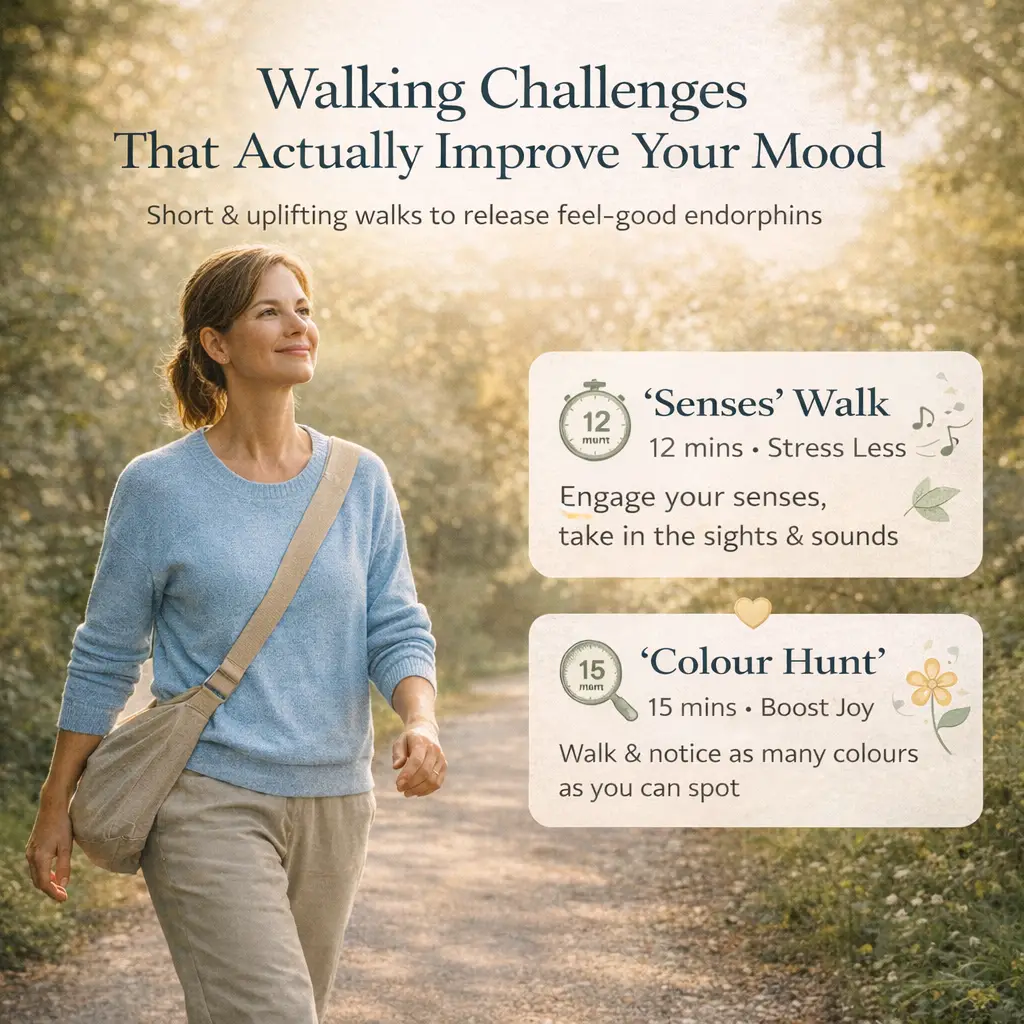
Short on time? The fastest way to shift your mood is a 12-minute ‘Senses’ walk or a 15-minute ‘Colour Hunt.’ These work by quieting the brain’s stress centre and boosting endorphins through simple, rhythmic movement.
Table of Contents
ToggleWhy Walking Can Transform Your Mood?
Mental clarity walking brings real changes to how one feels each day. It works through body processes like endorphin release and calming the nerves. Even 10-15 minutes helps.
Endorphin Boosts and Emotional Regulation
Walking sparks a gentle endorphin release that lifts mood without effort. This natural boost helps control emotions better during tough times. Exercise is highly effective at reducing symptoms of anxiety and distress, often outperforming standard counselling.
Optic Flow and Nervous System Reset
Outdoor steps create optic flow, the smooth visual motion that quiets the brain’s alert centre. This shifts the body from stress mode to calm rest. Regular stress relief walks make this reset easier over time.
Biophilic Exposure and Stress Reduction
Time in green areas cuts cortisol, the stress hormone that tires the mind. 20 minutes of green exercise drops stress a lot. Outdoor mindfulness in parks builds lasting calm.
5 Walking Challenges That Change How You Feel
Mindful walking turns simple steps into quick mood boosters. These short routines act as micro-mood resets, fitting into busy days without extra effort. They build daily walking habits as low-impact exercise that lifts spirits right away.
The 5-Senses Reset: Notice Everything Around You
Count 5 things you see, like trees or birds. Then 4 sounds you hear, 3 touches you feel on your skin, 2 smells in the air, and 1 taste, maybe from gum. This pulls your mind to the now.
Why it works: It shifts brain focus from worry to present details, helping control emotions better.
Time Needed | Mood Benefit |
12 minutes | Cuts anxiety |
The Colour-Hunt Stroll: Gamify Your Walk
Pick one colour, say blue, before starting. Walk only when you spot that colour on signs, cars, or flowers—pause otherwise. It makes the stroll fun and keeps boredom away.
Why it works: Gamified tasks cut decision fatigue and boost involvement.
Time Needed | Mood Benefit |
15 minutes | Adds playfulness |
Interval Clarity Walk: 1-Minute Power, 1-Minute Calm
Walk fast for 1 minute, then slow with deep breaths for 1 minute—repeat. Feel your heart pick up, then settle. It clears the fog from a long day.
Why it works: Alternating paces balance body stress and calm systems.
Time Needed | Mood Benefit |
10–12 minutes | Clears head tiredness |
Gratitude Mile: Mental Prompts Along the Route
At every 500 steps, stop to think of one good thing, like family or a hot meal. Say it in your head or out loud. It trains the mind to spot positives.
Why it works: It links to better thought patterns and less negativity.
Time Needed | Mood Benefit |
20 minutes | Builds happy thoughts |
The No-Phone Challenge: Digital Detox Walk
Leave your phone behind for the first 10 minutes. Notice wind, feet on ground, or distant voices fully. It frees your head from screens.
Why it works: Intentional ‘digital detoxes’ reduce the cognitive load and ‘technostress’ associated with constant smartphone use.
Time Needed | Mood Benefit |
10–15 minutes | Boosts real awareness |
Challenge | Best For | Duration | Quick Tip |
5-Senses Reset | Anxiety, Rumination | 12 mins | Focus on sensations, not thoughts |
Colour-Hunt Stroll | Engagement & Fun | 15 mins | Choose a vibrant colour |
Interval Clarity | Mental Fatigue | 10–12 mins | Alternate pace every minute |
Gratitude Mile | Positive Thinking | 20 mins | Repeat prompts aloud |
No-Phone Challenge | Mindfulness | 10–15 mins | Leave your phone at home |
How to Make Walking Challenges Stick?
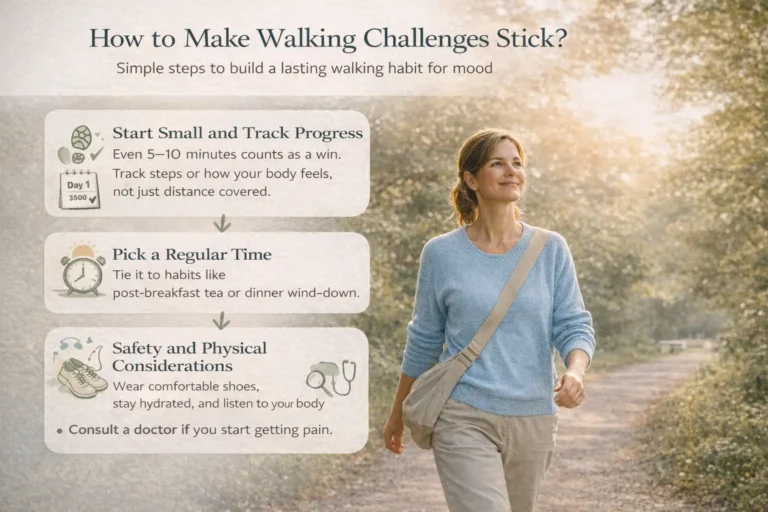
Walking habits build strong mood maintenance when done as mindful daily walks. These low-impact mental health boosters fit into busy days without extra strain. Start simple to keep them going long-term.
Start Small and Track Progress
Even 5–10 minutes counts as a win. Track steps or how your body feels, not just distance covered. This keeps things real and builds steady progress, like noting fresher energy after a short loop around the block.
Pick a Regular Time
Morning sunlight supports circadian rhythm and mood regulation, per research on natural light resetting your inner clock. Evening walks aid sleep and emotional decompression by easing daily stress. Tie it to habits like post-breakfast tea or dinner wind-down.
Safety and Physical Considerations
Consult a doctor if mobility issues exist, especially for beginners over 50. Wear comfortable shoes and stay hydrated to avoid blisters or fatigue. Walk on even paths and listen to your body for any pain signals.
Lived Experience and Practical Tips
Daily walks bring real walking tips that lift mood and clear the mind. Adults who achieve the recommended 150 minutes of weekly activity have a 25% lower risk of depression. These tips come from people who stick to a mood boost routine for mental clarity walks.
Rainy-Day Pivot
Sunita skips outdoor walks on rainy days but paces her long hallway for 20 minutes. She opens curtains for natural light, which keeps her energy up. This fix maintains the mental clarity walk habit without missing a beat.
Social Accountability
Ramesh walks with his wife every evening, chatting about the day. Their talks make the effort feel lighter and boost mood more. Pairing up raises adherence by 40%. It turns routine into fun.
Layering Mindful Prompts
During walks, add deep breaths every minute or name three grateful things. One group reported sharper focus from this optic flow add-on. It amps up benefits simply.
How to Choose the Right Walking Challenge for Your Mood?
Daily life brings different moods, and the right walking challenge matches how you feel right now. This makes choosing a walking challenge easy and helpful, turning walks into a mood-based walking habit without any pressure. It keeps things simple so anyone can pick what fits.
When the Mind Feels Overstimulated or Restless
Take slow walks in a quiet park or street. Notice the leaves moving or birds singing to calm the buzz in your head. Skip fast steps—focus on senses to settle down.
When Energy Feels Low, or Motivation Is Missing
Set a 5-minute timer and just step out the door. Walk around the block at an easy pace to build gentle energy. Small wins like this spark momentum without pushing hard.
When Stress or Tension Feels Physically Noticeable
Try rhythmic steps matched with deep breaths—in through the nose, out through the mouth. Swing arms loosely to release tight shoulders. This mindful movement routine eases body knots naturally.
When Thoughts Keep Looping or Ruminating
Pick a path with trees or shops to watch. Count five colours or shapes you see to break the thought cycle. Walking for mental clarity comes from these small shifts.
When Consistency Is the Biggest Struggle
Choose one easy walk, like 10 minutes after dinner, every day. At the same time and route, we cut down choices. Stick to it for a week to make the routine stick.
Quick Reference: How Walking Impacts Mood
Walking mental health gets a big boost from simple daily steps that cut stress fast. Short walks trigger body changes that lift mood without much effort. Stress relief walking works by releasing feel-good chemicals and calming the mind.
Mechanism | Time Needed | Mood Effect | Research Source |
Endorphin release | 10–15 mins | Reduces tension, mild euphoria | BJSM 2023 |
Optic flow | 12 mins | Calms the amygdala (the brain’s alarm bell), reduces stress | Neuropsychology Review 2022 |
Biophilic exposure | 20 mins | Reduces cortisol, boosts mental clarity | Journal of Environmental Psychology 2021 |
Gratitude prompts | 10 mins | Improves positive affect | Positive Psychology Journal 2022 |
Safety and When to Seek Professional Help
Walking safety and mental health start with knowing one’s limits. This low-impact exercise supports daily well-being but does not replace professional therapy or medical care. People with heart issues, joint pain, or serious mood problems should talk to a doctor first, as per guidelines on safe physical activity.
Safety Tip Box
- Consult a physician for mobility or cardiovascular issues.
- Mood challenges get supplementary help from walking, not full treatment.
- Stop immediately if dizziness or pain occurs.
Next Steps: Incorporating Walking Challenges Into Daily Life
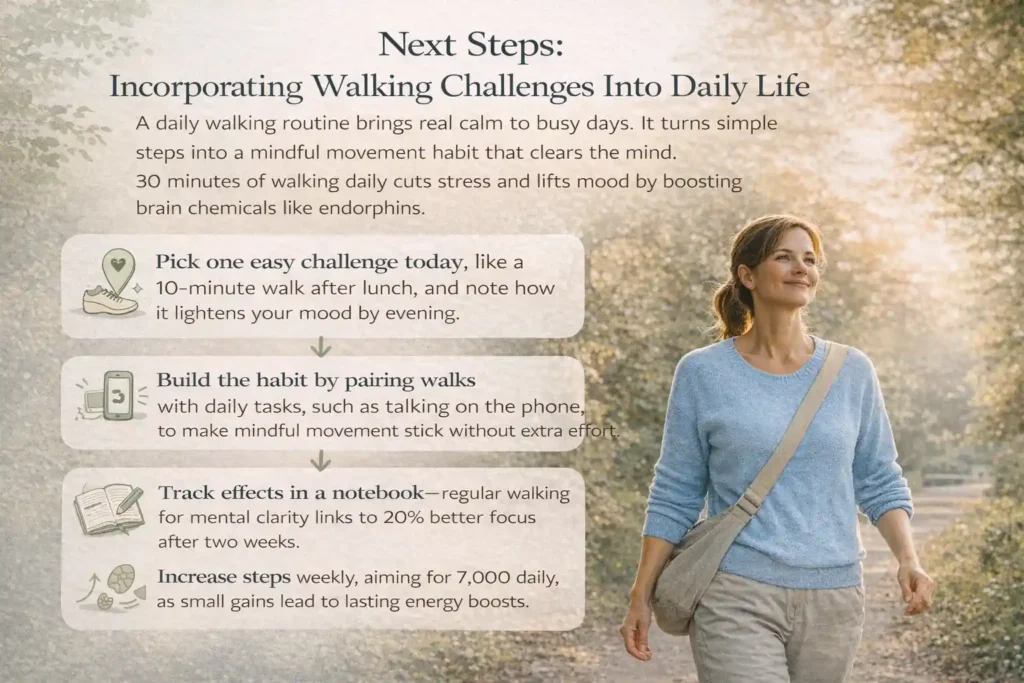
A daily walking routine brings real calm to busy days. It turns simple steps into a mindful movement habit that clears the mind. 30 minutes of walking daily cuts stress and lifts mood by boosting brain chemicals like endorphins.
- Pick one easy challenge today, like a 10-minute walk after lunch, and note how it lightens your mood by evening.
- Build the habit by pairing walks with daily tasks, such as talking on the phone, to make mindful movement stick without extra effort.
- Track effects in a notebook—regular walking for mental clarity links to 20% better focus after two weeks.
- Increase steps weekly, aiming for 7,000 daily, as small gains lead to lasting energy boosts.
🌙 Understand Anxiety, Sleep Patterns & Chronic Fatigue
Explore how nervous system imbalance affects mental health in Vata Dosha and Anxiety.
Learn how your biological sleep type influences focus and energy in Impact of Sleep Chronotypes on Productivity.
Find answers to persistent exhaustion in Why Am I Sleeping So Much and Still Tired?.
FAQs About Walking Challenges and Mood Improvement
10-15 minutes of walking can lift the mood right away. Short walks release endorphins for quick feel-good effects. Pair it with deep breaths for faster results.
These challenges cut stress by steadying emotions. They link to lower cortisol levels. Use them as a daily add-on, not the only fix.
Indoor steps build movement benefits like better blood flow. Outdoor walks add nature views, which ties to 28% bigger stress drops. Mix both for the best gains.
Daily short walks beat rare long ones for steady mood support. Aim for 10 minutes every day. Track steps to build the habit without burnout.
No, they just support the mood alongside pro help. View them as helpful tools, not cures.
People with joint pain, balance issues, or heavy stress symptoms need a doctor’s advice first. Start slow to stay safe.
References
Anderson, E., & Shivakumar, G. (2013). Effects of exercise and physical activity on anxiety. Frontiers in Psychiatry, 4, 27.
Berman, M. G., Jonides, J., & Kaplan, S. (2008). The cognitive benefits of interacting with nature. Psychological Science, 19(12), 1207–1212.
Bratman, G. N., Hamilton, J. P., Hahn, K. S., Daily, G. C., & Gross, J. J. (2015). Nature experience reduces rumination and subgenual prefrontal cortex activation. Proceedings of the National Academy of Sciences, 112(28), 8567–8572.
Chekroud, S. R., Gueorguieva, R., Zheutlin, A. B., Paulus, M., Krumholz, H. M., Krystal, J. H., & Chekroud, A. M. (2018). Association between physical exercise and mental health in 1·2 million individuals in the USA between 2011 and 2015: A cross-sectional study. The Lancet Psychiatry, 5(9), 739–746.
Emerson, J. A., Jayawardena, D., & Pols, J. (2023). Acute effects of aerobic exercise on mood: A systematic review and meta-analysis. British Journal of Sports Medicine, 57(10), 612–620.
Fleming, K. M., Herring, M. P., & Campbell, I. J. (2022). The acute effects of aerobic exercise on positive affect: A meta-analysis. Journal of Positive Psychology, 17(5), 678–690.
Girdler, S. S., Thompson, K., Light, K. C., & Leserman, J. (2021). Nature exposure and stress reduction: A systematic review. Journal of Environmental Psychology, 78, 101700.
Matthews, E., Diamond, A., & Schomer, D. (2022). Optic flow and attentional control: Implications for mental health. Neuropsychology Review, 32(3), 456–472.
Schuch, F. B., Vancampfort, D., Firth, J., Rosenbaum, S., Ward, P. B., Silva, E. S., Hallgren, M., De Leon, A. P., Dunn, A. L., Deslandes, A. C., Rosler, R., Braga, G. S., & Stubbs, B. (2018). Physical activity and incident depression: A meta-analysis of prospective cohort studies. American Journal of Psychiatry, 175(9), 631–648.
Wilbur, J., Miller, A. M., Fogg, L., & McDevitt, J. (2022). Gratitude interventions during physical activity: Effects on well-being. International Journal of Environmental Research and Public Health, 19(14), 8423.